Culture

Culture

The good, the bad and the ugly in books, exhibitions, cinema, TV, dance, music, podcasts and theatre.

Secrets and suspense

More from Books

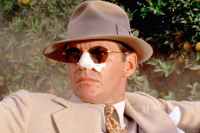
Andrew Martin continues his quest to create uniquely interesting crime novels in The Winker (Corsair, £16.99). Lee Jones is a rock musician facing cultural extinction as the punks take over. It’s 1976. He wanders around London dressed to the nines, living his fantasies. His trademark move on stage was to wink at a member of

Bold venture

More from Books

In 2017’s Goldsmiths Prize-winning novel H(A)PPY, Nicola Barker strewed pages with multicoloured text. The Cauliflower, her joyful previous offering, employed winky-face emoticons while telling the story of a 19th-century Hindu mystic. In her 13th novel I Am Sovereign, huge fonts careen, in the space of an exclamation, into tiny fonts. Bold and underlined text prickles

The wilder shores of Britain

More from Books

After kayaking solo in a November storm to a square mile of rock called Eilean a’Chleirich in the Summer Isles off the north-west coast of Scotland, and camping overnight on top of its cliffs, David Gange awoke to revelation. To the west he could see almost the entire length of the Outer Hebrides. To the

The brutal truth

Lead book review

Novelists will always be interested in enclosed communities — or the ‘total institution’, as sociologists say. When you separate a group of individuals from larger society with a wall and a controlling mechanism, all sorts of interesting facts about the way people interact become apparent. Convents, hospitals, asylums, schools, universities and prisons all serve the

Spectator Books: how pigeons won the War

Pigeons: revolting pests who can’t tell the difference between fag-butts and chips, right? Not so, according to my latest podcast guest Jon Day, distinguished man of letters, critic, academic and… pigeon-fancier. Jon’s new book Homing describes how — suffering an early midlife crisis in young married life with fatherhood approaching — he took up racing

Beetle invasion

More from Books

Silicon Valley moguls might not find Zed a particularly amusing read. Joanna Kavenna’s latest mindbender features the CEO of a multinational tech company whose sway has long outstripped that of mere governments. Guy Matthias’s creation, Beetle, has invaded western lives to an unprecedented degree. BeetleBands on wrists advise users when they need to eat, hydrate

Everyday wonders

More from Books

Walking home from work one day during the half-year I lived in London’s Maida Vale (almost three decades ago now), I was just about to turn into an archway leading to the mews house in which I rented a room when into my path a steady stream of grey feathers suddenly began falling. From directly

Brother sun and sister moon

More from Books

At the very back of the eye is a cluster of cells called ipRGCs. They are cells that don’t depend on vision to sense light, and that keep the circadian rhythms of both sighted and non-sighted people in sync with the sun. Without them, we would not feel the pull of sleep at night; we

The husband trap

More from Books

Around 25 years ago it became clear that there existed only two groups that could still be bullied by journalists without fear of public backlash. These were the upper classes and husbands. Female ramblings about how annoying men are began, and continue, to go down well and strike a chord of recognition among wearied women.

Manhunt in the taiga

More from Books

The Siberian-born novelist Andreï Makine has, as we say in the book world, a shedload of French literary bling. He’s the only writer to win the Prix Goncourt and the Prix Médicis for a single novel (Le Testament Français) which is, in pop cultural terms, like winning The Great British Bake Off and Strictly on

Distant voices, shattered lives

Lead book review

In 1990s Russia, war veterans were a bossy, even aggressive presence, upbraiding people in shops and pushing to the front in the trolleybus queue. Complaining about this at some point, I was struck and shamed by a Russian friend’s reaction: ‘Oh, but it’s sad… Imagine how hard their lives have been, to make them like

Sables, ruffs and doublets

More from Books

Roy Strong first encountered the portraiture of Elizabeth I and her court while a schoolboy in post-war Edmonton. In the early 1950s, as a second Elizabethan age beckoned, the teenaged Strong unexpectedly found himself face to face with the ‘Ermine’ and ‘Rainbow’ portraits of the Virgin Queen on a day trip to nearby Hatfield House.

Seek, and ye shall find

More from Books

The bearded figure clad in white robes and wandering barefoot through the streets of Jerusalem is not, in fact, the messiah. But neither is he a very naughty boy.  Rather, he is a middle-aged man from Texas in need of a shower who, like the German across the street claiming to be Saint Paul, is

… to nonagenarian love

More from Books

Towards the end of Live a Little, one of its two main characters says: ‘I’m past the age of waiting for something to go wrong. It already has.’ And we know what has, because some 200 pages earlier we have seen the man as a young boy, just before the second world war, pulling his

From teenage passion…

More from Books

The 16-year-old hero of David Nicholls’s fifth novel is ostensibly Everyboy. It is June 1997, the last day at dreary Merton Grange and, having flunked his exams, Charlie Lewis attends the leaving disco — all dry ice, vomit and snogging, laced with Cointreau and disinfectant. An infinity looms of bloated summer days, with only a

The great ministerial merry-go-round

More from Books

‘Annual reshuffles are crazy,’ remarked one of the prime minister’s most trusted advisers in July 1999 as I hovered outside the cabinet room, waiting to be anointed as the lowest form of ministerial life in John Prescott’s vast department — environment, transport and the regions. He went on: There is massive in-built insecurity. Ministers, who

The ‘rumours’ we chose to ignore

Lead book review

On 14 October 1942, the 23 Swiss members of the International Committee of the Red Cross met in Geneva to decide whether or not to go public with what they then knew about Auschwitz and the Nazis’ extermination plans. When they emerged two hours later they had voted, almost unanimously, to remain silent. As did

Staring into the abyss

More from Books

Rowan Hisayo Buchanan has achieved that rare feat, in her second novel Starling Days, of writing a convincing novel about depression which manages, miraculously, not to be in itself depressing. Her success is partly due to the fact that her protagonist, Mina, is not flattened by her despair and remains alive enough to become fascinated

Women on the edge

More from Books

In Nicole Flattery’s Show Them a Good Time (Bloomsbury, £14.99), her female protagonists grapple with abusive relationships, degree courses, difficult bosses, unemployment programmes and a lascivious professor. The stories are tragicomic and deliciously odd. The author writes sentences that make you laugh, and then immediately want to reread to savour a striking image: a woman’s

King of a wild frontier

More from Books

Red Dog is an ambitious hybrid of a book. It was published in South Africa to wide acclaim in 2014 and has been expertly translated by Michiel Heyns, who has retained the cadence and some of the vocabulary of the original Afrikaans — the mongrel tongue that evolved in the Dutch East India Company’s Cape

Murder at the funeral

More from Books

Harper Lee’s To Kill a Mockingbird remains one of the most beloved American novels of all time. Famously, Lee never completed another book, once declaring she’d ‘said what I wanted to say and I will not say it again’. But a journalist who went to Lee’s home in Monroeville, Alabama in 2015 learned of another

Harlequin ladybird, fly away home

More from Books

I was shocked some years ago to discover, as I scratched bites on my ankles on holiday on Maui, that mosquitoes are not native to Hawaii. They first arrived in the 1820s, in barrels of water from a visiting ship. Of course, the climate was perfect for them, and they settled in very happily. But

Distress signals

More from Books

It’s an increasingly common lament that computers have ruined everything, and a longing for the days before Google and Twitter, when everything was somehow more organic and authentic, is on the rise. As someone who can remember writing early reviews on an electric typewriter and then going to the library to fax them to a