Minoo Dinshaw

The cut-throat world of school magazines

From our UK edition

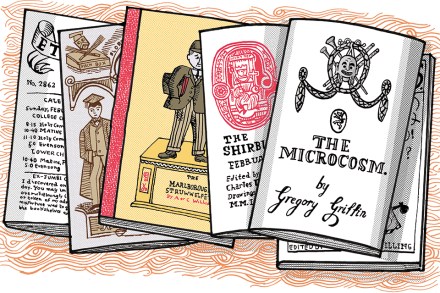
In my mind, there was always a sense of hubris in the air of our tucked-away offices at the Chronicle, Eton’s main student magazine. As in many other domains of our school’s life, we idly assumed ours was the first, as well as the only really consequential, example of a public-school magazine. The early 2000s, when I was a boy there, were a particularly suitable time in which to indulge in such a view; we were all acutely aware of the rise of Boris Johnson. If you were devoid of athletic, dramatic or musical talent, editing the Chronicle was the obvious crown The record for first school magazine does belong to Eton, but it is in fact for a much earlier and odder production, puckishly called the Microcosm, which ran for 40 issues in 1786-7, published as a book the next year.
The merchant as global reporter

From our UK edition

Joad Raymond Wren’s ambitious history of early modern European news, capacious in structure, monumental in volume, is named for a witticism by John Earle (c.1601-65). The author of Microcosmography, a compilation of satirical ‘characters’ whose obvious modern heir is Victoria Mather’s ‘Social Stereotypes’, was arguably the funniest member of mid-17th century England’s most likeable clique, the Great Tew Circle. Wren more than once returns to Microcosmography’s comparison of the nave of St Paul’s, where London’s freshest newsletters were to be procured, with the commercial buzz of the Royal Exchange, with news replacing goods and hard cash as a potentially fruitful alternative currency.

A thoroughly modern medieval romance

From our UK edition

The novelist and essayist James Meek’s confident new medieval romance is conducted in brief passages separated out by three icons, a rose, a sickle and a quill, emblematic of the three estates of the realm. The nobility play at courtly love; the commons can only evade their bondage by war service; and the clergy are in charge of chronicling and calendars. It’s 1348 and, as the Black Death mutates from fake news to imminent apocalypse, the novel’s liturgical title gets more and more ironical. The commons strand recalls in its stubborn Saxonicity of vocabulary (‘Some gnof had got her with child’) the ‘shadow-tongue’ employed by Paul Kingsnorth in The Wake, a Booker-longlisted saga of guerrilla resistance to William the Conqueror.

New York times

From our UK edition

Seven years ago Stella Tillyard, a successful historian of the 18th century, broke into historical fiction with Tides of War. This historically faithful and scrupulously detailed Napoleonic saga was thought in some quarters to have met its period’s gold standard: Patrick O’Brian’s Jack Aubrey novels. It also received the accolade, now obligatory for success in the genre, of being worthy of Hilary Mantel. For her second novel, Tillyard has adopted a fresher, braver setting — Cromwellian East Anglia, framed with 1660s New Amsterdam, the Dutch American capital about to succumb to the restored Charles II’s greed. In 2016 Francis Spufford produced Golden Hill, a hit of Mantelian proportions, set in the same city, by now 18th-century New York.

Crusading passions

From our UK edition

In W.B. Yeats’s ‘Meditations in Time of Civil War’, a testing allusion emerges amid a scene of nightmare: Monstrous familiar images swim to the mind’s eye ‘Vengeance upon the murderers,’ the cry goes up ‘Vengeance for Jacques Molay.’ More about de Molay, last master of the Knights Templar, can be found in Dan Jones’s new blockbuster on the crusading order, along with quite a few monstrous familiar images. Jones states from the outset his noble intention: to write ‘a book that will entertain as well as inform’. In this he has hitherto had great success; his two spectacular chronicles, The Plantagenets and The Hollow Crown, traced that dynasty from the White Ship to Bosworth Field, and threw in some Tudors for good measure.

The Crusades live

From our UK edition

The 12th-century crusader Reynald de Chatillon was one of the most controversial men of his time, and his new biographer Jeffrey Lee believes he has returned to disturbing relevance in ours. Over a relatively long life with a dramatically violent end, Reynald became Prince of Antioch by marriage, endured 16 years in a dungeon below Aleppo, attempted (uniquely in Islamic history) to raid Mecca and Medina, overturned the politics of the Crusader states, and became the bitterest enemy of Saladin. Reynald probably could not read or write, but had he tried his bloodstained hand at Blairesque apologetic memoir, the result might well have resembled Lee’s book. Like Reynald, Lee possesses a memorable style, flashy and crass by turns.

The First Crusade, by Peter Frankopan

From our UK edition

Perhaps more than any other single historical event, the First Crusade (1096-99) lends itself to the narrative technique. This was the quest — and a successful one — on the part of Roman Catholic Europe to regain the Holy Lands taken during the Muslim conquests of the Levant four centuries earlier. Its rich cast of characters — among them Bohemond of Taranto, Raymond of Toulouse and Godfrey of Bouillon — caught between conflicting motives of faith, avarice, loyalty and ambition, have inspired magnificent epic poetry. Their ultimate goal was the recovery of Jerusalem — and as Sir Ronald Storrs, British Governor during the Mandate once said, ‘There can be no promotion after Jerusalem.’ Where that quest began, however, is  more vexing.

A feast of vanities

From our UK edition

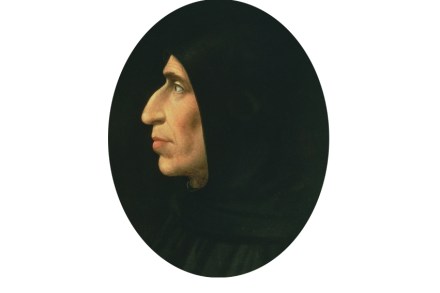
The name of Savonarola slides off the tongue as if concocted for an orator’s climax. But when it came to names, whether by melody or reputation, the Florence he knew offered aggressive competition. Pico della Mirandola, Lorenzo ‘il Magnifico’ de’ Medici, Botticelli, Michelangelo and Machiavelli all shared his era. In an unexpected and sympathetic conclusion to the radical friar’s latest biography, Donald Weinstein defends one of George Eliot’s least loved novels, Romola: Eliot’s success in bridging the 400-year historical and cultural divide between herself and Savonarolan Florence was remarkable, and her judgment of the Frate himself nuanced and independent.