Culture

Culture

The good, the bad and the ugly in books, exhibitions, cinema, TV, dance, music, podcasts and theatre.

The best of Rod Liddle’s Listener columns

Commissioning Rod on pop was easy. I’d email him a list of eligible albums and he’d ignore me and offer to review something completely deranged such as Cradle of Filth’s The Screaming of the Valkyries (‘plenty to admire’, B+). Within a few hours I’d receive a flawless little column. He started doing a monthly Listener in 2017. His musical interests were vast and unpredictable. He reserved his highest praise for albums by the likes of Beyoncé, FKA Twigs, Cypress Hill, A.G. Cook, Rosalia, Wet Leg, M.J. Lenderman, PWR BTTM, Snoop Dogg, Fat White Family. He much admired the Tuareg desert blues band Tinariwen and wondered if I might fly him to Austria to hear a Philip Glass recital.

The Trainspotting musical is made for cruise ships

Theatre

Plenty of critics have mocked Trainspotting – the musical (with lyrics and music by Irvine Welsh and Stephen McGuinness, respectively) but the producers know their audience’s mind. They want to see live theatre without taking the risk of a new play, which might be gruesome, and they prefer a dead-safe replica of a glamorous movie to something by Chekhov or Pinter. Reviewers admire novelty and inventiveness so they tend to punish theatre-makers who reheat leftovers. The show follows the book more closely than the film, where Renton was the central figure, and here he blends in with the community of wasters and criminals who mope around Edinburgh trying to raise cash for smack. The characters are reduced to simplistic gestures, as easy to read as hand signals. Begbie is a cocky thug.

Is this really the best Charli XCX can do?

Pop

Of the three creative pursuits that give Charli XCX’s eighth album its title, the English pop star seems least interested in the first. She admits as much on ‘Camera’, the best song on Music, Fashion, Film, which makes clear her obsession with acting and a desire to pursue it more fully. ‘Do I want to make music?’ she asks herself. ‘Am I being fucking stupid if I try to be a girl on the screen and I’m turning 34?’ Even without this clue – which, like much of the album, is presented via the singer throwing out rhetorical spiel more or less unexpurgated – it is no great stretch to surmise that the pursuit of making music is struggling to fully hold her attention.

Bring back the old Tube seat designs!

Exhibitions

Enid Marx once pondered ‘whether postage stamps are fine or industrial art. In my view the question rests on the quality of a design rather than its purpose. It is generally agreed, for example, that the work of Thomas Bewick is fine art, even when it is merely the engraving of a “trade card”.’ Marx was a textile designer, book illustrator, lino-cutter, wood-engraver, poster illustrator and, yes, postage-stamp designer (‘The calling card of a nation’, as she put it) and in all these things, the quality was unquestionable. Her unique, memorable designs were absorbed, unknowingly, by any number of people. Her best-known work was the sturdy moquette fabric she designed for seats on London Underground in the 1930s.

The concert of the year

Classical

Ah, so that’s where the kangaroo comes in! Garsington Opera produces a souvenir mug each summer decorated with cartoons of that year’s operas. Buy yours early enough, and you get a ceramic preview of the season – in the case of Gerald Barry’s The Importance of Being Earnest, a drawing of a kangaroo. True, Barry’s operas are famously anarchic. But quite where a marsupial was supposed to fit into Oscar Wilde’s comedy was unclear until halfway through Act One. Suddenly, there it was: fuzzy and large as life, lolloping dolefully across the stage. Because? Well, because someone said ‘Australia’, silly. That’s how it works.

The new Spider-Man is a triumph of Hollywood professionalism

Cinema

Remember Peter Parker? By the end of the last instalment of the Spider-Man movies, No Way Home, we were the only ones who could. Following a characteristically complicated but deft collision of multiverses, young Peter (Tom Holland) had realised that the only way to save the world (again) was by getting Doctor Strange to cast a spell that made everybody – including his best friend Ned (Jacob Batalon) and girlfriend MJ (Zendaya) – forget that he’d ever been Spider-Man. He therefore began his Brand New Day alone in his apartment with only a highly evolved piece of AI for company. Sure, he’d returned to his roots of capturing local crooks by the dozen. But while this restored the hero status that J.

What’s the point of Unesco?

Arts feature

The FIM-92 Stinger missile is not a subtle weapon. An anti-aircraft rocket, capable of launching a high-explosive ‘fire and forget’ laser-guided warhead at targets up to 5km away, it can be carried and operated by only one man. During the 1980s Soviet invasion of Afghanistan, the CIA provided hundreds of Stingers to the Mujahideen, where they proved terrifyingly lethal, downing scores of helicopter gunships and killing thousands of Soviet troops. But, at times, they’ve been as effective against other, more unusual targets. In 2001, during the first Taliban administration of Afghanistan, the group’s leader, Mullah Muhammad Omar, ordered the destruction of the monumental Buddha statues in the Bamiyan valley, a historic Silk Road site deep within the Hindu Kush.

All aboard for Paisley: a trip round unloved Britain

More from Books

‘Most people who have been to Crewe station have never been to Crewe.’ In a moment of serendipity, my train pulls into Crewe station at the exact moment I turn the page to begin the chapter ‘Changing Tracks’ in Chris Moss’s new travelogue Where Tourists Seldom Tread. In his Guardian column ‘Postcards from Britain’, Moss visits and reconsiders ‘improbable, bypassed and unloved’ destinations, such as Warrington, Gateshead, Paisley, Clacton-on-Sea – and Crewe, which my train from London has reached after no small delay. Moss is right, of course: I have travelled through Crewe more times than I have eaten disappointing Upper Crust baguettes, but I have never actually been into the town.

Into the wild: Country People, by Daniel Mason, reviewed

More from Books

In his mid-forties, Miles Krzelewski is a graduate student who makes Saul Bellow’s Herzog look like an academic overachiever. After 14 years and 11 changes of subject – including Rabelais’s monsters, Chekhov’s early humour and Tolstoy’s train journeys and farming techniques – he has yet to complete his doctoral thesis. When his wife, Kate, a respected Milton and Blake scholar, is offered a one-year visiting professorship at a rural Vermont college, Miles is thrilled, convinced that a pastoral life will afford him the inspiration he needs for his latest project – a study of Russian peasant folklore. Together with their children, 12-year-old Wesley and nine-year-old Olive, plus their dog, Giuseppe, they undertake the long journey from their Californian home.

How the multi-billion-dollar wellness industry is putting us at risk

More from Books

No one could accuse Dr Nick Tiller of taking health and wellness issues lightly. In his latest book he recounts an occasion in which a friend asked him whether he was an extrovert or an introvert – the kind of question most of us would treat as small talk to pass the time. Tiller, though, took it seriously. What did she mean by those terms, he asked, hearing in response that it depended on whether he got energy from being around others, or not. OK, then: what did she mean by energy? ‘At this point,’ he writes, ‘she got frustrated and didn’t speak to me for the rest of her wedding. Which was awkward, since I was the best man.

Whimsical defence mechanisms: Sail Away Land, by Ben Pester, reviewed

More from Books

A spectre is haunting England in the surreal tales assembled in Ben Pester’s Sail Away Land, the follow-up to his debut collection Am I in the Right Place? (2020) and last year’s novel The Expansion Project: the spectre of tweeness. Confronted with scenarios involving nightmarish gatherings, paranormal entities and psychic electronic devices, his characters respond with a lobotomised, quaint strain of stoicism – the type that makes us say things like ‘It’ll come out in the wash’ when getting made redundant, and ‘Least said…’ when handed a terminal diagnosis. ‘You have left the grill on!’ repeatedly frets the title story’s nameless protagonist, like a Tony Hancock character, oblivious to the fact he is also apparently shrinking to the size of a rat.

A broken bond: Gaining Ground, by Joan Barfoot, reviewed

More from Books

When a girl turns up at an isolated cabin in Canada, unannounced and uninvited, the woman busy thinning the lettuce has no idea who the stranger is. But then the woman has trouble remembering even her own name. ‘“Are you Abra Phillips?” asks the girl. “Am I?” the woman ponders, conscious that the words “mean something” to the girl,’ writes Joan Barfoot in the opening pages of Gaining Ground, a Canadian feminist classic now republished nearly 50 years after it first appeared as a debut novel entitled Abra. ‘I think, finally, that I must be; there is no one else to connect with this name,’ continues the protagonist, who we soon learn has been alone in the cabin for the past nine years, all but living off the land after walking out on her family.

The West has become its own worst enemy

More from Books

On 27 January 2024, Iranian-backed militants launched a one-way attack drone at the US base known as Tower 22 in the Syria-Iraq borderlands. It hit and killed three American soldiers and injured many other members of the 350-strong garrison. The attack was a pivotal moment. Before it, no US ground troops had been killed by an enemy aircraft since the Korean War. But they had been now, and would be again. Two years later, a similar attack, this time by Iran itself, evaded US air defences, hit a US command centre in Kuwait and killed six personnel. It was the deadliest Iranian strike of the recent conflict. Steve Feldstein is a senior fellow at the Carnegie Endowment for International Peace, an expert on technology, democracy and national security and an award-winning author.

A high seas adventure unlike any other

More from Books

When the American shipbuilder Enos Bright constructed the Mentor in 1807 he had no inkling of the tale it would one day tell from its watery grave. Many ships faced harrowing voyages on the high seas, but this one stood out more than others. It was an expedition that turned into a disaster that few could have foreseen. Eric Jay Dolin brings this long-forgotten story back into the public eye. The author of 17 books that have largely focused on maritime history, he is a talented researcher and natural storyteller. ‘The Mentor,’ he writes, ‘is not just another example of a shipwreck during the Age of Sail. It is one of the most complex and intriguing of such stories ever told.

The good, the bad and the grotesque: the mind-blowing diversity of parasites

More from Books

The oldest surviving sentence ever written in the first alphabet is inscribed on an ivory comb found in the ruins of the Canaanite city of Lachish in what today is Israel. Dating back around 3,700 years, it offers the owner a blessing of sorts: ‘May this tusk root out the lice of the hair and the beard.’ As Dino J. Martins points out in his marvellously entertaining tour of the netherworld of parasites, the comb (the design of which is almost indistinguishable from the plastic ones we use for the same purpose today) speaks of the depth of the human relationship with lice – creatures that have travelled with us, fed on us and multiplied with us for millions of years. Martins is the perfect guide.

Down memory lane: It Will Come Back to You, by Sigrid Nunez, reviewed

More from Books

Readers of Sigrid Nunez’s long-form fiction will be familiar with her concerns about storytelling: the gaps between what happened, what is remembered and what can be understood only through fictionalising. Her new collection of 13 stories, written across several decades, returns to questions of memory and the unreliability of narrative. The stories tend to have mundane settings: an insomniac awake late at night; a traveller stranded by a flight delay. Nunez is less interested in dramatic incidents than in the way a passing encounter can alter one’s understanding of life. Her narrators frequently find themselves re-evaluating past certainties or realising that events they thought they’d understood resist neat explanations.

Revelling in the music of words

More from Books

There’s a chapter in this mostly illuminating and occasionally irritating book in which the author – the award-winning writer of The Hours and other acclaimed novels – explains why he no longer reads reviews of his work. The decision was prompted first by an ‘excoriating’ hatchet job by Michiko Kakutani, erstwhile lead literary critic of the New York Times. ‘A worse review is difficult to imagine,’ Cunningham notes, claiming that he has ‘mostly repressed the memory’ of its contents, though he does share his rather macabre plan for revenge: to slip a copy of the book into her coffin so that ‘extra-terrestrial archaeologists’ will assume she wanted to be buried with it.

‘A selfish, ignoble person’ – the dark side of the Nobel prize-winner Mario Vargas Llosa

Lead book review

In October 2010, when Gabriel García Márquez, by then suffering from dementia, was told that his former friend and rival had won the Nobel Prize for Literature, he enquired: ‘Who is Mario Vargas Llosa?’ This tottering, always compulsive biography of the writer who died last year and which has taken 15 years to write (‘I completely miscalculated its complications’) is Gerald Martin’s valiant answer. ‘Is there a life quite like this one anywhere in the western world in the second half of the 20th century?’ In Martin’s breathless judgment ‘this literary adventurer, politician, diplomat and warrior all rolled into one’ was a single-minded workhorse whose sheer intensity, quality and variety of life was ‘almost literally incredible’.

A Sound of Music with brains as well as heart

Opera

If you’re interested in how words work with music, the collected lyrics of Stephen Sondheim are an investment you’ll never regret. But Sondheim isn’t infallible, and when he writes about his mentor Oscar Hammerstein II he’s often plain wrong. Sondheim mocks one particular lyric from The Sound of Music: ‘Like a lark that is learning to pray.’ ‘Wait a minute – a lark praying?’ he snarks. But the character who sings those words is a devout young Austrian woman with a head full of Schubert and folksongs. Hammerstein is writing as Maria, not himself. It’s an art that Sondheim never quite mastered, which is why his characters – whether Swedish aristocrats or East End cannibals – all sound like New Yorkers in therapy.

The invincibility of menopausal women in TV drama

Television

Ride or Die began with a typical day for a fiftysomething woman in a TV drama. Having assassinated a Russian oligarch in an Alpine mountain resort, Judith (Hannah Waddingham) skied away with Olympian speed, effortlessly evading capture by the many goons who pursued her, right until they crashed into trees. Back on solid ground, she went into a bar where she beat all the blokes in drinking games, before pulling a hunky young barman who was heartbroken the following morning when she made it clear that this was merely a one-night stand. Then, zooming home in a sporty Merc, she still found time to call her friend Debbie in London with the assurance that ‘I’ll be back for book club’.

The finest vacuum-cleaner romance you will see

Film

A Useful Ghost is the best sex-with-a-vacuum-cleaner film I’ve seen in a while – or perhaps ever. It is deeply funny. How could it not be? But it’s also, in its way, deadly serious. A first film from Ratchapoom Boonbunchachoke, its camp absurdism and high jinks with electric appliances are also a satire on Thailand’s violent recent history. You can see why it won the Critics’ Week prize at Cannes. With most films you know what the film is, and where it’s going, within the first few minutes: ‘Oh, it’s this film.’ Here, you’ll have no idea. We start with a character simply called Ladyboy (Wisarut Homhuan). He lives in an area of Bangkok where the local shops and other buildings are being torn down and replaced by a shopping mall.

The finest music ever composed by a Breton naval officer

The Listener

Grade: B+ There’s a special art in making something difficult appear effortless, and the string trio is a supreme test. It’s the smallest viable unit for string chamber music: with one each of violin, viola and cello, there’s no fat, no redundancy, and nowhere to hide for composer and performer alike. And yet its greatest masters – Mozart, Schubert and Beethoven (Schoenberg is a special case, as he usually is) – make it sound like a trifle, a recreation. They’re on a tightrope, but they can’t stop dancing.

This J. Edgar Hoover musical is destined for Broadway

Theatre

Here Comes J. Edgar! has a brash poster featuring a cross-dressing FBI agent in fishnet tights with his thighs splayed aggressively towards the viewer. He points a warning finger as if to say, ‘Enjoy this show or go to jail.’ The abrasive imagery aligns with the arrogant tone of most LGBTQ+ advertising but the show itself has a more humane and playful temper. Harry Shearer and Tom Leopold have written a superb tragicomedy about a powerful homosexual who wants to conceal his love life while hunting down America’s most notorious criminals. We first meet Hoover as he lies in a hospital bed flanked by two chain-smoking nurses who discuss his health while filling the room with tobacco fumes. This quietly amusing scene sets the mood.

The Victorian Hieronymus Bosch

Arts feature

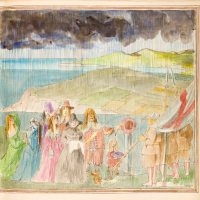
No one paints fairyland like Richard Dadd (1817-86). In ‘The Fairy Feller’s Master-Stroke’, 1855-64, he reveals a teeming congregation of tiny folk, summoned by a dragonfly trumpeter, marshalled by a pompous chamberlain no bigger than a daisy, all gathered in the presence of Merlin (dead centre) to witness a macho fairy break a hazelnut with an axe. The shell will serve, of course, as Queen Mab’s chariot. And yet the scene isn’t cute. By placing the shiny bald pate of a frightened gnome a jot too close to the swing of the axe, the artist suggests the fairy feller might break that nut instead. Dadd is like a Victorian Hieronymus Bosch.

Unlucky break: All In, by Claire Powell, reviewed

More from Books

Claire Powell’s first novel, At the Table (2022), delineated a year in the life of the Maguire family from south London – a separating couple and their adult children – with each chapter revolving around a meal. This was done so cleverly that not only did it not seem gimmicky, it was not even immediately obvious. The book won many plaudits, including from Philip Hensher and Marian Keyes. All In is even better.  Jo and Dave are about to go on a trip with Dave’s investment broker brother, Teddy, Teddy’s girlfriend, Kayla, and Dave and Teddy’s father, Alan. The brothers’ mother, Val, has recently died. The holiday has been paid for by Teddy, much to Dave’s discomfort.

New York crime caper: Cool Machine, by Colson Whitehead, reviewed

More from Books

Cool Machine, the final novel in Colson Whitehead’s Harlem trilogy (following Harlem Shuffle and Crook Manifesto), is another tour de force and a fitting conclusion to the Uptown peregrinations of his endearing protagonist Ray Carney, a successful Harlem furniture salesman and part-time fence. It’s an old-school crime caper, set in 1980s New York against the backdrop of Mayor Koch’s rapidly gentrifying city, told in three interconnected sections excoriating Reagan-era capitalism. The ubiquitous construction works, graffiti and corruption are fuelled by the twin deities of power and money.