Culture

Culture

The good, the bad and the ugly in books, exhibitions, cinema, TV, dance, music, podcasts and theatre.

The Latest Great Irish Storyteller?

Who can we add to the roster of Great Irish Writers? Why none other than our old chum Patrick Bartholomew Ahern. It seems that Bertie's autobiography (sadly not titled Dig Outs & Other Fuck-Ups) should be found on the fiction shelves. How so? Well... The granting of tax-free status to former taoiseach Bertie Ahern for earnings from his autobiography under the artists’ exemption scheme has prompted calls for the scheme to be revised. Labour Party arts spokeswoman Mary Upton said the tax break served a worthy purpose and she would not like to see it removed, but it should be reviewed. “In the current economic climate we need to have another look at who is eligible and the financial structures around their eligibility,” she said.

Continuity under threat

More from Books

This handsome and encouraging book is perhaps unfortunate in its title. The suggestion is that the author has been forced to rummage among the wreckage that is England in order to find something, anything, that is still intact. Its origins and intentions are quite the opposite. As Richard Ingrams explains in his short introduction, when he was editor of Private Eye he published a regular feature called ‘Nooks and Corners of the New Barbarism’, written by John Betjeman — a suitable kind of investigation for a satirical magazine.

Strong family feelings

More from Books

Mary Kenny’s survey of Ireland’s relations with the British monarchy is characteristically breezy, racy and insightful, with a salty strain of anecdote. Mary Kenny’s survey of Ireland’s relations with the British monarchy is characteristically breezy, racy and insightful, with a salty strain of anecdote. This reflects the secret affection of the Irish bourgeoisie for the royal soap opera, even when this addiction has to be concealed as carefully as a taste for alcohol in a fundamentalist Muslim state. Oddly, her account of secret suburban Catholic covens, communing with royal weddings and jubilees via television, rather trumps my memories of royalist interests among the Protestant (though emphatically not Anglo-Irish) circles of my youth.

A dream made concrete

You are celebrated as the architect of one of the most famous buildings in the world, now in your late eighties and living quietly in your home outside Copenhagen. One day a beautiful blonde German girl knocks on your door. She is clutching a folder of her photographs of the extraordinary structure on the other side of the world which, following a dispute in 1965 with a new Australian Government, you have never seen completed. For her, that architectural work was love at first sight. For you, her images are a love letter that confirms the enduring greatness of your conception. It is happiness on both sides, and its fruit the publication of this hauntingly beautiful book. Few modern buildings can have been more photographed than the Opera House on Geelong Point in Sydney Harbour.

Master of accretion

More from Books

Frank Auerbach (born 1931) is one of the most interesting artists working in Europe today, a philosophical painter of reality who works and re-works his pictures before he discovers something new, something worth saving. William Feaver, in this grand new monograph, calls Auerbach’s paintings ‘feats of concentration’, and stresses the hard work which goes into their construction, despite their appearance of spontaneity. Feaver has a gift for the evocative phrase: ‘Studied yet impulsive, ranging from darkness to radiance and from the declamatory to the subdued, they are keyed to an air of resolve as unguarded as joy, as involuntary as grief.’ This is a book strong on context.

Prize-winning novels from France | 2 January 2010

More from Books

After an unremarkable year for fiction the Prix Goncourt was awarded to Marie Ndiaye for a novel — actually three novellas — which must have beguiled the judges by the sheer unfamiliarity of its contents. After an unremarkable year for fiction the Prix Goncourt was awarded to Marie Ndiaye for a novel — actually three novellas — which must have beguiled the judges by the sheer unfamiliarity of its contents. Trois femmes puissantes (Gallimard) was already established as a favourite with the reading public. One suspects that the majority of those readers are women, for we are in feminist territory here, and it feels a little old-fashioned.

Ignoble nobles

More from Books

Badly behaved toffs have been a gift to writers since ancient times, and in English from Chaucer to Waugh.

The face of a muffin

More from Books

What was it about post-war British cinema? Our films were lit up by a collection of wonderfully idiosyncratic performers. Think Alistair Sim, Terry-Thomas and Robert Morley. Perhaps the most idiosyncratic of them all was Margaret Rutherford. The drama critic, J. C. Trewin once remarked, ‘When you have seen any performance by Margaret Rutherford you are certain to remember it.’ How right he was. She stole Blithe Spirit with her portrayal of the exuberant bicycling medium, Madame Arcati. She was wonderful as Miss Whitchurch, the domineering headmistress of a girls’ school mistakenly billeted at a boys’ school in The Happiest Days of Your Life. And she was a far more colourful and entertaining Miss Marple than the rather grey character in Agatha Christie.

Some sunny day!

More from Books

In August 1945 Cyril Patmore of the Royal Scots Fusiliers returned on compassionate leave from India. A few weeks earlier his wife had written to confess that she was expecting a child by an Italian prisoner of war. ‘Why oh why darling did I have to let you down, me who loves you more than life itself?’ she wrote, pleading for forgiveness and a reconciliation. It was in vain. Patmore stabbed his wife to death. ‘I live for my children and my wife,’ he told the police. ‘I hope the children will be well looked after.’ This bleak anecdote introduces a catalogue of disasters. At the end of the war five million Britons, 90 per cent of them male, were in uniform.

Racists, pigs and hysterics

More from Books

I cannot remember getting so much pleasure from a book. It is not just its beauty, the handmade paper, the quarter leather, the engraving of the Rhaeadr Falls cut in purple into the cover cloth of something the size of an atlas. These are accidental details (as, I note bemusedly, is the fact that it costs £300 more than the current value of my car). For this, quite simply, is the funniest book I have read in years. Its godfather seems to have been Napoleon, whose wars sealed Europe off to the Romantics. In other words, he deprived them of their fixes of the Sublime, the Picturesque, the Prospects of Infinity; the Emperor deprived them of mountains. So where were they to go?

Not perfect freedom

More from Books

‘Servants’ and ‘service’ have not always meant ‘servility’. ‘Servants’ and ‘service’ have not always meant ‘servility’. From the Middle Ages right through to the 16th century, everyone was servant to someone: a lord was servant to the king, a lesser lord to a greater. Children likewise served in the households of their parents’ equals: service was what one did before God, and before one’s superiors, in class, or age. And many servants were for display as much as utility: as the consumer durables of their time, their number gave their masters’ prosperity in physical form.

Objects of obsession

More from Books

The Museum of Innocence is the sixth novel by Turkey’s most garlanded novelist and his first since he became a Nobel laureate in 2006. The Museum of Innocence is the sixth novel by Turkey’s most garlanded novelist and his first since he became a Nobel laureate in 2006. Pamuk’s unflinching eye on his country’s history has brought him well-documented trouble, but it is in the subtle exploration of how west and east collude and collide there that he excels, notably in the novel My Name Is Red, a bravura extemporisation on art and representation at the Ottoman court of the 16th century, and in the more modern setting of his political thriller, Snow.

Short story competition

The results of the Spectator-Barclays Wealth short story competition have been published over at the Spectator Book Club’s discussion boards. We received more than 500 entries of the highest quality, and trying to pick the winners from a shortlist of 10 inspired bitter debate at 22 Old Queen Street. The four runners-up have been printed in full at Spectator.co.uk, but the winning entry, Black Box by Jonathan Wynne Evans, is printed in the Spectator Christmas double issue. Here’s a taster of his suspense filled story: Drifting curtains of fenland rain obscured everything from 20 yards so that, pedalling round the perimeter, the only indications of intense activity were waves of clatter from each dispersal as ground crews completed the arming of the Lancasters.

Christmas short story: The Dreams of Bethany Mellmoth

Features

The Dreams of Bethany Mellmoth, by William Boyd Illustrated by Carolyn Gowdy Bethany Mellmoth is in a quandary — and she doesn’t like quandaries. It’s December 20th. Five days until Christmas. The fact that this is a Christmas quandary makes it no more bearable. In truth she thinks that this fact makes it more unbearable. Her mother and father — nearly two decades divorced — both demand her presence on Christmas Day. The quandary will be resolved — Bethany is good at resolving things — but she hasn’t quite figured out how — yet. Her father — Zane Mellmoth — texted her from his home in California. ‘Coming to London. Must see you Christmas Day lunch. Big surprise. Lots to celebrate.

A long journey

More from Books

I never liked E. M. Forster much. He was too preachy and prissy, too snobbish about the suburbs, too contemptuous of the lower classes. I know this is not how a review is meant to begin. You may legitimately kick off by admitting that you have a soft spot for your subject, even perhaps that you used to be friends. But reveal a longstanding dislike in your first paragraph, and the reader may reasonably wonder why the editor did not give the book to someone else. My only excuse for this confession is that I am not alone. For a novelist, essayist and critic of such acknowledged eminence, Forster has had a surprising number of enemies. There was something about him that got people’s goat, and still does.

A great novelist

More from Books

In a remarkable way the trajectory of Ivy Compton-Burnett’s reputation after her death in 1967 parallels that of George Meredith’s in 1909. In a remarkable way the trajectory of Ivy Compton-Burnett’s reputation after her death in 1967 parallels that of George Meredith’s in 1909. A recipient of the OM and held in awe by such younger novelists as Henry James, Hardy and Stevenson, Meredith was generally regarded as one of the greatest writers of his time. But now, apart from his poetry — which he himself rightly thought superior to his prose — he is little read, even though every history of English Literature contains a lengthy entry for him.

The king of chiaroscuro

More from Books

These days, it is easy to take it for granted that Caravaggio (1571-1610) is the most popular of the old masters, yet it was not ever thus. In my Baedeker’s Central Italy (published exactly 100 years ago), he is acknowledged as having been ‘the chief of the Naturalist School’, but it is pointed out that from the outset ‘it was objected that his drawing was bad, that he failed in the essential of grouping the figures in his larger compositions.’ The first major exhibition of his works — in what has only very recently been established as the city of his birth, Milan — did not take place until 1951.

Sideshow on the lake

More from Books

During the night of 9 February 1916, two men were sitting on opposing shores of Lake Tanganyika. The longest lake in the world, it at that time divided German East Africa from the Belgian Congo. One of the men was Herr Kapitänleutnant Gustav von Zimmer, the other was an eccentric British navy officer, Commander Geoffrey Spicer-Simpson. The following morning, Zimmer would launch the Graf von Götzen, a large vessel which floats to this day on the waters of the lake. Spicer-Simson takes a starring role in my narrative non-fiction book, Mimi and Toutou Go Forth (2004).

Magic

More from Books

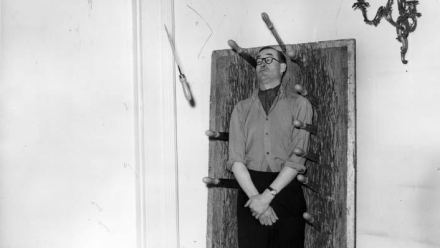
Are you staggered and amazed by today’s sleight-of-hand merchants? Are you staggered and amazed by today’s sleight-of-hand merchants? Perhaps David Blaine surviving in a block of solid ice for months leaves you cold? Or Darren Brown knowing your credit card number has you stifling a yawn? If something is missing from today’s masters of magic it’s not their fault; it’s our assumption that they can get away with anything on television, and that it’s all a con. Well, to put the magic back into your cynical soul, just look at this amazing collection of photographs and posters from the past. It will revive that tingling feeling that you just can’t figure out how they did it.

Squeaks and squawks

More from Books

How often, when listening to announcers or weather forecasters or politicians on the radio, do I think, ‘That’s an ugly voice’! This seldom applies to speakers with educated regional accents, such as Scottish, Irish or Yorkshire, but all too often to those from London or the Midlands where good standard English is becoming a rarity. This is not a matter of class; ‘Sloane’ voices are as unappealing as ‘Estuary’ ones; indeed the two sometimes hideously cross-fertilise. Good speech is a matter of clarity and the unselfconscious enjoyment of the spoken language. It was an unexpected and nostalgic pleasure to listen to old recordings of or about the Bloomsbury Group.

Parsons’ displeasure

More from Books

Despite its prosaic title, this is a humdinging page-turner of a book, revealing in livid detail the scandal of how the Church of England jettisoned onto the market what the author describes as ‘perhaps the most admirable, desirable and ascetic body of domestic buildings ever built’. Despite its prosaic title, this is a humdinging page-turner of a book, revealing in livid detail the scandal of how the Church of England jettisoned onto the market what the author describes as ‘perhaps the most admirable, desirable and ascetic body of domestic buildings ever built’.

Disastrous twilight

More from Books

With the opening paragraph of The Dogs and the Wolves (first serialised in France in 1939 and never previously translated) Irène Némirovsky takes us to the heart of her story: the complexities of Jewish life in eastern Europe and France in the first part of the 20th century. The Ukrainian city in which generations of the Sinner family had been born was, in the eyes of the Jews who lived there, made up of three distinct regions. It was like a medieval painting: the damned were at the bottom, trapped among the shadows and flames of Hell; the mortals were in the middle, lit by a faint, peaceful light; and at the top was the realm of the blessed.

Enjoyer and endurer

More from Books

I approached the late David Nokes’s scholarly book with some trepidation, having heard that it had been criticised for its apparent dismissal of James Boswell. I approached the late David Nokes’s scholarly book with some trepidation, having heard that it had been criticised for its apparent dismissal of James Boswell. As I had gained all my previous knowledge of the great Sam from Boswell’s magnificent biography I did not expect to enjoy this new exploration. But I did, very much indeed. Nowhere does he accuse Boswell of falsely creating the character of Johnson; indeed he acknowledges that he portrayed an irritable but very human subject.

Avoiding the Wide World

More from Books

The clue comes early on in the book. ‘Beyond the Wild Wood comes the Wide World,’ said the Rat, ‘And that’s something that doesn’t matter either to you or me. I’ve never been there and I’m never going, nor you either, if you’ve got any sense at all. Don’t ever refer to it again please.’ In 1903, a shocking incident took place at the Bank of England, where the soon-to-be author of one of the most magical of all children’s books was then Secretary. A man had walked in from the street asking to see the Governor but had to settle for Grahame. He held out a roll of paper with two ribbons tied round it, one black, one white, and asked Grahame to pull either one.

Surprising literary ventures | 14 December 2009

More from Books

Here are two Alternative Reading Christmas gift ideas: books respectively by Gordon Brown and David Cameron. The Gordonian offering is by an ordained minister who wants to help you with your finances. ‘Gordon Brown’s message is very clear,’ the back cover says. The Cameronian offering is by a poet from Brooklyn, whose poems are ‘false translations’ of Baudelaire’s Les Fleurs du Mal. This he achieves by taking the original French verse and then transmuting it into English via a sort of wilful mishearing: ‘Tout Entière’, for example, becomes ‘Two Ton Chair’, and its first line, ‘Le Démon, dans ma chambre haute…’ becomes ‘Lime demons are out dancing.

Jane Austen’s pompous heroes

More from Books

Jane Austen has become the most revered and probably the most popular of the great English novelists. Not even the vulgarisation of her novels by those who have adapted them for television has impaired the esteem in which she is held. She is not only deemed amusing, which she is, but a wonderfully fair and judicious moralist. Walter Scott praised her ‘exquisite touch, which renders ordinary commonplace  things and characters interesting, from the truth of the description and sentiment’; and this judgment is probably one with which we may all agree. Many of course go further and come close to canonising her.     There have always been a few dissenters, Charlotte Bronte for instance, and J. M.

The optimism of a suicide

More from Books

A postal strike would have been a disaster for Van Gogh. Letters were his lifeline and consolation. Not only did he receive through the mail his regular allowance from his brother Theo but, in letter after letter in return, he poured out his thoughts and feelings, recorded his work in progress and conveyed his impressions of books, people and places. In his often solitary existence, he was an avid recipient and kept in touch with a variety of correspondents, especially when he was in the South of France during the last two years of his life. The glory must be shared, however, with Theo, in that he kept Vincent’s letters, many of which contained drawings, either appended or on the sheet itself, surrounded by his tumble of words.