Patrick Marnham

Nights at the Lutetia – the dark history of a luxury hotel

From our UK edition

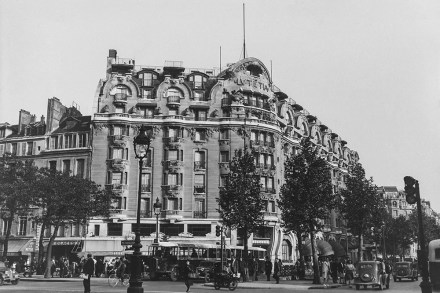
The saga of the rise and fall of the Third Reich could be traced by following events in any one of the countries occupied by the Nazis. Jane Rogoyska has refined this approach by focusing on what happened in a single building, a fashionable ‘grand hotel’ in central Paris, between 1933 and 1945.  The Lutetia is the only luxury hotel in Paris on the Left Bank, where it has always looked out of place – its bulbous, domed grandeur dominating less pretentious neighbours in a district that is still better known for its cultural and academic traditions. Rogoyska tells the story of the building’s wartime adventures in three parts – before, during and after the German occupation of France. The lives recounted fall into three groups, only one of which is French.
James Heale, Lara Prendergast, Patrick Marnham, Laura Gascoigne and Michael Simmons

From our UK edition

32 min listen

On this week’s Spectator Out Loud: James Heale interviews Woody Johnson, the former American Ambassador to the UK, about a possible second Trump term (1:19); Lara Prendergast reflects on the issue of smartphones for children and what lessons we could learn from Keir Starmer’s approach to privacy (6:35); reviewing Patrick Bishop’s book ‘Paris ’44: The Shame and the Glory’, Patrick Marnham argues the liberation of Paris was hard won (12:37); Laura Gascoigne examines Ukraine’s avant garde movement in light of the Russian invasion (20:34); and, Michael Simmons provides his notes on venn diagrams (28:33).  Presented by Patrick Gibbons.

How the myth of Paris liberating itself was born

From our UK edition

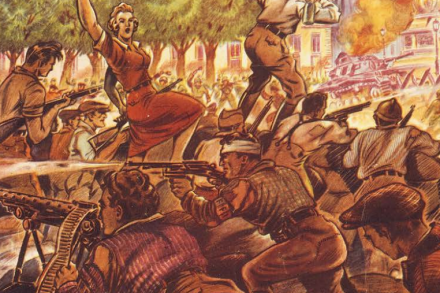
The liberation of Paris in August 1944, two months after D-Day, was one of the most highly publicised victories of the second world war, although it was of no military importance. General Eisenhower, the supreme Allied commander, originally planned to bypass the city altogether but was persuaded by General de Gaulle to allow the tanks of the French 2nd armoured division (the famous Deuxième Division Blindée – 2eDB) to lead a diversion into the city, backed by American infantry. De Gaulle claimed that he was concerned to avoid the danger of a bloody insurrection led by the communist Resistance. His real concern was less about bloodshed than his future political control of France.

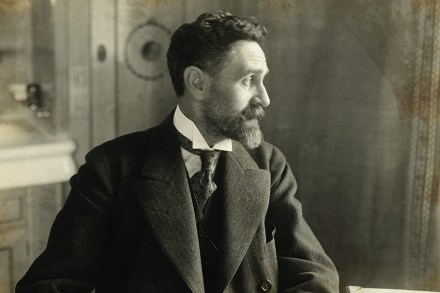
Sir Roger Casement never deserved to hang

From our UK edition

Telling the story of Sir Roger Casement’s life is a challenge for any biographer. In the land of his birth, he is remembered as a national hero. His remains lie in the Glasnevin Cemetery in Dublin beside the graves of Daniel O’Connell and Charles Stewart Parnell. He is there because he was hanged in Pentonville Prison in August 1916 as one of the leaders of the Easter Rising. The awkward fact that Casement had become opposed to the Rising and had tried to prevent it does not fit either the heroic Irish narrative of his life or the official English account of the wartime traitor who died on the gallows.

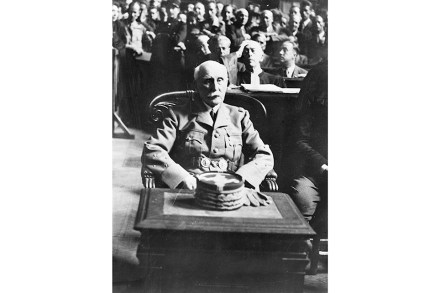
The trial of Marshal Pétain continues to haunt France to this day

From our UK edition

In September 1944, a few months after being greeted by cheering crowds in Paris, Marshal Philippe Pétain, the head of the wartime État Français, was driven across the German frontier into exile under Gestapo escort. He no longer had access to the national radio service, so, as he passed through France, typed copies of his last speech had to be thrown to passers-by from the window of his car. Julian Jackson, the author of a previous magisterial biography of Charles de Gaulle, now undertakes a more complex task in telling the story of Pétain’s subsequent three-week trial for treason in 1945. The novelist and resister François Mauriac summarised the ordeal as the ‘trial that is never over and will never end’.

When Paris was the only place to be

From our UK edition

For more than 100 years Paris has been as much a symbol and a myth as a geographical reality. The enchantment dates back to the end of the 19th century, when ‘le bordel de l’Europe’, in words quoted by Marie-José Gransard, was transformed into ‘la capitale de l’amour’. In Twentieth Century Paris she traces the growth of the community of mostly foreign artists and writers who created this international brand. By the 1890s Paris had recovered from defeat by Prussia and the atrocity of Bismarck’s bombardment in 1870 and had become the capital of more than ‘l’amour’.It ran a colonial empire powerful enough to deprive the Kaiser of his ‘place in the sun’.

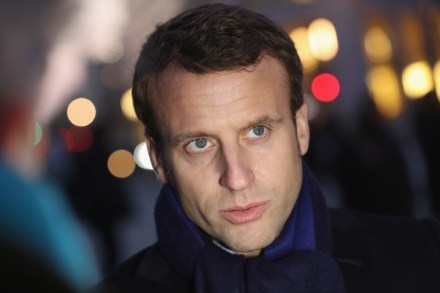
The man from nowhere

From our UK edition

Before the horrified gaze of its militants, the French Socialist party — which has been a major force in French politics since 1981, and forms the present government — is falling to pieces. There are many reasons behind this catastrophe. They go back to 2005 and the dithering leadership of the then secretary-general, François Hollande, at a time when the party was dangerously divided after the referendum on a European constitution. And they continue up to 1 December last year, when President Hollande, after again dithering for months, announced on national television, in tears, that he had bowed to the inevitable — his own failure and unpopularity — and would not run for re-election.

France’s new right

From our UK edition

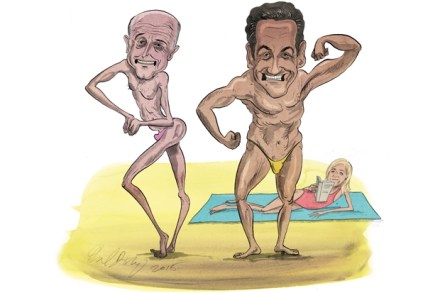
The result in France in the first round of the Les Républicains party’s primary elections marks the political death of one of the big beasts of French politics. Nicolas Sarkozy, widely known as ‘Sarko’, has been a volcanic presence on the public stage since he became Jacques Chirac’s minister of the interior in May 2002. Within two years he had become president of the right-wing UMP (forerunner of Les Républicains), defeating the favoured candidate of President Chirac, and from there it was but a short step to winning the presidency of France itself.

Japan Notebook | 20 October 2016

From our UK edition

Tokyo is visual chaos everywhere, the antithesis of the Japanese interior. It is a multilevel jumble of overpasses, neon signs, electric pylons, railway lines and traffic lights. The pavements are empty, not a pedestrian human in sight. And the leader of North Korea is still lobbing ballistic missiles right over Japan and cackling away about his collection of nuclear warheads. Drinking beer in a sushi bar in Ginza on our first night, I ask my neighbour whether people are worried by the behaviour of the lunatic child across the water. ‘No,’ he replies. ‘I am far more frightened by our prime minister. He really is dangerous.’ Shinzo Abe is proposing to repeal the clause in Japan’s constitution that bans recourse to war.

Frexit – oui ou non?

From our UK edition

In France, Brexit has provoked resentment and shock. For many years-Britain has been seen in both Paris and-Brussels as the European ‘bad boy’, out for what it can get and intending to give as little as possible in return. The first news was greeted with headlines such as ‘Can Europe-survive?’ but there was also a note of relief: ‘End of 40 years of love-hate’. Even before the referendum, Emmanuel Macron, the finance minister, had denounced the British record in Europe, claiming that the-United Kingdom had hijacked the great project and diverted the Union from its political destiny in order to reduce it to a single market.

Hollande’s hollow crown

From our UK edition

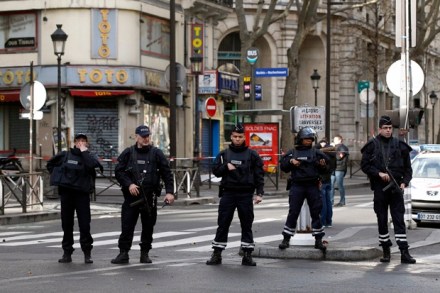
 Paris Sitting on a crowded café terrace in Rue Saint-Antoine on a sunny evening last week, there was no sense of national crisis. When a motor scooter backfired, no one jumped. The constant racket of police car sirens was ignored. The National Assembly had just voted for the third extension of a seven-month ‘national emergency’ following terrorist attacks that left 130 dead and 368 injured. But talk of violence in the streets generally referred to the police; have they been too rough with the student demonstrators who are conducting all-night sit-ins in the nearby Place de La République?

Throned on her hundred isles

From our UK edition

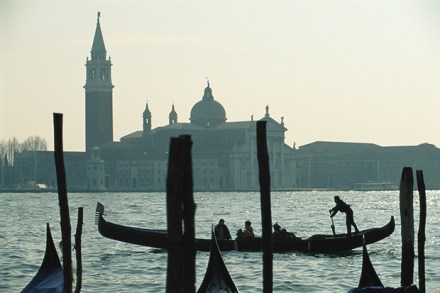
Approximately 500 new books on Venice are published every year and this is not the first literary anthology devoted to the city. But Marie-Jose Gransard lectures in Venice about Venice to Venetians, and conducts her students on guided tours of the city. Her selection draws on sources going back over 800 years and across six languages. So the text, based on very wide reading, is crowded with unfamiliar observations and includes the impressions of artists, musicians and diplomats as well as writers. This is not a guide book for the first-time visitor, but for anyone who knows Venice, and cannot keep away, it provides a delightful change. We are given Ruskin, Byron, Goethe, Henry James, Thomas Mann and Hemingway.

A people horrible to behold

From our UK edition

The much-lamented journalist and bon viveur Sam White, late of the rue du Bac, The Spectator and the Evening Standard, who lived in Paris for over 40 years, once wrote an affectionate portrait of his adopted home that opened with the defiant words, ‘Yes: I like it here.’ As a short review of the city it was perfect. Longer accounts that say less are published every year and must run by now into thousands of volumes. A glance at the map shows why Paris — ‘most sublime of cities’, as Luc Sante terms it — continues to attract such devotion.

Hollande’s own emergency

From our UK edition

The terrorist attacks of 13 November have had an enduring effect on people living in Paris and France’s other big cities. Hotel bookings and restaurant reservations are down, and some people will no longer go out in the evening. There have been several other minor terrorist outrages across the country since November, and tension — prompted by repeated government warnings — remains high. The campaign for the 2017 presidential elections will start in July, but François Hollande’s popularity, which soared after the Charlie Hebdo attacks a year ago, has been sliding again. Hollande’s polls rose slightly after he declared a state of emergency on 14 November.

France’s new reactionaries

From our UK edition

When President de Gaulle was asked to authorise the criminal prosecution of Jean-Paul Sartre for civil disobedience during the Algerian war, he declined. ‘One does not lock up Voltaire,’ he added, unhistorically. In France, ‘public intellectuals’ have a quasi-constitutional status, so it’s not surprising that a furious bunfight has broken out over a handful of philosophers known as ‘les nouveaux réactionnaires’. The new reactionaries do not see themselves as a group, but they defend a common point of view about the causes of France’s diminishing status and influence.

France’s fight on the right

From our UK edition

A year has passed since Nicolas Sarkozy announced his return to frontline politics, and the political landscape in France is still recovering from the shock. His rivals for the leadership of the French right have watched while their cordially disliked ex-leader consistently outmanoeuvred them. They had made the mistake of believing in the sincerity of Sarko’s farewell speech in May 2012 when, following his defeat in the presidential election by François Hollande, he said: ‘From now on I will seek to serve my country in other spheres.

Liberating Marianne

From our UK edition

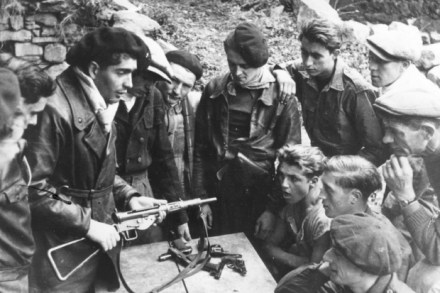
In Marianne in Chains, his last book on Occupied France, Robert Gildea offered an original view of life in that country between 1940 and 1944, arguing that outside the cities it had not always been as bad, nor had the Vichy regime always been as reactionary, as was subsequently claimed. Confining his research to three departments in the Loire valley, Gildea also suggested that for most people most of the time the Resistance was a dangerous irrelevance, to be avoided wherever possible. These conclusions were presented at a conference in Tours where they caused a minor uproar among French specialists. Gildea, professor of modern history at Oxford University, now turns to a much bigger subject.

Bringing Camus to book

From our UK edition

In 1975 the Nigerian novelist Chinua Achebe, in a lecture at the University of Massachusetts, identified Joseph Conrad’s Heart of Darkness as the work of a racist. Achebe objected to a story that used Africa as a setting for ‘the break-up of one petty European mind’, and depicted Africans as nameless savages. Achebe’s lecture — a masterpiece of special pleading, false analysis and anachronism — is now established as a founding text in the post-colonial school of criticism. On reading the cover blurb for The Meursault Investigation, one might have the impression that in this debut novel, Kamel Daoud, a native of Oran, has carried out a similar assault on Albert Camus’s first novel, L’Etranger (translated as The Outsider).

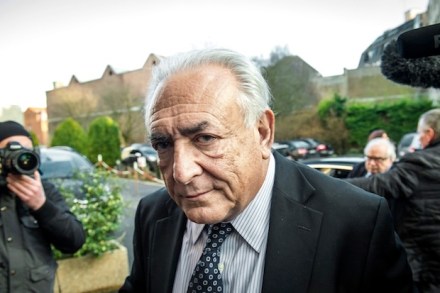
The French know what Dominique Strauss-Kahn gets up to in bed — and they’d still vote for him

From our UK edition

Dominique Strauss-Kahn, widely known as DSK, formerly France’s minister of the economy and finance, ex-director-general of the International Monetary Fund, frontrunner as Socialist candidate in the presidential elections of 2012, is a broken man. Or so it would seem. He was acquitted last week by the Lille criminal court of aggravated pimping and organising an international chain of prostitution, but his reputation is nonetheless in ruins. Ever since he was taken off an Air France flight in handcuffs by New York police in May 2011, and charged with raping a maid in the Manhattan Sofitel — a case dropped after his accuser was deemed an unreliable witness — he has been living a nightmare. No sooner was one charge dropped than another sprang up.

Is Nicolas Sarkozy headed back to the Elysée – or to jail?

From our UK edition

In his more hyperactive moods Nicolas Sarkozy, former president of France, has been known to compare himself to Charles de Gaulle. Following defeat in the 2012 presidential elections ‘Sarko’ made a dignified exit from the national stage, stating that in future his personal commitment to the well-being of France would be in some loftier sphere. De Gaulle did the same thing in 1946; he retired to his country estate for 12 years of reflection and study, before being summoned back at a time of national crisis to found the Fifth Republic. Mr Sarkozy is clearly hoping for a similar resurrection, though there are a number of differences in the two cases.