Culture

Culture

The good, the bad and the ugly in books, exhibitions, cinema, TV, dance, music, podcasts and theatre.

Savouring the mystique

More from Books

I have never met Roger Scruton, though I would like to; wine fans are slightly obsessional and enjoy clustering together, like trainspotters, though tasting rooms are more welcoming than the end of a platform at Crewe. We’re also very different. Shortly after I, working for the left-of-centre Guardian, became the wine writer for this conservative magazine, Scruton, a right-wing philosopher, took the same job at the New Statesman. Given the rivalry between these two organs, I took a keen interest in what he wrote. For instance, round about the same time that he pointed out that ‘it is almost impossible to find a decent Burgundy these days for less than £30’ we were selling El Vino’s own-brand Velvin for £3.95.

The unknown and the famous

More from Books

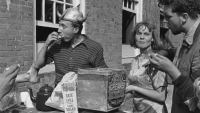
In 1950, Irving Penn, working for Vogue in Paris, set himself up in a glass-roofed attic and, between fashion assignments, began a series of full-length portraits of tradesmen, inspired by the street portraits of Eugène Atget 50 years before. Later that year he continued the project in a painter’s studio in Chelsea. Penn found that the working people of London responded to his invitation to be photographed differently from those in Paris. ‘In general, the Parisians doubted that we were doing exactly what we said we were doing. They felt there was something fishy going on, but they came to the studio more or less as directed — for the fee involved,’ he remembered. ‘But the Londoners were quite different from the French.

Recent books for children

More from Books

One thing which struck me immediately on surveying the books on offer for children this Christmas is the large number which are really toys, with only a minor bookish element. Walker Books have produced several of these this year. Cars by Robert Crowther (£12.99) boasts moveable pop-ups of cars ancient and modern, with realistic detail and turning wheels, from the Mini to the Bluebird, culminating in a full fold-out model of a Formula 1 racetrack. There is an informative text, but it is definitely subordinate to the models. The same is true of Gladiators by Toby Forward, illustrated by Steve Noon, (£16.99). This includes a book about the Roman games, but the main attraction is the spectacular pop-up model of the Colosseum.

Repeat that, repeat

More from Books

When the Louvre invited me to organise for the whole of November 2009 a series of conferences, exhibitions, public readings, concerts, film projections and the like on the subject of my choice, I did not hesitate for a second and proposed the list. Thus Umberto Eco on the genesis of this book, published simultaneously in Italian, French and English. Considering those parallel manifestations of the project, it was perhaps to be expected that this, its sole printed version, would be situated at the more ingratiatingly ludic end of the Eco spectrum. The Infinity of Lists is a work less of theory than of taxonomy.

Debt and addiction

More from Books

I knew that I was onto a good thing with this book before the page numbers were even out of roman numerals. Describing the wealth of new material that has come to light in the three decades or so since the last biography of Thomas De Quincey, Robert Morrison men- tions the areas in which it has enriched our understanding: . . . his enduring sorrow over the loss of his sister Elizabeth, his masochistic desire for humiliation; his association with prostitutes; his pursuit of, and subsequent alienation from, Wordsworth and Coleridge; his struggle with drugs and alcohol . . . his horrendous battles with debt; his imprisonment in Edinburgh gaols . . . This was a lively life, and this is a lively Life.

Looking back in anger

More from Books

Portugal has given the world two distinguished novelists. Eça de Queiros, is the Proust of Portugal. His masterpiece, The Maias, describes the decline of an aristocratic family in the late 19th century. Whereas Eça was a member of the Portuguese intellectual elite, José Saramago was born in a wretched shack in the the rural hamlet of Azinhaga. When he was two, his family moved to a series of two-roomed flats in the poorest quarters of Lisbon. I cannot think of any writer of consequence who endured such grinding poverty in his childhood and youth. His grandfather was a foundling and both he and his wife illiterate peasants. In an early essay I compared Saramago to Thomas Hardy, as a village boy who had made a career as a writer. This was a grave mistake.

Novelty value

More from Books

Auction house catalogues are multi-faceted publications. Primarily, of course, they’re sales tools, reassuring buyers that something is what it says it is, that it can legally be bought and where to do just that. Yet, they’re so much more. They can be a simple full stop to one of life’s chapters or, alternatively, a celebratory exclamation mark. An anonymous 1895 house-contents catalogue (of which there are only four known surviving copies) for a Chelsea abode on Tite Street bears secret testament, through a haphazard compilation of loose-lotting, to the Icarus fall of one Mr Oscar Wilde.

Before and after the Fall

More from Books

No one here (I mean in Britain, not perhaps in the columns of The Spectator) likes to read anything nice about the Germans. So I shall warn you that there will be some praise for Germany in this review, mixed with the usual level of bashing. If the very thought of this shocks or appals you, I’ll do that rare thing for any journalist and suggest you turn the page and move on to something more comforting. In the last few weeks there has been one principal story told in several new books, most of the press and broadcast coverage, and even the material on the Tweets that have marked the 20th anniversary of the fall of the Berlin Wall. It is that after all the euphoria and the street parties of 9 November 1989, something has gone badly wrong with the re-marriage of the Germanys.

Recent gardening books | 2 December 2009

More from Books

Philippa Lewis is a picture researcher, with an eye for uncommon facts and a wry way of presenting them. Her book Everything You Can Do in the Garden Without Actually Gardening (Frances Lincoln, £16.99), is a scholarly and entertaining social history with pictures. Most books of this type recycle old material, but this writer has a knack of discovering fresh facts. The Wordsworths papered their cottage with newspaper. Eric Ravilious tried to include a man diving into a swimming pool for his Wedgewood Garden service, but was told that the design would not be accessible to the British public. Princess Charlotte thought skittles were low grade at Claremont, so she turned the ninepin alley into flowerbeds.

A choice of art books | 2 December 2009

More from Books

Had I not been sent this year’s art books to review, the one I would most have liked to receive as a present would be Horace Walpole’s Strawberry Hill edited by Michael Snodin (Yale, £40). Had I not been sent this year’s art books to review, the one I would most have liked to receive as a present would be Horace Walpole’s Strawberry Hill edited by Michael Snodin (Yale, £40). J. H. Plumb — the historian who achieved the unusual distinction of being shouted out as a wrong answer by a schoolboy in Lindsay Anderson’s 1968 film If.... — dismissed the creator of this delectable Gothick meringue of a house as ‘incurably mannered and irrelevant’.

Alternative reading | 2 December 2009

More from Books

Thomas Keneally is the Booker-Prize-winning author of Schindler’s Ark and The Chant of Jimmie Blacksmith. Tom Keneally is the author of The Utility Player, a biography of the rugby league player Des Hasler. Naturally Thomas and Tom are the same person. The unashamed idolatry of The Utility Player is difficult to convey here, but can be glimpsed in the following description: ‘Des is an Australian version of an Arthurian knight. His heart was strong because his soul was rigorously aligned . . . he is the Zen practitioner of rugby league, the code’s monk.’ Keneally is one of those people who see a single sport as a template for the clockwork of the universe, and he is not alone among practitioners of fiction in this.

Thoughts on the Great Depression

More from Books

The Great Depression of the 1930s has passed into myth as essentially American, not global. The Wall Street crash ended the Good Times and led, apparently inevitably, to the crisis of Capitalism. Europe suffered from the effects, but had the glum fun of watching the dollar lose its almightiness. America’s internal response was dramatic and, literally, moving: the migration of John Steinbeck’s Joad family of ‘Okies’, from the dust bowl towards the golden mirage of California, exemplified a general restlessness.

The Woman in White

I've had Wilkie Collins on my To Read list for, well, for years now. Somehow it's never happened. And with a dozen or so still-not-finished books at the moment it would be foolish to add another to that menacing pile. On the other hand, it's 150 years since The Woman in White was first published by Charles Dickens's All Year Round (Does exactly what it says on the tin...) and so really one ought to read it this year... The first episode appeared in the issue of November 26th 1959.Now some canny fellows are "re-publishing" the novel in serial form. Each week's episode will be available to read online here and you can also email them and they'll send a PDF of the chapter to you every week. Hurrah for the internets! The web, in fact, would seem made for the return of the classic serial.

All Paris at her feet

More from Books

In what was intended as the opening line of a 1951 catalogue essay to an exhibition by the painter Leonor Fini, Jean Cocteau wrote: ‘There is always, at the margin of work by men, that luminous and capricious shadow of work by women.’ Not surprisingly, Fini excised it. In what was intended as the opening line of a 1951 catalogue essay to an exhibition by the painter Leonor Fini, Jean Cocteau wrote: ‘There is always, at the margin of work by men, that luminous and capricious shadow of work by women.’ Not surprisingly, Fini excised it. But it was an attitude that would plague her, and other female artists in Paris’s Surrealist milieu, for the rest of her life.

Disunited from the start

More from Books

Twice in the 20th century, men have sought to create a new world order. The League of Nations, conceived with high hopes as a result of the Treaty of Versailles, failed catastrophically. At the outbreak of the second world war, it was to be found solemnly engaged in the task of standardising European railway gauges. The United Nations, by contrast, was born in a mood of profound disillusionment in 1945. It was not, so it seemed, only the League that had failed, but also the conception of man that had been embodied in it, a conception that had been torn apart so savagely by the Nazis. Unlike the League, the United Nations has survived, but its position has all too often been that of the man who passed by on the other side.

Home thoughts from abroad | 25 November 2009

More from Books

This book is companion to a television series (though the times seem slightly out of joint — on the front cover we are told that it is ‘As seen on the BBC’ while at the back the series is described as ‘first broadcast in 2010’). This book is companion to a television series (though the times seem slightly out of joint — on the front cover we are told that it is ‘As seen on the BBC’ while at the back the series is described as ‘first broadcast in 2010’). As such, perhaps unfairly, few would expect it to be scholarly or profound. Sir Christopher, certainly, has no pretensions to either.

The last five hundred years

More from Books

In the aftermath of the destruction of New York’s World Trade Center, an elderly Arab from the Gulf told me that he thought it was the work of American agents. In the aftermath of the destruction of New York’s World Trade Center, an elderly Arab from the Gulf told me that he thought it was the work of American agents. The claim, however fantastic, seemed perfectly logical to him, for it gave the US an excuse to intervene in the Middle East and Asia’s oil-rich regions. Eugene Rogan’s book explains why that Arab, and Arabs generally, feel so suspicious of the West.

The myth survived

More from Books

You may find this book irritating. A complex exposition of 2,000 years of history, it is intended for the general reader, whoever he is (a general reader would surely not attempt it), so its source material is not identified but tidied away into long footnotes, presumably on the principle of pas devant la bonne. Thus the 12th-century historian William of Newburgh is introduced in the main text only as ‘a crusty old scholar’, and the family of Geoffrey of Monmouth as ‘the Monmouths’. All right, so Simon Young thinks he knows his readership. Yet he has this for an epigraph, ‘Ac nyt oed uawr yna y weilgi : y ueis yd aeth ef’, a sentence he attributes, cryptically, to ‘Branwen’.

Cookery nook

More from Books

Delia Smith first published her recipe ‘My Classic Christmas Cake’ 40 years ago. Delia Smith first published her recipe ‘My Classic Christmas Cake’ 40 years ago. The cake re-appeared in 1990 in Delia Smith’s Christmas, and now pops up again unchanged in Delia’s Happy Christmas (Ebury, £25). Though some of her newer recipes reflect changes that have crept up on us in the past 19 years (year-round salmon and the ubiquitous cupcake), her best Christmas recipes are the recycled ones. Since Delia’s How to Cook (1998), the first book where she dropped the Smith, beautiful photography by the world’s best photographers (Petrina Tinslay in this case) has made up for the lack of personality in her writing.

A lost masterpiece?

More from Books

These long anticipated literary mysteries never end in anything very significant — one thinks of Harold Brodkey’s The Runaway Soul, falling totally flat after decades of sycophantic pre-publicity, or Truman Capote’s Answered Prayers, emerging in fragments in 1975, after 17 years of non-work, to scandal but no acclaim. These long anticipated literary mysteries never end in anything very significant — one thinks of Harold Brodkey’s The Runaway Soul, falling totally flat after decades of sycophantic pre-publicity, or Truman Capote’s Answered Prayers, emerging in fragments in 1975, after 17 years of non-work, to scandal but no acclaim. (I wouldn’t get your hopes up for the quality of anything J. D.

Recent crime novels | 25 November 2009

More from Books

Fever of the Bone (Little, Brown, £18.99) is the sixth novel in Val McDermid’s Jordan and Hill series. Fever of the Bone (Little, Brown, £18.99) is the sixth novel in Val McDermid’s Jordan and Hill series. Someone is using a networking website to lure young teenagers, both boys and girls, to their deaths. Meanwhile Detective Chief Inspector Jordan is struggling with the demon drink, and also with a new boss, who questions both the cost-effectiveness of her unit and the nature of her personal and professional relationship with clinical psychologist Tony Hill. As for Hill, a father whom he never knew has just left him a posh house, a lot of money he doesn’t want and yet more doubts about his own self-esteem.

Remembering a classicist

Just as Alec Guinness resented being seen as Obi-Wan Kenobi for the rest of his life, Ian Richardson might have resented Francis Urquhart, the Machiavelli of Michael Dobbs’ House of Cards trilogy, whose catchphrase gives this book its title. Just as Alec Guinness resented being seen as Obi-Wan Kenobi for the rest of his life, Ian Richardson might have resented Francis Urquhart, the Machiavelli of Michael Dobbs’ House of Cards trilogy, whose catchphrase gives this book its title. Urquhart was a much better part to be identified with, of course; but it is a pity that an actor of such versatility and presence should be remembered only as a ruthless political operator.

Flower power

More from Books

Mrs Delaney (1700-88) is an inspiring example for old age; also a reproach to those who think ‘upper class’ a term of abuse and that women have only recently had a life. Mrs Delaney (1700-88) is an inspiring example for old age; also a reproach to those who think ‘upper class’ a term of abuse and that women have only recently had a life. Her extraordinary cut-paper flowers, collected in the 10-volume Flora Delanica, are now enshrined in the British Museum as masterpieces of collage art. Looking at their remarkable intricacy and accuracy, it is incredible to think she made them between the age of 72 and 82. Nonetheless, these ‘floral mosaiks’, as she called them, are only the summation of her achievements.

Death of the Novel & the Birth of the Everlasting Telephone

From a letter written by the American novelist F. Marion Crawford, on August 23, 1896: The old fashioned novel is really dead, and nothing can revive it nor make anybody care for it again. What is to follow it?...A clever German who is here suggested to me last night that the literature of the future might turn out to be the daily exchange of ideas of men of genius—over the everlasting telephone of course—published every morning for the whole world.... As Marbury says, that's a pretty good description of the internet, though, of course, access to the everlasting telephone is scarcely restricted to men of genius... But Crawford - who seems to have been an interesting chap himself -  was wrong.

Christmas Books II | 21 November 2009

More from Books

Ferdinand Mount Andrew Brown has spent a lot of his life writing about religion, not least for The Spectator. He has never written anything remotely like Fishing in Utopia (Granta, £8.99), but then nor has anyone else. The book tells the story of how the author fell in love with Sweden and everything Swedish, including his first wife, the fishing and the socialism. And when he falls out of love, it is not a straightforward disillusionment, but rather a rueful recognition of how hard it was for a country of dirt-poor farmers to emerge as an industrial nation without losing some of the idealism in the affluence. The descriptions of fishing are as enchanting as anything since Izaak Walton, but in its light and easy style the book is as profound as it is enchanting.

The peace to end all peace

More from Books

The first world war was the last major conflict to be brought to an end in the traditional fashion, with a formal treaty of peace. Or, rather, several treaties of peace, one for each of the defeated belligerents. They were all negotiated in Paris, but named after the various royal palaces in which the signing ceremonies were held: Versailles, the Trianon, Saint-Germain-en-Laye, Neuilly, Sèvres. These great buildings, arranged like pearls in a necklace around Paris across the hunting grounds of the former kings, were built to impress. But the treaties signed in them were arguably the most prodigious acts of folly in the history of European diplomacy. The process began on a note of high morality, with President Wilson’s Fourteen Points.