Justin Cartwright

The world of William Maxwell

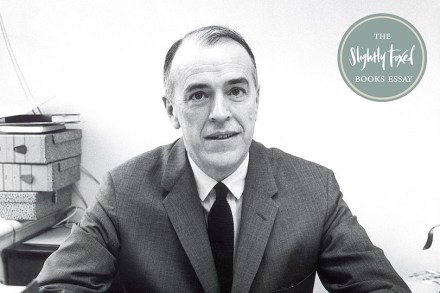
A curious thing: the New York literary world is smaller than the London literary world. It also has a strange feeling of being more old-fashioned. I was edited there by the legendary Joe Fox. I don’t think he liked me, but we would have dinner at a hotel restaurant, the last place where he could smoke in New York, and talk about great writers, including William Maxwell. Joe Fox died at his desk in Random House behind a huge pile of copies of the New York Times, cigarette on his lips. William Maxwell himself was one of this relatively small but influential group of New York literary figures. Because of his very long life and his great influence as literary editor of the New Yorker, he knew almost every writer who passed through the city.
william maxwell

The last word

From our UK edition

Nicola Barker is both prodigiously talented and admirably fearless. I have loved her books. But for some time I had little or no idea what the point of the story of Sri Ramakrishna was. In fact he was one of the outstanding men of 19th-century India. Characteristically of Barker, the narrative of her latest book is interlaced with little jokes and haikus and sly references to contemporary language and manners. (There is even an excursion to the Camargue.) At first I found the whole enterprise repetitive and wilfully quixotic, but it is well worth persevering. Barker describes her book as ‘truly little more than the sum of its many parts’.

Fear, loneliness and nostalgia: a return to Johannesburg

From our UK edition

Oddly enough, the cabin service people on the plane are constantly eating during the night, helping themselves to the first-class snacks. They are bulging out of their uniforms. They cannot pass each other in the aisles without difficulty. This is the sort of thing you notice during a long flight; at least the sort of thing I notice. I arrive in the morning at Johannesburg after an 11-hour flight from Heathrow, to promote my new book, Up Against the Night. I am met by a minder who turns out to be the wife of an admiral in the South African navy. He is stationed in Pretoria. I point out that there is no naval base within a thousand miles of Pretoria. She says her husband has noticed this. The book tour is a strange institution.

Lost in the telling

From our UK edition

This is a thriller, a novel of betrayal and separation, and a reverie on death and grieving. The only key fact I can provide without giving away the plot is that Caroline, the film-making wife of Michael, the novel’s main protagonist, is killed in the badlands of Pakistan by a drone controlled from a facility near Las Vegas. Caroline is filming Taleban leaders when they and Caroline are killed. Michael, who is ‘an immersive journalist’, has spent some years on a project with gangs in the Upper West Side of Manhattan. It is dangerous but rewarding work, and after a few years his findings are published to some acclaim under the title of BrotherHoods. Now back in London, he falls in with Josh and Samantha, neighbours in the adjoining house and flat on Hampstead Heath.

Justin Cartwright on redheads, anti-Semitism and the betrayal of Christ

From our UK edition

Peter Stanford is a writer on religious and ethical matters. He was for four years editor of the Catholic Herald. Writing Judas: The Troubling History of the Renegade Apostle must have been a difficult task because there are no facts. Judas may quite possibly never have existed at all, and if he did, the Judas kiss may not have happened. Also, he may not have hanged himself. This is a fascinating story of febrile myth-making over two millennia, with very little historical fact. Stanford starts his pursuit of Judas with a visit to gloomy Hakeldama in Jerusalem, the place where Judas is traditionally said to have hanged himself — if he did hang himself.

The bonkers (and not-so-bonkers) theories of what the pre-historic people of Cornwall believed

From our UK edition

Philip Marsden’s book is about place. He makes a distinction between place and space. In his mind ‘place’ is something resonant, evoking a connection with the land and its meaning. Marsden is obsessed with pre-history and the beliefs and practices of the earliest inhabitants of Cornwall. He cites with approval someone’s judgment that written history is a palimpsest and he is demonstrably eager to see what was written over. Although his area of special interest is Cornwall, he describes expeditions to other European countries in search of a kind of kinship of belief and practice among them.

The Good Lord Bird, by James McBride – review

From our UK edition

James McBride’s The Good Lord Bird is set in the mid 19th century, and is based on the real life of John Brown, the one who lies a-mouldering in his grave. Recently it won a National Book Award in the USA. Brown, the Old Man, was a religious fanatic who believed that he had the nod from God to free the slaves. Early in his harum-scarum life he killed and beheaded some pro-slavery opponents with God’s sanction; like many fanatics he had a direct line to the Almighty. But it all ended in tragedy when, with his small band of followers, very few of whom were slaves, he took a federal government arsenal at Harper’s Ferry in West Virginia. The plan was to distribute thousands of guns to the ‘negroes’ (as McBride calls them).

Decline in New York

From our UK edition

A connection between poetry and blindness is a classical trope. Homer was thought to be blind — if indeed he was one person — and Milton of course suffered torture by going blind. Blindness is also associated with special powers of insight and intuition, very useful attributes for a poet. Blind poets had to develop long memories, too, if they wished to recite their works. The Odyssey is thought to have been the work of Homer’s old age. Homer and Langley is the work of E. L. Doctorow’s old age. There are fewer Homeric references than you might have expected, given that the narrator is called Homer Collyer and is blind, although, like the classical Homer, not born blind.

Justin Cartwright’s Diary

From our UK edition

Too often, I go to South African theatre with a sense of foreboding: I anticipate something overwrought, tendentious, poorly acted and emotionally exploitative. So I arrived at the Hampstead Theatre last week without high expectations. The play, A Human Being Died That Night, was based on the book written by the psychologist Pumla Gobodo-Madikizela, who conducted interviews with Eugene de Kock, the most notorious of the appalling state-sponsored killers of the apartheid era. De Kock and his comrades murdered and tortured hundreds of anti-apartheid activists. But in the course of her discussions with him, Madikizela came to believe that De Kock should be pardoned and released from Pretoria Central jail, where he has been held for years. Many other killers who made confessions were pardoned.

The tragedy of a hamlet

From our UK edition

Jim Crace’s novels have one thing in common, which is that each is set in an entirely original world. None of these worlds is of a specific time or place, but they seem to have some connection to our own lives. The subjects Crace tackles are varied, from a microscopic study of death (Being Dead) to an eremitic retreat in the Judaean desert (Quarantine). They all deploy a terrible, lyrical, beauty that is nothing like any other novel I have ever read. Some of them are dystopian (The Pesthouse), some are set in very faintly demarcated places, or places that we recognise because we have dreamed of them. Yet this is not science fiction. It is rather a re-imagining of the world, using the available tools.

Welcome to surreal Luton

From our UK edition

Nicola Barker’s new novel is set in Luton. You could hardly find a place in Britain  more emblematic of non-being. It has an airport; it used to make something or other, it is not in London, not in the Midlands; its architecture is frightful, its pretentious but tatty hotels are full of middle management businessmen, its streets full of Vauxhalls driven by men with delusions and tattoos. It’s true Barker territory: the utterly grotesque sheltering amongst the banal.

Putting the fun in fundamentalism

From our UK edition

Turnaround Books, the publishers of Timothy Mo’s remarkable Pure, are revealed to operate from Unit 3, Olympia Trading Estate, Coburg Road, London N22. From this we may deduce that the publishing history of the three times Booker-shortlisted Anglo-Chinese novelist continues on its maverick way. Imagine if Mo had approached a conventional publisher with a proposition: this is a novel about jihad in south-east Asia, as seen through the eyes of a Muslim ladyboy. Mo’s perversity and boldness apply in equal measure to his hero/heroine.

Road to ruins

From our UK edition

This is a delightful book, nostalgic, slyly witty, perceptive and at times flirting — deliberately — with old fogeyism. Tom Fort, a BBC radio journalist, starts from the assumption that ‘many of us have a road that reaches back into our past’. For him, this is the 92 miles of the A303 — as he subtitles his book, the ‘Highway to the Sun’. At first glance I imagined there might a be a sort of literary suicide in store; but I quickly discovered that Fort had much more in mind than an anorak’s guide to a road.

Mumbai and Mammon

From our UK edition

This is a state of the nation novel or more accurately a state of Mumbai novel. Behind the tale of a struggle by a developer to acquire, for flashy redevelopment,  the three towers of the lower-middle-class, crumbling Vishram Co-operative Housing Society, lies a colourful and ambitious novel about the changing standards and habits of the citizens of Mumbai, poisoned as much by the rocketing wealth all around, as by the foul air and excrement-laden byways. (Adiga mentions shit and its stench time and again.) On the one side of the divide is a group of friends and neighbours who live in Tower A of the Society. The most respected of them is Masterji — Yogesh A. Murthy — a retired and recently widowed schoolmaster.

When the best defence is no defence

From our UK edition

This remarkable book is the account by their lawyer of the trial, imprisonment and sentencing to death in the late Eighties of a group of young men who came to be known as the Delmas Four. It is also a wonderfully vivid and at times alarming account of the inner workings both of ANC ‘operations units’ and of the police, who used torture, murder and intimidation without compunction in the fight to save South Africa from what they saw as a communist threat. As South Africans in general drew closer to some sort of détente between the ANC and the nationalist government, neither the ANC on the one hand nor the security police on the other were prepared to hold back. It was as if this was the last hurrah for their deepest fears and hopes for the country.

Positively Kafkaesque

From our UK edition

This is a companion to a collection published earlier this year of Nadine Gordimer’s non-fiction, called Telling Times. This is a companion to a collection published earlier this year of Nadine Gordimer’s non-fiction, called Telling Times. Short stories are, of all her endeavours, the most successful. Their heyday was in the Seventies, when they perfectly realised the awful but fascinating contrasts of South African life. As a boy I lived in Johannesburg just two streets away from Gordimer. She was a towering figure, known to be very close to the ANC. Her presence cast a certain penumbra over our modest house.

Taking on the turmoil

From our UK edition

Nadine Gordimer is now in her mid-eighties. For as long as I have been alive, she has been the towering figure of South African literature, a fact recognised in l991 by the Nobel committee. This is a collection of her non-fiction over 60 years, running to nearly 800 pages. There is a belief, prevalent in South Africa, that she received the Nobel more for her politics than her literature. The distinction between politics and literature is to her absurd; she quotes with approval a maxim, ‘Once I am no more than a writer I will stop writing’. No writer, she says, should be required to separate the inner life from a perception of the outer world.

A canker on the rose

From our UK edition

This is a very short book with large type. DeLillo has said that he no longer feels a compulsion to write long, compendious books. In his later years Saul Bellow said something similar. DeLillo, of course, has written very long in the past, notably with the 850-page Underworld (1997), and his story has been America. America is the big subject of the second half of the 20th century, tackled in one form or another by all the great American male writers. You could make a case for saying that it was the only game in town — from Bellow to Roth to Updike to Richard Ford — America was more or less explicitly the leitmotif. But now a canker has fallen on the rose.

The man who saved Oxford University

From our UK edition

The Sheldonian Theatre in Oxford is an astonishing building, designed by Christopher Wren. Its painted ceiling has just been restored, so that the darkish miasma that was Robert Streeter’s original allegory of truth and light striking the university, is now bright with playful cherubs and lustrous clouds. Here, bookended by large chunks of Latin, a new vice chancellor is to be admitted to the job. He is Andrew David Hamilton, his name Latinised for the ceremony into Andreas. He is not an Oxford man, having arrived here by way of Exeter, Cambridge and Princeton, where he was Provost. Later you could tell that he was not an Oxford man: he pronounced ‘Cherwell’, in his amusing and rather post-prandial speech, as ‘Churwell’.

To be mortal

From our UK edition

I have read two outstanding books this summer. This is one of them; the other is Summertime by J.M. Coetzee (reviewed on page 42). As I read The Infinities, with its magical, playful richness, its sensuous delight in the power of language to convey the strangeness and beauty of being human, I wondered if J.M.Coetzee with his bleak, pared-down, elemental view of the world, had ever read a Banville, and if he had, whether he had envied him his astonishing powers. It seems to me very odd indeed that this book is not, according to the Booker judges, one of the 12 best books of the year. It may be one of the 12 best books of the decade, or even of several decades. The plot is both extremely simple and vastly complicated.