Culture

Culture

The good, the bad and the ugly in books, exhibitions, cinema, TV, dance, music, podcasts and theatre.

Man Booker Prize 2017: Fiona Mozley’s debut novel is an old-fashioned portrayal of gender privilege

Elmet by Fiona Mozley John Murray, £10.99, pp. 311 Daniel and his big sister, Cathy, do not go to school. They live with their father, a gargantuan former prizefighter, eking out an autarkic existence as squatters on land belonging to the unscrupulous Mr Price; on a typical day they are engaged in woodwork, plucking mallards or tickling trout. Price’s personal fiefdom operates outside the law of the land, with violent henchmen enforcing his will. The children’s father had once worked as a fixer for him before turning renegade, rallying Price’s exploited workers and tenants into collective action to improve their lot.

Schama, Uglow and Applebaum among the longlisted authors for the Baillie Gifford

The Baillie Gifford longlist – consisting of contenders for the country’s most prestigious nonfiction prize – is out today. A very good list it is, too. For readers’ ease, I’m affixing some links here to the Spectator’s reviews of the longlisted titles. We missed Souad Mekhennet (sorry); and a couple of them – Applebaum, Schama and Uglow – are forthcoming so will be reviewed in the next few weeks. Expect a review of Allan Jenkins’s allotment memoir when we consider gardening books at Christmas.

Books podcast: A N Wilson

A N Wilson’s new biography of Darwin was acclaimed in these pages by Robert Douglas-Fairhurst for having a 'scientist’s forensic skill and a novelist’s imaginative touch'; but, he warned, it was likely to 'put the felis catus among the columbidae' with its portrait of the great man as a publicity-hungry plagiarist who got the science wrong. It certainly has done that.    In this week’s podcast I talk to Andrew Wilson about Darwin’s feet of clay — and the way in which, as Wilson sees it, the theory of evolution was used to license everything from the cruellest excesses of Victorian capitalism to the eugenics programmes of the mid-20th century.

Punks vs. Putin

More from Books

What makes for meaningful political protest? In regimes where ideology was taken seriously (such as the Soviet Union or America during the Cold War), dissidents and dissenters could target rulers’ political ideas, whether communist or capitalist. But in regimes where ideology is used more to distract than indoctrinate (such as Putin’s Russia or Trump’s America), directly opposing the leaders’ ‘narrative’ (one which can change, depending on political expedience) risks playing right into their game.

The magic of maths

More from Books

It’s odd, when you think about it, that mathematics ever got going. We have no innate genius for numbers. Drop five stones on the ground, and most of us will see five stones without counting. Six stones are a challenge. Presented with seven stones, we will have to start grouping, tallying and making patterns. This is arithmetic, ‘a kind of “symbol knitting”’ according to the maths researcher and sometime teacher Paul Lockhart, whose Arithmetic explains how counting systems evolved to facilitate communication and trade, and ended up watering (by no very obvious route) the metaphysical gardens of mathematics. Lockhart shamelessly (and successfully) supplements the archeological record with invented number systems of his own.

Pleasure palaces and hidden gems

More from Books

Theatre buildings are seriously interesting – as I ought to have appreciated sooner in the course of 25 years writing about theatre and opera. This coffee-table whopper, weighing in at just under a kilo, dazzles: Michael Coveney’s text is even better than Peter Dazeley’s remarkable photographs. And in a luminous foreword, Mark Rylance sets out the not-so-obvious difference between theatre and cinema: ‘In a theatre you need to hear the truth. In a cinema you need to see it.’ Most of the theatre audience can’t see the actor’s eyes, and have to rely on hearing emotion in the voice and, to a lesser extent, detecting emotion in body language. Hence the importance of lighting.

Homer Simpson meets Homer

More from Books

Milan Kundera has said that Homer’s Odyssey was the first novel. I’m not so sure — the verse kind of gets in the way — but it’s certainly the earliest surviving great travel book. Ever since the 5th century BC, Odyssey obsessives have been trawling the Mediterranean in their hero’s footsteps to track down the real Cyclops or the real Scylla and Charybdis. Herodotus and Thucydides identified the Land of the Lotus Eaters with a spot in Libya. In the 4th century BC, Euhemerus, a Greek Sicilian, maintained that, beneath all the monsters and the myths, there lay pure historical fact. The romantics who go in search of the real Odysseus — and the real Homer — are called ‘euhemerists’ as a result.

Beyond Timbuktu

More from Books

Every so often a monster comes along. Here’s one — but a monster of fact not fiction, over 700 pages recounting the French expedition from Dakar to Djibouti 1931–33. It doesn’t matter that this travel diary — part field study, part confessional, first published in 1934 — has arrived so late for an English readership. It comes with the additional resonance of a lost world. Michel Leiris was an exceptional man, a Parisian surrealist writer and protégé of Max Jacob. He was also close to Picasso, with whom he shared an interest in primitive art, shamanism and Mithraism; and he married a girl who was the illegitimate daughter of the wife of Daniel-Henry Kahnweiler, Picasso’s dealer.

Ill-met by gaslight

More from Books

What is it about Victorian murders that so grips us? The enduring fascination of Jack the Ripper caught the imagination of the American thriller writer Patricia Cornwell to such an extent that she allegedly spent more than $6 million of her own money examining the case and producing two books on the subject. (She thinks the killer was the artist Walter Sickert.) Meanwhile, Bruce Robinson, the writer and director of Withnail and I, devoted 15 years to Ripper studies: the result, They All Love Jack, is a gloriously labyrinthine, closely argued whopper of a book, rich with conspiracy theories about freemasons and the police. (He proposes another culprit, the songwriter Michael Maybrick.

Creature comforts

More from Books

As naturalist, educator and writer, John Lister-Kaye was for many years a voice in the wilderness. In 1976, when nature conservation was still considered a benign eccentricity, he moved into a crumbling estate in the Scottish highlands. Taking as its credo a text from Gavin Maxwell —‘I am convinced that man has suffered in his separation from the soil and from the other living creatures of the world’ — he set up the Aigas Field Centre. Since then, tens of thousands of people have visited it. Schoolchildren and adults alike have been encouraged to share his wonder for the natural world.

A blast from the past

More from Books

If you had to choose one book that both typified spy fiction and celebrated what the genre was capable of doing, then John le Carré’s The Spy Who Came in From the Cold is probably the one to go for. Published in 1963, and set within the comfortably binary framework of the Cold War, it combined moral ambiguity and an air of grim authenticity with a steady narrative pull. It also had an unforced literary distinction that made it impossible to dismiss as ‘mere’ genre fiction. Now, over half a century later, le Carré’s latest novel returns to this murky episode and proceeds to make it even more complicated and harrowing than it was before.

Crusading passions

More from Books

In W.B. Yeats’s ‘Meditations in Time of Civil War’, a testing allusion emerges amid a scene of nightmare: Monstrous familiar images swim to the mind’s eye ‘Vengeance upon the murderers,’ the cry goes up ‘Vengeance for Jacques Molay.’ More about de Molay, last master of the Knights Templar, can be found in Dan Jones’s new blockbuster on the crusading order, along with quite a few monstrous familiar images. Jones states from the outset his noble intention: to write ‘a book that will entertain as well as inform’. In this he has hitherto had great success; his two spectacular chronicles, The Plantagenets and The Hollow Crown, traced that dynasty from the White Ship to Bosworth Field, and threw in some Tudors for good measure.

Armageddon averted

Lead book review

From 1945 to 1992 the Cold War was the climate. Individual weather events stood out — the Korean War, the Cuban missile crisis, the Hungarian and Prague uprisings, the fall of the Berlin wall — but the possibility of nuclear annihilation, the great divide between the broadly capitalist West and the broadly socialist East and the numerous proxy conflicts it spawned, were the background to daily life. In retrospect, it seems stable, almost cosy: you knew where you were. Its ramifications were so many and so all-encompassing that virtually everything you say about it will be true of some part, somewhere.

Spare me the encomiums for John le Carré

More from life

In Absolute Friends, one of John le Carré’s lesser works, the central character explains his rebirth as a left-wing firebrand, radicalised by Britain’s support for America’s invasion of Iraq. ‘It’s the old man’s impatience coming on early,’ he says. ‘It’s anger at seeing the show come round again one too many times.’ This is followed by a rant about ‘the death of empire’, our ‘dismally ill-managed country’ and ‘the renegade hyperpower that thinks it can treat the rest of the world as its allotment’ (not Russia, obviously, but the United States).

The last great adventure

More from Books

Towards the end of his life, Robert Louis Stevenson travelled widely in the central and southern Pacific Ocean. As well as the region’s exotic reputation, he was drawn by hopes that its benign climate would alleviate his chronic bronchial problems. In 1889 he arrived in Samoa and decided to settle there. He was a hit with the locals. Unlike so many of his peers, he declined to dismiss them as savages. Certainly, he was scathing about their disregard for property rights, which he labelled communism, and he found some of the women’s dancing obscene. But Joseph Farrell tells us that Stevenson was relaxed about extensive tattoos and scanty attire, and that he was a willing participant in kava drinking (kava is a narcotic plant extract, recently banned in the UK).

The art of the arabesque

More from Books

The title of this book, By the Pen and What They Write, is a quotation from the Qur’an and comes from the opening of the ‘Surah al-Qalam’ (Chapter of the Pen), in which the authority of the cosmic scribes in heaven, whose writing determines the fate of humanity, is invoked in order to authenticate the revelation that follows. According to Islamic tradition, the Prophet Muhammad was illiterate (and so presumably were most of his audience). So it is odd to find writing featuring so prominently in this surah and throughout the Qur’an.

Books Podcast: World Book Club’s 15th birthday

This week, in the books podcast, I talk to Harriett Gilbert - who has a good claim to be the voice of books on radio. With the 15th anniversary of the BBC World Service's World Book Club (nine Nobel and 17 Booker winners have been guests to date), which she's presented from its first episode and in which world-class writers discuss their best known books. I ask her about her life and career, the changing literary landscape, and why she doesn't write novels herself any more. You can listen to our conversation here: And if you enjoyed that, do subscribe on iTunes for a new episode every Thursday. A special 15th Anniversary edition of World Book Club goes out on Sunday, featuring Sebastian Barry talking about The Secret Scripture.

A grand inquisitor

More from Books

Hidden behind Kensington Palace, in one of London’s smartest streets, there is a grand old house which played a leading role in Britain’s victory over Nazi Germany. Today it’s owned by Roman Abramovich, apparently — it seems he paid £90 million for it. But during the second world war, and for a few years thereafter, 8 Kensington Palace Gardens was a secret interrogation centre known as the London Cage. This is where suspected spies (and, later, suspected war criminals) were broken down. Between 1940 and 1948, thousands of German servicemen passed through here, on their way to POW camps (if they were deemed innocent) or prison (if they were guilty).

Mysticism and metamorphosis

More from Books

‘I frankly hate Descartes,’ states a character in Nicole Krauss’s new novel, Forest Dark: ‘The more he talks about following a straight line out of the forest, the more appealing it sounds to me to get lost in that forest …’ Like the author, this character is called Nicole, lives in Brooklyn, and is a writer and mother. Struggling with her work and her marriage, life is indeed a ‘forest dark’, and we follow her through the tangle of it.

Stage fright | 31 August 2017

More from Books

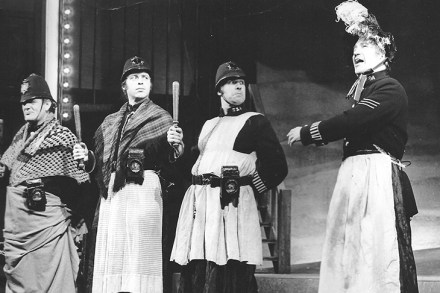
Patrick McGrath is a master of novels about post-traumatic fragmentation and dissolution, set amid gothic gloom. His childhood years spent at Broadmoor, where his father was medical superintendent, have given him a solid grounding in psychiatric illness for these disquieting dramas. His ninth novel is set in London’s theatreland in 1947, and the grey, skeletal remains of the bombed East End. As usual with McGrath, the narrator is far from straightforward; in this case it is the ladies of the local theatre-world chorus, who are omniscient, knowing each character’s thoughts.

City of dreadful dusk

More from Books

Fantastic fiction loves contrasts made explicit: Eloi and Morlocks, orcs and elves, and above all humans battling vampires, Martians or robots. Small wonder that Claude Lévi-Strauss specifically invoked science fiction for his theory of ‘binary opposition’. Sometimes these tensions are in the mise-en-scene — not just Earth vs. outer space, but settings — Lilliput and Brobdingnag, say — which try to make themes concrete. Classics of that sort are Edwin Abbott’s Flatland (set in two dimensions) and Lewis Carroll’s Alice books.

Well of sorrows

More from Books

The Red-haired Woman is shorter than Orhan Pamuk’s best-known novels, and is, in comparison, pared down, written with deliberate simplicity — ostensibly by a narrator who knows that he is not a writer, but only a building contractor. Polyphonic narratives are replaced by a powerful, engaging clarity. This simplicity is the novel’s greatest strength, yet at certain points seems as if it might become a weakness. Part one, which takes up the first half of the book, is superbly concentrated. It describes one summer in 1986 in the life of Cem, a middle-class 16-year-old boy who takes on a summer job 30 miles outside Istanbul to earn money before cramming for university entrance exams.

Finally tired of London

More from Books

Iain Sinclair is leaving London — like the croakiest of the ravens taking flight from the Tower. It is a proper blow: across five decades, he has been prowling the streets, part poet, part satirist, part prophet. Very few authors have fashioned a London more real than the one we see: Dickens, Conan Doyle, Patrick Hamilton, Angela Carter. Sinclair is firmly among them. While his contemporary Peter Ackroyd understands London as a city of eternally recurring patterns and echoes, Sinclair sees something more malign and gangrenous: forces that endlessly conspire to bend perception and bleach the streets of their real meaning. Oh: and he is also extremely funny.

The writer behind the brand

More from Books

Few publishing phenomena in recent years have been as gratifying as Chris Kraus’s cult 1997 masterpiece I Love Dick becoming a signifier of Twitter and Instagram chic. The ‘lonely girl phenomenology’ it exemplified has now attained cultural status, with first person, inventive writing by women often enjoying centre stage. It’s interesting, then, that just as the wider culture has caught up with her, Kraus has pivoted away, delivering ‘what may or may not be a biography of Kathy Acker’ — the underground punk novelist who is still, even 20 years after her death, awaiting the recognition she deserves.

Mozart’s mischievous muse

More from Books

If you were to compare Mozart to a bird it wouldn’t be the starling. Possibly the wood thrush or nightingale, with their beautiful, haunting songs; or maybe the lyrebird with its astonishing ear for imitation; or perhaps the composer would find his match in the exotic rarity of the ivory-billed woodpecker or giant ibis. But the common starling? More pest than pet in its adoptive North American home, this ‘ubiquitous, non-native, invasive species’ seems an unlikely fit for a singular prodigy. So thought the ecophilosopher and naturalist Lyanda Lynn Haupt, when she started work on this book, exploring the composer’s relationship with the bird he bought after hearing it singing one of his piano concertos, and kept as a pet until its death.