Book review

The world in limbo

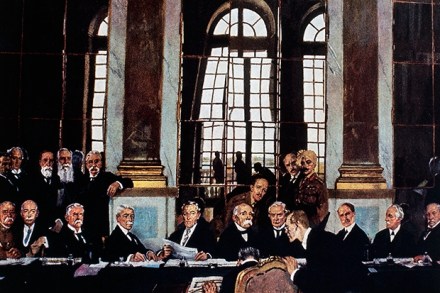
In 1919 the economist and sometime prophet John Maynard Keynes left the glittering ballroom of Versailles feeling profoundly despondent. The treaty that determined the political geography of a postwar world inspired in him a fearful sense of inevitability. The punitive conditions imposed on Germany would be too harsh for the country to tolerate for long. One junior delegate in Paris observed: ‘There is not a single person among the younger people here who is not unhappy and disappointed with the terms.’ This was a world not only united by the devastating results of the Spanish ’flu epidemic, responsible for the deaths of five times as many as had lost their lives in the war, but by political and religious fragmentation that was already endemic.

And the answer is…

Doorstoppers, slim volumes, loose leaves stacked in a box, bound pages fretworked with holes, epistolary exchanges, online postings, palimpsests…. Fiction comes in all shapes and sizes — and that’s just the format, before you get to the content, which might include fractured grammar, reversed chronology, parallel plots, contradictory footnotes, dead or unborn narrators and labyrinthine text. Never though, until now, have I encountered a work of fiction set out as an examination paper. From first page to last here are 90 questions, a sly parody of the Chilean Aptitude Test for university applicants, right down to the numbered multiple choice boxes to tick.

Behind the fringe

‘Sexual intercourse began / In nineteen sixty-three,’ Philip Larkin famously announced in his poem ‘Annus Mirabilis’, ‘Between the end of the Chatterley ban / And the Beatles’ first LP.’ But the key line is a far more private confession, caught in parentheses like a gloomy thought bubble: ‘(which was rather late for me)’. Few of Larkin’s contemporaries would have been more sympathetic than Alan Bennett.

Smoke and mirrors | 6 October 2016

Nell Zink’s route to publication became something of a story in itself: one that involved an email exchange about birds with Jonathan Franzen, which led to Franzen’s subsequently championing her work, and ended with not one but two novels — Mislaid and The Wallcreeper — published together in a lavish, design-savvy edition. But it was Zink’s style and ideas that drew fervid, hyperbolic praise. Fresh and undeniably original, this is fiction at odds with much of American literary convention, Zink’s prose refusing to conform to received ideas of how novels are constructed; time shifts, perspective changes and characterisation, for example, are all treated casually, almost with disdain. The word ‘genius’ was bandied around.

The magic of bookshops

It is not uncommon for writers to be obsessed by bookshops. Some even find their writing feet through loving a particular bookshop and developing a habit, which helps to form the writers they become. And often they end up in a rage with the common run of bookshops. Why would they not? It is, or used to be, a numbers game, and most bookshops fail to stock most writers. But in recent years online outlets such as Amazon have changed the stocking (and the hating) game. Since proper bookshops became an endangered species, a use-them-or-lose-them energy pervades the bookish classes. It is a form of virtue signalling to go to your local, if you have one, order in what they haven’t got and pay more than you would online.

Bolsheviks on board

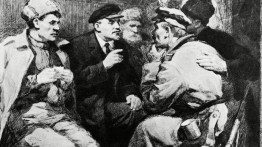
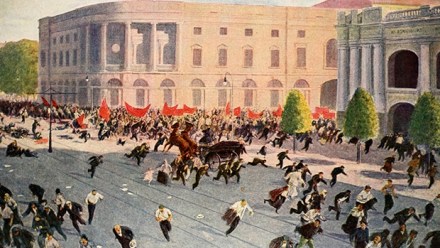
Full allowance must be made for the desperate tasks to which the German war leaders were already committed… Nevertheless it was with a sense of awe that they turned upon Russia the most grisly of weapons. They transported Lenin in a sealed truck like a plague bacillus from Switzerland to Russia. As so often, Churchill has the best lines. Here he is about one of the most famous episodes in European history: the safe passage given to Lenin by a Germany desperate for victory in the first world war. As long as German high command could dream up ways to eliminate the threat from either the West or East, there was hope it would not suffer defeat. Lenin, as Churchill wrote, was imperial Russia’s ‘Vengeance’.

More sinned against than sinning

The 55-year-old ’flu-ridden John Charles Wallop, 3rd Earl of Portsmouth, his feet in a basin of warm water, shivered in the dock with fever but also with fear. Would the jury, assembled in 1823 in London’s jam-packed Freemason’s Hall at the end of an unpredecentally sensational two-week trial, find him eccentric, delusional, simple-minded or, instead, stark raving mad? Elizabeth Foyster, a historian and senior lecturer at Clare College, Cambridge, was alerted to this enthralling, almost unbelievable true story with the caveat that the vastness of the material in Lambeth Palace archives concerning a scarcely remembered trial of a hugely wealthy, relatively obscure aristocrat had deterred anyone else from attempting to make sense of it.

The spell of the pharaohs

Here’s a book to make an Egyptologist of everyone. A compendium of accepted gen on the gift of the Nile, Rose-Marie and Rainer Hagen’s (updated and reissued) Egypt: People, Gods, Pharaohs ‘aims to answer some basic questions about life in Ancient Egypt and whet your appetite to find out more’, and achieves both in appropriate abundance. It looks great, reads well, even smells nice — and is positively jam-packed with wonderful things. Citing the fundamental continuity of 3,000-plus years of pharaonic culture, the Hagens tuck away a (very) concise chronology at the back of the book, and then get on with the business of showing us what Ancient Egypt looked like, and who/why/how/when/where.

Over hill and dale

When it comes to speaking of foreign affairs, Rory Stewart is one of the few MPs who does not peddle bland abstractions. Many of his parliamentary colleagues inhabit a blah-blah land where terms such as ‘peace process’ and ‘international community’ have meaning. An upbringing in the Far East, where his father was a diplomat, as well as years spent in Iraq and Afghanistan, have given Stewart direct experience not only of nations but of town quarters, villages and individuals. Walking was his preferred method in Afghanistan, where he tramped across the country with a dog and a Punjabi fighting stick. The dog couldn’t keep up and died, but here for his latest tramp the Punjabi dang comes out again.

Jolly good fellows

‘Leonard Michaels (1933–2003) was one of the most admired and influential American writers of the last half century,’ states the blurb on this reissue of the author’s first and penultimate novel, originally published in the US in 1978. Admired and influential Michaels may have been, but that was largely in his homeland and then as an essayist and author of short stories, rather than as a novelist. The Men’s Club was not published in the UK until 1981 (by Jonathan Cape) and is only now, 35 years later, being made available in paperback by Daunt Books in the category of ‘lost classics’.

A puzzling phenomenon

Everyone has played it, or one of its manifold variations and rip-offs. Blocks of different shapes fall from the sky; you have to rotate and shunt them around so they fit perfectly together at the bottom, and then that horizontal line of blocks vanishes. This is Tetris, and it was created in 1984 by a Soviet mathematician called Alexei Pajitnov. But how it came to the West is a remarkably complicated cloak-and-dagger story, here given its first book-length treatment. The narrative opens with all the bad bravado of a Dan Brown novel, as one of the several businessmen chasing the rights to the game flies into Moscow for a meeting with Elorg, a department of the Soviet trade ministry.

Nazis and narcotics

Norman Ohler is rather hard on the Nazis, for compared to what our little group got up to in the late 1960s and 1970s, they were shrinking violets in the drugs department. We smoked cannabis, ate opium and sometimes took strong LSD; lines of uncertain content went up nostrils; and we swallowed countless uppers (speed) and downers (tranquillisers, sleepers for looning on). Speed was amphetamine sulphate. Benzedrine, Dexedrine, Methedrine were the three original brands, in rising strength. Soon there were many other names, including slang: Desoxyn, Durophet, Durophet-M (speed with Mandrax), French Blues, Purple Hearts, Black Bombers. Many were prescribed by doctors who didn’t regard them as outrageously dangerous.

Lessons in sex

Helen Gurley Brown’s internationally influential career, as the author of Sex and the Single Girl and editor of Cosmopolitan, is revealed in this intimate biography in 50 shades of pink. ‘Let it be understood at the outset,’ writes Gerri Hirshey, an American freelance journalist for many upmarket periodicals: Sex has imbued the soft core, hard times and glory days of this story — sex surrendered, sex wielded, lavished and revelled in, sex merely endured and sometimes coolly transactional, sex reimagined, promised and packaged on glossy magazine covers for global dissemination... Hirshey tells all about Helen’s life, every nook and cranny, from her childhood poverty in hillbilly Arkansas, steeply ascendant to the pizzazz of A-list Manhattan.

Thoroughly bewitching

Angela Carter was a seminal, a watershed novelist: perhaps one of the last generation of novelists to change both the art she practised and the world. Reading this splendid biography, it is hard to avoid the false conclusion that she always knew exactly what she was doing. Her life, in its swerves and unexpected corners, always turns out to be contributing to her work; how clever of her, one starts to think, to get a job on a local news-paper, to go to Japan, to have an array of dotty, oppressive or plain witchy aunts, mother and grandmother…. Of course it was not like that. Carter’s life seems rich and inevitable in the retelling because she made use of almost everything. There was not much that she wouldn’t look at with interest.

Writing on the fly

Bogotá airport, immigration form in hand. Tourist, migrant, businessman? Andrés Neuman ponders the descriptors, unsure which to tick. He opts for the second. ‘I’d like to be a migrant.’ The decision is telling, and frames much of what follows in this curious, delightful, if disjointed book. Neuman is hot property in contemporary Latin American literary circles. A former winner of Spain’s prestigious Alfaguara Prize and the National Critics Prize, he is tipped (by Roberto Bolaño, no less) to be one of a select ‘handful’ to take up where the ‘boom’ generation of Márquez, Cortázar, Fuentes and Borges left off.

Digging deep into history

The year is 1963. A girl is walking around Stepney with a pack of index cards, visiting old residents in their dilapidated houses, drinking strong tea with tinned milk, listening to their stories of happy days past and looking at cracked walls and leaking roofs. As she promises them help on behalf of her employer, the Old People’s Welfare Association, redevelopment plans for the area are being drawn up with little regard for its inhabitants, many of whom don’t want to move. ‘There may be heartbreak in store for some,’ breezily remarks a magazine article. That girl was Gillian Tindall, and her interest in ‘the landscape of people’s lives’ has never waned, recently leading her to Crossrail, a project designed to transform London on a colossal scale.

Smaller than life

For Jonathan Safran Foer fans and sceptics alike, Here I Am comes as a wonderful gift, a truly painful, honest book which purports to be about a lot of things but is mainly about one thing: the breakdown of a marriage between a whiny, self-obsessed Jewish novelist turned scriptwriter and his blameless wife. Whether or not Foer drew inspiration for the book from the much-publicised breakdown of his own marriage to fellow novelist Nicole Krauss I have absolutely no idea and care less. Like any fully functioning adult, good fiction outgrows its origins. Or at least it should. A large part of Here I Am concerns itself with the very question of what we owe to the past and to others.

No regrets, really?

Never speak on the same platform as Sir Malcolm Rifkind. I tried it once, at a Spectator debate held during the Scottish independence referendum campaign in 2014, and I will not be repeating the experience. The former Foreign Secretary spoke as usual without notes, and with such ringing clarity and confidence that all the other panelists were easily eclipsed. That included Kelvin McKenzie, the former editor of the Sun, speaking in favour of Scottish independence. Sir Malcolm might just as well have recited the Edinburgh phonebook from memory, in his Jean Brodie tones, and the audience would still have cheered him to the echo. It was a magnificent performance from one of the best speakers of his generation. And yet, for all the brilliance, I can’t recall a single word he said.