Charlotte Hobson

Laughing at Putin is a powerful form of protest

From our UK edition

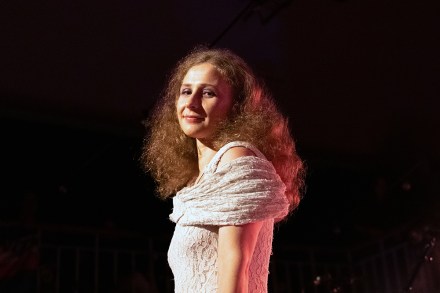
Penal Colony No. 2. A girl in a green coat. Red splashes of fireworks against the night sky. She arrives back in Moscow: photographers, a clamour of questions, what is it like to be free? Meetings, cops, her little six-year-old son with a sparkler, a video being recorded, her mother nearby, anxious. Like the flickering, scratchy lens of a film projector, Maria Alyokhina’s Political Girl illuminates the story of her life from the moment she and the other members of Pussy Riot were let out of prison in 2013 until, in 2022, she finally fled Russia disguised as a delivery driver. Nine years of fighting the slowly tightening noose of Putin’s regime with an endless, almost crazed persistence.

In Putin’s Russia, feminism is an ugly word

From our UK edition

The excellent Moscow-born journalist Julia Ioffe’s first book recounts a well-known slice of Russian history from a fresh perspective – that of the mighty Russian woman who, it’s said, can ‘stop a galloping horse and run into a burning hut’. And how superhumanly brave and resilient they have had to be. Women were granted sweeping rights following the Revolution, then watched them dwindle for the rest of the century, in law but mainly in practice. What remained was the Soviet obligation to work regardless of gender, which created a country of professional women in every sphere: engineers, cosmonauts, judges, professors and 70 per cent of doctors by the 1970s.

Putin’s stranglehold on the Russian press

From our UK edition

Since Vladimir Putin came to power in 2000, the Russian press has been slowly, methodically strangled, which has forced existential choices on newspaper and TV journalists. Twenty-one have been killed – beaten, poisoned or gunned down. Others, such as Andrei Soldatov and Irina Borogan, highly regarded investigative reporters, have been forced into exile. Yet others, like the ‘dear friends’ of this book’s title, have chosen a different path – to cleave ever closer to the regime. The authors tell the fascinating story of those choices and allow us a glimpse of why they were taken.

Whipping up a masterpiece: painters and their materials

From our UK edition

If you are someone who revels in the deliciousness of oil paintings, who looks at them and wants to eat them ‘as if they were ice cream or something’, in Damien Hirst’s phrase, then Martin Gayford’s latest book will be a banquet. In part, this is thanks to the illustrations – luscious close-ups of Van Gogh’s brushstrokes like buttercream icing, and a double-page spread of a golden Rothko large enough to tumble into. But mainly it’s due to his intention to understand the medium of painting from the inside out: from the artists’ viewpoint rather than the art historian’s. He is well placed to do this, having interviewed almost every well-known artist (many of them for this magazine) during his past 30 years as a critic.

Sarah Rainsford joins the long list of foreign correspondents banned from Russia

From our UK edition

Goodbye to Russia is an elegy for a lost country – the warm, chaotic Russia of unlimited possibility that welcomed the 18-year-old Sarah Rainsford in 1992. She stayed on, studied, worked in an Irish bar in St Petersburg, joined the BBC in 2000 and, after spells in other parts of the world, returned to Moscow as a Russian correspondent from 2014. Her memoir’s 30-year period covers an entire cycle in Russian politics – as Anna Akhmatova might have put it, from vegetarian to carnivore. In August 2021, Rainsford was stopped at the Russian border and refused entry as a ‘threat to national security’. A few weeks later, she was expelled with no right of return, one in a rollcall of foreign journalists banned from Russia.

Imprisoned for years on Putin’s whim

From our UK edition

Imagine: it’s 16 December 2004 and you are a middle-ranking banker living in Moscow – prosperous but ordinary, a long way below oligarch level. You are looking forward to a New Year’s trip with your family to Prague – the hotel is booked; your young son is excited. Your phone rings while you are at lunch: an investigator whom you’ve never heard of asks you to come and answer a few questions. You ask if tomorrow will do. ‘No, you must come today,’ insists the caller. ‘It’ll take around 20 minutes.’ What do you do? If this were the beginning of a thriller, Vladimir Pereverzin would have instantly made his way to the secret lock-up with the false identity documents and gone on the run.

‘A group of deranged idiots’ – how the Soviets saw the Avant-Gardists

From our UK edition

The Avant-Gardists tells the story of the small group of brilliant, punky outsider artists who, after the Bolshevik coup in 1917, to everyone’s amazement suddenly found themselves holding important posts in government (as if Sid Vicious were made minister of education). They were soon demoted, and by the end of the 1920s persecuted or driven abroad. Yet news of their breathtaking originality spread internationally, playing an important role in transforming not only our understanding of art, but the aesthetics of modern life, from buildings to household objects, textiles to the printed word. Sjeng Scheijen has written an exhilarating history of the movement, illuminated by new research and insights, and with many comic moments amid the unfolding tragedy.

The deathly malaise that’s crippling Russia

From our UK edition

Now is a difficult time to empathise with Russians – which is why we need Maxim Osipov. We need him to bring alive to us what it means to live in Putin’s Russia – how the system finds ways to crush all but a very few. Even more, we need him to remind us of the kaleidoscope of qualities that a country like Russia inevitably contains – the humanity and generosity as well as the stupidity and cruelty. An author of great subtlety, Osipov would no doubt wince at such grandiose claims for his writing. Yet when the world is deciding how to deal with the aftermath of Putin’s (eventual, but surely inevitable) defeat, I hope Kilometer 101 will be admitted in the Russian people’s defence.

Bright, beautiful and deceptively simple: the art of the linocut

From our UK edition

In the 1920s the linocut broke out of the schoolroom and on to gallery walls. Here was a democratic new art form, perfect for the times with its lowly materials — a piece of old linoleum flooring for the block, while the best tools, according to the artist Claude Flight, were an old umbrella spoke for cutting and a toothbrush to rub the back of the paper. The finished prints, Flight hoped, would be cheap enough for working-class pockets. Above all, the bright, dynamic images themselves, often depicting scenes of contemporary life — busy streets, the London Underground, skating, the first motor races — captured the mood of the age.

Pure, white and native: the birch as a symbol of Russian nationalism

From our UK edition

The image of the birch tree in popular Russian culture is as manifold as the trees themselves, but we could do worse than to begin with the song ‘Why do the birches rustle so loudly in Russia?’ By the patriotic band called Lube — apparently Putin’s favourite — it’s a melancholic guitar ballad that also mentions the soul, accordions, suffering, falling leaves, an old woman waving goodbye, and a beloved woman (rodnaya) ‘my own’, from the same root as rodina, motherland. It also happens to be sung by a handsome young village policeman. Na zdarovya! A shot of birch kitsch at its most potent.

The dark side of Venus — goddess of war as well as love

From our UK edition

Bettany Hughes has spent a decade, she tells us, exploring the origins of the goddess Aphrodite, first for a BBC documentary aired in 2017 and now for this book. I think it’s fair to say that if you saw the documentary, the book won’t have much more to offer you. If not it’s an intriguing tale that tracks the gorgeous and omnipresent Venus of western civilisation back 6,000 years to a series of strange little knobbly figures with penis-heads and emphasised vulvas found on Cyprus, presumably connected with a fertility cult. In the fourth millennium BC, a fearsome trio of goddesses swept into Bronze Age Cyprus from Mesopotamia. Innanna, described in a poem written c.

Distant voices, shattered lives

From our UK edition

In 1990s Russia, war veterans were a bossy, even aggressive presence, upbraiding people in shops and pushing to the front in the trolleybus queue. Complaining about this at some point, I was struck and shamed by a Russian friend’s reaction: ‘Oh, but it’s sad... Imagine how hard their lives have been, to make them like that.’ Last Witnesses consists of about 100 accounts by men and women who were children when the Nazis invaded. Without preface or context of any kind, their voices rise off the page — hesitant, desperate, terrified, matter of fact, poetic, bewildered. Their ellipses are loud with choked tears and still-raw fear.

Little shots of sedition

From our UK edition

In this handsomely illustrated book Tobie Mathew makes a case for the lowly postcard’s role in the politicisation of pre-revolutionary Russia. Cheap to produce, easily transported and hidden, and conveying a simple graphic message, picture postcards were ideally suited to anti-government agitation. Too dangerous to post, these little shots of sedition were preserved and shared for years in the postcard albums that were a feature of any polite drawing-room and increasing numbers of peasant huts and workers’ barracks. Before 1905 revolutionary groups printed postcards abroad and smuggled them into the country, simultaneously spreading their message and raising funds.

‘T’ is for Trotskyite

From our UK edition

Varlam Shalamov’s short stories of life in the Soviet Gulag leave an impression of ice-sharp precision, vividness and lucidity, as though the world is being viewed through a high-resolution lens. His subject matter, as well as his complete lack of sentimentality, means that much of what is brought into focus is horrifying or pitiful. Yet his capacity to capture and distil the experience, moment by moment, has an exhilarating effect, like that of the frozen bilberries he picked in the depths of the Siberian winter: ‘bright blue, wrinkled like empty leather purses, containing a dark, bluish-black juice… I ate the berries myself, my tongue carefully and eagerly pressing each one to my palate. The sweet, aromatic juice of each squashed berry intoxicated me for a second.

The dark side of the circus

In 2013 Tessa Fontaine joined up with the World of Wonders, a circus sideshow that travels around the United States each year displaying sword-swallowers, human-headed spiders, snake-charmers and fire-eaters to a marvelling/cynical public. Sideshows, as Fontaine writes, ‘are where people come to see public displays of their private fears’, and to probe their disgust reflexes and their yearnings. Here, too, they come to tread the line between relinquishing themselves to magic and uncovering, once and for all, the trick. Yet as Fontaine discovers in her first flame-eating lesson, the trick is simply that there is no trick. Flame-eaters get burnt; sword-swallowers die of wounds inflicted by carelessly inserted blades.

A brutal band of thieves

From our UK edition

Mark Galeotti’s study of Russian organised crime, the product of three decades of academic research and consultancy work, is more than timely. In these days of ever more bizarre Russian attacks, it reads like the essential companion to a bewildering and aggressive new world, a world that is no longer confined behind Russian borders but seeks actively to penetrate and disrupt our own society. Essentially a history of the development of Russia’s unique form of organised crime, it constantly illuminates and clarifies the familiar, legal narrative of Russian history and the attitudes of Putin’s clique. The Russian mafia’s distinctive culture originally emerged during the years of revolution and civil war.

First signs of thaw

From our UK edition

The Twentieth Congress of the Communist Party in February 1956 passed off entirely without incident. Speeches on the next five-year plan were applauded and Stalin’s pet agronomist Lysenko made his customary appearance to denounce bourgeois genetics. A visiting communist from Trieste, Vittorio Vidali, noted his envy of two Uzbek party members who sat reading short stories throughout the proceedings. By late on Friday, the Congress was over, except for the announcement of one additional closed session the following morning. How many delegates skipped this dreary-sounding extra session? Any that did missed the single pivotal moment in the history of the Soviet Union.

Exit the Tsar

From our UK edition

Helen Rappaport’s new book makes no claim to be a complete account of the Russian revolution. Instead it presents a highly readable and fluent description of the events of 1917 in the capital, Petrograd, as experienced by the city’s many foreign residents. Russia’s booming prewar economy had attracted every sort of business person and technical expert, as well as diplomats, journalists, adventurers and fleets of governesses. Their first-hand revolutionary experiences were too extraordinary not to record, and those who did not write contemporaneous accounts often produced memoirs later. Rappaport has unearthed striking new material from archives in Russia, the US, France and at the University of Leeds.

All is not lost | 5 May 2016

From our UK edition

Marina Lewycka’s latest happy-go-lucky tale of migrant folk in Britain takes a remark by the modernist architect Berthold Lubetkin as its epigraph: ‘Nothing is too good for ordinary people.’ In the vertical community within one of Lubetkin’s postwar blocks of flats in East London we meet hapless Bertie, resting actor caught on the hop by the spare-bedroom tax; disabled Len, thinking positive about his benefit reassessment; Violet, dreaming of her childhood in Kenya at her desk in a City insurance firm; and many more — some powering ahead in our new age of golden job opportunities and zero-hour contracts, others not so much.

We had so many books we had to hire a structural engineer to prevent us being buried

From our UK edition

My father Anthony Hobson, whose books are to be sold at Christie’s in two sales next week, claimed that the book collector’s greatest joy was the sight of an empty shelf: a vacuum begging to be filled. Such a thing was a rare occurrence in our home, so freighted with literary matter, mainly upstairs, that the advice of a structural engineer had to be sought: were we all about to be buried beneath an avalanche of bibliographical rarities? On the landing stood the vast tomes on Renaissance book binding, my father’s lifelong study - serried dark objects stamped with words that sounded to my young self like spells: Sigismondo Boldoni, Aldus Manutius.