Book review

Crying Wolfe

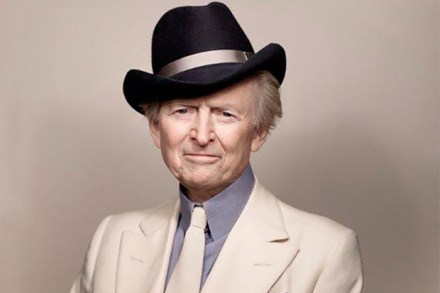
He might be 85 but Tom Wolfe is going strong with a new book and a dustjacket photo that still sees him working the suit and hat look. And although the new book may be small, it’s got big ambitions: first, to take down an establishment icon, and, second, to reveal the secret behind humanity’s progress. The establishment icon first. He is that infamous scoundrel, Charles Darwin — ‘Charlie’, as Wolfe often calls him, and not in a friendly way.
Gale-force lyricism

Centuries before their footballers learned giant-slaying ways, Icelanders knew how to startle the world with tall stories. In the moonscape that birthed Sagas and Eddas, little grew but epic tales. When this novel’s protagonist, the troubled poet-turned-publisher Ari, announces in an interview that he has given up authorship, his aunt Elin sends him a heartbroken letter. To see ‘one of our own’ write books, she writes, ‘made us feel almost as if everything had meaning’. Especially for a restless kid from the black lava fields of Keflavik, ‘this peculiar town situated behind the world’, where nothing happens and ‘it’s just work, just fish, the Yanks and the wind’.

Chinese whispers

Peter Ho Davies’s second novel, The Fortunes, is a beautifully crafted study, in four parts, of the history of the Chinese in America. Though it deals, of necessity, with racism in all its insidious forms, it does so with humanity, humour, self-deprecation and a hefty dose of irony. Each section — ‘Gold’, ‘Silver’, ‘Jade’ and ‘Pearl’ — covers a separate period in Chinese-American history. ‘Gold’ follows Ling, a half-white upwardly mobile immigrant, who arrives before the Civil War, starting as a laundryman and progressing to become the valet of one of the four big barons of the Central Pacific Railroad.

A view to a kill

A certain sort of male novelist will always aspire to be Joseph Conrad. The seedy cosmopolitanism of his fiction and its worldly, morally compromised protagonists — those European merchant seamen negotiating far-flung colonies — are an attractive counterpoint to the unmanly business of staying indoors to write a book. Toby Vieira’s entertaining, globe-hopping debut tale of diamond smugglers wears its debt to the great man on its sleeve notes. These tout Vieira’s ‘passion’ for Conrad’s work, while his title recalls Charles Marlow, the narrator of Heart of Darkness, sent down an unnamed African river to retrieve the rogue ivory trader Mr Kurtz.

To zyxst and back again

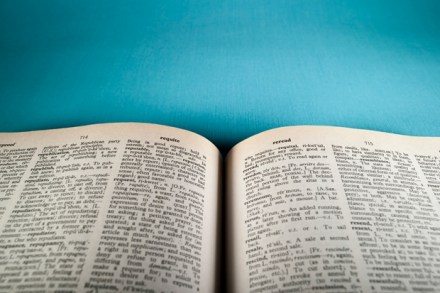
What the Great Eastern was to Brunel, the New English Dictionary was to James Murray (1837–1915) — an unequalled task that was his life, and eventually his death. What was later known as the Oxford English Dictionary should be a ‘sweep-net over the whole surface of English literature’, said Richard Chenevix Trench, one of its instigators in the 1850s, to be prepared ‘by reading all books’. This stupendous aim would have guaranteed its failure had not that hard piece of Roxburghshire granite James Murray set up in his iron Scriptorium at 78 Banbury Road, Oxford, working, working, working, 90 hours a week for years, sifting with a mind full of languages through millions of quotations written on slips of paper in pen and ink by volunteers.

The age of accusation

Mark Lawson’s latest novel, set in Britain in the recent past, presents us with a nation in the grip of ‘moral fever’. Here, the ‘giving offence to anyone at all over anything’ is considered ‘a capital crime’; the ‘post-Savile sexual witch hunt’ has trained people to ‘reinterpret heartbreak as violation’; and retribution comes not just in the form of established legal proceedings, but also of the ‘modern madness of amateur arraignment’. Lawson wants to show how pernicious this culture can be. To do so, he presents us with two characters, both academics, who are out of step with it.

Ways out of recovery

Perhaps because so many of them are former drunks and junkies, ‘addiction experts’ are touchy people. Often they don’t like each other — hardly surprising, since they are fighting each other for such a lucrative business. You can make bigger bucks out of selling ‘recovery’ than by peddling drugs. That’s not to imply moral equivalence, but the two do have one thing in common: plenty of repeat customers. In any media report of a celebrity’s battle with substance abuse, the words that you’re most likely to read before ‘rehab’ are ‘in and out of’. Ah, say the addiction gurus, but that’s because they’re suffering from a disease. This is one area in which the rivals speak with one voice.

The original and the copyist

Architecture is sometimes described as the second oldest profession, but often — in both theory and practice — it competes with the first. In his splendiferous office in Manhattan’s Seagram Building, Philip Johnson confirmed this when he told me, ‘Remember, son, I’m a whore.’ True to his vocation, this was a line he had often indiscriminately used. Architects need to have big personalities because their responsibilities are so huge. Frank Lloyd Wright said that surgeons can bury their mistakes, but architects have to live with them. And so do the rest of us. Few of us have ever met a reticent, self-deprecating architect.

Playing for high stakes

Now that even candidates for President of the United States can rise up from the undead dregs of reality television, it comes as no surprise to read that the National Youth Orchestra of Iraq owes its origins to a conclave of television execs. In 2008, Channel 4 and the independent production company Raw TV took upon themselves to campaign for a youth orchestra in Iraq, focusing their programme around the story of Zuhal Sultan, a 17-year-old Iraqi pianist. Later that same year, the Scottish conductor Paul MacAlindin was savouring a fish-and-chip supper in his favourite Edinburgh pub when his eye caught a headline in the Glasgow Herald about the same project — ‘Search for UK maestro to help create an orchestra in Iraq’ — and he thought: ‘I know how to do this.

Part sermon, part crossword puzzle

The Schooldays of Jesus is not, as it happens, about the schooldays of Jesus. It is the Man Booker-nominated sequel to The Childhood of Jesus (which, you guessed it, did not once refer to the childhood of Jesus either). J.M. Coetzee is now so much part of the literary pantheon, so liable to be rewarded by the critical classes and the academic industry surrounding him, that he no longer needs to worry about basics such as having a title that makes sense. He should still worry, one feels, about telling a story worth following. Like its predecessor, his new novel is set in a nameless Spanish-speaking province; a Kafkaesque, ‘featureless’ and ‘dreary’ place.

An age-old problem

With a title like A Beautiful Young Wife, this is of course about the decline of an older husband. Professor Edward Landauer, virologist in avian flu at Utrecht University, sees Ruth Walta’s bottom passing on a bicycle and knows she must be his. Full of autumnal entitlement, at 15 years her senior even Edward is surprised when this vegetarian PhD student of sociology loves him back. They marry. But with time, incompatible ideas — about vivisection, interior decoration and the meaning of human good — drive Edward to a public bathroom and into the arms of his colleague, Marjolein. As a regular at any coffee shop in a university town you may well overhear a story like it, invariably soliciting the same response: ‘How predictable.

Seeing red | 18 August 2016

Early on in his excellent and protean biography of a colour, Spike Bucklow quotes Goethe, writing in 1809: Every rope in the English Navy has a red thread running through it, which cannot be extracted without unravelling the whole, so that even the smallest length of rope can be recognised as belonging to the crown. Bucklow’s book follows a red thread through human history, whose twin strands are material extraction — the animal, vegetable and mineral lives of red — and the extraction of meanings from redness itself. All colour is cultural. We have our private definitions — the unshareable conviction as to what is and is not red — but it is societies that ‘make’ colours and their associations.

They’re all doomed

Night of Fire is Colin Thubron’s first novel for 14 years. For most of us he is better known as a travel writer, perhaps the finest of our time. But between journeys there have been seven previous novels, and this new one draws on his travelling. Ostensibly confined to a house converted into single apartments, and a night when it is consumed by a fire starting in its basement, it actually, in its chapters each devoted to one of its seven characters, wanders the world, while also moving to and fro in time. The seven characters are designated by role or occupation: landlord, priest, neurosurgeon, naturalist, photographer, schoolboy, traveller. We know from the first that they are all doomed: they will die this night.

Long lives the King

Elvis only ever appeared in one commercial in his life — for Southern Maid, his favourite jam doughnut shop. That commercial appeared on the Louisiana Hayride radio show in 1955. But since his death in 1977, Elvis has appeared in adverts all over the world: ‘Can’t Help Falling in Love’ has been borrowed to flog bathroom fragrances; a Greek dairy company used ‘Always on My Mind’; and Coca-Cola, BMW and Nike have all been promoted with ‘A Little Less Conversation’. Ted Harrison’s central thesis — that Elvis has been much more heavily and successfully commercialised in death than in life — is convincing. This is an odd, rambling, repetitive book, too clumsily written, even for Elvis maniacs like myself, to be worth buying.

The horrors of French colonialism

We can all share the anguish in the downfall of a simple soul — for movie-goers Brando’s despairing ‘I coulda’ been a contender!’ in On the Waterfront still resonates — but I have a problem with heroic thickos: Othello, so easily duped; purblind Lear… So I’m ambivalent about the leading character in the new novel by the French-Algerian writer Yasmina Khadra — his wife’s name, adopted by Mohammed Moulessehoul to evade the military censors when he was an officer in the Algerian army. The award-winning author of more than 20 novels, most notably The Swallows of Kabul, he now lives in France but retains the pseudonym.

Desperate liaison

Six years ago, the Canadian author Clancy Martin made a splash with his autobiographical novel How to Sell, based on the hard-drinking years he spent as a jewellery salesman before going to college and beginning the brilliant academic career he currently enjoys as a philosopher. Now he has come up with a weird, densely focused novella about an adulterous affair being pursued by an alcoholic female writer, who is the one doing the narrating. It’s beside the point to wonder if this too is autobiographical. In his acknowledgements, Martin thanks the people who ‘together convinced me to rewrite what began as a memoir into fiction’.

The axeman cometh | 11 August 2016

All organic beings descended from a single primordial blob, according to Darwin. Some of them developed sufficiently to leave the commodious depths and widths of the sea to scramble ashore. Was that wise? In this intricately detailed history, David Miles, a distinguished Oxford archaeologist, takes up the story of human evolution since our species and chimpanzees diverged from a common ancestor about seven million years ago. Between the origin of our life on Earth and the exponential population growth that causes long queues and traffic jams and threatens imminent apocalypse, there was a period when change amounted to beneficial progress.

Preaching in pictures

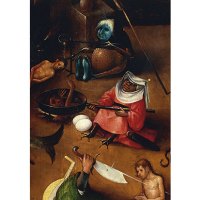
To call Nils Büttner a killjoy is perhaps a little unfair, but not very. The professor at Stuttgart’s State Academy of Art and Design has written a revisionist biography of Hieronymus Bosch: one which tells us that the Early Netherlandish painter wasn’t, as many over the centuries have suggested, the devil incarnate or Satan’s crazed representative on earth. Instead, his graphically disturbing visions of hell — infernal soups populated by hybrid monsters — were actually the product of a devoutly Catholic, medieval mind.