Culture

Culture

The good, the bad and the ugly in books, exhibitions, cinema, TV, dance, music, podcasts and theatre.

Emperor for three years: the doomed reign of Maximilian I of Mexico

More from Books

On 8 April 1864 an Austrian archduke with a penchant for daydreaming agreed to be emperor of Mexico. As Edward Shawcross describes in his majestic history The Last Emperor of Mexico, the process to install Maximilian of Habsburg began two and half years earlier. The plan was proposed by a determined clique of Mexican Conservatives and developed by Napoleon III, the scheming emperor of France. The Conservatives, who had just lost a four-year civil war, wanted to repeal the Liberal constitution that confiscated the assets and privileges of the Catholic church. They saw Maximilian as a symbol of the imperial family that had brought the faith to Mexico. Napoleon III, who wanted to expand French influence and trade, saw a potential puppet.

Beautiful enigma: Garbo’s mystery lives on

More from Books

‘We didn’t need dialogue’, glares Gloria Swanson’s crazed silent picture star midway through Billy Wilder’s Sunset Boulevard. ‘We had faces!’ She had a point. Even those of us who believe the movies weren’t really the movies until they had snappy dialogue (and no dialogue ever snapped the way Wilder’s did) have to concede that Swanson had a face that could stop a train. Still, she was an also-ran compared with Greta Garbo, who had a face that could start a religion. As her first champion, the Swedish filmmaker Mauritz Stiller, once said that Garbo’s mush would ‘make the gods happy’. Her embonpoint was rather less empyreal.

A cursed place: Small Things Like These, by Claire Keegan, reviewed

More from Books

Claire Keegan’s tiny, cataclysmic novel takes us into the heart of small-town Ireland a few decades ago, creating a world that feels in certain respects dead and buried but whose legacy the country is still processing. This is Ireland before the boom and bust of the Celtic Tiger; before the insidious, everyday power of the Catholic church began to be eroded by the exposure of multiple abuse scandals; before its population voted overwhelmingly in favour of marriage equality and access to abortion. Yet in other respects the life it describes is familiar, and the Wexford town of New Ross, dominated by the River Barrow and governed by the rhythms of work and family, is representative of life as it is still lived outside the country’s major population centres.

The first fairy stories were never intended for children

Lead book review

Stories are fundamental to humanity and no one can guess how far back they go — long before they were first recorded, no doubt. As Thomas Mann says at the beginning of Joseph and his Brothers: The further down into the lower world of the past we probe and press, the more do we find that the earliest foundations of humanity, its history and culture, reveal themselves unfathomable. The existence in different cultures and remote places of tales similar to Cinderella, for instance, suggests ur-stories, common ancestors millennia old. There is no accessing those original folk tales. All we can say is that they were already very deep-rooted when they first appeared in recorded culture. The routes by which they did so vary in nature and, apparently, in authority.

Welcome to Houellebecq’s France

On 8 January 2015, the day after eight Charlie Hebdo satirists and four others were murdered, a posthumous cartoon by one of the victims appeared in France's answer to Private Eye. It showed two decrepit-looking authors side by side at a book signing, with the caption ‘71 per cent of the French are pessimistic’. One was Michel Houellebecq, hawking his novel Soumission, which imagined a France that out of sheer malaise elects an Islamist president; the other was the then-journalist Éric Zemmour, with his own Le Suicide Français. 'Pessimistic, pessimistic... do we look pessimistic?' As an encapsulation of the mood of France, it was hard to beat.

What is it like to be worshipped as a god in one’s lifetime?

More from Books

In January 1780 the news reached London that Captain Cook had been killed and eaten in Hawaii. The story of his death was met with morbid fascination by the general public, inspiring paintings, poems and even a ballet. This ballet was so violent that one of the dancers accidentally stabbed another during the scene of the attack, yet it was also a fantastic success, touring the theatres of Europe and America. Soon aristocratic women were wearing dresses modelled on the natives who killed Cook, and interest in the explorer’s death continued into the 19th century, until one wit noted that every museum in the world contained a copy of the club that killed him. So, who was it that really deified Cook: the Hawaiians who murdered him or the Europeans who made a martyr of his memory?

Birds have helped mankind throughout history — but we have repaid them cruelly

More from Books

Unusually for a book about nature, the species in question, in this lucid story of the relationship between birds and humans, is ours. Why catch six million ibises, attractive water birds with curved beaks, plunge them into vats of liquid resin, wrap them in bandages and bury them in vast cemeteries in Middle Egypt in 650 BC? When There Were Birds explains that these ibises were offerings to Thoth, god of knowledge and wisdom. Throughout this story, faith, cash and custom drive humans to behave in astonishing ways towards birds. From the early 15th century we were moving canaries to the Swiss Alps and southern Germany, where breeders might raise 50,000 birds a year, which were then transported and sold across the world. In 1871 America alone bought 48,000 as pets.

Will the real Mel Brooks please stand up?

More from Books

‘I went into show business to make a noise, to pronounce myself,’ Mel Brooks told Kenneth Tynan in 1977, in a New Yorker profile entitled, with appalling relish, ‘Detours and Frolics of a Short Hebrew’. ‘I want to go on making the loudest noise to the most people.’ His memoir All About Me! may be his final act of this pronunciation. He is 95. His real name is Melvin Kaminsky but that wouldn’t fit on a drum — a drum is his natural instrument — and he shortened it to Brooks. He was the youngest of four boys of Max and Kate. His father died when he was two, and Mel created Maxes wherever he could — Max Bialystock in The Producers, a man too vivid to be forgotten; and a son with Anne Bancroft, Max Brooks.

The history of music – at breakneck speed

More from Books

From Ladybird’s The Story of Music (a dinky 50 pages, generously illustrated) to Richard Taruskin’s five-volume epic The Oxford History of Western Music, the history of classical music has been sliced and stretched in print to fit every possible length, format and agenda. Andrew Gant’s Five Straight Lines joins the cluster of works jostling and elbowing at the midpoint of these extremes. The Oxford-based academic (whose previous books on carols and hymns have introduced us to a genial, approachable narrator, with a welcome glint in his eye), shouts no provocative argument or USP from his cover, makes no novel claims for his survey. This is, quite simply, a narrative of music from the beginning to the now.

Restless visionary: Man Ray was always ahead of his time

More from Books

In the summer of 1940, after almost 20 years in Paris, Man Ray fled the Nazis for the country of his birth. Disliking New York, where he’d spent his youth, he made for the West Coast. He hoped to get as far as Tahiti or Hawaii. But his trip came to an end when, braced by the space, lifted by the lack of skyscrapers (‘made me feel taller’) and swept off his feet by a dancing girl (the latest in a long line of hoofers for whom he’d have the hots), he settled in Los Angeles. Though he would live there for more than decade, he never really liked the place. Nonetheless, he was far more productive in America than in Europe.

The crime which inspired Crime and Punishment

More from Books

‘Whether I am a trembling creature or whether I have the right…’ The much quoted words of Rodion Raskolnikov, the protagonist of Crime and Punishment, encapsulate the novel’s main question. Fyodor Dostoevsky first pitched the idea of ‘the psychological account of a crime’ to a publisher in 1865. Three decades earlier, a real-life murderer, Pierre François Lacenaire, waiting for his execution in a French prison, wrote: ‘Only I can decide whether I have done wrong or right to society.’ As Kevin Birmingham shows in his new book, this is but one detail of Lacenaire’s story mirrored in Dostoevsky’s masterpiece; moreover, Dostoevsky’s reflections on the case influenced the way he understood the nature of evil.

A reappraisal of James Courage

More from Books

James Courage is one of those fine writers who, though he enjoyed considerable success in his lifetime, has now more or less slipped from view. None of the eight novels he published between 1933 and 1961 is in print and most of them are impossible to find secondhand. The same goes for a collection of his short stories published in 1973. He is chiefly remembered for A Way of Love, a bold novel about a homosexual relationship that was published in 1959 and became a minor cause célèbre in New Zealand when it was banned there. Courage was born in New Zealand in 1903, but came to Oxford University in 1922.

Lydia Davis masters the art of translating without a dictionary

More from Books

‘Read slowly, word by word, if you wish to understand what I am saying.’ Despite appearing in Essays Two, the latest non-fiction collection from Lydia Davis, this exhortation is by the Norwegian author Dag Solstad; yet the approach is apt for Davis’s work. This is not because Davis, a feted translator and writer who won the Man Booker International Prize in 2013, is incomprehensible but because her work is often so short — a couple of lines or a couple of pages. It demands to be savoured slowly.

The horrors of 1922 included atrocities, assassinations and the rise of Mussolini

Lead book review

Sixty years ago the Daily Express ran a regular feature entitled ‘Just Fancy That!’ Each short segment highlighted some strange coincidence or weird incident that would hook readers’ interests. Human oddities, unlucky mischances, freaks of nature and improbable statistics were dealt out every day. It made for easy reading, but sometimes gave pause for thought. Nick Rennison has adapted the ‘Just Fancy That!’ formula to make a handy book for the bedside table in the visitors’ bedroom. In crisp and evocative snatches, he gives monthly summaries of global events, domestic episodes, newspaper sensations, sporting triumphs and cultural acclaim during 1922.

What the Russians thought of James Bond in the 1960s

More from Books

Last year I wrote a piece about James Bond for the ‘Freelance’ column of the Times Literary Supplement. All true Bond lovers — of the novels, I mean — know that he lived in a ‘comfortable flat in a plane-tree’d square off the King’s Road’, as Ian Fleming described it in Moonraker. Further internal evidence in Thunderball indubitably established that it was Wellington Square — but there was considerable mystery and doubt about exactly which house contained the Bond apartment. In my article I claimed to have identified it as No. 25, based on a certain amount of sleuthing and, I thought, convincing circumstantial evidence. No.

Were the Sixties really so liberated?

More from Books

Lolita, the Lady Chatterley trial, the pill, Christine Keeler, ‘(I Can’t Get No) Satisfaction’, love-ins, Oh! Calcutta!, the Oz trial — sex, even more than usual, was on people’s minds in the 1960s, that semi-mythical decade which, to stretch a point, lasted from the late 1950s to the early 1970s. That, anyway, is the plausible contention of Peter Doggett, whose Growing Up is a refreshingly undogmatic, well-researched and highly readable survey of some of the emblematic episodes and controversies surrounding the subject during these years. More detailed sociology would have been helpful — how, if at all, did everyday/everynight sexual practices and attitudes change in Barnsley, in Dunfermline, in Ashby-de-la-Zouch?

All successful spies need to be good actors

More from Books

On 2 October last year, when he became chief of the UK Secret Intelligence Service (MI6, if you prefer), Richard Moore tweeted (tweeted!): ‘#Bond or #Smiley need not apply. They’re (splendid) fiction but actually we’re #secretlyjustlikeyou.’ The gesture’s novelty disguised, at the time, its appalling real-world implications. Bond was, after all, competent and Smiley had integrity. Stars and Spies, by the veteran intelligence historian Christopher Andrew and the theatre director and circus producer Julius Green, is a thoroughly entertaining read, but not at all a reassuring one.

Dancing on Terence Conran’s grave

More from Books

‘Who,’ asks Stephen Bayley, in one of the ‘S.B’ chapters of this irresistibly spiky co-written book, ‘could countenance working for a man like Terence, a man of such fluid principles, of such day-glo opportunism, of such sun-dried narcissism, guiltless hypo-crisy and Hallelujah Chorus egomania?’ Well, both S.B. and R.M. (the ad man Roger Mavity) did work for Terence Conran, in exalted positions. Both fell out with him, and both experienced at first hand all those qualities and more. In their separate chapters they take turns to express the essence of his genius and to get their own back for his disdainful treatment of them. One of his worst traits was his refusal to acknowledge the vital contributions of his seconds-in-command.

How to tell your Roman emperors apart

More from Books

Rising professors do well to be controversial if they wish to be invited to contribute to mainstream media. But the elder professor, lauded, loved and telly-tastic, has the privilege of swerving controversy without losing the limelight. And so Mary Beard gives us this rich disquisition on the Caesars’ visual representation (and misrepresentation), from swapped plinths to forged heads. Handsomely illustrated and brightly ringing with Beard’s enjoyment and scholarship, the book doesn’t inflame debate but brings it down a few degrees. While her publicist might have preferred more engagement with today’s ‘sculpture wars’ (touted on the dust jacket but not mentioned within), Beard provides no ammo for either side, but takes a wry long view.

A keepsake – and to-do list – of Europe’s greatest cathedrals

More from Books

In his new book on Europe’s cathedrals, Simon Jenkins begins with the claim that the greatest among them are our most important European works of art. Greater than the paintings of El Greco or Berthe Morisot? More momentous than the buildings of Mies van der Rohe or Norman Foster? More important than the organ music of J.S. Bach or the Duruflé Requiem? Still, I see his point.

Why America’s attitude to mental illness is dangerously deluded

More from Books

A friend who works in social care speaks to me earnestly about a troubled young colleague: ‘Of course, she’s got a borderline personality disorder...’ I check her there: ‘What do you mean by that?’ She thinks for a moment and continues: ‘Well, she’s very emotional, she can’t maintain relationships, and she’s very defiant…’ I wait for a moment to see if there’s anything else before I say my bit: ‘Perhaps she just has a bad character — because fundamentally that’s all a personality disorder is: epithetic psychiatry. There’s no defined organic basis for these so-called disorders, no psycho-dynamic aetiology either, no progression — and, of course, no cure.

The real surprise contained in a Kinder Surprise Egg

More from Books

The Rosetta Stone has an awful lot in common with a Kinder Surprise Egg. Hear me out. The actual text of the Rosetta Stone is mainly about some changes to tax rules, and is about as interesting as such things usually are. The one important fact about it, for us, is that it is written in three languages and three alphabets: Greek, Demotic and Hieroglyphics: the Language of the Ionians, the Language of the Documents, and the Language of the Gods. Thus hieroglyphics were decoded. A Kinder Surprise Egg does an awful lot more than this. Tucked inside with the cheap plastic toy is a tiny sheet of paper that says: ‘WARNING, read and keep: Toy not suitable for children under three years. Small parts might be swallowed or inhaled.

Jan Morris’s last book is a vade mecum to treasure

More from Books

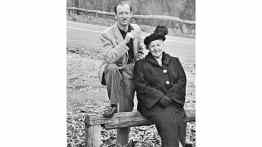
Jan Morris, in all her incarnations, was always able to evoke a place and a moment like no other. As James Morris, the only journalist to cover the first successful ascent of Everest in 1953, he described Edmund Hillary returning from the summit as huge and cheerful, his movement not so much graceful as unshakably assured, his energy almost demonic… It was a moment so thrilling, so vibrant, that hot tears sprang to the eyes of most of us. Morris, who died last year, was married to Elizabeth Tuckniss for 71 years and had five children, one of whom died in infancy. She transitioned to live as a woman in 1964, one of the first high-profile people to do so. Her subsequent memoir, Conundrum, was a bestseller.

Roberto Calasso’s retelling of the Hebrew Bible is both exasperating and beguiling

Lead book review

The Italian writer Roberto Calasso, who died in July at the age of 80, was an anomalous and fascinating figure on the international literary scene. In his early twenties he began working for the prestigious publishers Adelfi Edizioni and stayed with them his whole life, eventually becoming editorial director and, when the firm was threatened with a takeover, purchasing it. In his thirties he began writing a series of idiosyncratic books. The second of these, The Marriage of Cadmus and Harmony, established his reputation and was translated into many languages. Something should be said about it because the project it enacts is related to this last of his books.

A scrapbook of sketches: James Ivory’s memoir is slipshod and inconsequential

More from Books

James Ivory and Ismail Merchant formed the most successful cinematic partnership since Michael Powell and Eric Pressburger. Between the founding of Merchant Ivory in 1961 and Merchant’s death 44 years later, the company produced 42 films, more than half of which were directed by Ivory himself. Although its range was wider than is often allowed, the company’s fame rests on its adaptation of late 19th- and early 20th-century novels, among them Henry James’s The Europeans, The Bostonians and The Golden Bowl, E.M. Forster’s Howards End, A Room with a View and Maurice, and Jean Rhys’s Quartet.

Culture clash: Things We Don’t Tell the People We Love, by Huma Qureshi, reviewed

More from Books

Apart from what the title tells us, these stories are about a fundamental difference in cultures. Huma Qureshi writes like a psychotherapist, considering, analysing, explaining, seeking out conflicts, evasions, and discomforts. The clash is between London and Lahore, Britain and Pakistan. The girls who appear in these tales are westernised, but still hostages to their heritage. The narrator of ‘Superstition’ escapes the shalwar kameez that she has to wear at family dinners on Saturday evenings in suburban London. She is smitten with a boy at a neighbour’s house, and then endures a conspiracy of male, religious dominance: ‘All this happened over an unfortunate teenage kiss.

Who’s to blame if Britney Spears has been ‘devoured’ by celebrity?

More from Books

All the questions around Britney Spears can be condensed into this one: who should we blame? For a long time, there was a comfortable narrative that the pop star’s decade-long descent — from virginal queen of teen in 1998, to junk-food scarfing, twice-divorced single mother, to broken woman being transported to hospital in restraints — was wholly her own doing. Britney was a train wreck, white trash, a hot mess and, all in all, no better than she ought to be. The fact that her career recovered dramatically after she was placed under a conservatorship arrangement in 2008 (giving her father ultimate control over her life and finances) seemed to prove that the under-lying problem had been her freedom.