Sara Wheeler

Sara Wheeler is the author of Terra Incognita.

The history of Moscow was one of extreme violence from the start

From our UK edition

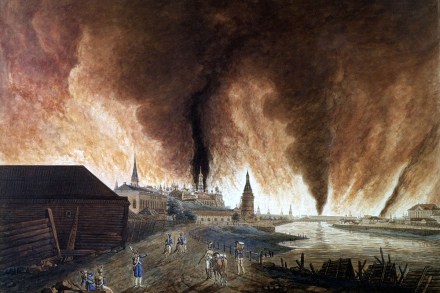
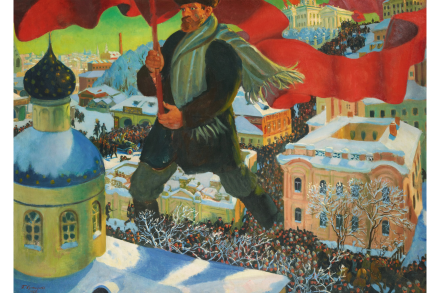
‘Moscow is hard to love,’ Simon Morrison writes at the beginning of this engaging book, ‘but I love it.’ He deliberately sets out unconstrained by academic pieties, despite holding the post of Professor of Music and Slavic Languages and Literatures at Princeton University. He says he wrote A Kingdom and a Village ‘out of nostalgia for pre-oligarch decrepitude, when the world looked at Moscow with pity’. The Orthodox Church and the security services have been conjoined from the 16th century to the present The book is tripartite. The first part begins in 1147, when a prince named Yuri built a fort on a hill above a river. (When the authorities unveiled a monument to Yuri in 1954, Morrison reveals, a Muscovite yelled: ‘Doesn’t look like him.

The young Anton Chekhov searches for his voice

From our UK edition

This book collects 58 pieces of fiction that Anton Chekhov published between the ages of 20 and 22. Many appear in English for the first time. In her introduction, Rosamund Bartlett refers to the material with disarming candour as a ‘wholly unremarkable debut’. Is there ever any point in publishing juvenilia? In his first years as a medical student Anton Pavlovich dashed off these pieces for a few kopecks a line (his father, born a serf, was a bankrupt shopkeeper). Ranging in length from three paragraphs to 76 pages, they appeared under pseudonyms in lowbrow comic magazines that included another Spectator (founded in Moscow in 1881).

Faith – and why mountains move us

From our UK edition

Sylvain Tesson’s White unfolds the story of a gruelling ski journey across the Alps during which the author aims to fulfil ‘a long-held dream of transforming travel into prayer’. Born in Paris in 1973, Tesson is a well-known adventure writer whose previous books include The Consolations of the Forest: Alone in a Cabin on the Siberian Taiga, which won awards on both sides of the Channel and was made into a film. As a public figure associated with the far right, Tesson remains divisive in his homeland. His political views do not seem to have dented book sales or literary coverage: one wonders if the same would be true if a travel writer of similar persuasion popped up here.

Who will care for the carers themselves?

From our UK edition

When her brother Lionel was born in 1949, ‘the concept of neurodiversity didn’t exist’, writes Caroline Elton. The subtitle of her profoundly moving memoir, ‘A Portrait of My Autistic Brother’, is misleading. The book is really about the experience of being the sibling of a person who is not like you. Lionel was nine years Elton’s senior, so she draws on their mother’s testimony to relate his infancy and childhood, turning to her own recollections for the later years. He learnt to read before he could speak, played the piano faultlessly by ear (his mother taught him), and could tell you what day of the week a date would fall on in any year.

The adventures of the indomitable Dorothy Mills

From our UK edition

When Dorothy Mills disappeared to Haiti to research a travel book, the British press led with the headline: EARL’S DAUGHTER GOES TO SEE BABIES EATEN IN BUSH. Mills was never out of the news in the interwar years. She wrote nine novels as well as six travel books, all of which sold briskly, and in 1928 she was the only woman in the starry line-up at London’s Explorer’s Week (Ernest Shackleton’s skipper, Frank Worsley, spoke alongside her). She was born Dorothy Walpole, in 1889.Her father, Robert, became the fifth Earl of Orford when she was five. Her ancestors included Britain’s first prime minister, another Robert. The young Dolly travelled widely with her parents; her mother was one of the American heiresses who enriched the aristocracy in the 1890s.

Paul Wood, Sean Thomas, Imogen Yates, Books of the Year II, and Alan Steadman

From our UK edition

30 min listen

On this week’s Spectator Out Loud: Paul Wood analyses what a Trump victory could mean for the Middle East (1:16); Sean Thomas gets a glimpse of a childless future while travelling in South Korea (8:39); in search of herself, Imogen Yates takes part in ‘ecstatic dance’ (15:11); a second selection of our books of the year from Peter Parker, Daniel Swift, Andrea Wulf, Claire Lowdon, and Sara Wheeler (20:30); and notes on the speaking clock from the voice himself, Alan Steadman (25:26).  Produced and presented by Patrick Gibbons.

Joan Collins, Owen Matthews, Sara Wheeler, Igor Toronyi-Lalic and Tanya Gold

From our UK edition

30 min listen

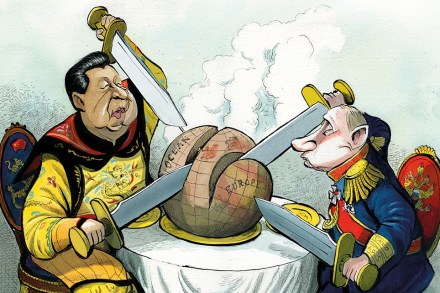
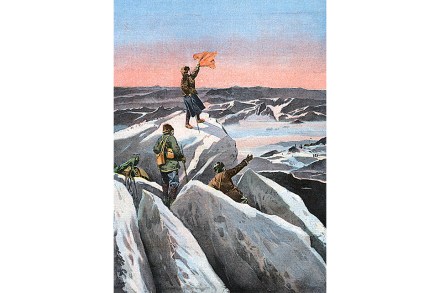
On this week’s Spectator Out Loud: Joan Collins reads an extract from her diary (1:15); Owen Matthews argues that Russia and China’s relationship is just a marriage of convenience (3:19); reviewing The White Ladder: Triumph and Tragedy at the Dawn of Mountaineering by Daniel Light, Sara Wheeler examines the epic history of the sport (13:52); Igor Toronyi-Lalic looks at the life, cinema, and many drinks, of Marguerite Duras (21:35); and Tanya Gold provides her notes on tasting menus (26:07).  Presented and produced by Patrick Gibbons.

How Putin manipulated history to help Russians feel good again

From our UK edition

Every country has an origin story but none has ‘changed it so often’ as Russia, according to Orlando Figes. The subject is inseparable from myth. In this impressive and deeply immersive book, the author sets out to reveal Russia’s history, its people’s perception of their past and the manifold ways in which those in power manipulate both events and legend to shape the present. It is a saga of multi-millennial identity politics. A bestselling historian with a storied background himself, Figes arranges his material chronologically over ten chapters, beginning with the medieval chronicles of Kievan Rus. Those sources launched myths that became fundamental to the Russian understanding of nationhood.

The quest for the world’s highest peaks

From our UK edition

What makes men and women climb high? Most commonly, according to Daniel Light, ‘the prosecution of science or the advancement of empire’. It might also be general flag-waving or just personal fulfilment, as in the case of ‘private traveller’ Godfrey Vigne, who opened his English eyes to the wonder of the Karakoram in the baleful 1930s. London-based Light – ‘a keen climber, not a serious mountaineer’ – has produced a colourful survey of mostly 19th-century mountaineering across the globe, starting with the geographer and natural philosopher Alexander von Humboldt and his five-year expedition to South America.

‘Now I have been made whole’: Lucy Sante’s experience of transition

From our UK edition

Lucy Sante concludes her thoughtful and occasionally poetic memoir with the words: ‘Now I have been made whole.’ Before transitioning at the age of 66 she had lived her life as a deeply divided man. This is an affecting book that could help move the trans debate forward from its currently undignified state of abuse and polarity. Sante interweaves the story of the first 18 months of her transition with that of the first three decades of her biography. Her parents emigrated to New Jersey from Belgium, initially when she was four (there were subsequent toings and froings). She writes a lot about her identity as a working-class Walloon, an ‘only child of isolated immigrants’, and notably about her relationship with her pious, difficult mother.

Pat Yale follows her hero across Turkey

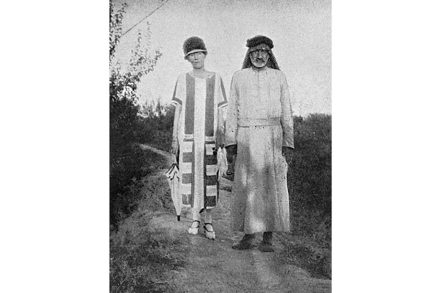
Green-eyed Gertrude Bell belongs in Charles Doughty’s Travels in Arabia Deserta, that slab of velvety antique that enthralled the English (they were not yet British) in the love-affair phase of their relationship with the Arabs. County Durham-born to a wealthy industrialist father, Bell (1868-1926) was a key player when the Powers tried ineptly to mould the Middle East, as the Ottoman Empire crumbled. She is well covered in the literature and appears in a large hat alongside Churchill in conference photographs. But as Pat Yale announces in this new book: “Her time in Turkey has been largely overlooked.” Bell traveled extensively in that country before the first world war (starting in 1899) and in its aftermath.

Yale

‘I glimpse her ahead of me’ – a solo female traveller follows her hero across Turkey

From our UK edition

Green-eyed Gertrude Bell belongs in Charles Doughty’s Travels in Arabia Deserta, that slab of velvety antique that enthralled the English (they were not yet British) in the love-affair phase of their relationship with the Arabs. County Durham-born to a wealthy industrialist father, Bell (1868-1926) was a key player when the Powers tried ineptly to mould the Middle East, as the Ottoman Empire crumbled. She is well covered in the literature and appears in a large hat alongside Churchill in conference photographs. But as Pat Yale announces in this new book: ‘Her time in Turkey has been largely overlooked.’ Bell travelled extensively in that country before the first world war (starting in 1899) and in its aftermath.

Jonathan Raban’s last hurrah

From our UK edition

Jonathan Raban, who died earlier this year, left this memoir almost complete. It tells two stories, artfully braided. One concerns the first three years of the author’s parents’ marriage, when Peter Raban was abroad serving in the second world war. He rose to become a major in the Royal Artillery, fighting in France and Belgium, evacuated from Dunkirk and proceeding to North Africa, Italy and Palestine. The second is about the author’s stroke in 2011, aged 69, his rehabilitation in a neurological ward where, on his first morning, a nurse asked ‘Do you want to go potty now?’, and the start of a new life as a hemiplegic.

Celebrity photographer and conservationist: Peter Beard’s life of extremes

From our UK edition

In 2005 the photographer Peter Beard invited me to his Thunderbolt Ranch in Montauk on the tip of Long Island. I was writing a biography of Denys Finch Hatton, Karen Blixen’s lover, and Beard had known Blixen at the end of her life. When Graham Boynton began this biography he telephoned me, and I told him about that weekend I spent alone with Beard. At the end of my story, there was silence. Then Boynton said: ‘You’re the only woman I’ve ever heard of he didn’t make a pass at.’ Born in New York in 1938, Beard was a trust-fund Wasp, Yale-educated. Having started as a fashion photographer, he became famous for collages which sold for hundreds of thousands of dollars at Christie’s in London and New York.

Our provision for adults with learning disabilities is seriously inadequate

From our UK edition

This book reveals one man’s determination to enable his brother to live his best life. It is also a fable for our time. It hints at how we all might live if we turned the lens on the world. ‘Does Reuben have a learning disability’ asks Manni Coe, ‘or do we have an understanding disability?’ Coe’s younger brother Reuben, now 39, has Down’s syndrome. In brother.do.you.love.me Coe senior describes their loving upbringing in Yorkshire and Berkshire as other people stared, and Reuben’s adventures living a supported, partially independent adult life.

How inoculation against smallpox became all the rage in Russia

From our UK edition

The concept of vaccination evolved from 18th-century inoculation practices and many people contributed to the accretion of knowledge. This book focuses on two individuals: the Quaker doctor Thomas Dimsdale, who, from his small Hertfordshire surgery, pioneered a simple smallpox immunisation; and Catherine the Great, who summoned him all the way to St Petersburg to inoculate her and the teenage Grand Duke Paul. Despite success all round, though, it turns out that anti-vaxxers are nothing new. After revealing the destructive force of smallpox – in one period of the 18th century, 400,000 perished annually in Europe – Lucy Ward, a journalist and former lobby correspondent, recapitulates the history of inoculation against the disease.

The unbearable brutality of the Bolsheviks

From our UK edition

For far too long,’ Sir Antony Beevor writes, ‘we have made the mistake of talking about wars as a single entity.’ In Russia: Revolution and Civil War he sets the record straight for the bitter years between 1917 and 1921, revealing the myriad ways in which individual actions constellated and 12 million people perished. This is not a story about winners and losers. As the war correspondent Martha Gellhorn once wrote about every conflict everywhere: ‘There is neither victory nor defeat; there is only catastrophe.’ It seems wrong to categorise this book as military history. It is like reading a film. Typhus-bearing lice in hospitals at the front are so abundant that they crunch under nurses’ feet ‘like sugar’.

A meditation on exile and the meaning of home

From our UK edition

What does home mean? Where your dead are buried, as Zulus believe? Or where you left your heart, as a migrant’s saying goes? In these pages William Atkins melds history, biography and travel into a meditation on exile and the meaning of home. It is a volume for our times, as the author seeks to reveal ‘something about the nature of displacement itself’. Part One introduces the three 19th-century political exiles who form the spine of the book. Louise Michel (1830-1905), the illegitimate daughter of a maid in Haute-Marne, became an anarchist and Communard, who murdered policemen with her Remington carbine. Dinuzulu kaCetshwayo (1868-1913), the young king of the Zulu nation, took up arms to resist southern Africa’s colonial overlords.

The heartbreak left in the wake of the Terra Nova

From our UK edition

The story of the five women waiting at home for Captain Scott and his doomed polar party is naturally occluded in tragedy. In this engaging book Katherine MacInnes for the first time presents them – two mothers at the outset, and three wives – as distinct individuals, separated one from the other by class, education, faith and temperament. Kathleen Scott, the leader’s wife, was a gifted, confident sculptor with a lively social set and a house on Buckingham Palace Road. Caroline Oates, the widowed mother of the saturnine, Eton-educated cavalry officer Laurie (‘I dislike Scott intensely’), was the wealthy owner of Gestingthorpe Hall in Essex.

The unfamiliar Orwell: the writer as passionate gardener

From our UK edition

This is a book about George Orwell’s recognition that desire and joy can be forces of opposition to the authoritarian state and its intrusions. To explore the theme, Rebecca Solnit has produced a sequence of loosely linked essays around the roses and fruit bushes the author of Animal Farm planted in 1936 in the garden of his modest Hertfordshire house. A Californian with more than 20 books behind her, Solnit opens this latest with a pilgrimage to Wallington, where Orwell’s Albertine roses have endured. The blooms instigate a reconsideration of the man ‘most famous for his prescient scrutiny of totalitarianism’, which in turn invites the author ‘to dig deeper’ and question ‘who he was and who we were and where pleasure and beauty...