Susie Mesure

No one is ordinary: The Things We Never Say, by Elizabeth Strout, reviewed

From our UK edition

It is both a comfort and a discomfort to yield to a new novel from Elizabeth Strout, who writes with such perspicacity that any time spent in her world unsettles as much as it consoles. So it proves with The Things We Never Say, her 11th book and the first since My Name is Lucy Barton (2016) to feature a new character. He is Artie Dam, a misunderstood 57-year-old history teacher from a Massachusetts coastal town. He is married, popular – ‘“Damn-dam, the greatest man,” his students would sometimes say to him’ – and likes nothing better than to take his sailing boat out in Massachusetts Bay. But it soon transpires that the joviality so treasured by his friends is a sham.

No Hungarian rhapsody: Lázár, by Nelio Biedermann, reviewed

From our UK edition

Few first novels, let alone literary debuts in translation from German, arrive with quite so many plaudits – or better covers for those who like horses – as the 23-year-old Nelio Biedermann’s Lázár, which sold more than 200,000 copies on its release in Germany and Switzerland last year. ‘A truly great writer steps onto the stage,’ trumpets Daniel Kehlmann, who is no stranger to great writing: his latest novel, The Director, is on the International Booker Prize longlist. To Patti Smith, Biedermann is ‘gifted’. He is also a scion of the eponymous Lázárs, an aristocratic Hungarian family, making this first foray into fiction a personal project.

The world destroyed by madness: Howl, by Howard Jacobson, reviewed

From our UK edition

Rarely has such a short title worked harder than Howl, which Howard Jacobson takes from Allen Ginsberg’s incantatory 1955 poem. ‘I saw the best minds of my generation destroyed by madness,’ Ginsberg wrote, a line that both prefaces Jacobson’s novel and sums up the author’s own angry anguish at the current madness in the corner of the Middle East that both Israelis and Palestinians call home. Make no mistake: Ginsberg’s poem puts the howl into Howard, who has written a characteristically crisp and deeply personal response to Hamas’s 7 October 2023 attack – the massacre in the Negev Desert.

The mystery of the missing man: Green Ink, by Stephen May, reviewed

From our UK edition

Stephen May used to write contemporary novels about men who ‘live outside big cities, lack self-confidence and rarely feature in contemporary fiction’, as he once put it, adding: ‘Even Nick Hornby’s characters are more sorted than mine.’ But a chance discovery of a Wikipedia page about the three weeks that a young Stalin spent in Edwardian London sent May’s imagination hurtling back through the decades. The result was Sell Us the Rope (2022), his sixth novel, which imagined what Koba, the Georgian then better known as Joseph Dzhugashvili, got up to in 1907 while attending the Fifth Congress of the Russian Social Democratic Labour party. May mixed the real with the fictional to great acclaim.

Trouble in Tbilisi: The Lack of Light, by Nino Haratischwili, reviewed

From our UK edition

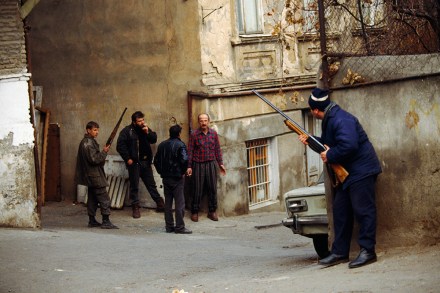
For a newly independent Georgia, the 1990s were a dark time literally and figuratively, as civil war raged, criminality flourished and the power stayed off. The Lack of Light, Nino Haratischwili’s fourth novel to be translated into English, turns that darkness into a gripping story about the power and pitfalls of female friendship that seeks to unpick the horrors of that decade. The narrative opens, briefly, in Tbilisi in 1987. The four protagonists – Keto, Dina, Nene and Ira – are on a schoolgirl mission to hang out in the Botanical Garden after hours. The escapade introduces the girls, who are all neatly – too neatly – ascribed various characteristics.

An ill wind: Helm, by Sarah Hall, reviewed

From our UK edition

To read something by the Cumbria-born Sarah Hall is to enter a dizzying, earthy and often dystopian world where the elements rule and nature is blood red. Her nine previous short story collections and novels straddle life’s peripheries, often scratching at the limits of what it means to be human. ‘Mrs Fox’, one of her best known stories – and one of two for which she has won the BBC Short Story Prize – is a visceral tale about a woman who turns into a fox. In her 2021 novel Burntcoat, a virulent virus made Covid-19 look almost benign. Helm is a different beast again, one she has been working on for almost 20 years. Its title and main character is Britain’s only named wind, which hits the southwest slopes of Cross Fell, in Cumbria’s Eden Valley where Hall grew up.

A precocious protagonist: Vera, or Faith, by Gary Shteyngart, reviewed

From our UK edition

It’s impossible not to love Vera Bradford-Shmulkin, the whip-smart Jewish-Korean- American child narrator of Vera, or Faith, Gary Shteyngart’s sixth novel, which is a masterclass in the author’s sardonicism, set in a frighteningly realistic near future. School is awful and Vera’s world is on the brink of imploding because ‘Daddy and Anne Mom’, her stepmother, aren’t getting on, what with Igor’s evening ‘mar-tiny’ habit and crumpling status as a ‘leftist intellectual’. The wider American world is in similar turmoil, with an escalating campaign for the Five-Three amendment. This calls for ‘exceptional Americans’ who can trace their roots to before the Revolutionary War to get added voting weight, heightening tensions.

An unlikely alliance: Drayton and Mackenzie, by Alexander Starritt, reviewed

From our UK edition

Alexander Starritt has form with satire. His 2017 debut The Beast skewered the modern tabloid press, drawing comparisons with Evelyn Waugh’s Scoop. For his third novel, Drayton and Mackenzie, he is back at it, mercilessly mocking everything from Oxbridge and management consultants to tech bros and new parents in a story that hinges on whether two unlikely friends can make a success of their tidal energy start-up. It’s more fun that it sounds. The narrative opens in the early 2000s with James Drayton – someone who gets his kicks by finishing his maths A-level exam in 20 minutes and who finds undergraduate life disappointingly basic. ‘He supposed he’d been naive to think of university as concerned with intellect...

Sean Thomas, John Power, Susie Mesure, Olivia Potts and Rory Sutherland

From our UK edition

22 min listen

On this week’s Spectator Out Loud: Sean Thomas reflects on the era of lads mags (1:07); John Power reveals those unfairly gaming the social housing system (6:15); Susie Moss reviews Ripeness by Sarah Moss (11:31); Olivia Potts explains the importance of sausage rolls (14:21); and, Rory Sutherland speaks in defence of the Trump playbook (18:09).  Produced and presented by Patrick Gibbons.

The past is another country: Ripeness, by Sarah Moss, reviewed

From our UK edition

Sarah Moss is a prolific and vital novelist whose books encompass an array of subjects from Victorian social reform and 19th-century Japan to broken Brexit Britain and eating disorders. She combines teaching at University College, Dublin with writing in real time: The Fell, set during the second lockdown, came out in the summer of 2021, while My Good Bright Wolf, an experimental memoir about her anorexic breakdown in late 2020, was published last year. A forthcoming Channel 4 adaptation of Summerwater, which explored national identity and isolation against the backdrop of a soggy Scottish holiday park, may catapult her into the sort of gold-foil territory enjoyed by Maggie O’Farrell or Ali Smith. If not, then perhaps Ripeness, her ninth novel, will.

Repetitive strain: On the Calculation of Volume, Books I and II, by Solvej Balle, reviewed

From our UK edition

I have counted the days. It is my 122nd eighteenth of November. I have come a long way from the seventeenth and I do not know whether I will ever see the nineteenth. But the eighteenth arrives again and again. This is life for Tara Selter, the protagonist of On the Calculation of Volume, a mesmerising projected septology by the Danish writer Solvej Balle that will make anyone who has ever longed to pause time rethink their wish list. Book I, published in Denmark in 2020 and on this year’s International Booker Prize longlist, opens on Day 121. Tara, an antiquarian bookseller, is hiding from her husband Thomas in the spare room of their cottage in Clairon-sous-Bois, a fictional town in northern France.

Amid the alien corn: Beautyland, by Marie-Helene Bertino

From our UK edition

‘I am an Adina,’ the four-year-old protagonist of Marie-Helene Bertino’s Beautyland writes to her extraterrestrial superiors on Planet Cricket Rice, which is light years away from Earth. ‘Yesterday I saw bunnies on the grass,’ she adds, using the fax machine her mother retrieved from their neighbour’s trash. ‘DESCRIBE BUNNIES,’ they respond, sparking a dialogue that continues well into her adulthood. Adina’s premature birth in September 1977 coincided with the departure of the Voyager 1 probe, which was launched with a phonograph record of sounds intended to explain human life to intelligent extra-terrestrials. The timing is significant because Adina was sent to Earth from Planet Cricket Rice to report on human life.

The perils of poaching: Beartooth, by Callan Wink, reviewed

From our UK edition

Beartooth, the second novel by the Montana-based writer Callan Wink, opens with two brothers elbow-deep in the viscera of the third black bear they have just shot out of season. Hazan’s hands are ‘moving around the hot insides of the animal as if he were rummaging through a junk drawer’. He wants the gallbladder, which will fetch around $1,500 – far more than the brothers get for chopping firewood. The skull, claws and skin will swell their illegal bounty by another $500. Thad and Hazan, aged 27 and 26 respectively, are in serious debt after their father’s recent death, and their roof is leaking. Logging in the Montana backcountry is hard work and poaching pays much better, even if their father would have disapproved.

The hunt for the next Messi: Godwin, by Joseph O’Neill, reviewed

From our UK edition

Those who remember Joseph O’Neill’s brilliant novel Netherland, which featured a multicultural cricket club and was set in post 9/11 Manhattan, will assume they know what they’re getting with Godwin, which purports to be about the hunt for the next Messi. A video file of an African teenager with legendary ball skills is circulating far from his homeland, wherever that may be. All that Mark Wolfe, ‘a blond, rangy man in his late thirties’ who works for a technical writing co-operative, needs to do is to help his half-brother, Geoff, a hapless young football agent, track down ‘Godwin’ – if indeed that is the boy’s real name.

A sea of troubles: The Coast Road, by Alan Murrin, reviewed

From our UK edition

Contemporary Irish writers have a knack of making their recent past feel very foreign. Clare Keegan’s Small Things Like These is set in 1985, but the horrors she reveals about one of Ireland’s Magdalene laundries seem more like ancient history. Alan Murrin pulls off something similar in The Coast Road, where in late 1994 divorce is still illegal in Ireland, unlike the rest of Europe. Izzy Keaveney, a housewife with two teenage children, ‘has the depression’ and has dragged herself to Sunday morning mass despite a hangover. She spent the previous evening at a dinner-dance, listening to her politician husband James give a talk about the importance of business in the local community. ‘Are you going to spoil another night?

The end of days: It Lasts Forever And Then It’s Over, by Anne de Marcken, reviewed

From our UK edition

How do you picture the end of days? ‘When I was alive, I imagined something redemptive about the end of the world,’ muses the unnamed narrator in It Lasts Forever And Then It’s Over. ‘I thought it would be a kind of purification. Or at least a simplification. Rectification through reduction.’ But no: ‘The end of the world looks exactly the way you remember. Don’t try to picture the apocalypse. Everything is the same,’ she continues from her vantage point in an afterlife, brought into vivid existence by Anne de Marcken. It’s telling that the author’s biography states that she ‘lives in the United States on unceded land of the Coast Salish people’.

Mystery in everyday objects

From our UK edition

‘The surest and quickest way for us to arouse the sense of wonder is to stare unafraid at a single object.’ Cesare Pavese wrote those words in Dialogues with Leucò, one of two quotations that preface Lara Pawson’s deceptively slim third book, Spent Light. When her dog starts killing squirrels, Pawson cooks them, acquiringa Whitby Wild Cat skinning knife Pawson takes the Italian writer at his word, turning to a toaster for inspiration. The electrical appliance, which appears two pages in, is a gift from a neighbour, Reg, after his wife dies. Pawson uses it to launch a deeply empathetic piece of writing exploring the brutality of the world in which we live. ‘What would have had to happen to me to make me be so cruel?

Prejudice in Pennsylvania: The Heaven & Earth Grocery Store, by James McBride, reviewed

From our UK edition

If chicken soup is balm for the soul, then James McBride’s eighth book, set in 1930s Chicken Hill, a neighbourhood in a small town in Pennsylvania that is home to Jewish, black and other immigrant people, is its literary equivalent. There is something nourishing about The Heaven & Earth Grocery Store, a warm story about the power of community in the face of prejudice that both salutes the American dream while exposing it as a sham. Like much of McBride’s previous work, which includes four other novels, a biography of James Brown and his 1996 memoir, A Black Man’s Tribute to His White Mother, about his Jewish mother, Ruth, The Heaven & Earth Grocery Store tackles race and religion via the prism of McBride’s own family’s history.

The hell of the antebellum South: Let Us Descend, by Jesmyn Ward, reviewed

From our UK edition

Jesmyn Ward, America’s only female two-time National Book Award winner, has had more than her share of hellish experiences to fuel her literary life. Her Mississippi-based family endured Hurricane Katrina. Salvage the Bones (2011), set during the catastrophe, was Ward’s response. Her memoir, Men We Reaped (2013), tackled her grief at losing five men close to her, including her brother, who was killed, aged 19, by a drunk driver. In January 2020, Ward’s husband died of acute respiratory distress syndrome. Ward recreates the hell of the antebellum South for the ‘stolen’ people forced into chattel slavery Hell is very much the context for her fourth novel, Let Us Descend.

A treatise on greed: The Vaster Wilds by Lauren Groff reviewed

From our UK edition

Lauren Groff writes to alleviate her angst about aspects of life she finds hard to confront. Climatic disaster, misogyny, spousal death, flawed utopias and pandemics have all fuelled the plots of books as disparate as Fates and Furies, her 2015 contemporary two-hander about marital verisimilitude, and Matrix, which features a 12th-century feminist abbess based on the little-known poet Marie de France. Yet neither is a bleak read; indeed, Barack Obama selected Fates and Furies as his 2015 pick.