Culture

Culture

The good, the bad and the ugly in books, exhibitions, cinema, TV, dance, music, podcasts and theatre.

Roger Mortimer writes again

More from Books

After Dear Lupin and Dear Lumpy, here’s a slightly more prosaically titled collection of letters from Roger Mortimer, longtime racing correspondent of the Sunday Times and frequent purchaser of stamps. Who would have thought that one man could write so many letters that, 20 years after his death, so many people would still want to read? But that’s the beauty of publishing: the oddest books can find a readership. And this encourages enterprising publishers to look out for even odder books, which benefits us all: writers, readers, even reviewers.

A thriller that breaks down the publishing office door

More from Books

Like teenage children and their parents, authors and publishers have a symbiotic relationship characterised by well-justified irritation on both sides. Judith Flanders’s career bridges this divide. She is now best known as an author of innovatory and formidably detailed books on Britain’s social history in the 19th century. But she also has worked as a publisher, which gives her an insider’s knowledge of the murkier byways of literary London. Hence the setting for her first novel, Writers’ Block, an entertaining thriller whose narrator, Samantha, is ‘a middle-aged, middlingly successful editor’ in a publisher’s Bloomsbury offices. One of her authors delivers a biography of a recently deceased fashion designer.

Ladies’ hats were his waterlillies – the obsessive brilliance of Edgar Degas

More from Books

Lucian Freud once said that ‘being able to draw well is the hardest thing — far harder than painting, as one can easily see from the fact that there are so few great draughtsmen compared to the number of great painters — Ingres, Degas, Van Gogh, Rembrandt, just a few.’ Christopher Lloyd’s new study of Degas’s drawings and pastels, with over 200 beautifully reproduced illustrations, demonstrates that Edgar Degas (1834–1917) deserves his place on that list. And more than that, it shows that for him there was no distinction between painting and drawing. In his art these categories so blur together that it is hard to say whether certain pictures — pastels with tempera paint additions, for example — are one or the other.

Churchill was as mad as a badger. We should all be thankful

Lead book review

Land sakes! Another book about Winston Churchill? Really? Give us a break, the average reader may think. Actually though, as title and subtitle suggest, this isn’t just another biographical study. It’s at once odder and more conventional than that. More conventional because, in some ways, it is just another biographical study. Odder because — instead of being a straightforward discussion of Churchill’s literary work — it sees literature as the key to his biography. More than that, its author seems to think he has hit on a ‘new methodology’ in which ‘we can write political history as literary history’. Well, perhaps.

Wonders written on the wall

More from Books

‘Take away, utterly extinct and destroy all shrines … pictures, paintings and all other monuments of feigned miracles, pilgrimages, idolatry and superstition so that there remain no memory of the same in walls, glass windows...’. These were the instructions handed down to churches in the reign of Edward VI, the death-knell for medieval church wall paintings following the wholesale destruction of the monasteries in his father’s time. That any church art survived this state-sponsored barbarism some five centuries ago seems extraordinary, and its rarity makes it all the more precious.

Half of a Yellow Sun: only Freddie Forsyth and the Bodenesque tribalwear rescue this snoozefest

I'm not one of those who automatically think the book's better than the film. Efficiency is a good thing and if a film can successfully cram 500 pages into two hours, it's to be applauded. We all have things to do. So, I was looking forward to watching Thandie Newton and Chiwetel Ejiofor in a refresher course on Chimamanda Ngozi Adichie's Orange Prize winner, Half of a Yellow Sun. The film, set in the late 1960s in Nigeria during the civil war, follows two twin sisters from a wealthy Igbo family. Olanna is headstrong and principled (a suitably brittle Newton) while Kainene is sassy and practical (a sexy Anika Noni Rose). The former ends up with an idealistic academic Odenigbo, played by Ejiofor, and is shuttled around Nigeria as they flee the spreading turmoil.

Six books to leave unread when you die

The recent challenge to compose the most off-putting book blurb imaginable elicited an avalanche of entries. This was one of those competitions that is both a pleasure and a pain to judge: a delight to read through but devilishly difficult to whittle down to just half a dozen winners. Virginia Price Evans’s entry was a masterclass in impenetrable jargon: ‘Policy Initiatives is an essential tool for civil servants responsible for driving effective public policy. Disdaining Ernest Gowers’ simplistic bourgeois maxims, the authors show how the use of prolix and abstruse circumlocution will facilitate meaningful dialogue and incentivize empowerment mechanisms, eventuating in sustainable outcomes for holistic governance.

I hope and pray that bookshops will survive – somehow

When writing a novel, there comes a time, in the process of gestation and planning, when other books are required. It is almost as though, Middlemarch-like, your little attempt at writing cannot be separated from what others have written. The world is a great web. Books speak to books. They cry out, call, whisper. I find it very strange. When writing a novel, when so much is held in your heart and your head, certain books quietly announce themselves. Usually, I have found, that happens in bookshops - those rapidly-diminishing repositories of paper and card and ink. It is not the same online, on the electronic web. Yes, I know that Penguin Random House has just publicised plans to build platforms that will enable readers to share their thoughts on good books.

Why don’t we have statues of Michael Oakeshott?

More from Books

Who or what was Michael Oakeshott? How many of our fellow citizens — how many even of the readers of this journal — could confidently answer the question? I guess, not many. One of the paradoxes of Britain’s intellectual history is that a country which, alongside the Greeks and the Germans, has contributed more than any other to philosophical inquiry is extraordinarily uninterested in its own philosophers. A million people are said to have crowded the streets of Paris to see the funeral procession of Jean-Paul Sartre. In Scandanavia, Kierkegaard is a household name. In Germany, Heidegger is as well known as Thomas Mann. But in Britain no one has heard of Oakeshott — a philosopher who ranks with Sartre, Kierkegaard and Heidegger.

There was good art under Franco

More from Books

Everyone knows about the Spanish civil war, first battlefield in the struggle that broke out in 1936 and ended nine years later in the ruins of Berlin. It has been immortalised in the work of Hemingway, Orwell and Koestler and commemorated in the heroic deeds of the International Brigades. This is how it is remembered by Camilo José Cela, the conservative novelist and Nobel Prize winner: To the conscripts of 1937, all of whom lost something: their life, their freedom, their dreams, their hope, their decency. And not to the adventurers from abroad, Fascists and Marxists, who had their fill of killing Spaniards like rabbits and whom no one had invited to take part in our funeral… In my copy of the French translation of Cela’s San Camilo, that dedication does not appear.

Pompeii’s greatest gifts are not all archeological

More from Books

The first visitor to take a break on the Bay of Naples was Hercules. He had just defeated some rebellious giants and buried them beneath Mount Vesuvius. To celebrate, he staged a procession across the mountain’s slope — in Greek, a ‘pompe’. He also founded two cities: one named after the procession, the other after himself. To this day, visitors from across the world still beat a trail to Pompeii and Herculaneum. The popularity of the two cities as tourist destinations owes everything, of course, to the restless thrashing of the giants imprisoned beneath Vesuvius. In AD 79, a particularly violent spasm resulted in an eruption so devastating that both cities ended up entombed in ash. The memory of the disaster never entirely faded.

Go east – the people get nicer, even if their dogs get nastier

More from Books

When Nick Hunt first read Patrick Leigh Fermor’s account of his youthful trudge across Europe in A Time of Gifts and Between the Woods and the Water, he knew ‘with absolute certainty’ that one day he would make that journey himself. When I embarked on Patrick Leigh Fermor’s biography, I made an equally firm resolve that I wouldn’t walk a step of it. Paddy’s books had left me with a vision of a timeless Europe suspended somewhere between memory and imagination, and I didn’t want that vision distorted by layers of personal impressions. But to Hunt the books posed a question. Eighty years on, was there anything left of the ‘gifts’ Paddy had enjoyed in prewar Europe?

The diary that proves Anthony Seldon wrong about the first world war and the public schools

More from Books

In March 1915 the 27th Earl of Crawford and Balcarres, with an already distinguished political career behind him, took the unorthodox step of enlisting, aged 43, as a private in the Royal Army Medical Corps. In 1916 he returned to England from France to take up important government duties, but for 14 months he had been a medical orderly on the Western Front, the only cabinet minister to serve in the ranks in the first world war. He was based at the casualty clearing station at Hazebrouck, close to the principal areas of British military activity in 1915. He kept a diary throughout this time — now admirably edited by his cousin Christopher Arnander — giving a unique close-up view of the great war though the eyes of a shrewd participant.

This beautiful new history of Kew Gardens needs a bit of weeding

More from Books

Edward Bawden’s Kew Gardens is a beautiful book. Lovers of early 20th-century British art will find it hard to stop gazing at the painted board cover under the dustjacket. It is so sheenily brilliant that you want to frame it and hang it on the wall at once. Every page, including the endpaper plans of Kew, is visually perfect, and the book is an agreeable size. Peyton Skipwith, formerly of the Fine Art Society, and Brian Webb, the designer, have collaborated on beautiful books before; their track record is impeccable. Published by the V&A, their latest work is an utterly desirable object. Having had the privilege of being on a tour of Paul Nash’s paintings at the Dulwich Art Gallery in the company of Mr Skipwith, I am aware that his knowledge on this period is vast.

Don’t let creative writing students read this book

More from Books

One of these is by Lydia Davis, acclaimed American writer. One is not. They are whole pieces, by the way, not extracts. This morning I went into the park I often pass on my journeys to somewhere else. I can now say that I have been into this park and not always passed it by. Now that I have been here for a little while, I can say with confidence that I have never been here before. One of these accounts of a dream is by Lydia Davis. One is not. I am a college girl. I tell a younger college girl, a dancer, that the sun is very low in the sky now. Its light must be filling the caves by the sea. I am watching a man lift up the sails of a windmill in his bare hands. The sails catch the light and appear to be spinning. One of these observations is by Lydia Davis. One is not.

A Beckett fagend rescued from a bin

More from Books

Spectator readers of my vintage will remember their first encounter with Beckett as vividly as their first lover’s kiss. For me they happened around the same time, aged 18. The dramatic initiation was a Colchester rep performance of Waiting for Godot, in 1956. Twenty-five years after his first mature work was written Beckett had hit England with the burst of an unexploded wartime bomb. The general response at the time was one of fascinated bafflement. That has dispersed over the last half century but the fascination — as the headlines accompanying the publication of this Beckettian fragment witness — remains undiminished. The story, ‘Echo’s Bones’, is an early work but in no sense juvenile.

Arianna Huffington meets Madame de Menopause

More from Books

A-Huff’s career has been remarkable for the contrast between hard-headed social advancement (‘the most upwardly mobile Greek since Icarus’) and addle-pated spiritual questing. In this she resembles an older, colder Gwyneth Paltrow, who coincidentally came out with her ‘consciously uncoupling’ corker as I was ploughing my way through Thrive — such a G.P. cookbook title! Like Paltrow, who recently vowed that after years of lying she was ‘starting to get honest: the path to honesty has been one of the most beautiful, painful and interesting lessons of my life’, A-Huff attempts to portray trauma as a lifestyle accessory and growth enhancer.

If you think Virginia Woolf’s novels are good, you should try her bread

More from Books

I have to declare an interest: as a scion of the Bloomsbury Group, I was naturally brought up on their cooking. During the course of her research for this book I met, got to know and became friends with Jan Ondaatje Rolls. She has certainly chosen a novel way to portray that well-known group of friends about whom so much has been written that it’s hard to imagine there could be anything more to unearth. Hers is a sprightly approach. By defining them through their dinners, she makes us see the Bloomsberries from another, more domestic, more gleeful point of view: the kaleidoscope is twisted again.

Jacqueline Wilson: ‘The first book that made me cry’

More from Books

I’m not sure if Rumer Godden wrote An Episode of Sparrows for children or adults. It was originally published on an adult list but I read it when I was about ten, Lovejoy’s age. She’s the heroine of this book, a small, strong-willed girl with the tenacity and determination of 20 adults. She’s got a feckless mother, no father at all, and scarcely any friends. It’s not perhaps surprising. Lovejoy is fierce and selfish because she had to learn to be tough to survive. She snatches, she steals, she’s witheringly scornful if she doesn’t like anyone. I knew as I read the book that I’d be very wary of Lovejoy in real life — but even so, I cared about her passionately.

Our leaders have betrayed the noble worker. Oh really?

Lead book review

In his essay on the ‘Peculiarities of the English’, E.P. Thompson gave his theoretical definition of class: When we speak of a class we are thinking of a very loosely defined body of people who share the same congeries of interests, social experiences, traditions and value-system, who have a disposition to behave as a class, to define themselves in their actions and in their consciousness in relation to other groups of people in class ways. But class itself is not a thing, it is a happening. Selina Todd has a snappier and more prosaic definition of the working class (‘The People’) as ‘a class of workers who depended on earning a living and were in that way distinguished from the rich who lived on the labour of others’.

Verse about vice

William Congreve wrote, in the Epistle Dedicatory to his 1693 comedy The Double-Dealer, that it is the business of a comic poet to paint the vice and follies of humankind — so I thought I would give you the opportunity to do just that. The task I set in the most recent competition was to paint an amusing portrait, in verse of up to 16 lines, of humankind’s sins and stupidity. Gail White’s entry expressed doubt that ‘the vices of our flesh and minds’ can ‘be contained in sixteen lines’. But John O’Byrne, keeping things short if not sweet, boiled it all down into a haiku: ‘My new credit card/ Means I can buy happiness./ Where did I go wrong?’.

Books and the justice establishment

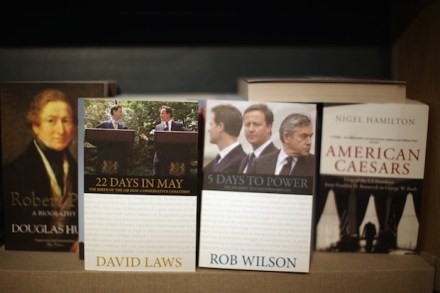
Every politician who engages in major reform ends up with scars on their back. Tony Blair famously complained about those scars from grappling with the public sector, while Michael Gove mostly relishes his tussles with the education establishment that he likes to call the 'Blob'. But the education world isn't the only one with a big, scary blob wibbling about with rage whenever a minister embarks on reform. In my Telegraph column today I look at the justice 'Blob', which has scored a pretty impressive scar on Chris Grayling with a campaign about a ban on books for prisoners which isn't quite as it seems. Books are a useful weapon for the Blob, but other fights are taking place in the justice world at the moment.

The one-man spy factory who changed history

More from Books

With two new biographies of Kim Philby out, an espionage drama by Sir David Hare on BBC2, and the recent revelation that the aristocrat superspy John Bingham was the model for George Smiley, there is little doubt that Britain is currently going through one of its fitful bouts of spy fever, and this book can only add to the excitement. Philby has a walk-on role in Jason Webster’s gripping and stylish new account of the extraordinary career of Juan Pujol, aka Agent Garbo — and a multiplicity of other monikers — arguably the second world war’s most successful double agent apart from Philby himself.

Oriel: the college that shaped the spiritual heart of 19th century Britain

More from Books

Oriel was only the fifth college to be founded in Oxford, in 1326. Although it has gone through periods of relative obscurity in the intervening seven centuries, it has also, at other times, been at the very centre of the intellectual life, not only of the university but of the nation. In the early 19th century, the Senior Common Room was dominated by the Noetics. These broad churchmen, who included Thomas Arnold, a fellow of the college before he became a famous head-master, believed in the acceptance of utilitarian economics, but also an application of Christian principles to society at large. Against them, and in the same common room, were the high churchmen or Tractarians, the most hypnotic of whom, John Henry Newman, was the closest Oxford ever got to possessing a guru.

White, blue-collar, grey-haired rebels

More from Books

In the 2010 general election, Ukip gained nearly a million votes — over 3 per cent — three times as many as the Greens, and nearly twice as many as the SNP. Unlike those parties, it won no seats, but its intervention almost certainly cost the Conservatives an overall majority at Westminster. The paradoxical consequence was to hand the balance of power at Westminster to the most pro-European party in British politics, the Liberal Democrats. In the local elections last year, Ukip won 24 per cent of the vote, and is well placed to win the European parliament elections in May. Its impact in next year’s general election is likely to be even greater than in 2010. So far, explanations of the Ukip phenomenon have been long on assertion but short on evidence.

Brains with green fingers

More from Books

‘Life is bristling with thorns,’ Voltaire observed in 1769, ‘and I know no other remedy than to cultivate one’s garden.’ This is the remedy espoused by Candide at the end of Voltaire’s satirical novel, published ten years earlier, and the literal and metaphorical cultivating of gardens is the subject of Damon Young’s sprightly and stimulating little book. Young examines the relationship between gardening and philosophy in the life and work of 11 writers, from the 18th to the 20th century, topping and tailing these individual essays with a consideration of the Ancient Greeks.