John Preston

Spectator books of the year: John Preston on the dramatic story of how Britain reinvented itself

From our UK edition

Dominic Sandbrook’s The Great British Dream Factory (Allen Lane, £25) is very long, but I read it in less than two days, my attention never flagging. Sandbrook’s main contention is that as Britain declined as an imperial power, it reinvented itself as a purveyor of popular culture to the world. Embracing everything from Black Sabbath’s guitarist, Tony Iommi, losing his fingers in a sheet metal press to the 2012 Olympic opening ceremony, it’s dramatic, perceptive and often extremely funny. Jonathan Bate’s Ted Hughes: The Unauthorised Life (William Collins, £30) is very long too — and somehow manages to be both prim and prurient. But there’s also plenty of fascinating stuff here.

Behind the scenes at the Brighton bombing

From our UK edition

Sadly, I can’t see it catching on, but one of the notable things about Jonathan Lee’s new novel is that it features a fleeting appearance by John Redwood. The late Geoffrey Howe is there too, distractedly eating fishcakes as he holds forth on the difference between humans and animals. Redwood, Howe and the rest of Mrs Thatcher’s Cabinet have gathered in Brighton’s Grand Hotel on the eve of the Tory conference in October 1984. In Belfast, Dan, one of the Provisional IRA’s brightest young stars, has been given the job of helping real-life bomber Patrick Magee plant the device that would kill five people — there has always been speculation that Magee had an accomplice who was never caught. This, though, is no Day of the Jackal retread.

The Etonian peer who became an assistant to a Mexican commie

From our UK edition

The lefty hereditary peer has few equals as a figure of fun, in life or literature. The late Tony Benn comes inevitably to mind here, as does the Earl of Warminster — ‘Erry’ — in Anthony Powell’s A Dance to the Music of Time. As his name would suggest, Francis John Clarence Westenra Plantagenet ‘Jack’ Hastings, the 16th Earl of Huntingdon, emerged into the world bedecked with promisingly absurd trappings. And for a time it looked as if his life would follow a predictably conventional path. But then everything changed. After some routine torturing by his nanny — she branded him with an iron — he went to Eton.

The author’s father didn’t want you to read this book. It’s hard to understand why

From our UK edition

There were several times when reading A Dog’s Life that I felt as if I’d fallen into a time warp. It starts with a quote on the cover from Hugh Massingberd: Holroyd is ‘a brilliant writer blessed with perfect pitch’. Nothing wrong with that, except that Hugh, alas, is no longer in a position to review books, having died seven years ago. The book itself, a novel closely based on Holroyd’s own family, was written in the late 1950s but never published in the UK after his father took violent exception to the way he’d been portrayed. He also warned that publication could well kill Holroyd’s elderly aunt. Under the circumstances, he decided it might be prudent to withdraw it. At this distance, it’s hard to see what all the fuss was about.

The queen, the cardinal and the greatest con France ever saw

From our UK edition

You usually know where you are with a book that promises the story ‘would violate the laws of plausibility’ if it appeared in a novel, and that’s in deep trouble. In the case of How to Ruin a Queen, however, this is a boast with a surprising amount of substance to it. You could make it up — just about — but you’d probably have a very sore head afterwards. In 1786 Cardinal Louis de Rohan, Grand Almoner of France and scion of one of the country’s leading families, went on trial accused of having stolen a 2,800-carat diamond necklace. This was serious enough, but what was far more serious was that he was accused of having appropriated the Queen’s name to do so.

There’s so much mystery around Charles Portis that we’re not even clear whether he’s alive

From our UK edition

The American writer, Charles Portis, has had what some novelists — the more purist ones — might regard as an ideal life. While his books have seldom been big-sellers, his fans sink to their knees at the mention of his name. In the mid 1980s, two bookshop employees in New York were so smitten with Portis’s then out-of-print novel, The Dog of the South, that they bought up all 183 hardback copies on the market and put them in their bookshop window. The books sold out in days. Contacted in his hometown of Little Rock, Arkansas, where he writes in an office behind a bar called Cash McCool’s, Portis said that he was ‘surprised and pleased by the attention’.

Hillary, Obama, Osama — and a hapless Bill

From our UK edition

The actor David Niven was once badgered by the American columnist William F. Buckley to introduce him to Marc Chagall, a neighbour of Niven’s in Switzerland. Buckley, a keen amateur painter, wanted to know what Chagall thought of his work. With grave misgivings, Niven agreed to set up a meeting. Chagall in silence gazed at Buckley’s pictures for some time until Buckley could restrain himself no longer. ‘Well, what do you think?’ he asked — whereupon Chagall clapped his hand to his brow and groaned, ‘Poor paint!’ I felt something similar on reading this book about Hillary Clinton’s time as US Secretary of State.

Why are Scandinavians so happy when they should be so sad? 

From our UK edition

As I sit here in my Sarah Lund Fair Isle sweater, polishing my boxed sets of Borgen and nibbling on a small piece of herring, it briefly occurs to me that perhaps I too have fallen victim to the prevailing mania for all things Scandinavian. Just about the only person who’s stayed resistant, it seems, is Michael Booth, the author of this book. At home in Copenhagen — he’s married to a Dane — watching the incessant drizzle falling through the perpetual twilight, Booth begins to think he’s losing his mind. How come every survey ever commissioned into human happiness puts the Scandinavians at the top of the list?, he wonders.

Simon Winchester slides off the map

From our UK edition

This book begins with Simon Winchester becoming a US citizen two years ago: ‘I swore a solemn oath before a federal judge on the afterdeck of the warship USS Constitution in Boston Harbor.’ On several occasions during the 450-plus pages that follow, I wondered if becoming a US citizen had driven him a bit mad. Winchester’s aim is to write about the explorers, geologists, cartographers, topographers and entrepreneurs who transformed America from a scattering of far-flung outposts into a cohesive whole. Nothing odd about that — but the way in which he has gone about it certainly is.

Curtains for kitty! How to care for cats — and how to kill them

From our UK edition

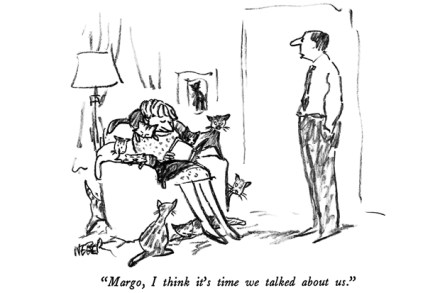
The New Yorker has always had a peculiar affinity with cats, perhaps because they have a lot in common — an elegance, an abhorrence of sentimentality and an innate sense of superiority. The Big New Yorker Book of Cats is full of cats and owners, each holding one another at arm’s length and peering through invisible lorgnettes. Pulitzer prizewinner Susan Sheehan writes about a tabby cat called Pynchon, owned by the proprietor of a Manhattan bookshop. Pynchon, who for unspecified reasons arrived in New York ‘with no front claws’, is fond of listening to classical music on the radio and regularly attends meetings of the James Joyce Society at the shop. However, he seems to have little in common with his namesake, being both unusually gregarious and enormously fat.

Queen Victoria, by Matthew Dennison – review

From our UK edition

When Prince Albert died in 1861, aged 42, Queen Victoria, after briefly losing the use of her legs, ordered that every room and corridor in Windsor Castle should be draped in black crepe. As a result, the country’s entire stock of black crepe was exhausted in a single week. One of the key factors of Victoria’s reign for Michael Dennison is that it was — not always consciously — a ‘performance monarchy’, in which the Queen sat in carefully fashioned stage-sets at Windsor, Balmoral or Osborne being discreetly ogled by the populace. This public posturing helped gloss over Victoria’s ‘dizzying’ contradictions, and the purpose of this short biography is to bring them back out of the shadows.

Move Along, Please, by Mark Mason – review

From our UK edition

Mrs Thatcher was widely believed to have said that ‘any man over the age of 26 who finds himself on a bus can count himself a failure in life’. In fact there’s no evidence Thatcher ever said it — the most likely culprit is the Duchess of Westminster. Mark Mason loves buses, and doesn’t much seem to care if anyone thinks he’s a failure. He loves them so much that he decided to travel the length of the country by local bus. This, he declares, would be a kind of anti-travel, ‘a rejection of everything we always strive for’, namely speed. Along the way he’d visit all kinds of strange and exotic places — Tiverton, Kirkby Lonsdale, Dornoch — while trying to take the pulse of contemporary Britain.

Magic, by Ricky Jay – review

From our UK edition

People, they say, want different things from a book over the summer than they do the rest of the year. If, by chance, you are looking for a book that will both give you a hernia and teach you how to make a bridge disappear, this could be just the thing for you. The motorbike messenger who delivered my copy of Magic had to come in for a glass of water and complained that the effort of carrying it had made his legs bowed. It is, quite simply, the largest book I have ever tried to read — the literary equivalent of the Great Bed of Ware. So what’s inside it? An awful lot of pictures, beautifully reproduced, interspersed with essays on the history of magic.

Dear Lumpy, by Roger Mortimer – review

From our UK edition

After the success of Dear Lupin, Roger Mortimer finds himself facing something not normally experienced by former Guards officers who have been dead for more than 20 years — namely Difficult Second Album Syndrome. Lupin, a collection of letters written by Mortimer to his extremely errant son Charles (‘Lupin’) took everyone by surprise when it became a big hit last year. Certainly its success astonished Charles himself. ‘It would not be an exaggeration to say that expectations for sales were not that high’, he writes here in his preface — hardly surprising as ‘I had barely read a book before, let alone compiled one.

‘Kurt Vonnegut Letters’, by Dan Wakefield – review

From our UK edition

In the early 1950s Kurt Vonnegut became the manager of a Saab dealership in Cape Cod, a job which often involved him taking prospective clients out on test drives. Keen to demonstrate the Saab’s front-wheel drive, Vonnegut would take corners at a tremendous lick, leaving his often elderly passengers ‘sickly and green’ afterwards. Vonnegut’s early writings left a number of editors feeling pretty sickly and green too. As the rejection slips piled up, he cast around desperately for some alternative source of income. He tried to flog a board-game he’d invented, as well as a bowtie made from ribbon the Atomic Energy Commission used to cordon off highly radioactive areas which he was convinced would prove a big hit.

Away with the fairies

From our UK edition

There have been plenty of books in recent years in which apparently sane hacks go off in search of loonies to poke fun at. While The Heretics looks at first as if it fits neatly into the genre, there turns out to be rather more to it than that. Not that the book doesn’t come richly stocked with people who hold what my mother used to call very unreliable opinions. They include a regressive hypnotherapist called Vered who once treated someone who believed they’d been a twig in a previous life, and an NHS-funded expert on satanic rituals who insists that satanists regularly stitch babies inside the bellies of dying animals so that they can be ‘reborn’ to Satan. Apparently the satanists — when peckish — also snack on foetuses. ‘Raw or cooked?

Beautiful and damned

From our UK edition

According to his mother, Neville Heath was ‘prone to be excitable’. He was that all right — and then some. In the space of two weeks in the summer of 1946, Heath murdered two women with such brutality that, as Sean O’Connor puts it with shuddering relish, ‘war-hardened police officers vomited on seeing them’. The public were fascinated by him. Elizabeth Taylor reworked Heath’s story into a novel, Patrick Hamilton drew on it heavily for his Gorse trilogy and Alfred Hitchcock wanted to make a film about the case, but had to ditch the idea when the studio decided it would be too revolting. Heath was fascinating mainly due to his ambivalence. Clearly capable of appalling brutality, he could also be tender and considerate.

The further tragedy of unknowing

From our UK edition

Margaret Evison spent Easter 2009 with her 26-year-old son Mark, who was about to go to Afghanistan as a lieutenant in the Welsh Guards. They walked around her garden talking about death in a general sort of way; Mark was worried that he might make a mistake which would lead to someone else dying. ‘He did not discuss the possibility of his own death.’ A month later, she returned from the newsagents to see a casually dressed man outside her house ‘apparently loitering with some intent’. He explained that he was a major in the Army and asked if they could talk inside. Two days after that, Evison was being driven to Selly Oak hospital in Birmingham when an ambulance sped by with a police escort. Inside was Mark. He had been shot while out on patrol in Helmand.

Torn between ideology and compassion

From our UK edition

On 1 September 1978, the then prime minister Jim Callaghan invited six leading trade unionists to dinner at his Elizabethan farmhouse in Sussex. By all accounts it was a very jolly affair with Callaghan’s wife Audrey doing the cooking and their granddaughter Tamsin Jay handing round the dishes. The trade union grandees went away convinced that Callaghan was about to call a general election. Instead, he sat on his hands and waited. It proved to be a catastrophic misjudgment. Just four months later they all met up again — this time to discuss declaring a national emergency.

Divided loyalties

From our UK edition

On his first day at boarding school in Kenya in the early 1950s, Ngugi Wa Thiong’o stood to attention as the Union Jack was raised on the school flagpole. Afterwards the boys sang Psalm 51 which contains the line, ‘Wash me Redeemer and I shall be whiter than snow.’ Then came a tour of the headmaster’s house during which they were invited to gaze in wonder at his electric cooker and his gleaming pots and pans. The weirdness of this was not lost on Thiong’o, especially as his brother, Good Wallace, was fighting for the Mau-Mau guerrillas at the time. At the end of his first term, Thiong’o returned home to find that it no longer existed. His whole village had been razed and his family packed off to a detention camp.