Lead book review

There’s something about Marianne – but can French identity be defined?

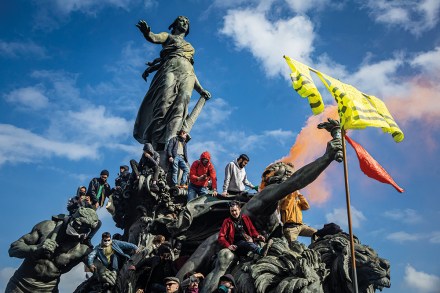
In October 2018, Andrew Hussey, the convivial and courageous observer and analyst of the political and social travails of modern France, was cycling back to his office after lunch through the rather staid and un-bohemian environs of the Boulevard Raspail on the Left Bank in Paris. To the ‘middle-aged man who already has a heart condition’, the scene into which he pedalled near the Montparnasse cemetery was terrifying, but to the veteran historian of the fractious Fifth Republic not particularly unusual. Parisians were sitting on café terraces and queuing for ice cream while just around the corner ‘a mini-civil war’ was taking place.

Christopher Marlowe, the spy who changed literature for ever

Stephen Greenblatt tells the story of being approached in the 1990s by a screenwriter who wanted to make a Shakespeare -biopic. Greenblatt repeatedly told him to forget Shakespeare and look instead at his predecessor Christopher Marlowe. The screenwriter knew what he was about and ignored Greenblatt’s advice – the result was Shakespeare in Love. The fact of the matter is that Marlowe’s life is the sort of thing that people assume would make a good film but in reality it was just too full of violence, passion and secret plots. By the time he was murdered at the age of 29 in 1593, Marlowe was enmeshed in far too much for a mere drama to set out. Biographies haven’t been lacking, many of them excellent. The allure is clear.

‘I’m tired of your ridiculous lies’ – the wrath of Muriel Spark

Few among Muriel Spark’s circle of friends would have disputed the judgment of Storm Jameson when recommending Spark to the publisher Blanche Knopf in 1963: ‘I warn you, or remind you, that you are taking on a tartar. She has worn out two Macmillan directors already.’ Even tartars are forgiven, however, when they exhibit a touch of genius. ‘On the credit side, she is a good writer.’ Spark was a good writer of letters, too. They were often a joy to receive, as this fascinating first volume of her correspondence shows. (Jameson to Knopf is quoted in an editor’s note.

‘I’ve taken to sleeping in my teeth’ – the wartime admissions of T.S. Eliot

In 1944, T.S. Eliot is 56 years old. He seems older: ‘I am getting to be a wambling old codger.’ He is war-worn: ‘I have taken, when in London, to sleeping in my teeth.’ As a fire-watcher sharing shifts, his sleep is hampered by understandable pudeur: ‘I haven’t got enough phlegm to undress completely, and I think it best to sleep in my truss, in case of sudden blasting, which is not very comfortable.’ He knows, too, that his letters are dull. To Anne Ridler, 19 June 1942, he confesses: ‘If I had any small gift for letter writing, it has been ruined years ago by the pressure of the kind of correspondence I have to practise most of the time.’ Namely, the business letter, where you can see Eliot now and then resorting to the formulaic.

A century of western meddling in Iran

On 22 June this year, seven B2 Stealth bombers flew on a 37-hour round trip from bases in the US to drop 14 30,000lb bombs on two nuclear facilities in Iran. A third was attacked with cruise missiles fired from a submarine, possibly in the Persian Gulf. Few can say with any certainty how much damage was done to the Iranian nuclear programme, which Tehran insists is only for peaceful purposes, but it is likely to have been considerable. Whether this will slow or accelerate Iran’s effort to build a bomb is unclear. This massive demonstration of American firepower brought the brief 12-day war between Iran and Israel to a rapid close. Iran came off considerably worse than its adversary in the conflict, though you would not know it from the rhetoric of Ali Khamenei, the Supreme Leader.

Assassinations have an awkward tendency to backfire

Plutarch says that Julius Caesar dined with friends the day before he was assassinated. When conversation turned to considering the best way to die, Caesar looked up from the papers he was signing (being in company never stopped him working) and said, without hesitation: ‘Unexpectedly.’ Thanks partly to Shakespeare, Caesar’s has a claim to be one of the two or three best known historical assassinations. Another, plausibly argued here by Simon Ball as one of the most consequential, was that of Archduke Franz Ferdinand in Sarajevo on 28 June 1914, precipitating the first world war. Without it, the past century might have been unrecognisably different.

The crimes of Cecil Rhodes were every bit as sinister as those of the Nazis

This is a brave and learned book. I would recommend it to anyone interested in the history of Africa; who has taken sides in the recent quarrel about ‘Rhodes Must Fall’, in Oxford or other parts of the world; or who wants to entrench themselves in contrary positions in our apparent ‘culture wars’. It is the biography of a vicar’s son, born in Bishop’s Stortford, Hertfordshire in 1853, who went as a teenager to Africa to join his elder brother who’d bought a plot of land in Natal. One day, walking past a stream by the side of a field, he noticed some pebbles gleaming especially brightly. They were diamonds. By the time Cecil Rhodes enrolled as an undergraduate at Oriel College, Oxford, aged 20, he had an annual income of £23,000 – the equivalent of about £1.

Charles I at his absolutist worst

Sometime after the Long Parliament met in November 1640, a seamstress living in London called Katherine Chidley decided that she didn’t much like the way that a man was telling her how to do her Puritanism. So, taking advantage of the recent collapse in traditional censorship controls, she published a pamphlet, The Justification of the Independant Churches of Christ (1641), which challenged the writings of Thomas Edwards, a preacher, heresiographer and polemical hardman of English Presbyterianism. Over the course of 80 tightly printed pages, Chidley contended that Edwards’s religious vision was an authoritarian and sexist misreading of God’s plans for his people.

The race against Hitler to build the first nuclear bomb

Ettore Majorana vanished in March 1938. According to Frank Close in Destroyer of Worlds, the 31-year-old Sicilian physicist ‘probably understood more nuclear physics theory than anyone in the world’, and was hailed by Enrico Fermi as a ‘magician’, in the elevated company of Newton and Galileo. Majorana was also an ardent fascist; yet he was haunted by the destructive potential of his work on mapping the nucleus. His disappearance – perhaps a suicide; more likely a new, incognito life in South America – has been related to an anguished remark he made to a colleague: ‘Physics has taken a bad turn. We have all taken a bad turn.

‘Too bohemian for Bournemouth’: the young Lawrence Durrell

These legendary lives need the clutter cleared away from them occasionally. Lawrence Durrell and his brother Gerald turned their family’s prewar escape to an untouched Corfu into a myth that supplied millions of fantasies. It still bore retelling and extravagant expansion recently, if the success of ITV’s series The Durrells is any sign. (One indication of that pleasant teatime diversion’s accuracy: the actor playing Larry, Josh O’Connor, is 6ft 2in. Larry himself was a whole foot shorter.) How Louisa Durrell, struggling with life in Britain after returning from India, went in a bundle with her children to a Greek island of cheap Venetian mansions, heat and innocent adventure is always going to have its appeal.

The importance of feeling shame

In several homilies, the late Pope Francis spoke of the ‘grace of feeling shame’. What a strange idea! Nobody wants to feel shame. Adam and Eve, after all, first felt shame only after being expelled from the Garden of Eden. Shame was God’s punishment: they felt ashamed of what had never troubled them before, namely their nakedness and their sexual desires. But what the Pope meant, I think, is absolutely salutary for our age. Shamelessness is ubiquitous. It is the accelerant of social media that encourages us to narcissistically fire up our victimhood to a gimcrack blaze. It is why so many of us are chained to the brazen idea that we can never be wrong. It’s the seeming life strategy of the most powerful man on Earth.

Admirable in their awfulness – the siblings Gus and Gwen John

‘In 50 years’ time,’ Augustus John gloomily reflected following his sister’s death on 18 September 1939, ‘I will be known as the brother of Gwen John.’ He was right. In 2004, when the Tate mounted a joint retrospective of Augustus and Gwen John, it was Gwen who had become the major artist. The ‘variable strident chords’ of the self-styled Gypsy King, likened in his youth to Michelangelo, Rembrandt and Raphael, had been supplanted by the ‘sustained minor key’ of the nunlike recluse.

Charles Darwin’s contribution to Patagonia’s grim history

It was a journey Bruce Chatwin hankered to make: to Southampton and the grave of General Juan Manuel de Rosas, the exiled Argentine dictator described in the Southampton Times after his funeral in 1877 as ‘one of the most cruel, remorseless and sanguinary tyrants who ever existed on Earth’. Chatwin died before I could accompany him to the Hill Lane Cemetery, but four years later I stood with his widow in front of Rosas’s ornamented tomb in Buenos Aires as we prepared to meander south on a 2,000-mile car journey in his footsteps. In 1989, the year of Chatwin’s death, President Menem decided to have Rosas’s remains repatriated as a gesture of national reconciliation. Their arrival was greeted by mounted lancers wearing Rosas’s signature red uniform.

‘I secreted a venom which spurted out indiscriminately’ – Muriel Spark

In 1995, Dame Muriel Spark, then one of Britain’s most distinguished living writers, was interviewed for a BBC documentary. During filming, the show’s editor commented that ‘her biographer must be the most depressed man in England’. Three years earlier, Spark had personally anointed Martin Stannard as the writer of what she intended to be the authorised version of her life, presenting him with the vast archive of documentation – spanning 50 years and 50 metres – gathered at her home in Arezzo. ‘Treat me as if I were dead,’ she instructed him. Stannard understood this to mean that he should proceed as a traditional historian; by the time his hag-ridden book was published 17 years later he had learned his mistake.

The mystifying cult status of Gertrude Stein

To most people, the salient qualities of Gertrude Stein are unreadability combined with monumental self-belief. This is the woman who once remarked that ‘the Jews have produced only three original geniuses – Christ, Spinoza and myself’. Of the reading aloud of her works, Harold Acton complained: ‘It was difficult not to fall into a trance.’ Even if you are as good a writer as Francesca Wade, it is still difficult to avoid the influence of what she herself calls Stein’s ‘haze of words’. So the first half of this impressively researched biography is cerebral rather than colourful.

Why shamanism shouldn’t be dismissed as superstitious savagery

In 2014, in the course of his inquiry into shamanism, the anthropologist Manvir Singh spent time with the Mentawai people on the Indonesian island of Siberut. He estimated that among the 265 residents he managed to interview, 24 were male shamans, or sikerei. These ‘specialists’, as he puts it, were uniquely empowered to commune with spirits and provide a range of services which included healing, divination and raining down afflictions on enemies. Over the course of two extended visits, living on a diet of fried grubs, boiled pangolin and pigs’ testicles, Singh witnessed ceremonies characterised by ‘turmeric coated sikerei decked out in leaves and beads... the dissonant clanging of bells and the hellish squeals of sacrificed pigs’.

Studying Dickens at university was once considered demeaning. Now it’s too demanding

Any consideration of Stefan Collini’s subject has surely to address a major recent issue. The academic study of English, both at school and university, has fallen away significantly, with the numbers opting for it greatly diminishing. Anecdotal evidence from even the most serious institutions suggests that many students are now finding previously accessible texts impossible to read or understand – because of their length (Charles Dickens), their complexity of meaning (Alexander Pope) or remote sensibility or politics (Joseph Conrad). Collini has been given a generous amount of space to write his history. Despite this, he has chosen to end it more than 50 years ago. His subtitle is quite misleading.

The love that conquered every barrier – including the Iron Curtain

In our age of cosmetic fantasy, a dramatic love story between two bespectacled art historians sounds implausible. But add in the Montague-Capulet effect of the Iron Curtain, along with a fearless Russian heroine who proved that love can conquer every barrier, and you have an enchanting tale: a completely true one, beautifully written by the art historian and novelist Iain Pears, the author of An Instance of the Fingerpost among many other books. Pears, who had been a pupil of Francis Haskell, began to visit his former tutor’s widow Larissa Salmina on a regular basis after 2000. He soon realised from odd remarks just how extraordinary their lives had been. He pointed to a photograph of a boy in naval uniform. ‘Ah,’ Larissa replied, ‘that’s my cousin. He was eaten by a bear.

Time is running out for the world’s great rivers

That rivers have a life of their own is an ancient idea become current again. Shape-shifting, vital and recognisably capable of being sickened or damaged – as the state of our fragile chalk streams so starkly illustrates – there is good reason why fluvial myths have such historic potency and why the flow of water enjoys so many figurative associations. The late James C. Scott, an amateur hydrologist and professor of anthropology at Yale, who died in July last year, opens his nicely fluent study with an unequivocal assertion – ‘Rivers, on a long view, are alive.’ In Praise of Floods examines the several ways in which homo sapiens have sought to tame and exploit watersheds, and the importance of floodplains in human culture.

The making of Van Gogh as an artist came at a terrible cost

Six months before Vincent van Gogh’s death, the critic Albert Aurier, waxing poetical, wrote an article entitled Les Isolés on the then unknown painter. It raised to sainthood the solitary genius driven to insanity by an uncomprehending world. ‘Is he not one of the noble and immortal race which the common people call madmen but which men among us consider sort of saints?’ The man had already become myth. His life would be a sacrament and his suicide a reproach. It has remained that way ever since. Miles J. Unger thinks otherwise. He recasts our hero as the very opposite of isolé, a painter whose stylistic development was totally dependent on the artists and influences surrounding him in Paris.