Lead book review

How interwar Germany became a breeding ground for evil

Did no one who lived through the Weimar Republic of 1918-33 see what was coming, asks Victor Sebestyen in his impressive new book. The politicians, the intellectuals, the foreign visitors who converged on Berlin in the wake of the first world war all wrote about the anti-Semitism and violence they witnessed, but virtually no one

Only prigs and bores could object to the incongruity of Portmeirion

The only answer to the question ‘What connects Brian Epstein, Frank Lloyd Wright, Portofino and Stevenage?’ is ‘Portmeirion’, a conceptualised village on the north Wales coast. You could call it a folly, except it is living, not dead; and it exerts a lasting fascination. Traditional modernists deplore its flamboyant historicism – ‘retro-kitsch whimsy’ – but

Riddled with contradictions: the enigma of Jan Morris

Jan Morris was driven by almost super-human levels of energy and ambition, producing more than 40 books as well as news and travel articles, introductions, interviews, reviews and essays, travelling incessantly and taking on every job that was offered. That’s as far as I can go without a pronoun, because of course Morris’s life is

Why Hitler’s suave architect escaped the noose at Nuremberg

At the Nuremberg trial of the main Nazi war criminals, one man stood out: Hitler’s favourite architect and later armaments minister, Albert Speer. He cut a gentlemanly figure in a gallery of rogues. The strutting, smirking Hermann Goering reminded Rebecca West, who attended the trial, of ‘a tout in a Paris café offering some tourists

A revival of Alan Bennett’s early work is long overdue

It is a curious literary form, the published diary. A surprising number of the classic diarists did write for eventual, usually posthumous, publication – Chips Channon under a 60-year embargo, A.C. Benson, Samuel Butler, in his wonderful notebooks, and surely the possibility was in the minds of Samuel Pepys and the Duc de Saint-Simon. More

The curse of gold for the Asante nation

As a metal, gold never corrodes. As a possession, the reverse is too often true. It has the power to warp morality, destroy decency and tarnish humanity. This duality – entrancing beauty alongside corrupting potency – lies at the heart of this magnificent book that engagingly blends African history with a current relevance that reaches

Blitz spirits: Nonesuch, by Francis Spufford, reviewed

If you read books for a living, the calling probably started with a moment of utter entrancement: a novel you couldn’t bear to set down; a few unforgettable days, as Bleak House, Earthly Powers, The Woman in White or Titus Groan worked its unsuspected magic on its millionth reader. Such books are rarer these days,

Rupert Murdoch’s warped vision of family

When Rupert Murdoch divorced his fourth wife, Jerry Hall, in August 2022 he made her sign an agreement that she would not give any story ideas to the writers of Succession. Frankly he need not have bothered, because it’s all here in this utterly gripping book. The award-winning journalist Gabriel Sherman has been reporting on

Forgetting was the best defence for the Kindertransport refugees

Michael Moritz, one of Silicon Valley’s most successful venture capitalists, really has got it in for Donald Trump. America is currently in a ‘dark age’ of authoritarian governance, he claims, which spurns legality and liberal do-gooders everywhere. As a lifelong Democrat, Moritz was appalled when, in 2017, Trump failed to denounce the alt-right protestors who

Leonardo Sciascia and the reshaping of the detective novel

Northern Italians sometimes speak of Sicily as the place where Europe finally ends. The island was conquered in the 9th century by Arab forces from north Africa, who left behind mosques and orchards of pistachio and almond. The Arab influence remains strongest in the Mafia-dominated west of Sicily where the sirocco blows in hot from

Imposing Christianity on Europe’s last pagans

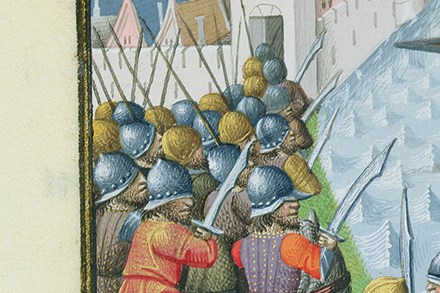
The crusades bring up images of the ancient cities and harsh deserts of the Levant, of Saladin, Richard Coeur de Lion and King Louis IX of France. The crusades to the Holy Land were a consuming obsession of Latin Christianity for four centuries and remain among the most famous episodes of the Middle Ages. Yet,

The last chapter: Departure(s), by Julian Barnes, reviewed

Departure(s), whose publication co-incides with Julian Barnes’s 80th birthday, will be his last book, a thank you and goodbye to his readers. Barnes has blood cancer, but the condition is manageable and not terminal; when he dies, it will be with, and not of, the disease. Or rather, as he puts it: ‘I, in dying,

The spiritual yearnings of David Bowie

What did David Bowie mean by ‘No confessions/ No religion’ in his lyrics to ‘Modern Love’? Peter Ormerod proposes what at first seems an unlikely theory – that Bowie was talking about Gnosticism, the complex spiritual, though not religious, belief that God lies beyond the material world and that all humans carry a divine spark

Carlo Scarpa’s artful management of light and space

If Carlo Scarpa were as well known as Le Corbusier, modernism might not be so reviled. This architetto poeta grew up in Vicenza, whose 21 buildings by Palladio surely had a formative influence on his fast- evolving artistic intelligence. Scarpa studied building design at university, but, instinctively disobedient, never bothered with a licence to practise