Spectator Life

Spectator Life

An intelligent mix of culture, style, travel, food and property, as well as where to go and what to see.

How I fell for 78s

I recently made a programme about the British jazz pioneer Arthur Briggs. Yes, I know. Arthur who? The much-missed Jeremy Clarke told me: ‘If only he’d been called Arthur “Big-Boy” Briggs or “Honeydripper” Briggs, maybe things would have turned out differently.’ As it was, his name always suggested a painter-decorator from Edwardian Brixton rather than one of the hottest cornetists on the prewar jazz scene. Briggs was a Caribbean child of empire who, as a teenager, fell in with makers of the new music in New York, then after the first world war helped bring jazz across to Europe.

Beyond Boswells: Oxford’s new safe space

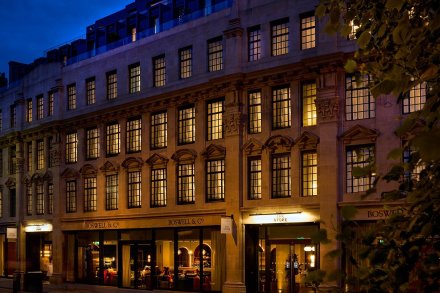
One can see a city so differently over time. Visiting Oxford recently I noticed fine whisky shops and fashion stores which have always been there but which I barely registered as a student 15 years ago. There are new arrivals: some good, such as the handsome Jericho Cheese Company; others less so, such as the proliferating bubble tea shops catering to the now numerous Chinese, both students and tourists. Covered Market is still there, where we used to indulge at the original Ben’s Cookies. Though I do not remember back then the Thames Valley Police signs now warning of ‘bag dippers’ operating in the area. Oxford is both swisher and scruffier than I remember it. Swish embodied in the new Ivy, in a palatial neo-Gothic pile on the High Street that used to be a NatWest.

Bets for the final day of Cheltenham Festival

There have been plenty of upsets in the Grade 1 contests on the first three days of the Cheltenham Festival but supporters of Galopin Des Champs will be hoping that trend comes to an end today when this talented nine-year-old gelding goes for a rare hat-trick of wins in the Boodles Cheltenham Gold Cup (4 p.m.) The Willie Mullins-trained and Paul Townend-ridden 9-year-old gelding needs to defeat eight rivals in order to land a first prize for connections of £364,000. In truth, he would want the ground to be softer but the chances are that this odd-on shot will still land the spoils. A convincing victory today would mean that Galopin Des Champs will inevitably be compared with the legendary Arkle, who won three consecutive runnings of the race from 1964 to 1966.

Good riddance to literary fiction

In case you hadn’t noticed, the London Book Fair has been gracing our nation’s capital this week, down in Earl’s Court. There, the publishers, agents and buyers of the literary globe (London is second only to Frankfurt in ‘book fair importance’) have been feverishly buying and selling the rights to hot new titles, hot new authors, maybe the odd lucky midlister, while identifying the trends, writers and genres that conceal the ultra-precious kernel of hotness to come. In today’s market it’s likely that buyers have been looking for visually rich comic books for children – enjoying a resurgence – and anything in a newish genre called ‘romantasy’ (think Fifty Shades of Grey meets Game of Thrones, with more vampires and less spanking).

We need a modern Wogan

Nowadays whenever an elderly celebrity dies – consider the death last month of Gene Hackman as a case in point – one of the first things that happens is that a chunky clip of them appearing on a talk show such as Wogan or Parkinson gets shared on social media. Before you know it, you’ve spent three or four minutes listening to them regale television-watchers of the 1970s, 1980s or 1990s with a reflective anecdote or a personal story that reveals something important or even profound about their lives and animating passions or influences.

Are schools taking in too many international pupils?

Browse the website of the Independent Schools Council (ISC), which represents some 1,400 schools teaching around 500,000 children, and it will tell you there are 26,195 overseas pupils at its UK member schools. They make up 4.7 per cent of the total student population. The cosy percentages belie the truth. For rather like the growing importance of foreign students in keeping our universities financially afloat, so there are swathes of overseas pupils enrolled at public schools providing a similar financial cushion. And that was true even before the Labour government slapped 20 per cent VAT on the entire sector.

Tips for Cheltenham day three

If the ground was riding really soft today, I would not be opposing Teahupoo in the Paddy Power Stayers’ Hurdle (4 p.m.) but the going is officially ‘good to soft’ this morning and it will dry further throughout the day. On that terrain, I would rather be on Teahupoo’s stable mate THE WALLPARK who has won four of his last five starts. His most recent outing was when he was fourth to another of today’s runners, Crambo, at Ascot just after Christmas. Since then he has been kept fresh by Irish trainer Gordon Elliott with this Grade 1, worth more than £180,000 to winning connections, in mind. At seven years old, The Wallpark should be at his peak and he should thrive on the quick surface.

The Boxing Academy changing young lives

It’s a typical morning at the Boxing Academy in east London. In the reception, men with handheld metal detectors pat down students, confiscating their belongings and mobile phones for the day. A child has emptied out his pockets and is holding a mucky plastic dental retainer. ‘Can he have this?’ one man with a metal detector asks another. With suspicion, it is permitted. The Boxing Academy is an alternative provision secondary school in Hackney, founded in 2007 on the experimental idea that you could better teach difficult children by making boxing a central part of their education. Students take daily boxing classes, wear navy tracksuits and are as disciplined as boxers would be.

In defence of single-sex schools

When I first became a teacher, I bought into the notion that single-sex schools were an anachronism – a result of historical happenstance that no longer had a place in the 21st century. I imagined all-boys schools as a macho world of Spartan dormitories and testosterone-charged classrooms. I assumed the boys graduated with repressed memories of traumatic hazing rituals and an unhealthy amount of anxiety around girls. Then, after two exhausting years teaching English at a mixed comprehensive, I moved to an all-boys independent school to see what it was like. I enjoyed it so much that when I moved from London to Oxford, I decided to teach at another (although my current one is co-ed at sixth form).

How should today’s pupils be disciplined?

On top of the canings and endless gym-shoe whackings – those ‘short, sharp shock’ corporal punishments endured by prep-school children (especially boys) until the late 1970s – what were the most memorable punishments inflicted on pupils born from the 1930s onwards? To put today’s more humane prep-school punishments in perspective (they’re not even called punishments but ‘sanctions’), I asked people in their seventies and above which punishments they most remembered. ‘The Denzil Blip,’ said Julian Campbell, who was at The Hall School in London in the 1950s. ‘Denzil Packard had been a prisoner of war of the Japanese and had a mangled finger. Offending boys were clipped on the head, with this finger being the point of contact.

Which school gate drop-off tribe are you in?

It wasn’t until I locked eyes with a Premiership rugby player as I got out of my car at 8 a.m. that I realised I might need to up my game for drop-offs at the children’s new school. I would need to start wearing eye make-up, for starters. I should also give a little more thought to an outfit than picking up yesterday’s T-shirt and cut-off jeans from the bedroom floor – although ‘outfit’ is one of those words that makes me wince, like ‘gift’ or a ‘pop’ of colour. Still, ‘outfits’ are what a certain type of woman around here goes in for. Among a sort of country-prep-miles-from-anywhere subset, you will find mothers trying their best to fit into what the Times has identified as the ‘Ganni Mum’ tribe.

The lessons I learned as education secretary

Education secretary really is the best job in government, though sometimes it doesn’t feel that way. Lives can be transformed – hopefully for the better – as a direct consequence of the decisions you make. But you are also firmly in the firing line. There’s no other area of public policy in which everyone is an expert. Only a minority of us have fought in battle, studied the impact of nitrates on chalk streams or contemplated what the correct approach to sanitary and phyto-sanitary standards should be in a trade agreement. But we’ve all been to school. And we all have views – sometimes deeply entrenched and emotional – about what constitutes a good education and therefore sensible education policy.

How to educate your child privately – without paying VAT

For some parents, VAT on school fees is the straw that’s broken the camel’s back. The Institute for Fiscal Studies estimates that between 20,000 and 40,000 pupils will be withdrawn from the independent sector. An answer to a parliamentary question revealed that 46 private schools closed between January and October last year. It is safe to assume more will follow. But if you really want to, there are still a couple of ways that you can educate your children privately without having to pay VAT. What about sending them to school abroad?

The enduring power of school dinners

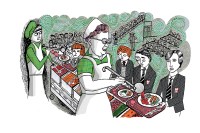
Cornflake tart. Spam fritters. Green custard. Turkey twizzlers. Chocolate concrete. These are some of the dishes that instantly transport you to the school lunch hall – and inspire either pure nostalgia or horror. Over the past five years co-hosting Table Talk, The Spectator’s food and drink podcast, I have spoken to people from all walks of life – politicians, chefs, writers, campaigners, entrepreneurs and artists – and they all have unique relationships with food. But school food defies all reason. It presents a binary, true love or hate. Some look back with delight, seeking out spotted dicks and instant mash for ever more, though none tastes as good as the dishes they had at school in Kettering in 1989. Others can barely look at a rice pudding without gagging.

When did RE teaching become so muddled?

I recently offered my services as a part-time RE teacher to my local comp, an inner-city affair with a Muslim majority. Yes please, said the nice headmistress: the Covid-blunted Year 11s needed all the help they could get with GCSE revision. The syllabus consisted of Christianity and Islam. What could go wrong? The first thing that went wrong was that I talked about the Jewish roots of Christianity and Islam: Judaism was the original monotheism. ‘I don’t know if that’s right,’ said one girl, frowning. Well, you do now, I wanted to say. But of course what she meant was: I don’t know if you are to be trusted on this. I consulted the textbook, for objective evidence.

School portraits: snapshots of four notable schools

Ludgrove, Berkshire Ludgrove, which was founded in 1892 by the footballer Arthur Dunn, is a boarding prep school in Berkshire and has 130 acres for its pupils to learn, run around and play in. The school is one of the last preps to provide full boarding (which is fortnightly). At weekends, boys can use 11 football pitches, four tennis courts, two squash courts and a nine-hole golf course. It’s not just Prince William’s alma mater: other old boys include Alec Douglas--Home, Simon Sebag Montefiore and Bear Grylls (who opened the new Exploration Centre in June 2021). Most of the boys go on to Eton, Harrow, Radley or Winchester.

Why I’ve never forgotten Sister Cecilia

It is never people, always buildings. Faces change, time blurs them, but – unless they undergo a complete makeover – buildings remain pretty much the same, bar a few coats of paint. Along the second-floor corridor lined with arched windows that overlook the street. Buses grind by below. Up the last short steep staircase and along the very top corridor, which is narrower and lined with books. They call it the library and I am often here, tucked into the window seat reading, but otherwise heading for the arched door – everything is arched here – at the far end. It opens on to a low-ceilinged room with roof lights through which the sun seems always to be shining.

A great-day-out cafe that’s good value: Kenwood House reviewed

The immaculate bourgeois socialists of north London – that is not code for Jews – like to eat and drink in the former servants’ quarters of Kenwood House, because this is a mad country.  Kenwood is beautiful. It is Hampstead’s best house, standing at the top of the heath, near the head waters of the River Fleet, the river of the journalists. Further down the hill the immaculate bourgeois socialists gambol in the swimming ponds, which is apparently a fashionable thing to do. I prefer the lido, but I am not afraid of working-class teenagers. Hampstead Heath is an excitable woodland.

Angela Rayner’s war on Britain’s playing fields

With the world on fire – not to mention large swathes of the North Sea – it is understandable that some of the scurvier implications of Angela Rayner’s stonking planning bill, aimed at streamlining all development, from roads and power stations to housing, might have gone unnoticed. Which is a pity, because it’s not very pretty. To make sure everything goes swimmingly, it seems that those objecting to any developments too much will have to keep their trap shut. Among the bodies that won’t have to be consulted any more is an outfit called Sport England, which may have its faults but is dedicated to promoting grassroots sport.

Racing tips for the second day of Cheltenham

Jonbon is the odds-on favourite for the big race on day two of the Festival, the BetMGM Queen Mother Champion Chase (4 p.m.). He is the most likely winner but there is little doubt that this Cotswolds venue is not his favourite racetrack and so I am happy to take him on. Eight runners are due to line up and so that makes each-way betting is attractive. I expect the outsider of the field, Libberty Hunter, to outrun his odds but I would be surprised if he is good enough to win this Grade 1 contest on ground that is faster than ideal for this soft-ground performer. I would rather concentrate on the form of Solness and MARINE NATIONALE, first and second in the Grade 1 Ladbrokes Dublin Chase at Leopardstown.

Football is demolishing its past

Saturday 17 May will see the final ever game at Everton’s Goodison Park, and with it the end of 133 years of history. Unless the rumour of a last-minute reprieve involving the women’s team turns out to be true (highly unlikely), the bulldozers will soon get to work and the ground will be reduced to rubble. The club will move into a new ‘super arena’ at Bramley-Moore Dock, Vauxhall, for the 2025/26 season. Sad? Well, yes. The club, on its website, has acknowledged the mixed feelings of the faithful but promised the move will be an ‘exciting new chapter in the club’s history’, with the additional 13,000 seats in the new ‘365-day’ ground offering space for additional ‘fandom’, including many more of those all-important, merchandise-hungry ‘tourists’.

The democratisation of cocaine

Love or loathe Danny Dyer, hard-man hooligan of Football Factory, EastEnders bod and breakout Rivals star, but he does talk sense. The kind of straight-up, geezer sense you can only get down the pub, a locale to which he is no stranger. In the promotional press for his latest film, Marching Powder, Dyer, when pressed on the not-so-euphemistic title of the film, had the following to say on cocaine: ‘I’ve got that social butterfly thing where I mix in both circles and believe me, everyone’s fucking at it [...] it’s classless actually, that drug.’ To some of us, this may seem obvious. In my decade of active addiction, I obtained and recreationally ‘enjoyed’ the drug with anyone from builders to baronets.

Have you got compassion fatigue?

Experts warn that doctors like me risk a condition known as ‘compassion fatigue’ – an emotional numbness that comes from too much caring for too long. But aren’t we all on the edge? Distant hardships are now visible as they happen, and the sense that victims are everywhere becomes vividly real. Newsreaders, documentary makers, editorialists, politicians and campaigners imply we’re shallow unless consumed by the wretchedness they describe. I meet the unfortunate, struggling and afflicted on my ward rounds. And I deal with those who have been made frail by age, bad luck and bad choices. Obstetricians get flowers and wine for helping bring wonder into people’s lives, orthopaedic surgeons for fixing hips and restoring freedom. I tend not to get gifts.

Tips for day one of the Cheltenham Festival

The Grade 1 Unibet Champion Hurdle (4 p.m.) is the highlight of the first day of the Cheltenham Festival this afternoon. There appears to be growing confidence behind the Irish challenger Brighterdaysahead after her demolition of a decent field at Leopardstown late in December. Trainer Gordon Elliott’s exciting six-year-old mare has a career record of seven wins from eight runs, her only defeat coming a year ago at the hands of Golden Ace, who is also in today’s field of just seven runners. However, both talented mares will probably be running for place money if – admittedly a big if – Constitution Hill really is back to the form he showed when winning the Champion Hurdle in a near-canter two years ago.

How Trump is fuelling London’s prime property boom

From Henry James and T.S. Eliot to Wallis Simpson and (albeit briefly) Taylor Swift, US expats have had a long love affair with London. But over the past year the number of Americans – overpaid, what with their favourable exchange rate, oversexed, possibly, and certainly over here – has been escalating fast.  In 2024, 6,100 Americans applied for British citizenship, the most since records began – in what’s been dubbed the ‘Donald dash’. And it seems it’s the wealthy who are leading the charge. According to estate agent UK Sotheby’s International Realty, four in ten of the $15 million-plus properties sold in the British capital last year went to US buyers.

The rise of protein washing

I bought some pork scratchings the other day, and the packet said it was ‘high in protein’. Gruntled, the brand, is distributed by the Keto Shop and is now being marketed as some type of health food. I had to laugh. Wolfing down a packet of pork scratchings in the pub is now part of the latest health kick? Demand for protein is being driven by health-conscious middle classes, including Gen Zers. According to one national poll, nearly half of adults in the UK have increased their protein intake in the past year, including a whopping two-thirds of those aged 16-to-34-year-olds. This is boosting demand for chicken breasts, lentils and – I can hardly believe I’m writing this sentence – cottage cheese.

What happened to BBC Radio 3?

The decline of Radio 3 makes a sad story. Established in 1967 to reflect the world of classical music, and high culture in general, it has become a swamp of mediocrity, peopled by presenters who might feel more comfortable on a pick ’n’ mix stall. Every day, in almost every way, it seems determined to forfeit the goodwill of listeners who remember what public service broadcasting used to sound like. Last week, building up to International Women’s Day, the station fluttered its feathers like a randy peacock. The Kanneh-Mason family, those latter-day Von Trapps, were on parade, and there were lashings of featherweight female composers. In the case of Florence Price, a favoured daughter, featherweight is possibly a division too steep.