Spectator Life

Spectator Life

An intelligent mix of culture, style, travel, food and property, as well as where to go and what to see.

Why can’t pop stars just stick to their hits?

Any old fossil like me keen on harrumphing that popular music isn’t what it used to be will have taken a certain snarky pleasure on reading that, last year, no British act figured in the world’s top ten singles or albums for the first time since 2003. To be fair, 2003 wasn’t the best year for chart music ever; Dido had the top-selling album – going 6x platinum – with Justin Timberlake, Christina Aguilera, Daniel Bedingfield and Norah Jones completing the top five. The bestselling single of 2003 was the Black Eyed Peas’ ‘Where is the Love?’, followed by ‘Spirit in the Sky’ by Gareth Gates and the Kumars, R. Kelly’s ‘Ignition’ (Remix)’, ‘Mad World’ by Gary Jules and ‘Leave Right Now’ by Will Young.

The restaurant where time (and prices) have stood still

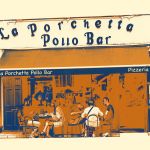
Walking into this crowded and clattering restaurant for the first time in more than 30 years, two things strike me almost immediately: 1) it seems to be largely unchanged and 2) the prices have scarcely risen. I can’t claim to have tried every wine list in Soho, but I can tell you with certainty that this is the first time in a very long time that I have seen a glass of wine for under £5 in the West End. But, incredibly, here it starts at £4.50 – with cocktails from £8.The restaurant is Pollo, as it’s still popularly known, or La Porchetta Pollo Bar as the sign outside calls it. It crams 100 covers on to two floors at the eastern end of Old Compton Street, just behind the Cambridge Theatre, in Soho.

Who’s still laughing at Donald Trump’s hair?

At last month’s Bafta ceremony, David Tennant attempted to make a joke about the state of Donald Trump’s hair, but it barely raised a chuckle. Not surprising, perhaps, when you consider the dramatic vibe-shift sweeping the western world. In a desperate attempt to stay relevant many on the progressive left are suddenly choosing to distance themselves from the luxury beliefs they once held as sacrosanct. But this has led to confusion, especially when it comes to comedy. For progressives, laughing at the right jokes became an indicator of moral virtue and political allegiance, so it was highly amusing to see all those nervous thesps wondering which segments of the ceremony they should be finding funny.

Walking in the footsteps of the Kray twins

A Sunday morning in Bethnal Green and Adam, who has been leading Kray-themed walking tours of the neighbourhood for almost two decades, corrals a congregation of eight polite, reserved, attentive customers who, with sensible rucksacks, floor-length M&S skirts, reusable water bottles and neutral-coloured, thin-laced trainers, look as far removed from pool hall brawls and basement flat stabbings as it’s possible to get without joining the Church Army or taking up cribbage. When he started giving tours of the Kray twins’ haunts, Adam tells us, it was impossible to go more than five minutes without some tipsy ageing derelict lurching out of the Blind Beggar pub to inform the group that he ‘knew the Krays personally’.

Let men do the housework!

Why are women still allowed to do housework? The question used to bother me during the years of my marriage when housework became a running sore between us. Perhaps the friction was inevitable. I was born in revolutionary times, the 1960s, and my mother taught me and my siblings to cook, clean and wash up for ourselves. We turned out as independent, self-sufficient adults. I would never ask a woman to make me a cup of coffee any more than I’d ask a bumblebee to build me a lighthouse. And doing jobs around the house suits my life as a writer. During the day I take frequent mini-breaks and do chores while my mind empties itself of clutter and my batteries recharge. Then I return to my laptop, renewed and refreshed. It’s like meditation – but with concrete results. Clean carpets.

Tips for Sandown and Cheltenham Festival

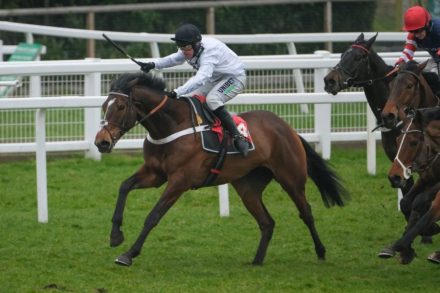
The annual running of the Betfair Imperial Cup Handicap Hurdle at Sandown means that the start of the Cheltenham Festival is only three days away. As usual though, tomorrow’s race (2.25 p.m.) is a noteworthy event in its own right: a competitive affair with 17 runners due to line up for a contest worth more than £51,000 to winning connections. Traditionally, too, this is a race that some trainers – notably Martin Pipe in years gone by – had been plotting to win for some time before sending their horse on to the County Hurdle at Cheltenham six days later. These trainers were, as some still are, in search of two lots of winning prize money and a tasty bonus – now restored to £100,000 – for victory in both the Imperial Cup and a Festival contest.

How ‘toxic’ poisoned our national conversation

There was a time when the word ‘toxic’ was applied in only a handful of circumstances. There was the stuff that occasionally oozed out of a power station into the North Sea and made the fish go funny. Or there was the substance that Christopher Lloyd would stick in the gull-wing doored DeLorean to make it go back to 1955. More prosaically there was the category of toxicity that included rat poison, bottles of bleach or those small sachets that drop out of cardboard boxes containing newly purchased electronic goods. They were generally labelled ‘toxic’ and for good reason. But then this all changed. I’m not exactly sure when it happened, but at some point in the space since Britney Spears’ 2003 hit of the same name and about five years ago, the word went bananas.

The problem with scrapping leasehold

Like most non-renting flat-dwellers, I call myself a home-owner or owner-occupier, but that isn’t quite true. I don’t own my flat; I am a leaseholder. What I bought was the right to occupy it for however many years are left on the lease – and as the lease runs down, the flat is worth less and less. Conversely, this is why, if you were so minded, you could find a prime London flat for a (relative) pittance if the lease has only a few years to run, and why long leases generally come with a premium.

Why possum beats cashmere

In 1990, an exotic Swiss-Canadian teenager of purportedly Habsburgian lineage descended on Cambridge in a cloud of cashmere. His wardrobe was unfeasibly organised, shelf after shelf of cashmere arrayed in all the hues of the rainbow. We regarded him as a thing of wonder. In those days most of us British undergraduates were deeply unsophisticated, many of us impoverished. We were just about graduating from high-street polyester to Scottish lambswool. Cashmere was unheard of. Life moves on, and who today hasn’t indulged in a spot of cashmere? My wife is addicted to the stuff – jumpers, cardigans, polo necks, gloves, scarves – good God, the scarves. These days cashmere is everywhere. Even Uniqlo regularly knocks it out at sub-£100 prices.

The Gen-Z fliers obsessed with maximising their air miles

Oscar, 26, joins me on Google Meet from Buenos Aires, having arrived earlier that day from New York – by way of a few hours in Mexico City and Panama. Just five days ago, he was in London. ‘New York was just going to be a weekend trip for a conference, but then I thought while I’m in America, I might as well head south and here I am.’ It’s a far cry from Wales, where his family lives. Yet this itinerary is barely a ripple in Oscar’s relentless travel schedule. His nonstop approach to flying places him firmly within a new tribe of Gen-Z frequent fliers – mostly men – who treat globe-trotting like a real-life computer game. Their obsession? Maximum air miles for minimal money. The destination itself is secondary; the point is simply to keep moving.

In defence of red velvet cake

I will admit to having been dismissive of red velvet cake in the past, considering it to be bland in flavour and garish in colour. It tended to come in cupcake form with towering hats of super-sweet buttercream, which made it unpleasant and difficult to eat. The cult love for red velvet, inspiring scented candles and lip balms all smelling of synthetic vanilla, always struck me as a bit naff – the preserve of teenage girls queueing outside Instagram-bait bakeries. Why would you plump for a red velvet cupcake when you could have coffee and walnut or a lemon syrup-soaked sponge or a nobbly carrot cake? Red velvet was a cake for people who didn’t really like cake.

Stop scoffing food on trains!

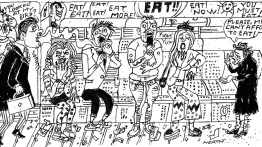
I’m on the 10.45 slow train to Ipswich. It’s not even lunchtime, yet everyone around me is already gorging on food. The corpulent man opposite is posting fistfuls of cheesy Doritos into his gaping maw, washing them down with cheap lager. A woman is noisily chomping her way through a limp burger that reeks of dirty vegetable oil. On my right, I’m greeted by the unmistakable whiff of Greggs meat pie, an unholy stench best described as ‘care-home carpet’. By the time we reach Colchester, the entire carriage sounds and smells like a student refectory, with competing crisp packets and loud slurping noises adding to my sense of despair at the awfulness of humankind. There is no longer much escape from the tyranny of ‘food-on-the-go’.

The dark side of World Book Day

What began in 1998 with Tony Blair standing in the Globe Theatre to announce a new celebration of books has morphed into something much bigger. Along with Black History Month or World History Day, tomorrow’s World Book Day is now a full member of the woke calendar. This calendar has grown – largely thanks to the UN, which spends millions inventing such initiatives – into a global non-profit industry. In March alone, we have Zero Discrimination Day, World Wildlife Day, and World Day for Glaciers. As an author of several books, I’m all for celebrating reading, poetry and especially book buying.

Why the left hates Gail’s

Is there any more evil influence on the world than Gail’s the bakery? It has thrown thousands of poor people out of their homes by gentrifying their neighbourhoods; it has destroyed the livelihoods of hundreds of hard-working owners of independent coffee shops by drawing away business; it has scorned the poor by throwing away its old sandwiches rather than give them to the homeless; and it allegedly supplied a box of pastries to the White House for tea last Friday, which so poisoned the atmosphere between Volodymyr Zelensky and Donald Trump that it could quite possibly lead to world war three. OK, I made the last one up. But as for the others, Gail’s stands accused of them all.

How Armando Iannucci lost his edge

The BBC celebrated one of its own on Monday night. Armando Iannucci was treated to a fawning retrospective by Alan Yentob, and it opened with a crass piece of TV trickery. ‘Armando Iannucci is not an easy man to pin down,’ said Yentob, as if his quarry were a master criminal or an international terrorist. ‘For ten years, I’ve been trying to talk to one of Britain’s greatest comic talents.’ Iannucci, in his heyday, would have enjoyed dissecting this sort of bombastic hyperbole. This week, he connived in the hoax. Yentob ran through Iannucci’s CV. He was raised by affluent Glaswegians (plenty of colour photographs suggesting a comfortable income), and after studying at Oxford he moved to BBC radio.

A pensioner’s guide to being broke

I’m a broke pensioner – quite a jolly one – not like those people Age Concern show wrapped in blankets, the caption informing viewers that she daren’t put the heating on. I’m not like those pathetic old people, I tell myself (untruthfully). I do put the heating on but, like the poor old dears in shabby armchairs, I worry about how I’m going to pay my heating bill – especially now Labour has taken away my wonderful winter fuel allowance. Being broke at 68 is humiliating. But it is also only to be expected, given how little money I’ve managed to make in my quite long life. Sometimes I get resentful and start to do a Cleopatra’s Nose on my life: what if I’d stayed married to the father of my children?

Nurses shouldn’t have tattoos

Of all the aspects of dating that make me grateful I came off the market when I did – ghosting, choking, sober socialising, facial hair like Brahms’s beard – it’s the spread of large-scale visible tattoos that makes me feel like I got the last chopper out of ’Nam. Neck tattoos and sleeves were once either indicators of prison gang allegiances or the preserve of thrash metal bands and their fans. Although perhaps the most heavily inked man in rock is Travis Barker, drummer of pop-punk crossover tarts Blink-182. His whole head is tattooed, as is Kerry King’s of Slayer, who also has ‘God Hates Us All’ down his left arm. Among Phil Anselmo of Pantera’s extensive body art is a portrait of himself as a demon with his now ex-wife riding an extending tongue.

Is Kate Moss… basic?

Could it be? Could the world’s sexiest, coolest woman be turning... basic? It has come to feel as if that effervescent, mercurial quality that kept her aloof from the cut and thrust of the celebrity rabble – the endorsement-chasers, the tell-all-interview mongers – has evaporated. Kate Moss is turning into the very thing she had always been at pains to shun. Moss once called an EasyJet pilot a ‘basic bitch’ after being escorted off the plane for swigging vodka from her carry-on after Sadie Frost’s 50th birthday. Now she is becoming a basic bitch (to say nothing of her daughter Lila, whose bare nipples at London Fashion Week have been the talk of the internet town). It began when she embraced Topshop as its designer, launching in 2007.

In defence of Jack Vettriano

The death of the painter Jack Vettriano at the age of 73 is sure to delight at least one art critic: the Guardian’s Jonathan Jones. Jones has consistently attacked the creator of The Singing Butler, Britain’s best-selling single image, as ‘brainless’ and ‘not even an artist’. He derided his work as ‘a crass male fantasy that might have come straight out of Money by Martin Amis.’ Nor is he alone.

Last orders: farewell to my 300-year-old local pub

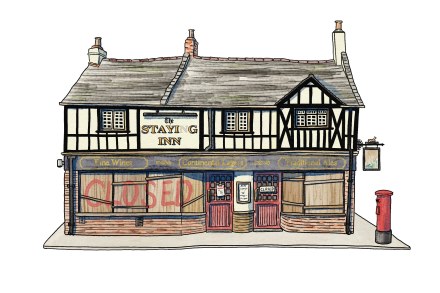
The Cherry Tree on Southgate Green began life as a coaching inn on one of the historic routes from London to York and beyond. It has been trading since 1695, when what are now the north London suburbs were open fields. But the other evening, the pub – my local – rang last orders for the final time. The brewery that owns it is having it refurbished as a brasserie, its pub status coming to an end after 330 years. I went on its final evening for the closing-down party. It was like being in an episode of EastEnders, in the sense that it was a pub full of faces you dimly recognised from events long past, drinking and being jolly, like the Queen Vic at Christmas. Becoming a brasserie seems an unlikely route to financial redemption for the Cherry Tree, though.

The Imperial War Museum’s betrayal of history

The news that the Imperial War Museum is closing Lord Ashcroft’s Victoria Cross and George Cross gallery is sadly not a great surprise. It’s the latest act in the ‘wokeification’ of this once outstanding museum. Writing in the Daily Telegraph last week, Lord Ashcroft said that the IWM didn’t even have the ‘courtesy to inform’ him of the closure. Rather, it issued a statement in which it thanked him for his generous 15-year loan but said the exhibition will shut permanently on 1 June. The reason, explained the IWM, is to create new space ‘to allow us to share more stories of conflicts that are within many of our visitors’ living memory’.

Something to relish: in praise of Patum Peperium

In a social media age, certain ingredients – long esteemed by those in the know – suddenly burst on to the scene. One morning we woke up to all the supermarkets stocking Mutti tinned tomatoes. Ortiz sardines and Perello Gordal olives are now in the limelight. I wonder – given the current zeitgeist for all things umami – whether Patum Peperium (Latin: ‘peppered paste’) could be next. Then again, the ‘Gentleman’s Relish’ – an anchovy paste made with butter and spices – isn’t for everyone. Much like Marmite, it has embraced this contentious reputation: ‘Dividing opinions since 1828’ it declares in its branding. After almost 200 years on the scene, it has started popping up in trendy spots, like a debonair rake sauntering into a party fashionably late.

Why Roman gladiators were the first feminists

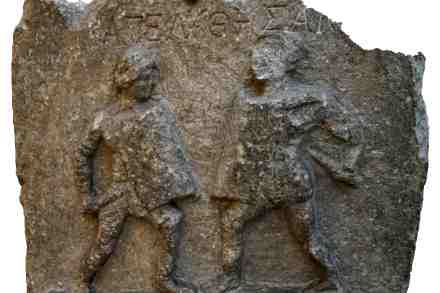
Chiselled out of stone in around the 1st century AD, the scene in this image gives a powerful snapshot of the excitement of gladiatorial combat. In this carving found in Turkey – once a key part of the Roman empire – the opponents face each other head-on, with a look of grim determination. From behind their curved rectangular shields, both appear ready to lunge with short stabbing swords. However, this gladiatorial fight differs from what you might expect in one crucial way: both opponents are women. Look closely enough and you will see the gladiator on the left has her long hair in a plait which snakes down to a bun at the bottom of her neck.

What does it mean to be British?

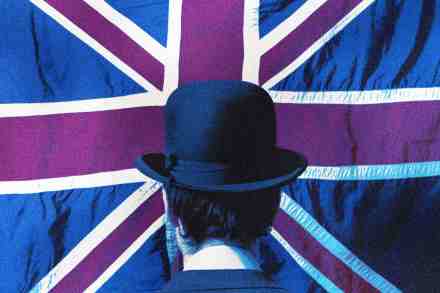
The comic writer George Mikes, who died nearly 40 years ago, knew he had made it when he received a fan letter one day from Albert Einstein. Mikes, the scientist said to him, was blessed with ‘radiant humour… Everyone must laugh with you, even those who are hit with your little arrows.’ Chief among Mikes’s targets were the British people, whom the writer – a refugee from Hungary – had chosen to spend the greater part of his life among. He had come to the UK on a visit in 1938 and wisely, given what would happen to his country in the years that followed, decided never to leave. Though it describes an England now long vanished, his 1946 book How to be an Alien, a comic study of the country and its foibles, brought him fame and acceptance.

Three tips for Kelso and Newbury

The ground will play a key role in the outcome of the big race at Kelso tomorrow, the bet365 Morebattle Hurdle (3.30 p.m.) worth nearly £62,000 to winning connections. The going description is currently 'good to soft, soft in places' but with a day and a half of winter sunshine forecast it could well be nearer to 'good' ground by the off. I certainly hope that is the case because the two horses I am backing both like fast ground. My number one fancy is Alan King’s FAVOUR AND FORTUNE, whose fine run when fourth to the impossibly well-handicapped Joyeuse can be marked up as he was inconvenienced by the soft ground at Newbury in the William Hill Hurdle.

Illegal rewilders are taking over the countryside

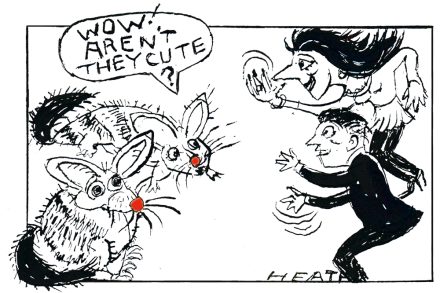
Hardly a month goes by without a report of guerrilla rewilders at work. Lynx released in the Cairngorms, wild boar on Dartmoor, beavers everywhere and, no doubt, before long, wolves and bears – if neo-Rousseauist guerrillas can find a ready supply and achieve it without being bitten.  Usually, these illegal releases of formerly indigenous-but-no-longer-native animals are in national parks, reinforcing my view that national parks give people a state-sponsored sense of entitlement to behave as they please on private land. The fact that the vast majority of farmers are against such reintroductions seems to give added incentive to the rewilding guerrillas. The extinction of family farms at the hands of Rachel from Customer Complaints is bad enough.

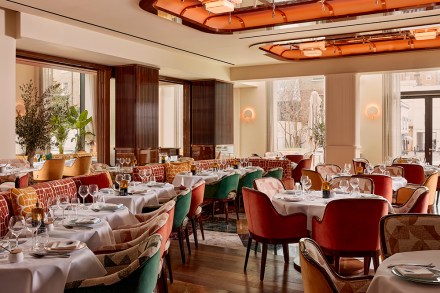
The tiramisu is one of the loveliest things I’ve eaten anywhere: La Môme London reviewed

La Môme is the new ‘Mediterranean’ restaurant at the Berkeley, Knightsbridge’s monumental grand hotel. It has changed, as all London’s grand hotels have changed: it is Little Dubai in the cold and the chintz is on the bonfire. Fairy lights hang from the awning of the entrance, as if in an eternal Christmas. I barely recognise it, though I ate an impersonation of a mandarin in its overwrought Instagram-friendly bakery two years ago, and it was inferior to a real mandarin. I cling to that. Designers must keep busy: this means grand hotels are always getting renovated – it’s life of a kind. The lobby feels gold, though that may only be an impression.

The strange superstitions of the racing world

In racing, superstitions are rife. I once saw a trainer remonstrate with an owner for displaying a green handkerchief: green, he insisted, was unlucky (although it doesn’t seem to work that way for owners Simon Munir and Isaac Souede, whose ‘double green’ colours have been carried to success in many top races). Henrietta Knight, who trained Best Mate, is famously superstitious: straw on the way is OK, but if she sees a load of hay en route to the races she’s so sure of bad luck that she’s inclined to turn back. She couldn’t bear to watch Best Mate’s Gold Cups from the stands and hid in a tent behind the weighing room. Former jockey Sam Thomas, who’s making a name for himself as a trainer by successfully targeting big handicaps, seems to be of the Henrietta school.

The real reason for Scotland’s Six Nations defeat

The confused world of Duhan van der Merwe must seem more confused than usual after last weekend. The Scotland winger with an accent that sounds more Western Cape than Western Isles found himself crowned man of the match despite Scotland’s defeat by England at Twickenham, while at the same time being scapegoated as the man who lost the game and the Calcutta Cup for his adopted nation. Van der Merwe, who at 6ft 4in and nearly 17 stone could easily be mistaken for a lock forward, was roundly criticised for cutting away from the posts rather than towards them when he ran in the try right at the end of the match that took Scotland to within one point of England.