Culture

Culture

The good, the bad and the ugly in books, exhibitions, cinema, TV, dance, music, podcasts and theatre.

Paradise regained: how the world’s wastelands are regenerating

More from Books

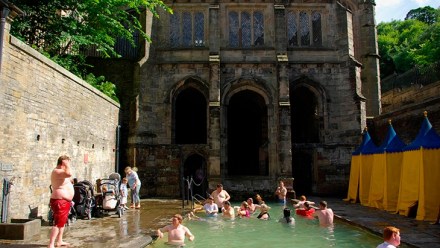
Ignoring the padlocked gate, my six-year-old son Nicholas and I climbed through a break in the metal fence and pushed into the mesh of undergrowth. This was the site of Ducker, the open-air swimming pool that once belonged to Harrow School. Here the young Winston Churchill romped (naked, since trunks were for prefects), as, in his day, did my dad. When I arrived at Harrow in the 1980s, the pool — far bigger than Tooting Bec Lido, which is now the UK’s largest — had just been abandoned. It was covered with graffiti, the haunt of skateboarders. Returning in 2021, I looked for changes wrought by three decades of neglect. Google Maps showed a J-shaped artificial lake, 30m by 150m.

The roots of humanity remain obscure

More from Books

To comprehend ourselves and the future of humankind we have to understand where we came from. Unlike the approximately 350,000 known species of beetles on Earth, there is just one existing species of human. It is hard to imagine how our bodies and minds might have been constructed along different design principles or generated even a fraction of such diversity. With our growing ability to manipulate human genomes using gene editing, and the emergence of technologies that may enable human genomes to be rewritten in their entirety, the question of what we might become is no longer theoretical. Should humankind decide to redesign itself, the crapshoot of design by Darwinian evolution may become as redundant as taxi drivers in an age of driverless cars.

Paint in the bloodstream: The Death of Francis Bacon, by Max Porter, reviewed

More from Books

Francis Bacon once told the art critic Richard Cork: ‘I certainly hope I’ll go on till I drop dead.’ Max Porter’s The Death of Francis Bacon is a book about painting to the end. It is about art, rags and the restless artist’s eye. Porter, the author of Grief Is the Thing With Feathers and Lanny, has called it ‘my attempt to write as painting, not about it’. In this he brilliantly succeeds. The writing is matted and clotted and thickly impastoed. Each page has the ridge and texture of paint; the paper is like scabby canvas, the words are like drying oil. There is a sticky, tacky quality, as if the author has only just stopped and stood back to look at his work. The book feels unfinished and that seems right.

The criminal code of Rotwelsch deciphered

More from Books

When Martin Puchner was a child, tramps would turn up at his family home in Nuremberg to be fed by his mother. His father explained that they were drawn by a zinken (sign) associated with Rotwelsch, a language spoken by vagrants and criminals whose name is derived from two terms: Rot (beggar) and Welsch (incomprehensible). The zinken, a cross within a circle carved into the house’s foundation stone, told them that lechem (bread) could be had there. Rotwelsch became Puchner’s key to unlocking a cupboard of family skeletons. His grandfather, Karl, the director of the Bavarian State Archive, was one of many unrepentant Nazis who benefitted from the swift changes in the status quo that followed Germany’s defeat in 1945 and the new threat from Soviet Russia.

The aesthetic prejudice towards white classical statues

More from Books

In the 1930s curators at the British Museum, under orders from Lord Duveen, a generous donor, scoured and hacked at the friezes and statues of their Parthenon collection. They were trying to remove the smudges and stains thought to be discolouration, to restore the marbles to their original colour — white. But it wasn’t discolouration; it was paint. Though the idea was rejected for years, an arsenal of new technologies — infrared, ultraviolet, X-ray and chemical analysis — has since established that classical sculpture was slathered with the stuff. Though polychromy — the art of painting statues and architecture — was finally accepted in the 1970s, it was proposed over a century before Duveen’s men picked up their chisels.

Does William Barents deserve to have a sea named after him?

More from Books

Narratives of frozen beards in polar hinterlands never lose their appeal. Most of the good stories have been told, but in Icebound Andrea Pitzer fills a gap, at least for the popular reader in English, with the story of the 16th-century Dutch mariner William Barents. He sailed further north than any man before him and lives still, on the map, with an eponymous sea off the northern coasts of Norway and Russia. In 1594, during the third decade of his country’s war with Spain, Barents voyaged to the unknown Nova Zembla (‘New Land’ in Dutch), planning to find a route to the fabled riches of Cathay. The notion of a navigable northern ocean had tantalised explorers since the Ancient Greeks, and geographers in Amsterdam thought the North Pole would be warm.

The farce of the Nobel Peace Prize

More from Books

Betraying the Nobel opens with a detonation from Michael Nobel, Alfred’s great-grandnephew. The vice-chairman and then chairman of the Nobel Family Society for 15 years, Michael believes that the Nobel Peace Institute has betrayed the ‘original conditions of Alfred Nobel’s will and intentions’. Its selection process is ‘very sketchy’ and its committee of Norwegian parliamentarians reflects the balance of power in their parliament. Its awards follow ‘personal interests’, ‘political and national considerations’ and ‘human rights or global warming’, all of which have ‘little or nothing’ to do with Alfred Nobel’s bequest. The Prize was a dynamite idea when it was founded in 1900.

How Hitler’s great gamble nearly paid off

More from Books

Do we need another wrist-breaking book about Adolf Hitler, the Third Reich and the second world war? Since Ian Kershaw published his two-volume biography of the Führer 20 years ago, there have been at least a dozen similarly weighty tomes on the war by historians including Max Hastings, Andrew Roberts, Antony Beevor and Kershaw himself; not to mention more recent massive lives of the Nazi dictator by Brendan Simms and the German historians Peter Longerich and Volker Ullrich. So what is there left to say that we do not already know? To gain attention, any new study has to have a thesis: some fresh angle that previous writers have overlooked or played down.

Is Indian cricket no longer cricket?

More from Books

There is nothing in world sport, ‘nothing in the history of the human race’, Ramachandra Guha modestly reckons, that can remotely match the passions that surround Indian cricket. I have no idea how many listeners or viewers hung on every ball of Ben Stokes’s Headingley heroics last year, but it is a safe bet that had it been Sachin Tendulkar or Sunil Gavaskar batting, and an India victory over Pakistan at stake, then you could add as many noughts to that figure as will accommodate a cricket-mad population edging its way towards the one and a half billion mark. The Commonwealth of Cricket is part celebration, part elegy, but before all else unashamedly the book of one of those tens of millions of India’s cricket fans.

In search of Noëlle: Invisible Ink, by Patrick Modiano, reviewed

More from Books

At some point in his twilit, enigmatic novels of vanished lives and buried memories, Patrick Modiano likes to jolt his reader with a glimpse of the all-too-real horrors that underpin his work. In Invisible Ink such a moment comes when the narrator recalls images from a postwar trial, where ‘behind the accused were about 30 suitcases — the only remaining traces of persons who had gone missing’. You might say that Modiano has spent a literary lifetime opening those suitcases to find out whose lives they contained. Born in Paris in 1945 to a Belgian actress mother and a Jewish father who had survived the Occupation by weaving through an underworld of shady deals, he grew up in a family microclimate of evasion and oblivion.

Latin America in crisis again

More from Books

It wasn’t so long ago that British readers, on hearing about the incompetence and corruption of Latin America’s political leaders, could gasp, despair or smirk, depending on their own political leanings and the leaders in question, and rest assured that, for all the United Kingdom’s problems, they were immune to such folly. Institutions were stable, the rule of law was unshakeable, the economy was reliably solid and, besides, the good old Brits, born with an innate common sense that was the envy of the rest of the world, would never fall for such blatant chicanery. Those days are no more. In Latin America, however, charlatans have long been part of the political landscape.

The life and loves of Mary Wollstonecraft

Lead book review

What did Mary Wollstonecraft like and love? This is the question Sylvana Tomaselli, a lecturer at Cambridge University, asks herself at the start of her new book about the writer and philosopher who is often described as ‘the mother of feminism’. After the unveiling of Maggi Hambling’s controversial statue in honour of Wollstonecraft on Newington Green last November, and the vitriolic spats between its detractors and supporters that ensued, a book that refocuses attention on the person at the centre of the storm is a welcome relief. Wollstonecraft, born in 1759, was determined to live independently by her pen.

Will we soon see the end of conservatism as we know it?

Lead book review

For some years I chaired the international alliance of centre right and conservative parties, the International Democrat Union. It is an organisation that illustrates the difficulty of defining and categorising right-wing political movements: it is called ‘democrat’, but includes the American Republicans, boasts the Australian Liberals among its avowedly conservative members and includes Christian Democrats, Independence parties, National parties, People’s parties and even one United Workers Party. This variety is more than a matter of nomenclature. What these parties have in common is that they are the main rivals in each of their countries to a party of the left. They are defined more by a shared enemy than having similar programmes of their own.

Barbara Amiel is a cross between Medusa and Maria Callas

More from Books

If this book becomes a Netflix blockbuster, as it surely must, Barbara Amiel presents us with an opening image. She describes, during a visit to see her husband Conrad Black in prison, watching a Monarch butterfly rise above roadside debris: You couldn’t miss it in that bright early morning sunscape of trash cans and crumpled paper cups, so intense the colours and so large its wings as it did a parabola over a little triangular patch of wildflowers growing off to the side of the service area at Turkey State on Interstate 95. Let me have a think about whom that might metaphorically represent.

A conciliatory P.J. O’Rourke is not the satirist we know and love

More from Books

There was an acidic bravura and beauty in P.J. O’Rourke’s early journalism and a gleefulness in the ease with which it raised ire. Hitherto, satirists — and especially American ones — had tended to come from the left, none more so than O’Rourke’s mentor Hunter S. Thompson, who campaigned long and hard for George McGovern in 1972. Not Patrick Jake. He sprung like a jubilant, potty-mouthed leprechaun from a country which had fallen back in love with itself after the self-flagellating miseries of Vietnam, Watergate and Tehran.

Christiaan Huygens – hero of time and space

More from Books

This book, soaked like the Dutch Republic itself ‘in ink and paint’, is enchanting to the point of escapism. The author calls it ‘an interior journey into a world of luxury and leisure’. It is more than that. What he writes of Christiaan Huygens’s milieu is true also of his book: ‘Like a Dutch interior painting, it turns out to contain everything.’ Hugh Aldersey-Williams says that Huygens was the first modern scientist. This is a delicate argument to make: the word ‘scientist’ didn’t enter the English language before 1834. And he’s right to be sparing with such rhetoric, since a little of it goes a very long way.

Labyrinthine tales: We All Hear Stories in the Dark, by Robert Shearman, reviewed

More from Books

When the estimable Andy Miller, the host of the Backlisted podcast, recommended a new collection of short stories on Twitter, he said just enough about it to pique my interest. Online booksellers didn’t seem to have heard of it and I had to buy it directly from the publisher. I’m very glad I did. Robert Shearman’s We All Hear Stories in the Dark, running to three volumes and 1,750 pages, is the most original and impressive new fiction I’ve read this year. You have to find your own way through it. It takes its form from an outdated but fondly remembered series of paperbacks for children, the Adventures of You, invented by the American author Edward Packard.

Mozart the infant prodigy was also a child of the Enlightenment

More from Books

‘My dear young man: don’t take it too hard,’ Joseph II counsels a puppyish Mozart, the colour of his hair unknown in nature. ‘Your work is ingenious. It’s quality work. And there are simply too many notes, that’s all. Just cut a few and it will be perfect.’ ‘Which few did you have in mind, your majesty?’, Mozart enquires, the sinisterly oleaginous F. Murray Abraham as Salieri quietly registering the subtle brilliance of Mozart’s grinning lèse-majesté. Those interested in the subject of Miloš Forman’s 1984 film Amadeus are today faced with a not dissimilar predicament: which of the millions of words written about Mozart should we cut?

The map as a work of art

More from Books

’Tis the season of complacency, when we sit in warmth and shiver vicariously with Mary and Joseph out in the snowy wastes, A Christmas Carol or The Snowman. A handsome exploration of Antarctica seems equally appropriate festive fare. Peter Fretwell brings us chillingly close to a continent that has always inspired awe, evidenced by christenings such as Mount Erebus and Fenriskjeften — the Wolf’s Jaw mountains, named after Fenris, the Norse equivalent of the Beast, which will arise at the end of time to eat the world. The coldest, driest, remotest and windiest place on the planet, surrounded by the roughest ocean, has always seemed like somewhere primordial deities might live and secrets subsist — entrances to underworlds, hidden civilisations, UFO bases.

The Enlightenment was a many-splendoured thing

More from Books

History used to be so much easier. There were the Wars of the Roses, then the Reformation, the Civil War, the Enlightenment and finally the Victorians. Each one had its own century and its distinctive tag. Throw in Henry VIII and Elizabeth I, garnish with a few zealots and adventurers, some glorious triumphs and some grisly deaths. It was all part of our Island Story. You knew where you were. Take the Enlightenment, for example. Everyone knew that this was the Age of Reason: the moment when science finally started to impose order and banish religion. The French rationalists had their heyday, Voltaire, the philosophes and all that, before they were vanquished by the Scottish empiricists David Hume and Adam Smith and the great commercial acceleration of the late 18th century.

All change: The Arrest, by Jonathan Lethem, reviewed

More from Books

This is an Exquisite Corpse of a novel — or if you prefer another name for that particular game, Heads, Bodies and Legs, or Combination Man, or perhaps most appositely Consequences. The parlour game involves creating something and then passing along the hidden creation to which another then adds, and The Arrest reads like Jonathan Lethem playing the game against himself. He is a novelist whose work has always experimented with, and evaded, genres. In this one, he is juggling dystopia, Thoreau-like idealism, science fiction, folk horror, sentimentality, revenge plot and quite a lot more. It is also very funny. I did want to say that it is like Cormac McCarthy animated by Hanna-Barbera, but Lethem gets there first, since one scene is a — loving?

What is so special about heavy metal?

More from Books

Ever since my early youth I have loved, followed and respected a certain music genre that some people consider strange, even dangerous: heavy metal. The journey started in Istanbul, at a small, stuffy music store on a side street in Taksim, nestled between an Ottoman mosque and a fish market, where I would buy cassettes of Iron Maiden, Judas Priest, Led Zeppelin, Megadeth, Twisted Sister, Metallica... and then go home and listen to them endlessly while eating sunflower seeds, because that’s what we Istanbulites do to pass time. Over the years I veered towards less-well-known sub-genres, such as industrial metal, symphonic metal, metalcore, gothic metal, Viking/pagan/Nordic metal; and while the cassettes disappeared, my love for heavy metal remained solid.

The only man who didn’t want to be Cary Grant was Cary Grant himself

More from Books

Cary Grant was a hoax so sublime his creator struggled to escape him. He was a metaphor, too, for the transformative magic of cinema, for its lies; and for the artifice and social mobility of the 20th century itself. His real name was Archie Leach, and he could, the critic David Thomson wrote, ‘be attractive and unattractive simultaneously; there is a light and dark side to him, but whichever is dominant, the other creeps into view’.

The End of Times and the coming of the Antichrist

More from Books

Two things it may be wise to know before picking up this relatively short and surprisingly cheerful brand spanking NEW biography of the Antichrist: (1) the meaning of the word ‘eschatological’ (it’s fairly critical); (2) the fact that the Antichrist is not the devil (a common misapprehension). The Antichrist is actually the son/spawn of the devil, and Philip C. Almond has already provided us with a perfectly serviceable biography of the Prince of Darkness himself (also NEW, even though, um, a few years old now). As a religious/cultural figure the Antichrist was actually a bit of a slow starter.

Unpleasant smells can actually enhance pleasure

More from Books

Harold McGee’s Nose Dive: A Field Guide to the World’s Smells is an ambitious and enormous work. Indeed it’s so large, at 654 pages and weighing nearly a kilo, that I could only manage to read it at the kitchen table — which made me appreciate its wipe-clean binding. Its distinctive new-book smell (there is such a thing) contrasts mightily with the musty, familiar old-book scent of my study. As I walk through the house, I detect the not entirely agreeable whiff of last night’s wood fire in the sitting-room, but this gives way to the snap-to-attention aroma of just-made coffee, the fragrance of the sliced banana and apple in the morning muesli, the scent of the loaf just out of the oven and the unmistakable redolence of toast.

The serious business of graphic novels

More from Books

One of the running jokes about ‘serious’ graphic novels is that so many seem to consist, one way and another, of comics about how lonely, miserable and socially inept comic book creators are. Adrian Tomine leans into the trend, but with great charm, in The Loneliness of the Long-Distance Cartoonist (Faber, £16.99). Here is an autobiographical anthology of humiliation in chronological order — a series of wan vignettes taking the artist from inadequate-feeling schoolboy comics nerd to... inadequate-feeling New Yorker-published middle-aged comics superstar.

Joseph Ratzinger’s coat of many colours

More from Books

A common but flawed assumption about Joseph Ratzinger is that he is simply an ardent conservative. That’s the figure we see in Netflix’s The Two Popes. Anthony Hopkins’s performance may be a visual feast, but the script leaves no cliché unaired. Better informed observers note that the Vatican’s former doctrinal guardian is a poacher turned gamekeeper who once supported major reform of the Catholic Church but then performed a somersault, partly because of worry about threats including Marxism and moral relativism. Among the truest verdicts is that he has always been torn between different versions of himself.