Turing’s Cathedral
More from BooksClick here to view this article.

The good, the bad and the ugly in books, exhibitions, cinema, TV, dance, music, podcasts and theatre.
Click here to view this article.
Fifteen years ago Ahmed Rashid wrote an original, groundbreaking and wonderful book about the Taleban, a subject about which few people at the time knew or cared. Then along came 9/11 and Rashid turned overnight from obscure scribbler into global sage. He was courted (as he reminds us from time to time in this book) by presidents and celebrated by Washington think-tanks. But all this recognition, while well deserved, has had a terrible effect on his prose. Instead of writing very good books, he now writes very bad ones. His Descent into Chaos, published in 2008, an account of the years after 9/11, was ponderous and loaded with received wisdom. This volume is no better.
In a large upstairs room of the YWCA building behind Tottenham Court Road, a group of actors were nervously waiting for the arrival of the director. There was the powerful whiff of a good cigar, the faint scent of expensive cologne and Orson Welles arrived. He had been in Paris cutting his film of Kafka’s The Trial and now here he was; a huge man, beautifully dressed in a dark suit and floppy tie, full of good humour, apologising for having missed a week of rehearsal. The room exploded with his laughter, an explosion so loud you feared for the windows, and everyone relaxed. He had prepared a version of the two parts of Shakespeare’s King Henry IV and he was going to play Falstaff. Most of the cast were young, and amongst them was a teenager who had been at Oxford.
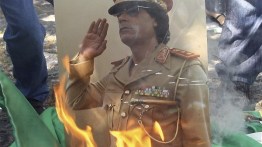
The date that rebel leaders chose for the final assault on Tripoli was auspicious: 20 August 2011 coincided with the 20th day of Ramadan by the Muslim lunar calendar, the date on which Muslim forces led by the Prophet Muhammad conquered the holy city of Mecca for Islamic rule in AD 680. It was also exactly six months since the Libyan people had risen against Colonel Muammar Gaddafi and his regime. The nomenclature of the operation — Mermaid Dawn — was no less bizarre than the regime it sought to overturn. Neighbourhood co-ordinators roused sleeper cells with the agreed code phrase ‘We’re going to have soup tonight.’ After sunset, when Muslims broke their Ramadan fast, the assault began.
Barbara Pym was never just a cosy writer. She could be barbed and sour — and seriously, hilariously funny. Kate Saunders, in her introduction to Pym’s last novel, explains how ‘Rather to my surprise,’ Barbara Pym wrote to her friend Philip Larkin in 1971, ‘I have nearly finished the first draft of another novel about a provincial university told by the youngish wife of a lecturer. It was supposed to be a sort of Margaret Drabble effort, but of course it hasn’t turned out like that at all.’ The novel was An Academic Question — witty, sharp, light as a syllabub, nothing like anything by Margaret Drabble and with a cast of typically Pym-like English eccentrics.

It must have been hard to settle on a title for this book; but then this is not the book that Richard Cork originally had in mind. In his introduction to The Healing Presence of Art he describes how he was approached to write on the contemporary role of art in hospitals, but in beginning the research for this he became aware, as he puts it, ‘of the rich, complex and largely overlooked tradition’ to which modern art and medicine are the heirs. It is this vast hinterland that forms the theme of Cork’s book. It is neither ‘art in hospitals’, nor ‘art and medicine’ nor ‘art as therapy’ but all these things and more.
Ursula Graham Bower belonged to the last generation of those well-bred missy-sahibs who came out to India at the start of the cold-weather season in search of genteel adventure and a husband. But unbeknown both to herself and to those about her, the gawky, ‘well-covered’, Roedean-educated Miss Bower was of that stern stuff upon which empires are built. Having arrived at a frontier outpost of Assam in the autumn of 1937 as the 24-year-old guest of a friend housekeeping for her elder brother, she set about carving out her own niche as an anthropologist. Her chosen subject was the Nagas, a lose confederation of tribes much given to raiding and head-hunting. Bower’s timing was spot-on.
In 1598, a certain Margaret Browne of Houndsditch gave a graphic description to the court of her neighbour Clement Underhill engaged in an adulterous act with her lover, as observed through a hole in the party wall. Some people have always been very interested in what the neighbours are up to; all of us can be affected by them. Emily Cockayne has investigated the relationship by conjuring up scores of pieces of evidence such as the one cited, from the early Middle Ages till the present day, trawled from manorial records, police and law courts, civic authorities and newspapers. The result is a nicely personal view of how we have got on with the people next door, homing in on the perennial issues — noise, sanitation, intrusion and privacy.
‘Poets don’t count well,’ says Ian Duhig in his contribution to Jubilee Lines — an assertion unexpectedly confirmed by Carol Ann Duffy’s preface. Admittedly, if the book did contain one poem for every year since 1952, there’d be an annoyingly untidy 61. Even so, Duffy’s declaration that the Queen was crowned ‘on 2 June 1953, 60 years ago this year of 2012’ may come as a surprise. No less puzzlingly, we’re also told that in 1977 ‘the Queen had been on the throne for nearly a quarter of a century’, which makes the Silver Jubilee seem a bit ill-timed.
Hard on the heels of the ecstatically received London revival of Michael Frayn’s Noises Off (currently playing at the Novello Theatre) comes this hilarious novel. It’s not easy to pull off farce on the printed page when so many of the laughs of the genre generally depend upon physical comedy. In Noises Off, for example, one character hops about the stage like a demented kangaroo, his shoelaces tied together. But just as a filthy joke is made funnier when told by an apparently po-faced academic, so a really silly plot is enlivened when composed by a highly clever author. Frayn is that man. In the hands of someone less accomplished, the events in Skios would be too improbable, its characterisation too thin, its reliance on that old trope, mistaken identity, just too plain daft.
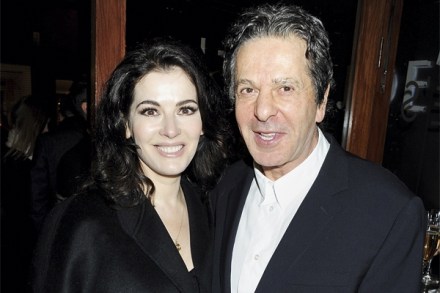
At first glance, Be the Worst You Can Be (Booth-Clibborn Editions, £9.99) by Charles Saatchi (pictured above with his wife, Nigella Lawson) seems a rather distinguished book, with its gilt pages bound in what feels like genuine Gnomitex, and this impression persists until one begins to read it. The title page explains the format — ‘Charles Saatchi answers questions from journalists and readers’ — and the first page sets the tone: ‘If you had a bumper- sticker on your car,’ asks a journalist or reader, ‘what would it be?’ And our modern Maecenas replies: ‘Jesus loves you. But I’m his favourite.’ (Boom boom!) So it’s not a distinguished book. It’s a toilet book. Nothing wrong with that, of course.
In June 1991 while working as a reporter in Rome, Ed Vulliamy received a phone call from his editor at the Guardian asking him to the travel to the neighbouring Balkan states to check out something strange that was happening in the region. Vulliamy spent the next few years immersed in the Bosnian War, the worst carnage to blight European soil since the Third Reich. In August 1992, Vulliamy revealed to the world the horrific concentration camps that were in operation in Omarska and Trnopolje in Bosnia. Vulliamy’s latest book The War is Dead, Long Live The War is a tribute to some of the survivors, who are now scattered across various cities around the world in exile.
Bond is back. William Boyd has agreed to don the garb of Ian Fleming and write the latest tale in 007’s story. Boyd will not be aping Fleming’s style. The recent franchise revivals by Sebastian Faulks and Jeffrey Deaver are singularly different to each other and the original canon, while remaining faithful to the (anti-)hero in some fundamental way. They match the Bond film series in that regard. Daniel Craig, Sean Connery and Roger Moore could not be more dissimilar in their depictions of the character, yet each is recognisably shaken not stirred. Deaver and Faulks wrote slightly psychological Bond thrillers — I can’t really remember where they were set.
William Boyd is to write the next book in the James Bond franchise. The as yet untitled novel will be published next autumn. To mark the announcement, Daisy Dunn casts her mind back to a recent encounter with Boyd, where he spoke about the art of imagining and writing a thriller. It’s an ambitious eight minute walk from St. Hilda’s College to the Master’s Garden of Christ Church, where William Boyd is preparing to appear at the Oxford Literary Festival. He’s visibly bracing himself. It’s quite a walk from there to the stage - the kind of walk you’d make at a school prize-giving. A formal path for such an unassuming man. I imagine him making the journey I’ve just done over the bridge from St.
Chances are you’ve read, seen, or at least heard about The Hunger Games, the young-adult book and film sensation by Suzanne Collins. The crux of the story centres on The Hunger Games itself, an annual event in a dystopia in which twenty-four teenagers are forced to fight each other to the death – the winner is the sole survivor. Unsurprisingly, this has proved rather a controversial storyline. While the film has smashed box office records and the books have sold over 23 million copies, the books are also among some of the most complained about works in America. (Albeit in good company with To Kill a Mockingbird and Brave New World.) Key to the controversy is all the violence.
Nigel Havers is in the hotseat this week. He tells us about his intimacy with the Racing Post and his dreams of playing Casanova. You can catch him tonight in Corrie. 1) What are you reading at the moment? Fifty Shades of Grey – EL James 2) As a child, what did you read under the covers? The Racing Post 3) Has a book ever made you cry, and if so which one? The White Hotel – DM Thomas 4) You are about to be put into solitary confinement for a year and allowed to take three books. What would you choose? War & Peace – Leo Tolstoy, The Darling Buds of May – HE Bates, and Nostromo – Joseph Conrad 5) Which literary character would you most like to sleep with?
The Arab Awakening, Tariq Ramadan’s contribution to the fast-growing body of literature on the Arab uprisings, begins with a request for the Arab world to ‘stop blaming the West for the colonialism and imperialism of the past…and jettison their historic posture as victims.’ This is an encouraging start, and hopes for a refreshing change of tone from the author are further bolstered by a sentence which would not be out of place in the pages of a journal of the American neoconservative right: ‘some people are quick — too quick — to rejoice at the collapse of American power.
We all know the names Auschwitz, Treblinka, Belsen, and Dachau. But what about Pechora, Vorkuta, Kolyma and Norilsk? Why are the camps to which Nazism's victims were deported household words, while the Gulag archipelago – the far flung network of Soviet labour camps and penal colonies where the victims of Stalin and Communism suffered and died – remains terra incognito to most of us.
‘A Drizzling Easter Morning’ And he is risen? Well, be it so. . . .And still the pensive lands complain,And dead men wait as long ago,As if, much doubting, they would knowWhat they are ransomed from, beforeThey pass again their sheltering door. I stand amid them in the rain,While blusters vex the yew and vane;And on the road the weary wainPlods forward, laden heavily;And toilers with their aches are fainFor endless rest---though risen is he. Historically, most poems about Easter have been written by Christians. They are normally celebrations of faith. Thomas Hardy, however, was very self-consciously not a believer. But people’s need to understand the world in broadly religious terms is an enduring theme of his novels and poetry.
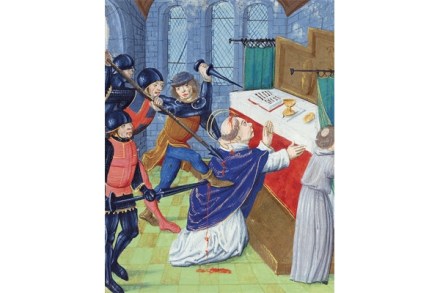
Posterity has always embellished Thomas Becket. After his death in Canterbury Cathedral in December 1170 the Church idealised and canonised him; his tomb inspired miracles and became the most famous shrine in Christendom; the local monks grew rich and fat on the tourist trade that would attract Chaucer’s pilgrims. The 18th century invented Henry II’s hint, ‘Who will rid me of this turbulent priest?’ Playwrights spice the dish. Tennyson’s drama about Becket was staged by Irving; everyone remembers Eliot’s chorus, living and partly living; and Anouilh’s play, which turned the Norman immigrant into a Saxon, gave him, in the screened version, a wide and charismatic appeal.
The late squarson, Henry Thorold, was fond of pointing out that his Shell Guide to Lincolnshire was the bestselling of the series, not because of any intrinsic merit but because no guide to the county had been produced since the early 19th century. The same might turn out to be true of the latest volume of the Pevsner Architectural Guides, Dundee and Angus. The county, which changed its name in the 19th century, has not been described since Forfarshire Illustrated (1843) and the five volumes of Alexander J. Warden’s Angus or Forfarshire (1880-85). The book under review cannot quite claim to be the last ‘Pevsner’.

I used to read NME when I was young. Of course I did. I was obsessed by pop music in its every colour and my youth happened to coincide with the old inky’s heyday, or certainly one of them. In the late 1970s and early 1980s, the New Musical Express was one of four weekly music magazines. Record Mirror was for kids (people a year or two younger than us). Melody Maker was worthy and a bit dull. Sounds was brash and lively, but too keen on heavy rock for my taste. NME was broader in range and more ambitious in tone, and it had the writers: strung-out drug zombie Nick Kent, blues ideologue Charles Shaar Murray, the teenage lunatic Julie Burchill and frog-faced Tony Parsons, whose sneer spoke for a generation.
As you cross the Trent, you are very much aware that you have moved from the south to the north country. The next great divide is the Tyne, with the dramatic straggle of Newcastle stretching east and west. Beyond lies mile upon mile of Northumberland, all the way to the Scottish border, arable land for grazing (punctuated with coal mines) by the coast, giving way to heathery moors and countless sheep. The centre of this often wild and always beautiful land is Alnwick, with roads stretching out, to north and south the Great North Road, east to the fishing port of Alnmouth, westward to the Roman Wall and the Cheviots. Alnwick Castle was the centre of the defence against invaders from the north, seat of the Percy family, Earls and Dukes of Northumberland.
In 150 BC, Cato the Elder arrived in the Senate House in Rome with an eye-catching basket of figs. This redoubtable statesman — often referred to as ‘censorius’, an epithet I have coveted since my childhood — was famous, apart from his censoriousness, for his conviction that the most important thing for Rome at any given moment was the military destruction of its enemy, Carthage. Yet here he was, instead of making another swingeing speech on that topic, apparently about to eat his lunch. Cato picked out an especially juicy looking fig. He took a bite. And then he asked, in his most censorious of tones, ‘Do you know where these figs come from?’ As was his habit, he answered his own question. ‘Carthage! That’s right.
Michael Spicer is too honourable to be a brilliant diarist. As he himself says, ‘I eschew tittle-tattle or small talk.’ These diaries cannot be read, as Chips Channon’s or Alan Clark’s can be, because they offer a joyful cascade of indiscretions. When Clark dies in September 1999, Spicer writes of his fellow Tory MP: ‘We never really hit it off. I thought he was untrustworthy.’ Spicer’s father was a soldier, and these diaries read like the history of a regiment written by one of its most loyal officers. A few pages are devoted to Spicer’s hotheaded youth, in which he sets up Pest (‘Pressure for Economic and Social Toryism’) and calls for the resignation of Sir Alec Douglas-Home — a cry magnified by William Rees-Mogg.
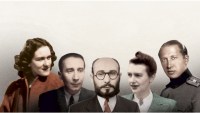
To the French, Albion’s expertise in perfidy will come as no surprise. But centuries of warfare have given them time to learn. With their experience only dating back to 1914, the Germans clearly found it difficult to grasp during the second world war that nowhere is the truth more expertly and instinctively spun than in the land of the gentleman. While a schoolchild soon masters the lie simple, and the lie financial merely requires a degree of brazenness easily developed by proximity to other people’s money, the lie belligerent demands an instinct for dis-simulation that must be bred in the bone of its practitioners to be carried off convincingly.

The question of what artists actually get up to in their studios has always intrigued the rest of us — that mysterious alchemical process of transforming base materials into gold, or at least into something marketable in the present volatile art world. Today’s studio might as likely be a laptop as laboratory, factory, hangar or garden shed, but is nevertheless an apt prism through which to explore the notion of creativity, and this boldly ambitious volume does just that, interviewing 120 British artists in a freewheeling way about their practice and process, inspiration and ideas.
I wanted to find a YouTube clip of a classical British actor reading of Christ’s Passion from the KJV. There must be such a thing, but I can’t find it among the morass of American, Spanish and Pentecostal recordings. That seems to signify the growing irrelevance of Anglicanism and Englishness in this digital world. But, who needs Ken Branagh when you can read the greatest book ever written at the click of a mouse. As it is Easter, here is ‘The Suffering Servant’ prophesy — taken from the book of Isaiah, chapter 53. 1Who hath believed our report? and to whom is the arm of the LORD revealed?
In the fifth century BC Herodotus of Halicarnassus set out a history of hostilities between the Greeks and the Persians. For all his quirky non-sequiturs (Ethiopians’ skin is black, so must be their semen…) he fulfilled his not-so-modest objective to immortalize the deeds of Greeks and non-Greeks alike, in particular, the reason they warred against one another. Tom Holland (who is, incidentally, in the process of translating Herodotus’ Histories) evokes more than a little of this spirit in his new book, In the Shadow of the Sword, an intrepid history of the evolution of the Arab Empire. From Rubicon to Persian Fire and Millennium Holland has hurtled through ancient history like a runaway horse on a hippodrome.