Andro Linklater

Uncle Bill, by Russell Miller – review

From our UK edition

Given the outcome of recent military campaigns in Iraq and Afghanistan, it is pertinent to look for one particular quality in our senior commander: honesty. In other words, after blaming vainglorious politicians for precipitating us into war without adequate preparation or resources, it is reasonable to ask, how capable are our generals of admitting their own mistakes? Their persistence in two failed strategies — the application of Northern Ireland peace-keeping tactics to Basra and the dispersal of troops among forward posts in Helmand — does not suggest any culture of mea culpa, and ruthless self-examination has not been a distinguishing feature of the annual lectures delivered by the Chiefs of the Defence Staff to the Royal United Services Institute in the past decade.
Russian Roulette, by Giles Milton – review

From our UK edition

Had Onan not spilled his seed upon the ground, he might have invented invisible ink. The possibility had not occurred to me until I read this account of the start of Britain’s intelligence services. Even then the implications seemed so startling as to be barely credible — that the entire trade in espionage, including the serried ranks of Cheltenham’s GCHQ, the massed battalions at Fort Meade’s National Security Agency, the MI5s, 6s and other shadowy digits, not to mention literature’s denizens, from Ashenden and Greenmantle to James Bond and George Smiley, owed its origin to solitary sex. Yet the source given on page 48 of Russian Roulette appears impeccable.

Notes on…Walking in the Auvergne

From our UK edition

The homicidal sheepdog that launched itself at me from behind a grassy hillock, had the look of a demented hearth rug but the fangs of a leopard. No self-respecting Border collie would have taken such a creature as a serious competitor in the herding business. But French sheep are different, at least those in the unfenced wilderness of the Aubrac plateau in the Massif Central are. More goat than sheep, they evidently regarded the ferocious dog as a minder that allowed them to graze full-time while it saw off wolves, bears and other predators, including a pink-faced randonneur trying to decide whether the map had put a volcano in the wrong place or he was indeed lost. I leapt backwards, apparently far enough to satisfy the rug that I was no longer a threat.

Saving Italy, by Robert M. Edsel – a review

From our UK edition

During the civil war, the Puritan iconoclast William Dowsing recorded with satisfaction his destructive visit in 1644 to the parish church of Sudbury in Suffolk: ‘We brake down a picture of God the Father, 2 crucifixes and pictures of Christ, about an hundred in all.’ The Taleban’s decision in 2001 to blow up two gigantic statues of Buddha in the Bamiyan valley in Afghanistan was more spectacular but not different in kind. War gives licence to such subterranean urges. In an order issued exactly three centuries after Dowsing’s expedition, General Sir Henry Maitland Wilson, supreme Allied commander in the Mediterranean, explained why great art needed to be protected. ‘Works of art are not like diamonds,’ he told the troops.

The Men Who Lost America, by Andrew O’Shaughnessy – review

From our UK edition

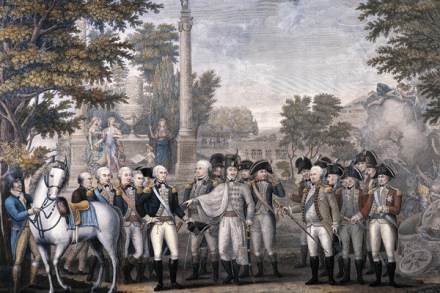
On Christmas Day 1776, the ambitious, well-connected war hero, General John Burgoyne, soon to be appointed commander of British forces in Canada, agreed a wager of 50 guineas with Charles James Fox ‘that he will be home victorious from America by Christmas Day 1777.’ Nine weeks short of that date, on 17 October, Burgoyne surrendered his sword and an army of more than 8,000 men, together with 50 cannon and vast quantities of muskets and gunpowder, to an American general, Horatio Gates, after defeat and encirclement at the battle of Saratoga in upstate New York. No bet was ever more comprehensively lost. The victory at Saratoga, won by citizen-soldiers over professional troops,  played a vital role in the dramatic events that led to the birth of the United States.

The Tank war, by Mark Urban – review

From our UK edition

In November 1941, Sergeant Jake Wardrop narrowly escaped being killed when his tank was crippled in the midst of a catastrophic battle in the north African desert where the armour and artillery of Rommel’s Afrika Korps destroyed scores of other British tanks. ‘It wasn’t a very healthy position to be in’, he wrote in his diary that evening, ‘but it could have been worse; at least it wasn’t raining.’ When he came across this mordant comment in the course of his research, Mark Urban must have realised that he had struck gold.

Life and Letters, by Allan Massie – review

From our UK edition

It is a safe bet that Alex Salmond has no immediate plans to embrace Allan Massie as one of Scotland’s National Treasures. A Unionist in an increasingly nationalist country, a traditionalist in a time of change, an ungoogler engulfed by the internet, and an amateur of creative activities, cultural and sporting, when the fashion is for professional analysis, Massie could hardly be more out of step with the prevailing ethos of his countrymen. Yet, this collection of his Life & Letters columns for The Spectator illustrates why the larger community of readers and writers should clasp him to their collective bosom as a figure of genuine literary distinction.

The Real Great Escape, by Simon Read — review

From our UK edition

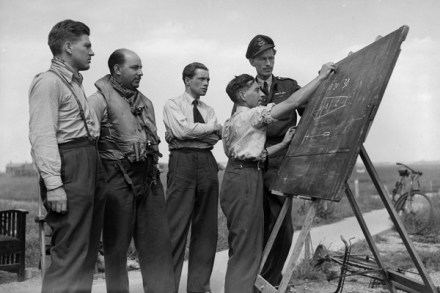
The scene is chilling. Four men stand in the snow, all in uniform. The men are in pairs, one in each pair holds a pistol to the head of the man in front. Behind them two parked cars, 1940s models; in front a snow-filled ditch. What happens next? The right answer depends on which scene you are watching. The one reproduced in both these books (and above) occurred in February 1946, and was a reconstruction staged by RAF police hunting for the killers of two men, Flying Officer Gordon Kidder and Squadron Leader Thomas Kirby-Green. Afterwards, all four participants and the man who took the picture got back in the cars and drove off. In the original scene, which had taken place two years earlier, there was no photographer.

Winning the war with wheezers

From our UK edition

The Anfa Hotel in Casablanca has seen better days. Seventy years ago it was the grandest hotel in Morocco, good enough to house Winston Churchill and Franklin D. Roosevelt when they met in January 1943 to devise a strategy that would win the second world war. The views remain as fine and the bedrooms as expansive, but today the carpets are unmistakably worn and the bathrooms are beginning to peel. In its own small way, the hotel illustrates the central theme of The Rise and Fall of the Great Powers, Professor Paul Kennedy’s epochal history now more than 20 years old, that a dearth of economic resources progressively enfeebles the mightiest of institutions.

Italy’s first Duce

From our UK edition

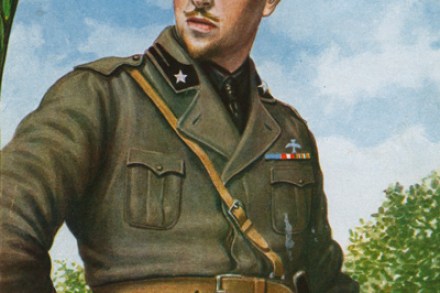
There is something to be said for a bald-headed gnome with the power, according to his biographer, to seduce any woman he wanted, including the most celebrated and desirable actress of the day, despite being handicapped by red-rimmed eyes, bad breath and crooked teeth ‘of three colours, white, yellow and black’. And something more deserves to be said about the seducer’s rabble-rousing demagoguery that allowed him to pave the way for fascism, and for the nationalist hatred of democracy that blighted Europe after the first world war. But whether those deserts really require 200,000 words is another matter. The gnome was Gabriele d’Annunzio, who stumbled into the footnotes of history when he seized the Yugoslav city of Rijeka, or Fiume, in 1919 on behalf of Italy.

Eavesdropping on the enemy

From our UK edition

Say ‘Colditz’, and the name immediately triggers an image of prisoners of war digging tunnels, building gliders and in general plotting outrageously to cross the barbed wire into freedom. You could shout ‘Trent Park’ from the rooftops and, until now, no one would have known what you were referring to. But this book should give the name as lively a notoriety as the brooding Saxon fortress. Trent Park in Middlesex was where Britain housed the cream of captured German officers. They were brought together, not to prevent their escape, but to encourage their conversation. Scattered throughout their cells and huts was a network of concealed microphones designed to record whatever they had to say about the war, the Nazis and Hitler himself.

Selective vision

From our UK edition

In 1904, the great Halford Mackinder, founder of the modern academic discipline of geography, published one of the most subversive maps of the century. It might seem unlikely that a scientific representation of the physical world projected according to mathematical principles onto a two-dimensional surface could mess with your head, but that is the unmistakable conclusion of Professor Jerry Brotton’s exhilarating book.

Fading ambition

From our UK edition

‘Despite 30 years of war,’ remarked General Stanley McChrystal, the commander in 2009 of NATO forces in Afghanistan, ‘civilisation grows here like weeds.’ Unfortunately for the Afghans, their tribal, rural, autarchic civilisation that grows so readily has never been acceptable either to the western allies or to the Taleban.

The courage of countless generations

From our UK edition

The most stirring sermon I ever heard was delivered by a company sergeant-major in the Black Watch to a cadre of young lance-corporals, barely 19 years old, who were about to experience their first deployment to Northern Ireland during the Troubles. Like an old-fashioned Presbyterian minister, he warned them of the dangers of the world, in this case roof-top snipers and stone-throwing rioters, and the temptation these presented to the unwary soul, in this case, as he put it, ‘to run like buggery’. But they would not succumb, he said; indeed, they would lead their sections looking such dangers fearlessly in the face, because they were armed with a greater power — the red hackle, or feather, they wore in their khaki bonnets.

Some legends flourish …

From our UK edition

Confronted by the dead Athenian heroes of the Peloponnesian War, Pericles gave voice in his funeral oration to an idea that explains better than any other why we are so obsessed by our military past. The freedom intrinsic to democracy, he said, made the unconstrained decision of its citizens to risk their lives in war more honourable than the choice forced on the soldiers of a militaristic system such as the Spartans’. ‘The man who can most truly be accounted brave,’ Pericles concluded, ‘is he who knows best the meaning of what is sweet in life and of what is terrible, and then goes out determined to meet what is to come.

Target man

From our UK edition

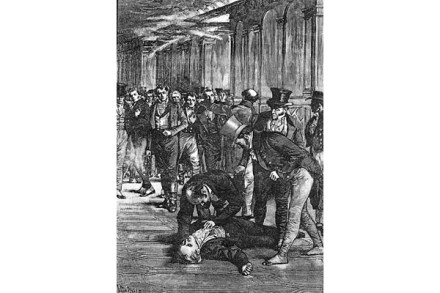
John Bellingham dressed fastidiously. On the day that he committed murder, he wore exactly what the fashion magazine Le Beau Monde advised for a gentleman’s morning wear in 1812 — a chocolate broadcloth coat, clay-coloured denim breeches and calf-length boots, the whole set off by a waspish black-and-yellow waistcoat. By contrast, his victim, clad in the equivalent of a business suit — blue coat and dark twill trousers — was almost ­anonymous. But Spencer Perceval had no need for display. Not only was he prime minister and chancellor of the exchequer, but, thanks to the insanity of George III and the loyal support of a majority of MPs, he had achieved a unique degree of political power.

Not quite cricket

From our UK edition

To the French, Albion’s expertise in perfidy will come as no surprise. But centuries of warfare have given them time to learn. With their experience only dating back to 1914, the Germans clearly found it difficult to grasp during the second world war that nowhere is the truth more expertly and instinctively spun than in the land of the gentleman. While a schoolchild soon masters the lie simple, and the lie financial merely requires a degree of brazenness easily developed by proximity to other people’s money, the lie belligerent demands an instinct for dis-simulation that must be bred in the bone of its practitioners to be carried off convincingly.

Triumph of the redcoats

From our UK edition

Given the choice between philosophising in the company of Socrates or fighting in the army of the soldier-monarch Charles XII of Sweden, most men, Dr Johnson observed, would prefer arms to argument. That physical danger should offer a more appealing prospect than logical thought remains one of the Great Cham’s more provocative insights. At one level, it explains why universal peace will not soon arrive, and at another why military history commands a larger readership than philosophy. In recent years, a golden generation has set the bar pretty high in this field.

To the Ends of the Earth by T.M. Devine

From our UK edition

When Scotland’s rugby team landed in Invercargill for the World Cup, they were greeted by a piper in full Highland fig and a cheering crowd of more than 500 New Zealanders, bedecked in tartan and waving St Andrew flags. The significance of both welcome and dress went beyond sport or nationality. Two important currents of modern life were at work, the ancient ability of the British empire to create societies in its own image, and the new power of the heritage industry to invent the past. Together they have made it necessary to update the old formula, ‘history is written by the winners,’ with the qualification, ‘but heritage is created by the losers’.

Losing the rat race

From our UK edition

This is a book for anyone whose blood ever ran chill on reading the most sinister recipe in fiction, Samuel Whiskers’ instructions on how to cook Tom Kitten: ‘Anna Maria, make me a kitten dumpling roly-poly pudding for my dinner, make it properly with breadcrumbs.’ With or without breadcrumbs, or indeed butter and flour as Anna Maria preferred, rats will eat anything, dead or alive, from kittens to albatrosses. This is a book for anyone whose blood ever ran chill on reading the most sinister recipe in fiction, Samuel Whiskers’ instructions on how to cook Tom Kitten: ‘Anna Maria, make me a kitten dumpling roly-poly pudding for my dinner, make it properly with breadcrumbs.