Penelope Lively

I shall never see the Arctic, but I have Arctic Dreams

As travelers go, I am a wimp. I like comfortable transport and a bed to sleep in. But I would dearly like to be otherwise, and the travel books that appeal to me are those which give me vicarious experience of the sort of spartan roaming that I know I could never have undertaken.Barry Lopez’s Arctic Dreams is much more than a travel book; its subtitle is Imagination and Desire in a Northern Landscape, which causes one to raise an eyebrow. Desire? What does the man mean? To be honest I am still not too sure, but by now I am sufficiently beguiled by its author not to care too much.

slightly foxed arctic

Penelope Lively’s notebook: Coal holes and pub opera

From our UK edition

I have been having my vault done over. Not, as you might think, the family strong room, but the place beneath the pavement — the former coal cellar — pertaining to an early 19th-century London house. The vault opens onto the area — mine is the last generation to know that that is what you call the open sunken space between the basement and the pavement — and has been given the latest damp-proof treatment, plus shelving and smart lighting, so that I can use it for storage. Others use their vault more creatively: a couple next door had theirs excavated several feet and made into a troglodyte bedroom. No, they said, they couldn’t hear feet overhead, but wheeled suitcases could be tiresome.

Penelope Lively’s diary: My old-age MOT

From our UK edition

My surgery has been calling in all those over 75 for a special session with their doctor — a sort of old-age MOT. I came out of mine pretty well, I thought: I could remember the name of the Prime Minister, blood pressure excellent, spark plugs need cleaning, windscreen wipers ineffective, bodywork showing signs of wear. But not too bad for 80. Gerontologist Tom Kirkwood, in his book Time of Our Lives, gives a clinical but excellent and entirely comprehensible account of what we should expect, and what can and cannot be done about it. His study of a group in their mid-eighties found that not one had zero age-related disease, and most had four or five. We take our pick: hips, knees, macular degeneration and so forth.

‘The Wry Romance of the Literary Rectory’, by Deborah Alun-Jones – review

From our UK edition

The property pages of Country Life invariably feature an old rectory or two, probably graceful 18th-century, of honeyed Cotswold stone, and if you plan to move in you will need a deep pocket. This is Aga Saga country, Joanna Trollope territory. Old vicarages, old rectories, all the defrocked plant of the Church of England, are in hot demand: the estate agent’s dream. They are substantial, elegant, they propose permanence and stability and some sort of evocative past, and today they will be tricked out with central heating, en suite bathrooms and, of course, that Aga. It was not always thus.

The Unknown Bridesmaid, by Margaret Forster – review

From our UK edition

The power of the past, the directive hand of childhood: the themes of The Unknown Bridesmaid are familiar fictional territory. But Margaret Forster has a deft and idiosyncratic touch in this story of child psychologist Julia, whose young clients reflect the trauma of her own early years. Sessions with Camilla, Precious, Janice, Claire and others are intercut with Julia’s own memories, so that gradually we learn what happened to her after her father’s early death and that of her mother when Julia was a teenager. For the reader, she presents something of a challenge. The memories are candid: her behaviour was insufferable.

Being Sam Frears, by Mary Mount

From our UK edition

Sam Frears is 40. He has an extremely rare condition called familial dysautonomia, or Riley-Day syndrome; the life expectancy for most babies born with this is five years. Mary Mount has made her account of what it is like to be Sam a short impressionistic chronicle, interspersed with comments from his mother, Mary-Kay Wilmers. The result is both illuminating and empathetic, with a picture emerging of someone who has refused to be defeated by his condition. Sam has limited vision now and is physically hampered, but he acts, he enjoys the climbing wall at a leisure centre and he is the charismatic centre of a circle of friends. I did not see the Storyville documentary, My Friend Sam, made by Toby Reisz and shown on BBC 4 earlier this year.

Bookends: Deftly orchestrated chaos

From our UK edition

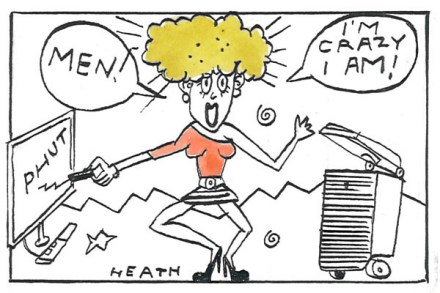
The headings set the scene: ‘Last Tango in Balham, in which I meet Marlon Brando on the dance floor of Surbiton Assembly Rooms but thankfully do not have to do anything with packet of country life.’ The essential premise in Melissa Kite’s breezy new collection Real Life: One Woman’s Guide to Love, Men and Other Disasters (Constable, £7.99) is: single girl (of advancing years) desperately seeks man and invariably ends up with the wrong one. Plus a great deal more of mundane affronts to do with TV remote controls that won’t work, Lambeth Council’s wheelie- bin regulations, and the challenge of filling in a passport application form. Real life. Possibly. The fun lies in the enjoyable unreality, the deftly orchestrated scenarios of chaos.

His own best story

From our UK edition

A biography that is also a collaboration with its subject is something of a novelty. Here, Maggie Fergusson writes the life, while Michael Morpurgo contributes seven stories, each springing from the subject matter of the preceding section. Fergusson has previously written an excellent biography of George Mackay Brown, so has now moved from a detached consideration of a person no longer alive to work on and with someone very much around and active (who had himself proposed the idea of the book). In other words, this is a very different sort of project— and it could be said right away that this is no hagiography.

Ladies, you don’t want to go back there

From our UK edition

In 2009 a magazine survey found that many women in their twenties wanted to stay at home baking while their husbands went out to work: ‘I’d love to be a captive wife.’ Jessica Mann’s thoughtful and emphatic book is a riposte to this, an overview of the Fifties, which she calls a polemic and a personal memoir, winding together fact and opinion with her own experience of being, first a teenager and then a young woman at that time. The result is a richly readable and persuasive piece of work. I found myself reverently ticking the notes I took (‘Yes! Yes!’) while being reminded of aspects of those days I had forgotten — or sublimated.

Far from close

From our UK edition

In 1598, a certain Margaret Browne of Houndsditch gave a graphic description to the court of her neighbour Clement Underhill engaged in an adulterous act with her lover, as observed through a hole in the party wall. Some people have always been very interested in what the neighbours are up to; all of us can be affected by them. Emily Cockayne has investigated the relationship by conjuring up scores of pieces of evidence such as the one cited, from the early Middle Ages till the present day, trawled from manorial records, police and law courts, civic authorities and newspapers. The result is a nicely personal view of how we have got on with the people next door, homing in on the perennial issues — noise, sanitation, intrusion and privacy.

The choppy sea of family life

From our UK edition

This is a lovely book. Judy Golding writes of her father —indeed of both her parents — with candour, humour and great insight and perception This is a lovely book. Judy Golding writes of her father —indeed of both her parents — with candour, humour and great insight and perception. More than that, here is an exemplary memoir of childhood, not remorselessly chronological, but drawing on the jumbled past to give an account of what it was like to be a child in an unusual family. She describes an intense marriage, which was devoted and intermittently stormy. She sees herself and her brother David as always taking second place, especially as far as their mother was concerned.

Shop till you drop

From our UK edition

Within the past month I have been to an 80th and a 90th birthday lunch, both of them highly festive occasions. And now here is an entertaining, erudite and thought-provoking meditation on the matter of age by Jane Miller (aged 78). The so-called twilight years are no longer quite that, for some of us. This book takes a look at the experience of age, and the perception of age, using the writer’s own engagement with it for the former, and for the latter the promptings of a well-stocked mind to demonstrate how literature has reflected life. Those called in range from Simone de Beauvoir through Bellow, Updike, Roth to Turgenev and Tolstoy.

Officers, if not gentlemen

From our UK edition

The execution for desertion of a young officer during the first world war goes disastrously wrong. What exactly happened? Who was there, and why have some of those involved met untimely deaths? This is the crux of a novel that is a marriage of who-done-it and commentary on the class-ridden attitudes of the early 20th century. The action takes place in the immediate wake of the war, when battle-damaged men try to adjust to civilian life. One of these, Laurence Bartram, is persuaded to try and find out why a fellow officer, John Emmett, has apparently committed suicide; the persuader is Emmett’s sister Mary — romance hangs in the air.

A ghastly crew | 6 October 2007

From our UK edition

Jennifer Johnston is adept at economy. Here is a short novel in which the eight characters are introduced one by one, with minimum fuss — some dialogue, a brief reference by someone else — and their complex relationships obliquely revealed. Complex indeed are these connections. ‘I am gay, bent, queer, homosexual, call it what you will,' says Donough, coming out to his mother Stephanie. Sexual identity lies at the heart of the narrative — who is inclined to what, and with whom. By the end, four of the eight are defined as gay, bent, call it what you will, and the past is floodlit, with all its confusions and deceptions. Stephanie’s ex-husband Henry is in hospital, recovering from a car accident in which the driver, his wife, was killed.

As entertaining as ever

From our UK edition

Fifty-two-year-old Alan Mackenzie has been in severe and unrelenting pain for 16 months, having slipped a disc during a game of volleyball. No one has been able to alleviate his condition, not ‘four physical therapists, three ortho-paedic surgeons, two neurologists and an acupuncturist in a pear tree’. He no longer expects to get better, and lives amid a welter of medication and cumbersome aids; his wife Jane has become effectively his attendant, suppressing her guilty resentment. At this point, sufferers from acute back pain may wish to stop reading. Actually, they would do well to continue, with relish, for we are in an Alison Lurie novel, where deft irony will illuminate the most apparently dire situation.