Culture

Culture

The good, the bad and the ugly in books, exhibitions, cinema, TV, dance, music, podcasts and theatre.

Marty’s way

Television

Vinyl (Sky Atlantic) — the much-anticipated series, co-produced by Martin Scorsese and Mick Jagger, about the 1970s New York record industry — began on Monday with a two-hour episode directed by Scorsese himself. The result was, as you’d expect, an exhilarating watch. So why did it also create an undeniable feeling of slight disappointment? One reason, I suppose, could just be that modern TV viewers are spoiled rotten. So many American dramas since The Sopranos have shown such a miraculous mixture of breadth and depth that the problem is no longer believing how ambitious television can be, but simply keeping up with them all. (More bloody golden eggs? Why can’t these people leave us alone to read a book?

Touching the void | 18 February 2016

Cinema

Scholarly filmgoers may recall a movement that sprouted from Danish soil called Dogme 95. It worked to a Spartan set of rules and regs. In Dogme titles there could be no lighting and no soundtrack, no locations pretending to be other locations. Hell, there were probably no Portaloos on set and actors fixed their own herring smørrebrød. The director, in an ultimate gesture of klaxonning self-effacement, took no credit. Except that everyone knew Thomas Vinterburg shot Festen and Lars von Trier made The Idiots. The spirit of cinema’s Mennonites lives on in Chronic, a pitiless, hatchet-faced film set somewhere sunlit in the grassy American suburbs. It is written and shot by Mexican director Michel Franco.

Kerching, Mr Bing

Theatre

Here’s how to set yourself up for a fall. You stage the world première of your debut play in the West End and you cast yourself in the lead role. Matthew Perry (Chandler Bing from Friends) has invited a critical monstering by brazenly challenging all-comers like this and the result is a terrible let-down. For the reviewers, that is, who have mindlessly attacked this breezy, stylish new dating comedy. It’s not perfect but it succeeds on many levels. It’s pacy, original and easy on the eye. It’s funny throughout (apart from a bizarre scene in a maternity unit, which suggests, rather bafflingly, that no member of the creative team has a clue what happens to a woman during labour).

Not a pretty sight

Opera

‘Forget Downton Abbey!’ exhorts David Pountney in the programme for Figaro Forever, Welsh National Opera’s season of Beaumarchais operas, The Barber of Seville, The Marriage of Figaro and Elena Langer’s Figaro Gets a Divorce. ‘A televisual age in which the vast narrative panorama of a “series” strung out across many episodes seems to capture people’s imaginations is perhaps exactly the right moment to follow the fortunes of the Count and Rosina, their servant Figaro and his fiancée, Susanna,’ he continues. What WNO’s artistic director means is the opposite of what he says.

Notes on a scandal

More from Arts

How could it possibly go wrong? The magnetic, seething Russian star Natalia Osipova playing the tragic woman in John Singer Sargent’s magnetic, enigmatic portrait of Madame X, all alabaster skin, black dress and arrogantly sexy profile. A Mark-Anthony Turnage-commissioned score, a top-prestige Bolshoi co-production, and enough scenery to rebuild Canary Wharf. If only Christopher Wheeldon’s new Covent Garden ballet Strapless were a scandal, like the portrait itself when originally unveiled in Paris in 1884, or like Kenneth MacMillan’s Manon at its première. If only it could be dubbed a tasteless exhibition of an undesirable type of female. Instead, it’s just a polite little flop, vastly over-decorated, overcomplicated, and with a whiff of evasion about it.

Whodunnit?

Arts feature

On 7 February 1506, Albrecht Dürer wrote home to his good friend Willibald Pirckheimer in Nuremberg. The great artist was having a mixed time in Venice: on the one hand, as Dürer explained, he was making lots of delightful new acquaintances, among them ‘good lute-players’ and also ‘connoisseurs in painting, men of much noble sentiment and honest virtue’. However, there was also a very different type lurking in the early 16th-century Serenissima: ‘the most faithless, lying, thievish rascals such as I scarcely believed could exist on earth’. Dürer hints that among these latter were painters, perhaps including some whose works will be seen in a forthcoming exhibition at the Royal Academy, In the Age of Giorgione.

Tina

Poems

Dearest, I’d love to have your Tina to stay — what are aunts for? — but I’m not sure if it can be managed just now. I know you’d like her to have a change of scene after that business with her maths tutor (has he gone back to his family now, by the way?) And I really admire her for being a vegan and only eating that food beginning with Q which I could never find round here. She was so animated at that party of mine she turned up at, and I’m sorry she lost her nose studs. The broken glass was no problem, just a stitch or two. It’s such fun having a young person around: but, alas, I’m expecting the decorators any day now. Such a shame. But do let’s keep in touch.

In excess

Television

Judging from its website, Hebden Bridge’s tourist office considers the fact that BBC1’s Happy Valley is filmed in the town something of a selling point. Personally, I can’t see why. (Perhaps points of especial tourist interest might include the cellar where Sergeant Catherine Cawood was almost battered to death, or the caravan site where drug dealers fed heroin to the teenage girl they’d kidnapped and raped.) And now that it’s back for a second series, viewers of Sally Wainwright’s Bafta-winning drama are still unlikely to confuse Hebden Bridge with, say, Chipping Norton. In Tuesday’s opening scene Catherine (Sarah Lancashire) filled in her sister on the events of her day.

The big reveal

Radio

Much ado about Radio 4’s latest venture into the new smart world of aural selfies. Reaction Time, on Thursday mornings, is a compilation of mini-recordings by listeners telling us about their lives (overseen by Kevin Core). No tape machine needed or sound recordist. Just a listener with a smartphone and a thick skin. For these stories are not the kind of thing you would tell your nearest and dearest (unless they, too, have an equally thick skin). But rather they reveal disappointments in love, embarrassing date nights, ‘how I met my husband’, things you might unburden to a good friend over a couple of glasses — but would you do the same to almost 11 million listeners? Gary tells us about his night with Briony, back in the Seventies when he was a gauche student.

Master of psychology

Theatre

The Master Builder, if done properly, can be one of those theatrical experiences that make you wonder if the Greeks were a teeny bit overrated. Matthew Warchus’s version is four-fifths there. Ralph Fiennes is well equipped to play Halvard Solness, the cold, brilliant autocrat with a troubled past who falls into the arms of a gorgeous young suitor. But he’s the wrong age for the part. So is his opposite number, Sarah Snook, who seems too mature to suggest Hilde’s skittish frivolity. Fiennes, like all film stars, attends carefully to his looks and although he’s over 50 he could easily play ‘late thirties’. But the aged Halvard needs to be like a grizzled alderman ogling a virgin in the choirstall. The affair should seem repellent and sinful.

Fashion faux pas

Cinema

‘I’m pretty sure there’s a lot more to life than being really, really, ridiculously good-looking,’ said a pouty Derek Zoolander back in 2001. Well, apparently not. Because Zoolander 2, the long-awaited sequel to Ben Stiller’s cult hit undercutting the male-model industry, is a good-looking bore, a fashion faux pas where hot celebrities such as Kate Moss, Penélope Cruz and Kim Kardashian are parachuted in to make a relentlessly dreary script look good. Except they don’t. They can’t. What on earth was Stiller thinking? Or Owen Wilson, back here as the loveable frenemy Hansel. Or, for that matter, the endless parade of fashion and rock-star cameos? Anna Wintour, Justin Bieber, Sting.

Mozart magic | 11 February 2016

Opera

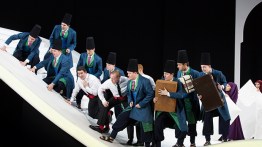
Centre stage, there’s an industrial-looking black platform, secured by cables. The Three Ladies snap the unconscious Tamino on a mobile phone. The Three Boys look like Gollum in a fright wig. And Papageno, dressed as an ageing vagrant, simulates urination (at least I hope that’s what it was) into an empty wine bottle. Simon McBurney’s production of The Magic Flute could have been designed to raise the collective blood pressure of Against Modern Opera Productions, the Zeffirelli-worshipping Facebook group that’s opera’s equivalent of the Mail on Sunday letters page.

The worst public art imaginable

Have you ever walked or driven past a piece of 'public art' and wondered how on earth it got commissioned, or whether it is just a bit of leftover junk from a building site? In this week's Spectator, Stephen Bayley awards the inaugural 'What's That Thing?' prize to the very worst specimen he can find: Dashi Namdakov’s ‘She Guardian’ on Park Lane, pictured above. And it really is awful. You can listen to Stephen discussing the problem with public art on our podcast with Posy Metz from Historic England here. My own personal favourites when it comes to utterly inexplicable 'sculptures' in public places are the Dorking Cock, plonked on a boring roundabout outside the town as a tribute to the rather fabulous-looking hen that was bred there: https://twitter.

Public offence

Arts feature

[audioplayer src="http://rss.acast.com/viewfrom22/fightingovercrumbs-euroscepticsandtheeudeal/media.mp3" title="Stephen Bayley and Posy Metz from Historic England discuss public artwork" startat=1206] Listen [/audioplayer]There are, as adman David Ogilvy remarked, no monuments to committees. (That’s not quite true; Auguste Rodin’s ‘Burghers of Calais’ — you can find a version in Victoria Tower Gardens — is somewhat collectivist in subject matter.) But there are certainly abundant monuments to the committee mentality, the bureaucratic spirit and art-world groupthink. That is what most contemporary ‘public art’ amounts to.

‘So quick and chancy’

Exhibitions

When asked the question ‘What is art?’, Andy Warhol gave a characteristically flip answer (‘Isn’t that a guy’s name?’). On another occasion, however, he produced a more thoughtful response: ‘Does it really come out of you or is it a product? It’s complicated.’ Indeed, it’s those complications that make Warhol’s works compelling, as is demonstrated by a new exhibition at the Ashmolean Museum, Oxford. One is that it is hard to tell how much he was really in control. When you look at one of his pictures, are you really looking at the work of his assistants or, indeed, of chance? And the way he forces you to think about that makes you ponder other kinds of art as well.

Breaking

Poems

Was everybody scared? Mum was, certainly. Slip-clinging hold, respectability. World-lost, he didn’t care,   Or didn’t cotton on. Inexplicably, He once broke out, performing memorably: Reckless, and with aplomb.   Mistiming exquisite; Turning their stomachs; Master-class for me in how to flummox Guests: it was The Visit.   Scented and Sunday-clad, – Teacups four-high, stacked, And then paraded like a circus act – Mother pronounced him mad.   Kitchen philosophy, The moment passed. The next time tumbled everything amassed; Her judgment, prophecy.

Weekend world

Television

When the time comes to make programmes looking back on the 2010s, I wonder which aspects of life today will seem the weirdest. Quinoa? The fact that we were expected to be ‘passionate’ about our jobs? Being so overexcited by new technology that we constantly stared at phones? Or maybe it’ll just be how many almost identical TV series looking back on previous decades we used to watch: the kind where a family dresses up in period costume and lives for a while like people from previous eras, carefully ticking off the signifiers as they go. (Space hoppers and Chopper bikes for the Seventies, Rubik’s Cubes and shoulder pads for the Eighties.

Straight talking

Opera

It’s widely agreed that the most difficult form of opera to bring off is operetta, whether of the Austro-German or the French tradition — interesting that the Italians wisely eschew the genre (so far as I know), while the British stay with G&S and their inviolable traditions, including the audience’s laughing in all the right places. In the past four days I have been to two performances of French operetta, neither of them much of a success, for quite different reasons. Opera Danube is a young company devoted to nurturing singers who recently graduated from one or another of the many music schools. It works with the Orpheus Sinfonia, a small orchestra of players at the same stage of their careers.

Being and nothingness

Theatre

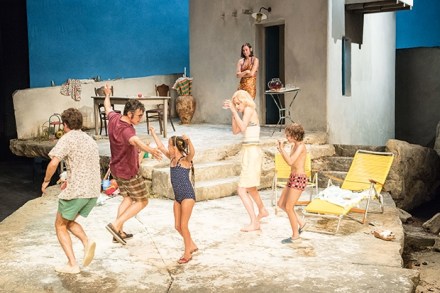
Florian Zeller has been reading Pinter. And Pinter started out in repertory thrillers where suspense was created by delaying revelations until the last minute. He tried an experiment. Suppose you delay the revelations indefinitely. The results were interesting. Pinter’s characters were vague, stark silhouettes lacking background and substance. Audiences found them inscrutably suggestive. Zeller follows suit. He presents us with a bourgeois marriage. The father works. The mother sits at home being stylishly empty-headed. Their grown-up son lives with his girlfriend. No other details are offered. It’s evening. Mother, disported on an all-white sofa, greets her husband and languidly interrogates him about his day’s activities and casts aspersions on his fidelity.

It’s doomed!

Cinema

The TV sitcom Dad’s Army ran on the BBC from 1968 to 1977 (nine series, 80 episodes) with repeats still running to this day (Saturday, BBC2, 8.25 p.m.) and I sometimes watch these repeats with my dad (92) and we laugh like idiots and I sometimes watch with my son (23) and we laugh like idiots and sometimes the three of us watch together (combined age 169, should that be of interest) and we all laugh like idiots but I was not minded to laugh like an idiot during this film, possibly because I was not minded to laugh at all.

Unforgettable fire | 4 February 2016

More from Arts

How much of a compromise does a fashionable choreographer loved by all have to make with his paymasters? When he’s unfashionable, it’s only the Arts Council he has to please. When the world wants a piece of him, he has London’s Sadler’s Wells and the Roundhouse, Grenoble, Paris, Luxembourg, Montreal, Hong Kong, Taipei, Wolfsburg, Brighton, Amiens, Bruges, Amsterdam, Rheims and Leicester producers all tugging at his sleeve, offering support for the quasi-divine creation but wanting to get their spanner into the works somewhere. In which light I take my hat off to Khan.

Easy Street

More from Books

Roller skating down the main road in the cycle lane, her easy, smooth and flowing scissor stride on booted castors, measured, steady and elongated, seamlessly pushing through yards and moments, as if traffic was merely imagination and grace impervious to danger.

Unreliable Narrator

More from Books

If a clock can be a household’s totem then we remain hopeful ours will show us an accurate blue moon before too long. In the meantime, we’re quite used to people asking (ineptly) What’s with its arrythmia and beaten-tortoise air? The much-polished answer is: uncertain timekeeping is remarkably soothing for the under-twenties, disposed to fantastical lie-ins, while visitors can’t help but declare themselves, either, leaping up horribly at its misdirection or, mildly trusting to its idiosyncratic version of the now. In or above the fray, our clock clucks on plying a number of desirable timezones with its deft black hands as oars.

Location

More from Books

Old friends, we scarcely speak of death or dying. As ever, the displacements continue, just as when we used to fail to get round to speaking about love or confined ourselves to giving it a mention in letters — about which we didn’t speak. Until I knew better, I thought poets talked of such things, but as we see they share a guarded language of technical asides. If someone treats their work as a strip-tease, they back off, apparently confounded, the action — the real conversation — being somewhere else — but where?

Losing a Crown in the National Portrait Gallery

More from Books

The cafe was full of connoisseurs of the scones. As he bit into his flapjack a sinister uncoupling took place and he felt the crown of a tooth jerk free — to be rescued behind a discreet paper napkin. Now the geography of his mouth was unfamiliar, harsh and sharp. No wonder those Tudors in their portraits kept their mouths shut. No white-clad guru for them, injecting, probing, drilling and finally murmuring: One more rinse for me please. No, they had to make do with white paint, and opium, and hiding unfortunate swellings under a generous ruff.