Martin Gayford

A Tate show with dreamy, elusive power

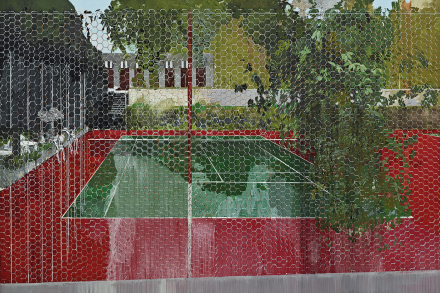
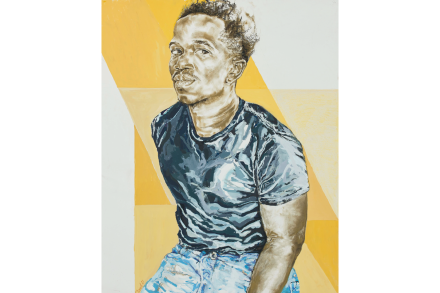
One of the miracles of art history is how painting, so often written off, keeps on coming back. Right now we are in the middle of just such a resurgence, and one sign of the current vitality of the medium is the emergence of painters such as Hurvin Anderson. Admittedly, Anderson – who was born in 1965 – has been emerging for a long time now. But, with the opening of a big retrospective at Tate Britain, his status as a major figure in modern British art is clear. Anderson is completely individual yet visibly connected to the tradition – indeed, to several traditions – and capable of creating huge, wall-filling canvases into which you can sink and float away, but which also make you think and feel.

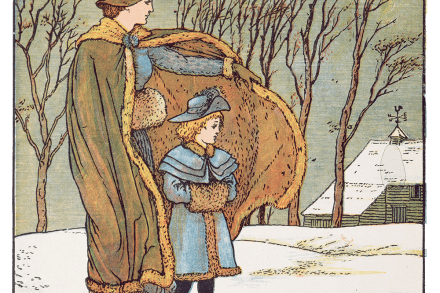
From the wilds of Kyrgyzstan to the Victorian nursery – a choice of art books

From our UK edition

One day, according to a venerable anecdote, an earl pushed his way into Hans Holbein’s London workshop demanding that his portrait be painted straight away. Understandably annoyed, Holbein hit him. This nobleman then asked Henry VIII to punish the painter, but apparently the monarch replied: ‘I can make seven earls (if it pleased me) from seven peasants – but I could not make one Hans Holbeen [sic], or so excellent an artist, out of seven earls.’ Holbein’s pictures must have seemed miraculous when they appeared in Tudor England. In fact they still do. Seeing them is like opening a window into the past and finding it populated by people like those you might pass in the street today.

Was Serbia the real birthplace of the Renaissance?

From our UK edition

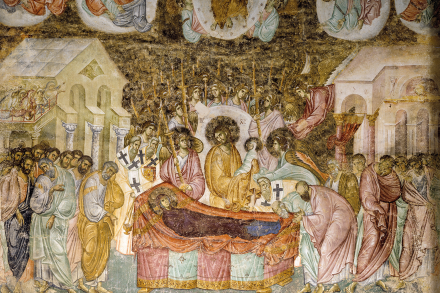
Where did the Renaissance begin? There has been an official answer to that question since 1550, the date that Giorgio Vasari’s Lives of the Artists was first published. According to this version, it all began in Florence and the first painter in the long line that ended with Leonardo, Raphael and Michelangelo was named Cimabue. But here’s another suggestion: you could just as well try looking in the rolling hills of Serbia. My wife and I went travelling there earlier this year. For a couple of nights we stayed in the town of Novi Pazar in the south-east of the country. From the religious point of view this town is a remnant of the Ottoman Empire; according to the census of 2022, nearly 80 per cent of the population is Muslim (with just 71 atheists).

The greatest decade for British painting since Turner and Constable? The 1970s

From our UK edition

Slowly the canvas was unfurled across the concrete floor of a warehouse on an industrial estate in Suffolk. On and on it went, a flurry of paint marks and brush strokes, yellow, green and occasionally blue, like a cornfield at harvest time. By the time we got to the end some seven metres of it lay stretched out at our feet. It was the first time anyone had seen this unknown magnum opus by Gillian Ayres since it was rolled up in 1974 – and it looked sensational. Recently I’ve been reflecting on the 1970s for a couple of reasons. One is that I’m working on a book about art in London at that time, the other is that I’ve been helping to organise an exhibition of Ayres’s work from that era at the Heong Gallery, Downing College, Cambridge. Of course, as L.P.

‘Death is a very poor painter’: the 19th-century craze for plaster casts

From our UK edition

On the morning of 7 May 1821 an urgent task was performed at Longwood House on St Helena. A day and a half previously, the celebrated prisoner for whom this dwelling had been built had died. Obviously it was necessary to make his death mask, and fortunately a British military doctor, expert in such matters, was at hand to do so. So it was that in times to come every bourgeois home in France ‘had its plaster Napoleon’, as Alain Corbin writes in this brief but highly original book. The proliferation of such casts was a feature of the age. Some homes became ‘virtual museums of the dead’. Artists’ sitting rooms and studios frequently contained a moulding of the emaciated features of Théodore Géricault; musical households would naturally have one of Beethoven.

‘The possibilities of paint are never-ending’: Sir Frank Bowling interviewed

From our UK edition

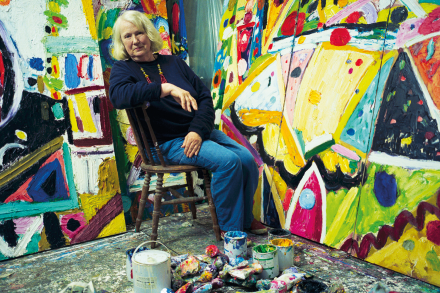
‘I’m full of excitement waiting for this to dry out,’ Sir Frank Bowling exclaims. We are sitting in his studio, a room in a quiet Victorian yard that survives amid the tower blocks of Elephant and Castle. In front of us a semi-finished canvas – a glorious welter of yellow and orange in diverse modulations – is pinned to the wall. It’s executed in acrylics, a water-based material. Bowling, like Turner – one of his heroes – believes in using buckets of water, sometimes more or less literally. ‘I don’t always use conventional tools to mark the surface,’ he confides. ‘Sometimes marks are made by a brush, sometimes by simply flinging the paint at the canvas.’ Such matters have long fascinated Bowling.

‘Teaching someone to draw is teaching them to look’: the year’s best art books

From our UK edition

Colour, the painter Patrick Heron once proclaimed, is a continent that artists have yet to explore. The mammoth two-volume The Book of Colour Concepts (Taschen, £150) catalogues numerous attempts to map this mysterious chromatic domain, from the late 17th century to the mid 20th. It quickly becomes clear that this area is infinitely vast. One only has to glance at the plates of the ‘Viennese Colour Cabinet’ (1794) – a whole column of blue-greens – to realise that. The effect of these technical diagrams is beautiful in the manner of abstract art.

How a single year in Florence changed art forever

From our UK edition

The story goes that one day early in the 16th century Leonardo da Vinci was strolling through Florence with a friend. Near the Ponte Santa Trinita they came across a group of gentlemen disputing a point in Dante’s Divine Comedy. Seeing Leonardo, they asked him to explain the passage. At that same moment, Michelangelo Buonarroti also happened to hurry by, and Leonardo beckoned the sculptor over to interpret it for them. But Michelangelo, feeling he was being mocked, rounded on Leonardo: ‘Explain it yourself, you who tried to cast a horse in bronze, and couldn’t do it, and had to abandon the project in shame!’ With that he turned on his heels and stalked off, leaving Leonardo standing in the street embarrassed and furious.

How Michael Craig-Martin changed a glass of water into a full-grown oak tree 

From our UK edition

‘Of all the things I’ve drawn,’ Michael Craig-Martin reflects, ‘to me chairs are one of the most interesting.’ We are sitting in his light-filled apartment above London, the towers of the City rising around us, and we are discussing a profound question, namely, what makes an object a certain type of thing? Or to put it another way, what makes a chair a chair? Craig-Martin’s career has been characterised by what he calls ‘my object obsession’. There will be chairs on view in the grand retrospective of his work which is about to open at the Royal Academy, but by no means only chairs. The galleries will be filled by a cavalcade of mundane bits and pieces, among them safety pins, filing cabinets, forks, smartphones, pliers, light bulbs and buckets.

Surreal visions: the best of this year’s art books reviewed

From our UK edition

Édouard Manet and Edgar Degas first met in a gallery at the Louvre. Degas was standing, etching plate in hand, copying a picture. How audacious, Manet exclaimed, to work without a preliminary drawing. ‘I would not dare to do the same.’ And thus he revealed the essential difference between the two. Degas was a supreme exponent of drawing, while Manet was a magician of the brushstroke. In many ways they moved on parallel tracks, each interested in subjects from contemporary life, both at odds with academic convention. But their talents were at a tangent. Famously, they fell out after Degas painted a double portrait of his friend and his wife. Enraged, Manet cut off a slice containing Mme Manet’s face. Making women look glamorous wasn’t something Degas did.

Why everyone should go to life-drawing classes: Claudette Johnson interviewed

From our UK edition

While looking at Claudette Johnson’s splendid exhibition Presence at the Courtauld Gallery, I kept trying to pin down an elusive connection. Her works are large drawings (sometimes very large – one reclining figure is more than two-and-a-half metres wide), and each one zooms in on a single figure seen in close-up, often larger than life-size. They reminded me of something, but for a while I couldn’t place it. About halfway round I got it. They look a little like fragments from the cartoons Renaissance masters made as templates for painting. These, too, tend to concentrate on the human body on a monumental scale.  Those who dedicate themselves to drawing and work from live models are scarce.

Unmissable: Donatello – Sculpting the Renaissance, at the V&A, reviewed

From our UK edition

‘Donatello is the real hero of Florentine sculpture’, so Antony Gormley has proclaimed (hugely though he admires Michelangelo). It’s hard to disagree. But the full range of his work is hard to see, spread out as it is on altars and tombs through Florence and elsewhere in Italy. This makes Donatello: Sculpting the Renaissance at the V&A an unmissable treat. Donatello was versatile, prolific, inventive, influential and long-lived Throughout much of the Quattrocento, Donato di Niccolo di Betto Bardi (c.1386-1466) – or ‘Donatello’ – turned out new notions about what art could look like and how it might be made. In origin he was, as the V&A show emphasises, a goldsmith.

A choice of art books – from Carpaccio to David Hockney

From our UK edition

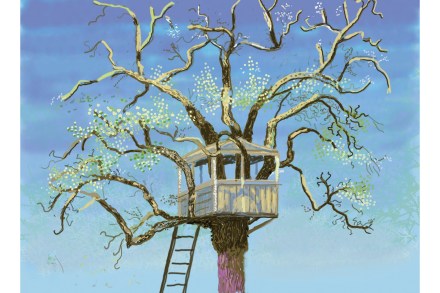
David Hockney once remarked that he wasn’t greedy for money, but was covetous of an interesting life. Then he added that he could find excitement ‘in raindrops falling on a puddle’. There are no puddles in My Window (Taschen, £100), previously only available as a limited edition, but Hockney finds ravishing beauty in such sights as the roofs of neighbouring houses, a street lamp or a distant crane. This huge and sumptuous volume is a visual diary: it consists of what Hockney saw as he lay in bed and looked out at the world each morning between 2009 and 2011. His view was much like anyone else’s, nor is there anything unusual about the window itself.

The jewel-bright, mesmerisingly detailed pictures by Raqib Shaw are a revelation

From our UK edition

Describing the Venice Biennale, like pinning down the city itself, is a practical impossibility. There is just too much of it, tucked away, scattered throughout the maze of alleyways and canals. And the art is no longer confined to the Biennale’s national pavilions in the gardens. It has spread, via dozens of tagalong shows cashing in on the presence of the global art world, to a motley array of disused palaces, warehouses, churches, at least one shop and a hidden garden loggia. A good way to sample it is just to follow your fancy: step through an ancient doorway and find out what is on the other side. That’s how I came across a little show by the Swiss artist Ugo Rondinone in the venerable Scuola Grande di San Giovanni Evangelista.

Valuable reassessment of British art: Barbican’s Postwar Modern reviewed

From our UK edition

Notoriously, the past is another country: what’s more, it’s a terrain for which the guidebooks need constantly to be rewritten. That’s one attraction of the new exhibition Postwar Modern at the Barbican. It’s a survey of what might seem all-too-familiar territory: British art in the two decades that followed VE day. Yet it succeeds in revealing numerous half-forgotten or undervalued movements and people, the good, the bad and – most intriguingly – candidates for reassessment. The decades that followed the second world war were marked by dreary austerity, perhaps explaining the tendency for the art to be coloured oatmeal, beige, grey and brown. But this was also a time of dawning hope, increasing prosperity and growing optimism.

Beautiful and revealing: The Three Pietàs of Michelangelo, at the Museo dell’Opera del Duomo, Florence, reviewed

From our UK edition

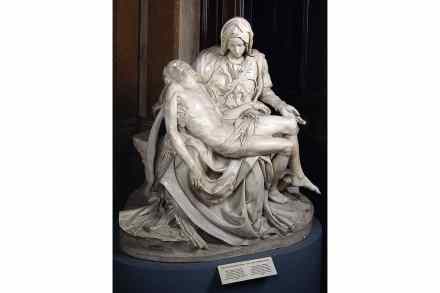
The room is immersed in semi-darkness. Light filters down from above, glistening on polished marble as if it were flesh. This is the installation for Le Tre Pietà, a remarkable micro-exhibition that has just opened at the Museo dell’Opera del Duomo in Florence. It is low in quantity, containing just three works. But stratospherically high in quality, since it comprises Michelangelo’s three versions of the Pietà – that is, the Madonna mourning the dead Christ. He carved these over almost 70 years: one in his early twenties, the next in his seventies, the last in his eighties. Admittedly, the first and the last are present only in a rather old-fashioned virtual form: high-quality plaster casts.

Astonishing and gripping: Van Gogh’s Self Portraits at the Courtauld reviewed

From our UK edition

In September 1889, Vincent van Gogh sent his brother Theo a new self-portrait from the mental hospital at Saint-Rémy-de-Provence. ‘You must look at it for some time,’ he instructed, then ‘you’ll see, I hope, that my physiognomy has grown much calmer, although the gaze may be vaguer than before, so it appears to me.’ Vincent was severely ill and was in the hospital to recover from his affliction, the nature of which remains controversial. Yet he carried on creating marvellous pictures, including several of himself. One of the questions raised by Van Gogh. Self-Portraits, the wonderful exhibition at the Courtauld Gallery, is simple but fundamental: why? We take it as a given that artists depict themselves; but some never do, and others only rarely.

Feral showstoppers and some of the greatest paintings of the 20th century: Francis Bacon at the RA reviewed

From our UK edition

The superb new exhibition at the Royal Academy, Francis Bacon: Man and Beast, is not a retrospective. Nonetheless it is one of the most revealing presentations of this great painter’s work I have ever seen. It follows one of the most important of the chains of thought and feeling that ran through his art — animality: the beastliness in humanity, and the humanity of beasts. He was a great master of the feral. ‘Man with Dog’ (1953) depicts a creature with which it would be hazardous to tangle: a blurred, slathering smear with just a hint of Cerberus, the ancient guardian of Hades. Just below its paws is the gutter, with a drain opening downwards into the earth.

This radical Nativity is also one of the great whodunnits of art history

From our UK edition

On 25 October 1510 Isabella d’Este, the Marchioness of Mantua, wrote a letter to her agent in Venice inquiring after a certain highly collectable item. ‘We believe that in the effects and the estate of Zorzo da Castelfranco, the painter, there exists a painting of a night scene, very beautiful and unusual.’ She thus set off one of the great whodunnits of art history: a mystery hidden inside an enigma that caused a furious 20th-century quarrel between one of the greatest connoisseurs of Renaissance art and the most powerful dealer of the age — and which has never been definitively solved.

A celebration of natural wonders: the best of the year’s art books

From our UK edition

If one of the purposes of art is to help us see the world around us, then Sebastião Salgado’s photographs in Amazônia (Taschen, £100) does so in the most spectacular way imaginable. Not only are they ravishing in themselves; they show us sights that very few have ever seen. To take these shots, Salgado trekked deep into the rainforest, sailed the rivers, visited remote tribes and flew over the vast terrain in the helicopters of the Brazilian air force. During those flights he saw immense vistas over trees, billowing cloudscapes and snaking rivers covering an area larger than the EU.