Anna Picard

Darkness and light

From our UK edition

The femme fatale was invented in France. A giddy, greedy child in her first incarnation, as the antiheroine of Abbé Prévost’s L’Histoire du Chevalier Des Grieux et de Manon Lescaut (1731), she had no voice of her own. Reshaped as a sphinx by Alfred de Musset, made over as a gypsy by Prosper Mérimée, plumped out with fashionable sentimentality by Massenet and mordant sensuality by Puccini, her function was to beguile and elude, to want something that those who wanted her were unable to give her, then die. In Debussy’s Pelléas et Mélisande even that wanting is stripped away. ‘Ne me touchez pas!’ sings Mélisande, but Golaud, made ugly and old for want of love, cannot or will not listen.

What’s love got to do with it?

From our UK edition

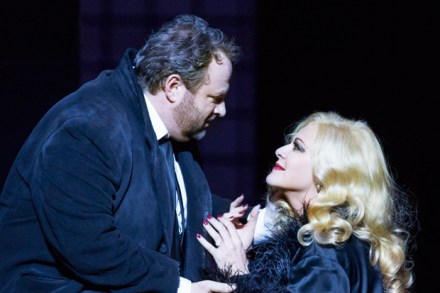
The setting for Il tabarro, the first drama in Puccini’s 1918 triptych of one-act operas, is not the Paris of tourists and honeymooners, nor even the Paris of impoverished poets and painters. On a bend in the Seine a Dutch barge is moored at a soot-blackened wharf. A tableau of stevedores and seamstresses unfreezes. Sirens blast through the oily haze of muted violins. A tart touts for trade. There is no romance here: no first love, no new love, no true love. Just ordinary sadness and ordinary yearning: a marriage bruised beyond repair, a dead child kept alive in his father’s memory, and a futile and fatal affair. The first revival of Richard Jones’s Il trittico sees a new conductor at the helm, Nicola Luisotti, and several key cast changes.

Not a pretty sight

From our UK edition

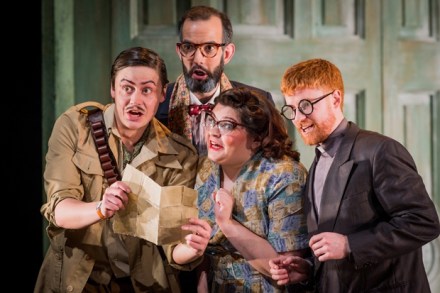
‘Forget Downton Abbey!’ exhorts David Pountney in the programme for Figaro Forever, Welsh National Opera’s season of Beaumarchais operas, The Barber of Seville, The Marriage of Figaro and Elena Langer’s Figaro Gets a Divorce. ‘A televisual age in which the vast narrative panorama of a “series” strung out across many episodes seems to capture people’s imaginations is perhaps exactly the right moment to follow the fortunes of the Count and Rosina, their servant Figaro and his fiancée, Susanna,’ he continues. What WNO’s artistic director means is the opposite of what he says.

Northern Ireland Opera’s Turandot will fill you with awe and revulsion

From our UK edition

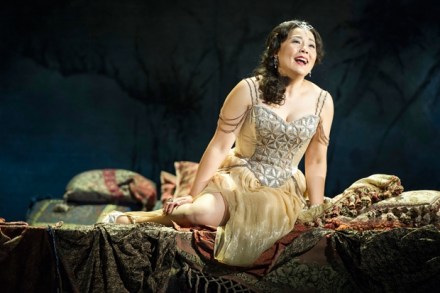
Chords as bright and sweet as pomegranate seeds burst and spill in Turandot, a splinter of bitterness at their centre. Left incomplete at Puccini’s death in 1924, the opera is his most radical and most cruel. You can taste something of Stravinsky’s Rite of Spring in the instrumentation, a musky roughness that rubs against the Italian composer’s customary silky precision. Woodwind and strings cling to the voices of the monstrous princess Turandot, her intoxicated suitor Calaf, and Liù, the slave who slavishly adores him because he once smiled at her. So closely scored is the writing that it is almost suffocating. This is love as an addiction: violent, sleepless, lethal. The renaissance of opera in Northern Ireland has not been timid or gentle.

Lady killer

From our UK edition

‘Kiss me, Sergei! Kiss me hard! Kiss me until the icons fall and split!’ sings Katerina Ismailova, adulterous antiheroine of Lady Macbeth of Mtsensk. Stalin was not amused by Shostakovich’s bleak black comedy but our culture would be poorer without bored wives like Katerina. Perhaps all that Emma Bovary, Anna Karenina and Laura Jesson needed was a proper kiss — the sort that mutes the white noise of disappointment. But a kiss is never enough in these cautionary tales of bourgeois bed-hopping. One thing leads to another and before you know it you’re knocking back the arsenic, throwing yourself in front of a train or back home listening to the wireless with poor dear Fred, a man whose kisses were never that hot.

Welcome to Bedlam

From our UK edition

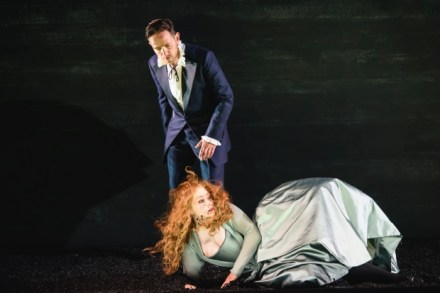
Caius Gabriel Cibber’s statues of ‘Melancholy’ and ‘Raving Madness’, their eyes staring blindly into the void, petrified in torment, once posed on top of the gate to Bedlam. In 1739, when Handel’s dramatic oratorio Saul was first performed, you could pay a modest fee to pass beneath them and gawk at the living spectacles within, victims of ‘arbitrary passions’ including pride, lust and envy. In Barrie Kosky’s Glyndebourne staging of Saul, Cibber’s archetypes are animated and given voice by Christopher Purves as the king driven mad by ‘Envy! Eldest born of Hell!’ Saul was the second of Handel’s great studies of madness.

Lost boys

From our UK edition

In Beryl Bainbridge’s novel An Awfully Big Adventure the producer Meredith Potter issues a doughty injunction on the subject of staging Peter Pan: ‘I am not qualified to judge whether the grief his mother felt on the death of his elder brother had an adverse effect on Mr Barrie’s emotional development, nor do I care one way or the other. We all have our crosses to bear. Sufficient to say that I regard the play as pure make-believe. I don’t want any truck with symbolic interpretations.’ Symbolic interpretation hangs heavily over the rough-and-tumble jumble of Janacek, Beethoven, Stravinsky, Satie, Handel, Vivaldi, sea shanties and klezmer in Lavinia Greenlaw and Richard Ayres’s half-brilliant, half-bewildering operatic adaptation for Welsh National Opera.

Alice in Wonderland at the Barbican reviewed: too much miaowing

From our UK edition

Charles Lutwidge Dodgson loved little girls. He loved to tell them stories, he loved to feed them jam, he loved to set them puzzles, and he loved to take their photographs. On 25 March, 1863, he composed a list of 107 prepubescent portrait subjects, arranged alphabetically by forename. Below the Agneses came the Alices, including Alice Liddell, the little girl for whom he created Alice in Wonderland. Mostly good-mannered, occasionally lachrymose and stuffed full of half-remembered governess-led learning, the fictional Alice displays behaviour quite out of step with her age. Instead of doing what she is told to do by the creatures she meets, she behaves like an adolescent (though adolescence was to Dodgson a destructive force) and learns to disobey.

Opera North’s Coronation of Poppea: a premium-rate sex-line of an opera

From our UK edition

Virtue, hide thyself! The Coronation of Poppea opens with a warning and closes with a love duet for a concubine and a psychopath, their union celebrated in sinuous melismas over a blameless passacaglia. First performed in 1643, Monteverdi’s final opera is all about talking dirty and talking tough. Seductions, threats, boasts and betrayals are snapped, spat, stuttered and smooched over harmonies that pinch and squeeze like a premium-rate sex-line. Does it work in English? Yes and no. There are casualties in Tim Albery’s slick, vicious Opera North production, some historical, some poetic, some musical. In Laurence Cummings’s hybrid edition, drawn from the Venice and Naples scores, transpositions and cuts proliferate.

Rigoletto in a gentleman’s club

From our UK edition

So it’s farewell to the fedoras and adieu to the jukebox. After 32 years of service, Jonathan Miller’s Little Italy staging of Rigoletto has been given the heave-ho by English National Opera and replaced by a younger model. First seen and disliked in Chicago in 2000, then seen and disliked again in Toronto, Christopher Alden’s nearly-new production affords the London audience an opportunity to congratulate itself for being less conservative than the North Americans, thereby mitigating its customary fright at the provocations of Continental Regietheater.

Manon Lescaut is twerking — should we applaud or shudder? 

From our UK edition

Last seen clambering over the MDF wheelchair ramps of Laurent Pelly’s Royal Opera House production of Jules Massenet’s opéra comique, Manon the minx, the ‘sphinx étonnant’ of Abbé Prévost’s 1731 novel Histoire du Chevalier des Grieux et de Manon Lescaut, reappears in two guises as part of Welsh National Opera’s Fallen Women season; as the heroine of Puccini’s Manon Lescaut and the antiheroine of Hans Werner Henze’s Boulevard Solitude, both directed by Mariusz Trelinski. The connection between her story and La traviata, the third opera in WNO’s season, is deeper than a coincidence of job descriptions.