Culture

Culture

The good, the bad and the ugly in books, exhibitions, cinema, TV, dance, music, podcasts and theatre.

Where will the extremes of OOO philosophy lead?

More from Books

The world divides between creeps and jerks. History can be seen as a long, unedifying creep, or what one of Alan Bennett’s characters called ‘one fucking thing after another’. Alternatively, it might be seen as consisting of jerks – that’s to say, big events that revolutionise the world (the invention of the printing press, the advent of steam, the French Revolution, Hiroshima, Tim Berners-Lee’s creation of the world wide web). The latter position is essentially that of the philosopher Alain Badiou. The French Maoist maintains that the significance of events that stand out from the usual blah of history can only be grasped retroactively – vindicating Zhou Enlai’s reply when asked in 1972 about the significance of the French Revolution: ‘Too early to say.

A commentary on the grim present: Glyph, by Ali Smith, reviewed

More from Books

Glyph (whose sibling, Gliff, was published last year) is Ali Smith’s 14th novel and her fifth since 2016, when her ‘Seasonal Quartet’ saw the beginning of her project to use fiction to comment on contemporary events. It takes as its subject two sisters. Petra and Patricia (‘Patch’) negotiate their difficult childhood by retreating into a story world. Not that their escape is all unicorns and rainbows. The two stories they most often return to involve a horse blinded in the Great War and a man’s corpse flattened towards the end of the second world war. They call this flattened man ‘Glyph’: it’s ‘the sound he makes when he breathes out’. We soon skate from this grim past to the grim present.

How mastering friction transformed humanity

More from Books

The fundamental purpose of science is to view the world from a different perspective. In the age of modern science, however, in which each academic discipline represents a world in itself, this is hard to remember. The field of ‘tribology’ would appear to be a perfect example. But such opacity is merely a front for the study of friction. And, according to Jennifer R. Vail, friction is ‘the unsung hero of the material world’. Why? Because ‘the way we experience the world, whether through greater efficiency, flight or space exploration, has been shaped by our understanding of friction’. Indeed, ‘our relationship with friction dates back to one of humanity’s greatest discoveries: fire’. How’s that?

A satirical masterpiece: Blinding, by Mircea Cartarescu, reviewed

More from Books

Before the 1989 revolution, Romania had seen nearly a century of polarisation – a fascist regime swiftly replaced by a communist one. In Blinding, Mircea Cartarescu’s first instalment of an ambitious, surrealist trilogy, that duality, along with other antagonisms central to existence, is represented by the motif of a butterfly. The novel was originally published in Romanian in 1996, and the title refers to the epiphany which, it’s suggested, can be achieved if life’s opposites are reconciled. We first meet the narrator, twentysomething Mircea, languishing in a squalid studio flat in Bucharest, his rapidly industrialising home city. He is writing his own ‘endless book’, his aim being absolute self-knowledge.

Will we ever stop predicting the end of civilisation?

More from Books

In the sphere of British environmentalism, Paul Kingsnorth is admired as a maverick in thought and deed. Starting out as a journalist with the Ecologist magazine, he co-founded the Dark Mountain Project, an online portal devoted to stories about the more-than-human world in a time of ecological collapse. On resigning from both, he retreated as a self-proclaimed ‘recovering environmentalist’ to an Irish smallholding, where he has embraced the Romanian Orthodox church. Against the Machine, his tenth book, is billed as a summary of his intensifying disillusionment with events in the past 30 years. It is a serious work leavened with sardonic humour and is by turns rich in unsettling ideas and deeply pessimistic.

Who will rule the Arctic?

More from Books

In 2007, two Russian submersibles descended from the ice at the North Pole to plant a small Russian flag on the sea floor more than two miles down. While the aquanauts were greeted as heroes in Russia, the reaction of other Arctic nations was somewhat less positive. ‘This isn’t the 15th century,’ complained the Canadian foreign minister. ‘You can’t go around the world and just plant flags.’ In response to the protests, President Putin – then Time magazine’s ‘Person of the Year’ – reassured the world: ‘Don’t worry. Everything will be all right.

Time for a reckoning: Vigil, by George Saunders, reviewed

More from Books

George Saunders is at his most lively in the company of the dead. At ease with ghosts. In the 2022 Booker-winning Lincoln in the Bardo, Abraham Lincoln mourns his young son in a graveyard surrounded by a clamorous crowd of the newly deceased trying to be helpful. Grief, handled with sweet humour. But Saunders has not always been so gentle. His acclaimed first collection of stories, CivilWarLand in Bad Decline (1997), featured a landscape of grotesque theme parks populated by corpses, enslaved humans and ghosts. Even then, compassion edged in, rubbing shoulders with absurdist humour.  Saunders is a cradle Catholic, and the liturgy frequently surfaces in his stories; but his Catholicism has a humanist face, a vein of kindness running through his work. He is now a student of Buddhism.

What triggered punk rock’s swastika fetish?

More from Books

When she was an 11-year-old schoolgirl, the writer Gitta Sereny passed through Nuremburg while a Nazi rally was in full swing. She recalled being awed by ‘the joyful faces all around, the rhythm of the sounds, the solemnity of the silences, the colours of the flags, the magic of the lights’. She understood nothing of the political message. Nor, of course, could she have known where it would all lead. It was pure showbusiness. Reading her words in Daniel Rachel’s survey of certain musicians’ thorny fascination with the iconography of the Third Reich, two thoughts occur. One: it is no wonder that as early as the 1950s, rock’n’roll shows reminded some observers of Nuremburg.

An intellectual farce: Rapture of the Deep, by Robert Irwin, reviewed

More from Books

If Robert Irwin had not existed, then Dan Brown, or better still Umberto Eco, would surely have had to invent him. In his Memoirs of a Dervish, the roller-blading, pinball-playing polymath reported: ‘It was in my first year in Oxford that I decided that I wanted to become a Muslim saint.’ Irwin, who died in 2024, first pursued that esoteric life goal in a Sufi monastery in Algeria. He returned to become not just a vastly erudite scholar of Arab Muslim culture but a madcap maverick of a novelist as well. As a writer, he loved paradox, surprise and reversal.

How ‘bad’ does a mother have to be to lose custody of her children?

More from Books

I’m lucky. I’ve only visited a family court once, and that was as a journalist rather than a party to a case. One detail stuck with me. On the wall in the waiting area was a poster preparing attendees for the layout of the courtroom: the judge goes here, the barristers go here, and you go here and wait for your fate – for your children’s fate – to be decided. It was a reminder that, however much family courts have become friendlier in recent years (notably, family court judges stopped wearing wigs in 2008), these are still places that confound and alienate those hoping for justice. That is, whatever ‘justice’ means when the issue at stake is the division of a child between warring parents.

Imposing Christianity on Europe’s last pagans

Lead book review

The crusades bring up images of the ancient cities and harsh deserts of the Levant, of Saladin, Richard Coeur de Lion and King Louis IX of France. The crusades to the Holy Land were a consuming obsession of Latin Christianity for four centuries and remain among the most famous episodes of the Middle Ages. Yet, in the perspective of history, they made almost no difference. The crusaders were defeated and expelled, leaving no trace in the life of the Middle East apart from a handful of churches and some spectacular ruined castles. By comparison, very little attention is paid to other crusades – in the Baltic and against the Moors in Spain and Portugal – which were truly transformative.

The serious business of games: Seven, by Joanna Kavenna, reviewed

More from Books

Joanna Kavenna is very serious about games. Her novels have a certain playful quality, even her debut Inglorious, where the humour and allusions are Mittel-european. More markedly ludic are her Lewis Carroll-esque fantasy about quantum physics, A Field Guide to Getting Lost and the Philip K. Dickish tech-dystopia of Zed. In Seven, however, it’s not just the style but the subject. As if to make clear that games are neither childish nor mere distractions, there is a pointed reference to Johan Huizinga’s study Homo Ludens¸ published on the eve of the second world war. The narrator here is working for a formidable philosopher in Oslo, whose current project is entitled ‘Thinking outside the Box about Thinking outside the Box’. (‘I’m serious,’ the narrator archly notes.

A young Englishwoman is caught up in the Russian Revolution

More from Books

This vivid account of a young English-woman caught up in the Russian Revolution was first published in 1919 as Under Cossack and Bolshevik, but it’s possibly even more gripping today. Rhoda Power, a political science graduate, was 26 when she was hired as a tutor to a 16-year-old Russian girl, Natasha Sabaroff, living in Rostov-on-Don. Going to Russia had for years been one of her dreams, so off she sailed from Newcastle to Bergen through U-boat-infested seas; and, indeed, future sailings were cancelled after four ships were torpedoed. But she arrived safely in Bergen, where the Cook’s man put her on a train to Petrograd (St Petersburg), which she spent four happy days exploring before taking the three-day train journey on to Rostov.

Bookshop blues: Service, by John Tottenham, reviewed

More from Books

A friendly admonition for the thwarted or struggling writer in your life: that tempting little job at the local bookshop might not be the best way to keep the show on the road until the Muse comes through. Would-be actors who take a front-of-house gig at the National Theatre aren’t constantly buttonholed by strangers raving about how brilliant Andrew Scott’s Hamlet was. Plus, of course, their more successful contemporaries will generally be elsewhere of an evening, doing shows of their own.

The madness of Prince Rogers Nelson

More from Books

In June 1993, the Artist Who’d Just Decided He Didn’t Want to be Called Prince Any More handed his passport to his long-suffering tour manager Skip Johnson and told him to get the name on it changed to the squiggly symbol with which he’d decided to rebrand himself. It is ironic that he felt ‘oppressed’ by a name bestowed on him by others while insisting on renaming most of his colleagues and lovers. The passport incident is one of the more comical demands listed in the exhausting catalogue of employee grievances that make up John McKie’s sprawling biography of Minnesota’s own Prince Rogers Nelson, the virtuosic visionary who died, aged 57, of an accidental Fentanyl overdose in 2016.

What is it about Bob Dylan that sends writers mad?

More from Books

Ron Rosenbaum is a man of galactic learning. Theology, neuroscience, American history, psychology, Shakespeare, cosmology, ‘all of Dickens’, nuclear weapons, quantum theory, iron ore – nothing escapes his hungry eye. Except, perhaps, Bob Dylan. Which is unfortunate, given that he’s written a book about him. What is it about Dylan that sends writers mad? Christopher Ricks’s usual mellifluousness succumbs to a pun-overdose; Clinton Heylin’s blindingly completist biographies are as impenetrable as their subject; Sean Wilentz lurches from the unlikely to the banal. With Things Have Changed, Ron Rosenbaum, the de facto ‘Dylan correspondent’ for the Village Voice in the early 1970s, proves that even ‘being there’ confers no immunity.

Does running 42 Lakeland fells in less than 24 hours really bring ‘serenity’?

More from Books

‘We continue to grapple as a species,’ writes Carl Morris, ‘with a knotty philosophical divide between anthropocentric and biocentric approaches to the natural world. Our bodies are both transcendent – seemingly beyond nature and capable of rationalised enhancement – but also immanent – that is within nature and therefore subject to the same frailties and limitations.’ What is he addressing? Space travel? Diving to the bottom of the Mariana Trench without oxygen? Not quite. He is talking about the process of human locomotion. He is talking about running. Stay with me. Books about running can be as dull as a ten-mile road race in the Illinois flatlands, and I say that as a keen fell runner. This book isn’t.

The scourge of plagiarism reaches crisis point

More from Books

‘Talent borrows, genius steals.’ Do you like it? I just came up with it. No, honestly. Any resemblance to the work of anyone else is purely coincidental. The idea that taking someone else’s words and passing them off as one’s own constitutes a form of theft goes back to antiquity. Aeschines, one of Socrates’s disciples, was said to have read out dialogues appropriated from his master, to which one philosophically informed heckler blurted out: ‘Oh! you thief; where did you get that?’ But, as I learned from Roger Kreuz’s Strikingly Similar, it was the Roman poet Martial who gave us our modern word for this crime. Plagiarius means kidnapper.

The anxious gaiety of Britain’s interwar years

More from Books

However many times one absorbs the brevity of the interlude between the first catastrophic worldwide conflict of the 20th century and the next, it was the not-knowingness of that timetable that allowed society to cope. In the 20 years between world wars that shattered several generations, Britain’s full emotional recovery was never really accomplished. But with his eye for the political and the cultural, for the game-changing and the deliciously absurd, for comedy and for tragedy, Alwyn Turner demonstrates the irrepressible optimism of humanity, whatever the circumstances: ‘Highbrows and lowbrows [lived] cheek by jowl, rubbing along with politicians, priests and pressmen.

The last chapter: Departure(s), by Julian Barnes, reviewed

Lead book review

Departure(s), whose publication co-incides with Julian Barnes’s 80th birthday, will be his last book, a thank you and goodbye to his readers. Barnes has blood cancer, but the condition is manageable and not terminal; when he dies, it will be with, and not of, the disease. Or rather, as he puts it: ‘I, in dying, shall have killed my cancer! Barnes 1, Cancer 0 – result!’ Otherwise he is in good nick and still master and commander of his narratives. He is bowing out because his body of work is complete: his 18 novels and two memoirs – or, depending on how Departure(s) is categorised, his 17 novels and three memoirs – form a perfect whole. It is a canny move to write your own final chapter, and Barnes is a canny writer who has always had the sense of an ending.

The spiritual yearnings of David Bowie

Lead book review

What did David Bowie mean by ‘No confessions/ No religion’ in his lyrics to ‘Modern Love’? Peter Ormerod proposes what at first seems an unlikely theory – that Bowie was talking about Gnosticism, the complex spiritual, though not religious, belief that God lies beyond the material world and that all humans carry a divine spark within. Ormerod admits that perceiving intellectual depths in a hit single sounds far-fetched – ‘an attempt to find weight in a scrap of fluff’. But he points out that Gnosticism, with its rejection of organised religion and its trust in God and man, was one of Bowie’s lifelong obsessions: a sincere enthusiasm he shared with Leo Tolstoy and Carl Jung.

Coming of age in Melbourne: Landscape with Landscape, by Gerald Murnane, reviewed

More from Books

Gerald Murnane’s Landscape with Landscape opens with a splendidly disgruntled preface. The book is a collection of six longish stories and was originally published in 1985, when it was panned by a reviewer. ‘Some writers may claim not to be affected by reviews or even not to read them,’ he observes in his preface: ‘I make no such claim.’ And he explains how this brutal notice (‘I call to mind easily some of the nastiest passages’) led to poor sales and the disappearance of the collection, his fourth book. There is some comedy in this alongside the spiky pathos. Murnane is about as close to review-proof as any writer can get. Now 86, he is often mentioned as a likely contender for the Nobel Prize in Literature. He has high-minded admirers (J.M.

Odd man out: The Burning Origin, by Daniele Mencarelli, reviewed

More from Books

This terse, unsparing novel can be summed up thus: after nearly a decade’s absence, the successful designer Gabriele Bilancini returns home to suburban Rome, where he wrestles with an identity crisis. His family and friends – his intimates before he moved to Milan and raced up the social ladder – feel like shameful reminders of his proletarian origins, which he keeps hidden – in ‘the way you hide a sin’ –  from the Milanese élite he is anxious to fit in with. In Milan, where he works and lives with his girlfriend Camilla, the daughter of his mentor, the celebrity designer Franco Zardi, Gabriele dresses smartly, limits lunch to ‘a salad with full protein’ and purges his speech of any signs of his unsophisticated upbringing.

The many shades of Pink Floyd

More from Books

The English rock band Pink Floyd was founded 60 years ago in Cambridge. Reading two new books about them, it struck me how much time and place matter to their story. Now in their eighties, the surviving members remain a product of the milieu in which they were formed: middle class, semi-boho, comfortably numb. First they moved to London; then to the outer reaches of the cosmos. After that they circled the planet for decades, recollecting the emotions of their youth in both tranquillity and anger. You can take the multi-million-selling, emotionally repressed space cadets out of Cambridge… Broadly speaking, five different businesses have traded under the name Pink Floyd.

After the party: One of Us, by Elizabeth Day, reviewed

More from Books

This is the sixth novel and tenth book overall by the highly successful journalist and podcaster Elizabeth Day. She hit her stride as an author with her third novel Paradise City (2015), which was leaps and bounds ahead of her first two in terms of narrative propulsion. Her next was what might be considered her breakout book, The Party (2017), after which came Magpie (2021).  One of Us returns to the characters and story of The Party, but it can easily be read as a standalone. Day has said that the earlier novel was partly inspired by reading The Great Gatsby at the age of 12; and while she has conceded that no one can write like F.

The glorious ventilation shafts hiding in plain sight

More from Books

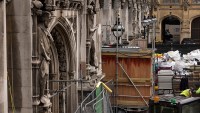
In the centre of London’s Paternoster Square there is a tall column on a heavy octagonal base that provides a few seats and shelter from the winds whipping around St Paul’s. If you look closely, you see a mishmash of styles, with the Corinthian column topped by a gold-covered flaming urn and various baroque flourishes. Passers- by might be surprised to find such an ode to eclecticism amid the rather modern neoclassicism of what was a highly controversial development in 2008 that attracted the attention of the then Prince of Wales. What few of them will know is that the column is not just a decorative addition to a dull square but has a function. It is a ventilation shaft (vent for short) whose primary use is to extract air and, crucially, fumes from the car park below.