Culture

Culture

The good, the bad and the ugly in books, exhibitions, cinema, TV, dance, music, podcasts and theatre.

Big School left me po-faced

Television

How did our comedies become so sad? BBC1’s new sitcom Big School (Fridays) opened with a scene that would probably tickle the ribs of many, but I, in my usual humourless way, found it depressing. Chemistry teacher Mr Church, played by David Walliams, hoped to excite his morbidly uninterested pupils about the effects of dunking a bottle of cold liquid nitrogen in warm water by using hundreds of table-tennis balls to dramatise the resultant explosion. But the bell rang, and his students filed out of class radiating boredom and contempt, leaving Mr Church gazing forlornly at a thousand ping-ponging shells.

A masterclass in stage presence from the Bolshoi

More from Arts

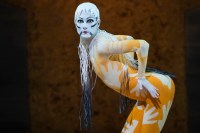
Jewels is everything a George Balanchine admirer could ask for. The sumptuous triptych, set to scores by Fauré, Stravinsky and Tchaikovsky, is a compendium of what Balanchine’s style is about; each part — Emeralds, Rubies and Diamonds — provides unique insights into the subtleties, signature features and inventiveness that inform the art of the Russian master who fathered American ballet. Yet on these shores Jewels is seldom a sell-out production. Unless, of course, it is danced by the Bolshoi Ballet. Comparisons are odious, but seasoned dance-goers could not help noticing that, on Monday, the Royal Opera House was packed to the brim.

The next Joyce Grenfell at the Edinburgh Fringe

Arts feature

Strict bylaws in Edinburgh prevent you from buying off-licence booze after ten at night. You can, however, buy all the sauce you want from ten in the morning. (This may explain why alcoholism is so rare up here.) When midnight tolls, Festival revellers pour forth and fill the air with chanting and singing of variable aesthetic quality, and the only way to get any peace is to lapse into a Valium coma. By day I venture forth with sleepy eyes in search of great art. Lee Kern: Bitter Twitter (Gilded Balloon) wants to unmask the superficial malignity of Twitter. His tactic is to tweet silly questions to silly celebs and to recite their silly replies on stage in an angry voice. This doesn’t take us very far.

Climb aboard the runaway train

More from Arts

Brother, can you spare me a train? Or maybe just a Pullman carriage or two? There are so many brilliant films set on trains that I’d love to screen some of them in loco locomotive, as it were. Shanghai Express (1932), The Lady Vanishes (1938), The Narrow Margin (1950), Night Train (1959)… I’ll stop there. Just grab a ticket and scramble aboard. Andrey Konchalovsky’s 1985 film Runaway Train, which has just been released on Blu-ray and DVD, would certainly be included on the programme. It has the qualities of other rail-bound films: the heavy sense of momentum, the restrictiveness of the carriages, and so on. But it’s several times gruffer than the rest.

Kate Chisholm connects to her inner tortoise

Radio

Of course there’s a future for digital radio, it’s just that we’ll probably be listening to it online, or on the phone. The wireless set, tucked on the kitchen shelf, beside the bed, among the vases in the lounge, permanently tuned in to Aggers or Humphrys, Livesey or Lamacq, will become a museum piece, an object from the past. Instead we’ll be going back to the future and walking around with a smartphone plugged to our ears as if it were an old transistor radio. But with a difference. Aggers and co. will have to compete with the constant chatter of online life. No longer a dedicated stream of wireless talk but a babble of disconnected thoughts and ideas.

Wagner at the Proms

Opera

It would be interesting to know why Tristan und Isolde was placed in the Proms programme in between Siegfried and Götterdämmerung. You might as well programme Othello between acts four and five of King Lear. Wagner wrote Tristan and Die Meistersinger between acts two and three of Siegfried, and to be really chic some company should have mounted the Ring and the two others in that order. But dramatically it makes no sense, and that partly accounts, I think, for the lukecool reception that the performance of Tristan has had in the press. All told, I found it one of the more striking performances I have heard of Wagner’s masterpiece in recent decades.

Send George Osborne to the Tower

More from Arts

Send George Osborne to the Tower, then he might learn that currency manipulation rarely ends well. Coins and Kings occupies four small rooms in a Yeoman Warder’s house on the site of the old mint, which was established by Edward I in the 1270s in response to endemic counterfeiting, coin clipping and general skulduggery. This permanent exhibition progresses through the Middle Ages to Elizabeth I’s attempt to restore confidence after her bankrupt father had debased the currency and caused inflation, riots and misery (on display is an Elizabeth I half pound coin, above). The Reformation saw traces of continental popery being removed from coins, and the crown take even greater prominence as the nation state began to form.

Is David Starkey God?

Television

‘Somerset. Winter 877,’ said the subtitles below an arty, BBC-nature-doc style close-up of a coot paddling amid the reeds on the eerie black waters of the Somerset levels. ‘Yes!’ I went, mentally punching the air. ‘I’m in safe hands here, I can tell. Bet they’re going to get all the costume details totally right. There might even be battle scenes. Not crap three-men-with-shields-filmed-over-and-over-again-from-different-angles-with-a-shaky-camera like in the bad old days. But totally convincing CGI-enhanced ones. The Battle of Ashdown, done even more realistically than it was in 871. Yay!’ Then it got even better.

It’s possible that Deborah Ross left her critical faculties outside the screening room

Cinema

The thing is, I love the character of Alan Partridge so much it may well be that, when it came to this film, I left my critical faculties outside the screening room, possibly somewhere along Wardour Street. If you see them, might you return them? I would hate them to fall into the wrong hands, or be sold to the highest bidder. Anthony Lane of the New Yorker, for example, has always been after my critical faculties and the late film critic Roger Ebert was once quoted as saying he’d pay anything for them; anything. Luckily, he was American, and they would never be allowed to leave the country, but you see what I’m saying? Why it’s important I get them back?

Hell is other people’s taste in music

Music

‘I don’t really like most of the music you play,’ said the tall blonde woman with whom I share my life. ‘There are no tunes. Where are the tunes? A lot of it sounds like the sort of thing you’d hear in Topshop.’ I was outraged. Admittedly, the song playing at that moment — a droll little thing called ‘Boring’ by The Pierces — didn’t exactly boast a killer melody, but even so. Like any music obsessive worth his salt, I pride myself on my ability to spot a decent tune from 40 paces, even if many of them are couched within the acoustic, minor-key, vaguely melancholy textures I tend to favour.

Highlights of the Edinburgh Art Festival

Arts feature

Few come to Edinburgh in August for the art but this year they should. The line-up for the official Art Festival is impressive and, happily, rich in painters. Foremost among them is Peter Doig, whose semi-retrospective No Foreign Lands is the main event at the Scottish National Gallery (until 3 November). Doig was born in Edinburgh in 1959 and is being claimed as ‘one of us’. That he left the country as a baby should not stand in the way here; we need painters like this. For too long now, perceptions of art in Scotland have been skewed by the consistent success of Glasgow artists in the Turner Prize. As Doig himself has said, the influential art prize should not be the Turner but the John Moores, the annual award for painting that Doig won in 1993.

A bearded, medallion-wielding, miniature puppet won’t persuade us to go digital

Radio

Will digital radio ever really take off? We were supposed to be switching over to digital-only reception in 2015 (three years after the TV switchover) but with only 36.8 per cent of listeners as yet tuning in to a digital station the future of DAB is beginning to look very uncertain (and most of those 36.8 per cent will also be listening to an old and much-loved analogue wireless set or transistor). Ed Vaizey, the government’s minister for culture, communications and the creative industries, has said he will announce a new date for the switchover ‘by the end of the year’, but this seems an unlikely target given that more than 60 per cent of the population don’t have access to digital and that take-up is only increasing by 4 per cent per year.

The Bolshoi remains faithful to the classics

More from Arts

Tradition is often frowned on. Yet, if properly handled, it can be sheer fun and pure bliss, as demonstrated by the Bolshoi Ballet’s current season in London. Far from being museum pieces, the classics so far presented stand out for their vibrant and captivating theatricality. According to an enlightening note by Yuri Grigorovich, the father of Russian contemporary ballet, much of it depends on an approach that favours performance tradition over sterile philology. In other words, care is taken to note the cuts, the interpolations, the revisions and the additions that have helped each ballet stand the test of time, instead of going for a much idealised ‘original’.

Is this the best Ring ever?

Opera

The first complete performance of Wagner’s Ring cycle at the Proms is already, less than a week after its conclusion, being hailed as historic and will soon be mythic, an appropriate status and designation for this amazing and amazingly great work. Even Radio 3 ‘presenters’ who have music degrees but have always quailed at the thought of anything so daunting have breathlessly confessed that it was among the very greatest musical experiences of their lives. Some of us have been saying that for quite a time, without making much impression other than that we are the members of a weird and even sinister cult. Still, better late than never.

A mega-musical that’s like watching the Downton cast crammed into a telephone kiosk

Theatre

Hats off for theatrical recklessness. The producer Danielle Tarento has taken a $10-million Broadway mega-musical and staged it in the 240-seat Southwark Playhouse. Titanic, by Peter Stone and Maury Yeston, opened in 1997 to howls of critical derision that it merrily ignored. The run lasted for two years. The writers take a comprehensive approach. All the passengers, from first class to steerage, are represented. There are smut-smeared boilermen and bustling waiters. Salts of various ranks are shown alongside the designer, the builder, the financiers, the lot. It’s like watching the Downton cast crammed into a telephone kiosk. This method leaves no room for a catchy storyline to appear. Quite deliberately.

Spectator Play: The highs and the lows of what’s going on in arts this week | 3 August 2013

‘Shakespeare’s Globe’, as the theatre has been called since it was founded in 1997, is unusual for a theatre in that it makes a large annual profit, without receiving public funding. How? Its unique angle means it has no need to market itself – what’s more attractive to an American audience than Shakespeare, in London, in a reconstructed Shakespearean theatre? But its decision to put all Shakespearean productions on hold to make way for another dramatist is a decision which Lloyd Evans isn’t too sure about. Samuel Adamson’s Gabriel may be accompanied by some lovely Purcell music, but the actual play’s content leaves much to be desired. Theoretically, there’s nothing more delightful than evening at Glyndebourne.

Melissa Kite is punished for ignoring the Madonna of the sea

Real life

‘Benvenuti alla Small Cluster Band!’ And about time, too. We had been sitting in the Castello in Castellabate for half an hour watching an empty stage, while members of La Small Cluster Band stood around eating slices of pizza from takeaway boxes. ‘They’re on Italian time,’ I told my mother, as she sat in her place wearing an expression communicating polite but profound dissatisfaction. It had been my idea to spend an evening in the historic hilltop town of Castellabate listening to La Small Cluster Band playing ‘Concerto Swing’ after seeing a poster advertising the event on a wall. What could be more sophisticated, I thought, than an evening of live music in Castellabate, which boasts of being the most beautiful town in Italy.

Clarissa Tan experiences the greatest show on earth, and laughs

Television

I watched Top Gear (BBC2, Sunday) for the first time in my life last week (the rock under which I’ve been living is pretty large, practically a boulder). I thought I’d better plug this knowledge gap before it got too embarrassing, seeing that Top Gear is the greatest show on earth, the travelling Big Top de nos jours, a daredevil combo of acrobatic stunts, mechanical wizardry and freakery. Fakery too, apparently, as it’s emerged that in a recent episode scenes that looked spontaneous were actually staged. These involved flashes of watery chaos, upturned tables and angry diners shaking their fists as an amphibious vehicle hastily built and even more hastily driven by Jeremy Clarkson & co. blasted past a bucolic restaurant by the River Avon, spraying all and sundry.

Sandra Bullock must be blindfolded when she picks her movies

Cinema

Sandra Bullock is a highly watchable actress and she seems like she’d be fun to hang out with — I have no idea why I think that; I just do — but, Jesus, how does she choose her movies? With a blindfold and pin? Sure, she won an Oscar for The Blind Side, during which she dragged around that poor black boy as if he were a tired old circus bear, and there was Speed and After You Were Sleeping, but The Proposal? Premonition? Speed 2? Two Weeks Notice? I suppose you think I’m going to add: ‘And now this?’ which I am, although not unreservedly. It’s not all bad. It’s possibly only half bad. Perhaps when she was poised with pin, the blindfold shifted? And she saw out of one eye, at least?

Michael Tanner’s Glyndebourne experience is ruined by the traffic

Opera

What could be more delightful than going to Gyndebourne with someone who has never been before, arriving in time for a Figaro or Ha-Ha Tea at the Mildmay Hall, taking a stroll round the grounds, which incidentally have been considerably changed this year, and for the better (though the slightly alarming jungle near the opera house is still thriving in its sinister way), then going in for the first half of the opera, suitable exclamations from the newgoer about how enchanting it is, what wonderful sightlines, perfect temperature, and so forth, then in the long interval going to the Nether Wallop for the superb buffet, returning unbuttoned for the second half, and driving — in my case, being driven — tired but relaxed and stimulated home? That’s what one imagines.

70th anniversary of Composer of the Week

Music

Mention of the 70th anniversary of Composer of the Week brings to mind a distinguished list of long-running programmes on Radio 3. They all beg the question of how they have managed to survive so long in an atmosphere of constant doubt about the value of a station that has so few listeners. Time and again it has seemed as though dumbing down would be the fate of all these old shows, if not of Radio 3 itself, and every time a peculiarly British mix of grudging respect for the arts alongside a trenchant nostalgia for familiar things — of the kind that has kept The Archers going since 1951 — has saved them. Composer of the Week can outrank The Archers, however, having been launched (as This Week’s Composer) in August 1943.

Compare and contrast Rodin and Moore

Exhibitions

One generation is usually so busy reacting against its predecessors that it can take years for a balanced appreciation of real and relative merits to emerge. Henry Moore was born in 1898, and Rodin didn’t die until 1917, but they never met. All his life Moore was aware of Rodin’s work, and although early on he made apprentice works influenced by Rodin, it was only when he had established his own territory as an artist that he could afford to look long and admiringly at the senior artist. Indeed, Moore came to value his work so highly that he included four sculptures and three drawings by Rodin in his own collection and was happy to be consulted over the installation of the great Rodin exhibition at the Hayward Gallery in 1970.

How Manet was influenced by the artists of the Renaissance

Arts feature

Manet’s paintings were regularly rejected by the Salon, yet he continued to submit them and declined to exhibit with the Impressionists, who regarded him as a father figure. Even when his works were accepted by the Salon, they were routinely received with outrage among both critics and the public. This response baffled him. When his ‘Olympia’ was shown at the Salon in 1865, along with his ‘Jesus Mocked by the Soldiers’, Edouard Manet wrote to Baudelaire in exile in Brussels: ‘I wish I could have your sound judgment on my pictures, because all this uproar is upsetting, and obviously someone must be wrong.’ And to Antonin Proust he said: ‘Only a fool could think I’m out to create a sensation.

Siempre | 1 August 2013

Poems

I am not jealous. If you arrived with a man on your back, or a hundred men hanging in the rigging of your hair, or a thousand men sleeping on the soft mound of your belly, if you were a river filled with drowned men met by the furious sea foaming at its mouth, by eternal weather – if you arrived with them all where I wait for you, I would not be jealous. We will always be alone. We will always be, you and I, alone on this earth to begin life.

Punchdrunk’s bizarre spectacle

More from Arts

Standing enthusiastically by as a naked man writhes in agony might not be everyone’s cup of tea. But this is the sort of bizarre spectacle that devotees of immersive theatre group Punchdrunk sign up for. Like previous efforts including 2007’s The Masque of the Red Death, Punchdrunk’s latest venture, The Drowned Man: A Hollywood Fable, requires theatregoers to don masks and chase actors down disorienting, low-lit passageways, happening haphazardly upon non-sequential ‘scenes’. Rummaging is encouraged, talking is not. And every individual sees something different. The Drowned Man (playing until 31 December; www.nationaltheatre.org.uk) is a delirious fever-dream, replacing dialogue with dance and abandoning most audience/actor interaction.

Bradley Manning awaits sentence. Would the real Julian Assange please stand up?

Bradley Manning’s relationship with Wikileaks has, inevitably, brought Julian Assange back into the papers. Viewed on the frontpage, Assange is egimatic. We know what he’s done; but we know little of him. Alex Gibney’s compelling new documentary film We Steal Secrets: The Story of Wikileaks presents an extensive and revealing biography of Assange — and much more besides. Gibney’s camera is impartial. We hear from Assange cultists, former collaborators and alleged rape victims. No two people will react in the same way to what they see. A white-haired Icarus formed before my eyes; a charismatic brought down by his own narcissism and hubris.