Culture

Culture

The good, the bad and the ugly in books, exhibitions, cinema, TV, dance, music, podcasts and theatre.

A fresh perspective on reassuringly familiar artists

Exhibitions

This exhibition examines a loosely knit community of artists and their interaction over a decade at the beginning of the last century. It is centred around the marriage of Ben and Winifred Nicholson (which began to split up in 1931), involves their crucial joint-friendship with Christopher Wood and a fruitful exhibiting relationship with William Staite Murray, topped off by the all-pervading influence of a true original, Alfred Wallis, Cornish fisherman, marine-stores dealer and compulsive painter. The intellectual and artistic meeting of these individuals was a formative impulse in the development of Modernism in England; and it could be said — with some justification — that they brought out the best in each other.

Civilisation doesn’t need a woman presenter – and it doesn’t need to be remade!

I was pleased to see that June Sarpong had added her weight to Kathy Lette's petition to get a woman to present the BBC's remake of Civilisation. I've often wondered what became of her after Five Go Dating, a show I used to watch religiously, and one which - if you're listening, Channel 4 - equally deserves to be resurrected. Lette's letter is in yesterday's Times. She complains that Kenneth Clark's original had little to say about women (true) and that because of this, a 'female historian' should take the reins this time. 'A female presenter', argues the Australian novelist, 'would ensure that the series is not just about History but also Herstory. It’s imperative that women also have a voice in the story of our world.

John Deakin is no genius – and he has not been forgotten

More from Arts

Every so often, John Deakin, jug-eared chronicler of Soho and hanger-on at the Colony Rooms, is breathlessly rediscovered as the unknown giant behind Bacon and the forgotten man from Soho’s  generation of genius. All that is so much tosh: Deakin is no genius and he has not been forgotten. In fact, he can never be forgotten, most importantly because Bacon commissioned photographs from Deakin that he used to make his paintings but also because Deakin himself was the subject of one of Freud’s greatest portraits (above) and because Deakin’s photographs capture Bohemian Soho in aspic for the mental tourist of the future.

The Archers hit a new low by letting Tom dump Kirsty at the altar

Radio

Did you hear those bloodcurdling screams from Kirsty? Those long-drawn-out wails that echoed horrifically through the ancient walls of St Stephen’s Church last Thursday — in a strange, unwelcome echo of Nigel’s unfortunate descent from the roof of Lower Loxley in 2011? They were enough to make every woman’s blood run cold. Kirsty, the bride-to-be, was not just dumped by Tom on her way to the altar but also left dangling in all her finery at the church gate while Tom (what a waster of an Archer) sobbed his heart out in the vestry. Did you see it coming? (I didn’t.

Khovanskygate is about the dreadfulness and possible glory of being Russian

Opera

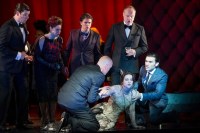
Within the space of a few weeks we have had the rare chance of seeing the two great torsos of Russian opera, Borodin’s Prince Igor, unfinished because the composer was often otherwise engaged, and Musorgsky’s Khovanshchina, unfinished because its composer died of drink. Prince Igor at the Coliseum was musically magnificent, and dramatically utterly absurd, ‘self-parody’ that did not do justice to its low-jinks. By contrast, Birmingham Opera Company’s Khovanskygate is musically at least as superb, and dramatically gripping though questionable. As is usual with BOC, the location is unorthodox, in this case an immense tent in the middle of Cannon Hill Park.

Blue Ruin is unwatchable, bloody – but, from what I saw, rather good

Cinema

Blue Ruin is a low-budget yet highly accomplished revenge thriller although whether you have the stomach for it is another matter. I do not have a strong stomach, as we know, and as I braced myself for the next startlingly bloody burst of violence, having yet to recover from the last startlingly bloody burst of bloody violence, I was often just longing for it all to be over. I like excellent film-making as much as the next person but, ideally, I would also like to be able to watch it. Stuff you don’t need to know but might like to: this has been a huge festival hit, winning several prizes, and much acclaim for its writer-director Jeremy Saulnier, who had previously only made corporate videos and one small feature (Murder Party).

Thanks to Audio Description, the blind have the best seat in the house

More from Arts

I did not mean to snort so loudly. There I was watching the amazing Simon Russell Beale in King Lear at the National Theatre and things were all getting a bit nasty — what with daughters scheming and people having their eyes gouged out. And then, through a small earpiece, which no one else could hear, I heard the immortal words, said in a deep and quiet voice: ‘Lear enters to find Goneril clenched in tight embrace with Edgar. He clasps her tightly.’ At my snort, a very serious man behind me tapped me on the shoulder and ‘shushed’ me. He had no idea that I was tuned into the wonderful world of audio description, or AD as the industry refers to it. For the uninitiated, AD has been around for some time.

The Guardian didn’t much like Noel Coward’s Relative Values – but you will

Theatre

Cripes. How did I get that one wrong? A few issues back I blithely predicted that Harry Hill’s musical I Can’t Sing would run for three years. It closes this month, so I’m a little reluctant to praise another glittering comedy, Relative Values by Noël Coward, which, like Hill’s stricken satire, has received a few snubs from the critics. In his early dramas, Coward portrayed servants as amiable bunglers or bossy cynics and he rarely gave them more than one wisecrack per act. In Hay Fever, for example, the leading lady can’t even recall the housekeeper’s name, and her forgetfulness is supposed to be funny and attractive. Relative Values dates from 1951, when domestic service was in decline and social divisions were being steam-rollered flat.

British choirs can’t match up to those from abroad

Music

To curate a festival these days is to put oneself in the firing line. There is every chance that all one will earn is the charge of stirring up apathy. It is a risk; and there will be no knowing how it has gone until it is much too late to withdraw gracefully. In the recently concluded first edition of the London International A Cappella Choral Competition, held at St John’s Smith Square, it could have gone either way. What will stick in my mind is how the wind got behind it round about day three, so that by the end a packed house could go mad at a Spanish victory.

For God, King and Country

More from Books

Flags and flowers: three bloody years worked in silk. At the needle’s eye stand easy, ghost, slip through my fingers your blue, indelible, weightless kisses for the children. Tell Charlie, Min, time is short now. Up to the firing line for night operations — a ‘fabrication française’ where threads unravel, unvarnished truths must be embroidered by cheery cards. Not the only one not by a long way, your loving brother Albert.

Locke: a great excuse to gawp at Tom Hardy’s lovely neck

The ancients thought that the seat of female hysteria was the womb. My theory (just as credible) is that male charisma resides in the neck. The most magnetic films stars have always had impressive upper spines. Marlon Brando’s neck was so thick it was simply a continuation of his temples with only a jutting chin to betray the difference. While James Dean’s sudden bare nook between hair and leather collar is the definition of sexy vulnerability. Tom Hardy, one of the most exciting actors of the moment, is just as well endowed. His neck, playing the serial killer in Nicolas Winding Refn’s Bronson and a charming forger in Christopher Nolan’s Inception, was in constant danger of overshadowing his head (not to mention the other actors on screen).

When Aachen was the centre of Europe – and Charlemagne ruled the known world

A UNESCO World Heritage Site since 1978, Aachen (Aix-la-Chapelle) will this summer become the focus of European attention. From June to September, the Aachen Palatinate, Europe’s best surviving Carolingian palace complex, plays host to three inter-related exhibitions commemorating the 1200th anniversary of the death of Charlemagne. The exhibition entitled Charlemagne. Power. Art. Treasures. occupies three separate parts of the former palace complex: the town hall, the Centre Charlemagne (a new visitor centre on the site of the original inner palace courtyard) and the Cathedral Treasury. Charlemagne, king of the Franks from 768-814, was crowned Holy Roman Emperor by the Pope in 800 and hailed the ‘father of Europe’ by a poet of his own day.

Good Morning Britain: news, sport, showbiz and blithering nonsense

Some of the greatest minds of our generation have struggled to get to grips with the thorny conundrum of breakfast television. Should it be fluffy, should it be tough, should it do sofas or puppet rats or news? Back in the 1980s, many believed it shouldn't do any of them, and shouldn't exist at all. As Nick Ross, one of Frank Bough's acolytes on the BBC's pioneering Breakfast Time, put it, 'television in the morning was outrageous - it was just decadence beyond belief.' Judging by the opening salvo from Good Morning Britain, ITV's latest revamp to the redeye slot kicking off this week, today's state-of-the-art thinking is that it should be everything at once, presented with almost intimidating professionalism.

Cutting all state funding to the arts would be monstrous

One of the best things about The Spectator is that it has no party line. As its dauntless refusal to compromise on Leveson Inquiry has shown, it is incomparably committed to the free speech of its writers. So only here could a humble arts blogger announce that this magazine’s editor, Fraser Nelson, was riproaringly, doltheatedly, cloven-foot-in-mouth wrong in his post on arts funding last week. On pretty much everything. Fraser’s right about one thing: Sajid Javid will make a great culture secretary, because unlike most culture bureaucrats, he gives a toss about staying solvent. Running culture by committee has always been a problem: the Department of Culture, Media and Sport (DCMS) remains a bloated department.

I Am Divine reminds me why I’ve always hated drag

It was early evening and I had not yet eaten, so I took a glass of wine and a packet of Haribos into the private screening of I Am Divine: the story of Divine. I touched neither, because early on in the film I felt a little sick. I'm unsure as to whether that queasiness was a result of the mention of dog excrement (more anon) or the scale of misogyny contained within its 90 minutes. Divine, aka Glenn Milstead, was an American actor, singer and drag queen who died in 1988 of a massive heart attack. Divine developed a name for himself as a female impersonator known for outrageous behaviour in John Waters counter-culture pre-punk films. Following his death, People magazine described Divine as the 'Drag Queen of the Century'.

Batman: from midnight monster to pop-tacular star. Kapow!

Arts feature

‘Well, Commissioner, anything exciting happening these days?’ Those were the first words — all seven of ’em — spoken by a new character introduced in the May 1939 issue of Detective Comics. That character was a chap called Bruce Wayne. You may know him better as the Batman. And, if you subtract May 1939 from now, you’ll realise that he is three quarters of a century old this year. So, yes, Bruce, there is something exciting happening these days. It’s your 75th birthday. Mr Wayne is sprightly for a septuagenarian — particularly given that he was hardly fresh-faced and spring-limbed at birth. When the writer Bill Finger and the artist Bob Kane designed this new comic-book hero they took inspiration from plenty of old non-comic-book heroes.

The German devotion to high culture is quite shaming

Exhibitions

The 300th anniversary of George I coming to the British throne on 1 August 1714 is big news in his home town of Hanover in Lower Saxony. Five shows are being put on in Hanover and the Hanoverian country schloss in nearby Celle, an utterly charming town that largely escaped the attentions of Allied bombers in the war. The same can’t be said for Hanover, an important railway and manufacturing city flattened by our boys.  Still, enough has been restored to make it worth a visit, not least the Herrenhausen Palace, the Hanovers’ austerely classical summer residence, burnt to the ground in 1943 and rebuilt last year by Volkswagen at vast expense.

The Matisse Cut-Outs is a show of true magnificence

Exhibitions

Artists who live long enough to enjoy a late period of working will often produce art that is radically different from the achievements of the rest of their careers. Late Titian and late Rembrandt are two such remarkable final flowerings, but Henri Matisse (1869–1954) did something even more extraordinary: he not only changed direction, he also gave up painting entirely. In the last years of his life he concentrated exclusively on making pictures, some of them vast, from cut paper. If ill health prevented him from painting, it could not stop him creating, and he reached new heights of greatness in the breathtaking beauty and daringly simplified harmonies of his cut-outs. ‘I have attained a form filtered to the essentials,’ he said.

Was I abused by Jimmy Savile?

The Spectator's Notes

‘Twenty-six million people in Europe are looking for work. And whose jobs are they after?’ asks the Ukip poster for the euro-elections, beside a Lord Kitchener-style pointing finger. Obviously, Ukip thinks the answer is ‘Ours’. But this isn’t true. Twenty-six million people are not looking for British jobs, but for jobs in general. And even those who do want jobs in Britain are not trying to take jobs from people who have them (though this might sometimes be the effect): they just want jobs. If Ukip is opposed to unrestricted EU immigration, it should direct its anger at the politicians who support this policy, not at the blameless people who, like most of us, want work.

Dolly Parton’s secret for surviving decades of celebrity

Radio

It’s a shame Dolly Parton has never gone into politics. She’s someone who’s lived her life very much in the public eye and yet has never lost sight of who she is, of her claim to fame as a country singer. You can tell by the way she sings, even now after more than 50 years in the business, that it’s straight from the heart, nothing synthesised, nothing stage-managed. Her voice just ripples out, tripping lightly through those lyrics of broken hearts, feckless men, without ever sounding bored, trite, as if she didn’t really care.

Estate agents: we were right about the bastards all along

Television

Television executives must be longing to make a programme about estate agents that casts the agents in a good light. There would be a national outrage, and in these Twittering, Facebooking times nothing is more appealing to a producer than a bulging digital postbag. Under Offer: Estate Agents on the Job (BBC2, Wednesday) is, sad to say, not that series. The factual six-parter goes behind the scenes with agents around the country, only to show us that we were right about the bastards all along. Everyone we met was a pastiche of an archetype. There was Lewis Rossiter, in Exeter, a young man whose drinking banter and easy way with aphorism suggested that the BBC had cultivated him from David Brent’s rib.

If The Other Woman is a box-office hit, I’m going to have to top myself

Cinema

The Other Woman is not just an extremely bad film but also a wholly reprehensible one (she says, with her most disapproving hat on). It’s a comedy, although if you find any of it funny, that’s all I will ever need to know about you, but its unfunniness isn’t what upsets me so much. It’s the dishonesty. It’s being sold as a film that ‘celebrates female friendships’ and ‘is absolutely a feminist movie’ (Cameron Diaz) even though it is an insult to all women everywhere from beginning to end. Who doesn’t realise this? Do they expect us not to realise this?

The real original kitchen-sink drama

Theatre

Rewrite the history books! Tradition tells us that kitchen-sink drama began in 1956 with Look Back in Anger. A season of lost classics at the White Bear Theatre has unearthed a gritty below-stairs play that predates John Osborne’s breakthrough by five years. Women of Twilight by Sylvia Rayman (which has transferred to the Pleasance) was a thumping West End hit in the early 1950s. It spawned several touring productions, one of which featured the young June Whitfield. When the script was filmed in 1952 it became the first British feature to attract the enticing ‘X’ certificate (over 18s only). The setting is a lodging house in Hampstead where unmarried mothers are crammed together, three to a room.

Britten’s worldwide reputation is enhanced in Lyon

Opera

One of the proudest boasts to come from Britten HQ in Aldeburgh during the composer’s anniversary last year was that performances of his works were proliferating across the globe — and not just in the UK — as never before. If the Opéra de Lyon might be a little late to the anniversary party in featuring Britten in its annual Eastertime opera festival only this year, the fact that it’s doing so at all certainly provides evidence of the composer’s worldwide reputation, as well as of the artistic adventurousness of Serge Dorny, reinstalled for the time being as the opera house’s boss after a short-lived stint at Dresden’s Semperoper came to an abrupt end in February.

David Moyes’ failure – in his own words

As children, we learn very quickly that a blame shared is a blame halved - but in the long-term, the ruse works only with the co-operation of the co-opted. This is a lesson that must have escaped David Moyes, whose public pronouncements regularly identified unwilling conspirators, illustrating precisely why he failed at Manchester United. Which is not to say that liability resides solely with him. Most obviously, Moyes was let down by his players; their performances were his ultimate responsibility - not excusing the indolence, indignation and entitlement that defined them. Also at fault is Alex Ferguson, who bequeathed Moyes a midfieldless squad - a partial consequence of a takeover he welcomed.

Don’t mock pro wrestling. Today’s TV is made in its image

Earlier this month, when a 54-year-old man with the birth name James Brian Hellwig died of a suspected heart attack outside a hotel in Arizona, a million boyhood fantasies also clutched their chests and fell to the ground. To fans – and former fans – of professional wrestling, Hellwig was The Ultimate Warrior, the man who defeated Hulk Hogan at Wrestlemania VI and taught a generation of scrawny kids to nurture their own inner Warrior. Some of us never forgot that poignant lesson, and there’s evidence Hellwig never forgot either. Despite his obvious lack of in-ring talent (enough time has passed since his death that we can admit he wasn’t the greatest athlete) he believed in his own character until it bled into his civilian life.

Britpop 20 years on: the Tory voters who love Oasis

It’s twenty years since the height of Britpop, but does anyone still care about it? YouGov has carried out some polling on the subject today. Although 35 per cent stated that they like or really like Britpop (compared to 20 per cent who dislike/really dislike), 44 per cent replied 'don’t know'. There’s also a lot of indifference on whether music has been better or worse since. Nine per cent think better, 26 per cent worse, and 34 per cent stated they also don’t know. At the height of Britpop, Oasis painted themselves as a working class band, the lads, in contrast to the perceived effete and posh boys of Blur. Based on this public image, one would expect Oasis fans to be natural Labour supporters (like Noel Gallagher, who posed in No.