Hugo Shirley

ENO’s The Girl of the Golden West is irresistibly seductive

From our UK edition

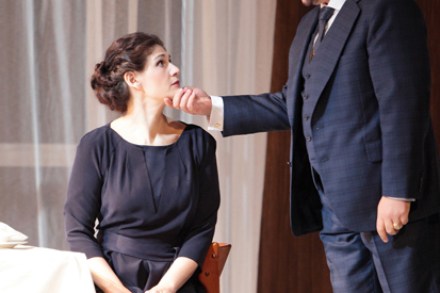
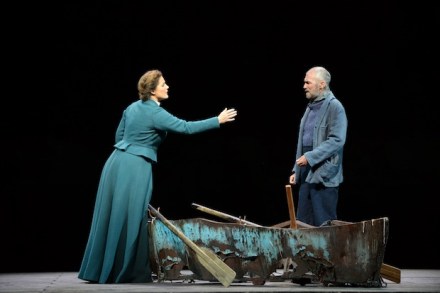
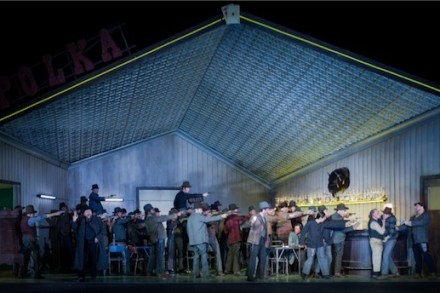
Puccini’s La fanciulla del West is, one suspects, one of those works that modern audiences struggle to keep a straight face through. The hero, for a start, decides to call himself Dick Johnson. The piece’s Wild West trappings, long since staled into Hollywood cliché, still seem a strange fit for the operatic stage (it was performed here as The Girl of the Golden West, with Kelley Rourke’s translation delivered in a variety of American accents). The redemptive, into-the-sunset conclusion takes for granted a belief that capitalism in its most primitive, brutal form could leave a group of hardened Gold Rush miners capable of forgiveness. That it might have done, ENO’s programme told us, is not actually that wide of the mark, historically speaking.
Robo-Tell hits Welsh National Opera

From our UK edition

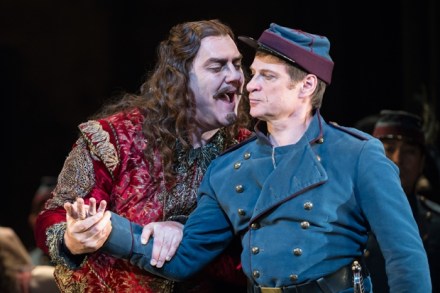
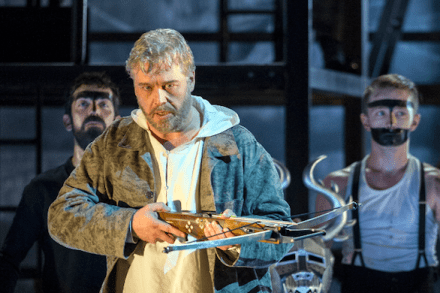
Is there a fundamental, insuperable problem with staging Rossini’s Guillaume Tell on a budget, without the resources to conjure up the sense of scale that was part of grand opéra’s appeal and raison d’être? Take away the special effects, whip away the phantasmagorical curtain, and, as with any Hollywood blockbuster, you are left with a modest little plot whirring away at its centre. In Tell, this involves the love between Arnold and Mathilde across a national divide. It’s the struggle of the Swiss — in a time before neutrality and cuckoo clocks — against their Austrian oppressors that, along with the Alps, forms the backdrop.

Mariinsky’s Les Troyens — a bad night for Berlioz and Edinburgh

From our UK edition

I wonder whether grand opéra really takes war as seriously as this year’s Edinburgh Festival wanted it to. These vast works, written to exploit and reflect the power, resources and tastes of mid-19th-century Paris, tended to favour history and its battles for the scenic opportunities they afforded rather than for the lessons they taught. It was the cross-cultural love stories in the foreground that were the dramatic focus; whatever the context, the obligatory ballet always had to be shoehorned in. Berlioz provided a work that ostensibly fitted the formula with his Troyens, fashioned from Virgil’s Aeneid during the 1850s, painstakingly, obsessively and with minimal reward. It was rejected by the Paris Opera and for many decades performed only in truncated, bisected versions.

The small rewards of small-scale opera

From our UK edition

Perhaps I should come clean straightaway and admit that, despite the fact that OperaUpClose is about to celebrate its fifth birthday, I’d never been to see one of its shows before last week. This has not been a conscious decision; maybe, though, I’d been unconsciously put off by the company’s early braggadocio — by the manner in which it gleefully trumpeted the Violetta-like decline of ‘traditional’ opera so that it could offer itself up as a timely cure.

Strauss and Hofmannsthal deserve better from the Salzburg Festival

From our UK edition

The Salzburg Festival’s reputation might largely be one of cultural conservatism, but it made an impressive commitment to new works when it announced in 2011 that it had commissioned four operas, to be unveiled at the rate of one a year between 2013 and 2016. The first was to have been by György Kurtág, but he failed to deliver on time. And it sounds as though the French composer Marc-André Dalbavie might also have given the Salzburg management a bit of a scare. His Charlotte Salomon made it to the stage on time for this year, but there had been substantial reworking of the piece’s Epilogue by Dalbavie and his director, Luc Bondy, right up until the start of rehearsals.

Jonas Kaufmann’s illness, a muddled production – nothing can stop Bavarian State Opera’s La forza del destino

From our UK edition

Rather than brave the boos and the first reprise of Frank Castorf’s half-hearted Ring at Bayreuth, I decided to pay a visit to Munich and catch the last two days of its annual opera festival. Less of a festival, as one usually understands the term, than a ramping-up of activity in the final month or so of its regular season, it mixes new stagings with starrily cast revivals. I caught one of each: a new production of Monteverdi’s L’Orfeo, with Christian Gerhaher in the title role, and a revival of La forza del destino that was rendered a little less starry by the last-minute illness of Jonas Kaufmann — that’s destino for you, I suppose.

I can’t see the point of Glyndebourne’s La traviata

From our UK edition

One of the highlights of last year’s Glyndebourne Festival was the revival of Richard Jones’s Falstaff, spruced up and invigorated by Mark Elder’s conducting of the Orchestra of the Age of Enlightenment and a beautifully balanced cast. Elder is also in charge again for the festival’s third new production of this year, Tom Cairns’s La traviata, although with the London Philharmonic this time. His conducting is extremely fine once more, managing to be lucid and intelligent, thrillingly dramatic and lovingly shaped. The playing of the LPO is of supremely high quality throughout, while the cast features a genuinely exciting leading couple.

Buxton Festival sticks its neck out with two rarities by Dvorak and Gluck

From our UK edition

Dvorak’s The Jacobin and Gluck’s Orfeo ed Euridice, the two operas that opened this year’s Buxton Festival, are both relative rarities today, but their creators’ fortunes tell an interesting story. Dvorak’s operas — or at least Rusalka — joined the repertoire around the same time, during the 1980s, that Gluck’s arguably starting slipping from the stage, to the extent that now means the UK’s main companies are all but ignoring the composer’s 300th anniversary this year. Both works, in their different ways, also explore the power of music.

Royal Opera’s Maria Stuarda: pathos and nobility from Joyce DiDonato, lazy nonsense from the directors

From our UK edition

London is lucky to have heard Joyce DiDonato at the height of her powers in two consecutive seasons. The American mezzo has arguably done less well out of the arrangement, however, finding herself at the centre of two disappointing new productions. Last year it was Rossini’s La Donna del Lago, an intractable non-drama which John Fulljames’s staging (sponsored by Harris Tweed) turned into an unconvincing treatise on constructions of Scottish nationalism. This season it’s Donizetti’s Maria Stuarda — similarly, if even more obliquely, concerned with Anglo–Scottish relations.

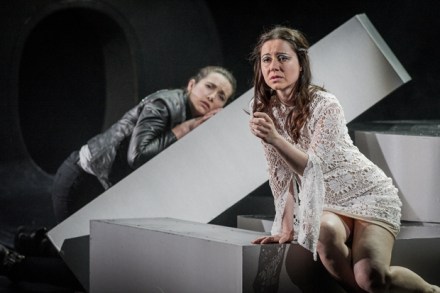
Manon Lescaut: Puccini’s Anna Nicole?

From our UK edition

This season has already seen Manon Lescaut appear in several different operatic guises across the UK, but it was Covent Garden’s new production of Puccini’s version (its first staging of it in three decades) that was the hottest ticket of all. The Latvian soprano Kristine Opolais and the superstar tenor Jonas Kaufmann were tackling the roles of the lovers, Manon and Des Grieux, for the first time. Antonio Pappano, in the repertoire where he most reliably excels, was in the pit. In an introductory talk before the production opened, the conductor tentatively drew a comparison between Puccini’s first major success and Mark-Anthony Turnage’s Anna Nicole, which opens the Royal Opera’s next season.

Tilting at metronomes: Massenet’s Don Quichotte opens at Grange Park Opera

From our UK edition

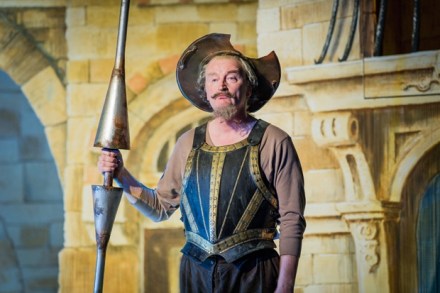
To suggest that the ageing Jules Massenet identified himself with the title character of his Don Quichotte is nothing new — and late works such as this by definition encourage biographical interpretations. One of the main liberties of the opera, premièred in 1910 and very loosely based (via a contemporary verse play) on Cervantes, was to bring the character of Dulcinea (here ‘La Belle Dulcinée’) out of the realm of the imagination and to embody her as a distinctly flesh-and-blood mezzo-soprano. That the first singer to perform Dulcinée, Lucy Arbell, was the object of Massenet’s infatuation only emphasises the biographical parallels, all of which give extra layers to a gently wise and touchingly melancholy work.

Terry Gilliam turns to eye-watering excess for his staging of Berlioz’s Benvenuto Cellini

From our UK edition

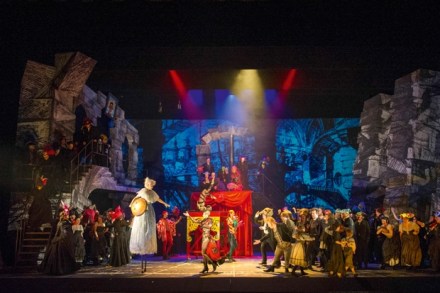
Operas about artists are not rare. However — perhaps for obvious reasons — those artists tend to be musicians, singers, or at least performers, able to persuade and cajole both us in the audience and the other characters on stage through their eloquence. Berlioz, in his first opera, presents the renaissance sculptor Benvenuto Cellini, in an episode loosely adapted from his autobiography. But the final casting and unveiling of his new statue of Perseus, against all the odds, provides a climax that music (let alone stagecraft) seems fundamentally ill equipped to portray.

WNO’s production of Schoenberg’s Moses und Aron is an overwhelming experience – but make sure you close your eyes

From our UK edition

On paper, Moses und Aron might seem intractable and abstract: a 12-tone score setting a libretto that meditates on God, faith, the essential inadequacy of language to express the ineffable, and a great deal more. Put it in the theatre, as Welsh National Opera has done as the first part of its ‘Faith’ mini-season, and it’s an overwhelming experience, compelling because of, rather than in spite of, its subject matter and musical methods. And just over 80 years after Schoenberg stopped work on it (he left it incomplete, having written only a fragmentary text for the third act), its themes are as pertinent as ever.

A Rosenkavalier without a heart ain’t much of a Rosenkavalier

From our UK edition

In all its minute details, Der Rosenkavalier is rooted in a painstakingly stylised version of Rococo Vienna that, paradoxically, is further fixed in a web of cannily juxtaposed anachronisms. Upset their balance and you risk upsetting the balance of the whole piece. That’s no bad thing, of course, but Richard Jones’s bold new production for Glyndebourne — opening the festival’s 80th season — shows exactly the advantages and disadvantages of doing that. Out go the dusty stucco-work and wobbly walls of elderly traditional productions; in come Paul Steinberg’s sharp sets and Jones’s trademark garish wallpaper, which Mimi Jordan Sherin’s brilliant lighting floods with further shifting colours.

More woe for Oedipus

From our UK edition

I had high hopes for Julian Anderson’s first opera, Thebans. Premièred at the Coliseum last Saturday, it promised to mark a departure from the trendiness of ENO’s recent commissions, Nico Muhly’s Two Boys, for example, or the dreadful Sunken Garden — in fact, ENO’s next season seems to reflect a company at last a little less enamoured of innovation for its own sake. Thebans, the advance publicity suggested, was to be a serious, grown-up work, closer in spirit, perhaps, to Detlev Glanert’s Caligula, of which ENO gave the UK première two years ago. The company had put a lot of faith in Anderson, currently composer-in-residence at Wigmore Hall and a master of orchestral colour and texture.

Britten’s worldwide reputation is enhanced in Lyon

From our UK edition

One of the proudest boasts to come from Britten HQ in Aldeburgh during the composer’s anniversary last year was that performances of his works were proliferating across the globe — and not just in the UK — as never before. If the Opéra de Lyon might be a little late to the anniversary party in featuring Britten in its annual Eastertime opera festival only this year, the fact that it’s doing so at all certainly provides evidence of the composer’s worldwide reputation, as well as of the artistic adventurousness of Serge Dorny, reinstalled for the time being as the opera house’s boss after a short-lived stint at Dresden’s Semperoper came to an abrupt end in February.

Bryn Terfel lords it over ‘Faust’ magnificently

From our UK edition

There’s a great deal to disapprove of in Gounod’s Faust. It breaks down a pillar of western literature and whisks up what remains into a flouncy French fancy. It turns the hero’s famous striving into mere lust — for a virginal heroine who is cursed by one and all (‘Marguerite! Sois maudite!’, runs the rather-too-catchy refrain), then saved, in a mawkish, tacked-on finale, by celestial powers. It has a ballet, set pieces, jolly choruses and all the unfashionable niceties that Parisian opera in the mid-19th century required.

Mixed results from the ENO and ROH in their seasonal away games

From our UK edition

It’s been a spring tradition for several years now for English National Opera to present small-scale productions in various venues around London. But this year the Royal Opera followed suit, heading across the Thames to the new Sam Wanamaker Playhouse at Shakespeare’s Globe. Ahead of the announcement of its solid but mainly safe 2014–15 season, we also learned that the ROH will present Monteverdi’s L’Orfeo in English at the Roundhouse in Camden next year — a rather more blatant incursion into ENO territory. And if the company can take these small shows, which don’t even employ its orchestra, to NW1 and SE1, what’s to stop it taking them on tour beyond the M25?

Handelian pleasures vs modern head-scratchers

From our UK edition

Opera seems almost always to have been acutely concerned with its own future. These days this is most often manifested in occasionally desperate, sometimes patronising attempts to entice new audiences to the art form. A new three-way initiative between Aldeburgh Music, the Royal Opera and Opera North takes a different tack by enabling a new generation of composers and librettists to try its hand in this most exacting art form. The initiative’s first fruit was a double bill premièred in Aldeburgh before being shown at Covent Garden’s Linbury Studio Theatre and Leeds’s Howard Assembly Room.