Culture

Culture

The good, the bad and the ugly in books, exhibitions, cinema, TV, dance, music, podcasts and theatre.

Egon Schiele at the Courtauld: a one-note samba of spindly limbs, nipples and pudenda

Exhibitions

One day, as a student — or so the story goes — Egon Schiele called on Gustav Klimt, a celebrated older artist, and showed him a portfolio of drawings with the abrupt query, ‘Do I have talent?’ Klimt looked at them, then answered, ‘Much too much!’ One gets an inkling of what Klimt was getting at from the feverishly intense work on show in Egon Schiele: The Radical Nude. From childhood, Schiele drew with manic fluency. His father, a syphilitic stationmaster, was irritated to discover that a sketchbook, a gift to the boy intended to last for months, had been filled in less than a day.

Is there anything a gospel choir can’t cheer up?

Music

‘I’m starting to think that all of the world’s major problems can be solved with either oyster sauce or backing vocals.’ That was Brian Eno writing in his diary one evening, after a long day’s thinking and maybe a glass or two of something agreeable. I am not entirely convinced by the bivalve mollusc argument, but the second half of his apophthegm makes perfect sense. Last week I was listening to Tim Burgess’s 2012 album Oh No I Love You (OGenesis), a recent and possibly inspired purchase. Mr Burgess is perhaps better known as lead singer and increasingly large face of The Charlatans, the long-serving Midlands indie band who enjoyed a brief spell in the sun during the Britpop horror.

An inept dud penetrates the Park Theatre’s dross-filters – and I blame Beckett

Theatre

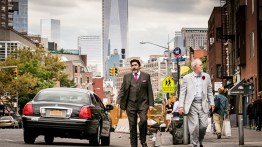
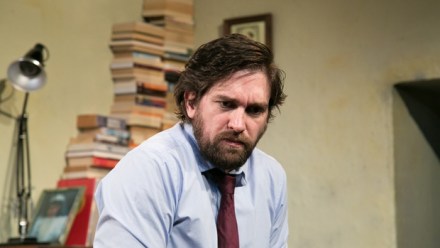
Jonah and Otto is a lost-soul melodrama that keeps its audience guessing. Where are we? The Channel coast somewhere. Indoors or out? Not sure. Near a church maybe? Violence barges in. Jonah, a mouthy scruff, shoves a knife in the face of Otto, a dignified old gent with Big Ears whiskers and a dark, elegant suit. This strange assault is followed by further peculiarities. Rather than calling the cops, Otto seeks a rapprochement with Jonah and they start a rambling, off-beat friendship. Later we discover that Otto, a Cambridge-educated vicar, has an adult daughter who was crippled in childhood by a road accident, and this detail lends credibility to his desire to befriend and redeem his mugger. But the relevant information arrives far too late.

Mariinsky’s Boris Godunov – a revelation

Opera

Anyone who thinks opera singers and orchestral players are overworked should spare a thought for the Mariinsky Opera on its trek round England and Wales this week. After Prokofiev’s Betrothal in a Monastery in Cardiff on Sunday, the whole caravan rolled up at the Barbican in the shorter — but not exactly lightweight — first version of Musorgsky’s Boris Godunov. And by the time you read this it will have added Shchedrin’s The Left-Hander and (in Birmingham) the first two instalments of Wagner’s Ring, plus, for the chorus (not required in The Ring till Sunday’s Götterdämmerung), two concerts of Russian sacred music in London and Cardiff.

Many more Germans were displaced in 1945 than Indians during partition

Radio

What Radio 3 needs is a musical version of Neil MacGregor. The director of the British Museum and now a stalwart of Radio 4 is an intellectual powerhouse but his talks on radio are so clear, so crisp, so deceptively easy to follow that he draws you in and makes you feel that you too can understand the world in the way he does, with his enormously broad vision and his deep understanding of the way things connect.

To my father, solicitor to the landed gentry

More from Books

If you were still alive You would be ninety-six tomorrow. I think of you most days. Just now, for example, I heard you Defending the word ‘folk’ When, sometime in the Eighties, I said it was twee. Another day, I see you doing the weeding At my sister’s wedding And another day still You’re at church Hunched over a book With your fingers in your ears During the sermon. Often I hear you sneezing. When you lay in your coffin Your face was as darkly speckled as an old deed  — I think of that, too. My brain breaks you up like this But really now you are all together And not far away.

Autumn Shades

More from Books

They start to say autumnal in the forecasts, And on the Northern Line the shifting panels Look bleached already. I think less about The low-cost rivieras than the remedies At the ends of small pale almanacs for afflictions Acquired by the old, or suffered by loners In the margins of respectable families — Ailments with names we don’t use any more. Each black-and-white ad in the narrow columns Promised miracles on the same unlikely terms, For the sender sitting in a bedroom corner To seal an envelope bought that afternoon... Could I even imagine one such to be my own, With a man returning from a PO Box in Strood And sending by return, as promised, the First Lesson In his course called Why Not Join Me in the Coloured Pages?

What happens to male ballet greats when they retire?

What happens when a torrent of exceptional male stars leave the stage and flood the jobs market? Especially in a world when classical ballet appears to be becoming less fashionable, eclipsed by contemporary fashions and nervousness about audiences? The titan of the Royal Ballet and Bolshoi, Irek Mukhamedov, was renowned at Covent Garden in the Nineties for his unique combination of muscle and gentlemanly manners, and if English National Ballet’s men are looking particularly refined on their winter tour of Swan Lake and Coppelia it may well be the result of his stellar coaching last month. ENB’s director Tamara Rojo invited him over from Slovenia, where he has been running the national ballet, to hand on some of his precious knowhow to her young team of new male soloists.

Pop stars at prayer – from Madonna to the Beatles, and jihadist Cat Stevens

A spoof in the Israeli Daily recently had Eminem planning to convert to Judaism and move to Tel Aviv. But I don’t think we’ll be seeing that any time soon - he’s not really waiting for the Messiah, he’s just a very naughty boy. Still, stranger things have happened. I was very amused by the Reverend Richard Coles recently; when asked if he is the only vicar who has ever topped the British pop charts, he said 'Yes, but I met the vicar of Hitchen the other day and I said 'We've met, haven't we? Was it through the church?"' Apparently the vicar of Hitchen replied 'No, I was in Pigbag in the 1980s!

The pop artist whose transgressions went too far – for the PC art world

Arts feature

Allen Jones (born 1937) has been demonised. In 1969 he made a group of three sculptures of scantily-clad female figures. They were slightly larger than life and arranged in positions that enabled them (with the addition of a glass top or padded seat) to be turned into a table, a chair and a hat stand. These super-mannequins were highly modelled, wigged and leather-booted, and unavoidably realistic. When first exhibited in 1970 they provoked outrage among the feminist community. Jones’s 1978 retrospective of graphic art at the ICA caused a near riot even though the sculptures weren’t shown. In 1986, when the chair went on display, it had acid thrown over it by an incensed extremist.

The secret world of the artist’s mannequin

Exhibitions

A 19th-century London artists’ supplier named Charles Roberson offered imitation human beings for sale or rent, with papier-mâché heads, soft leather skin and flexible, jointed limbs. The top-of-the-range article — described in Roberson’s catalogue as ‘Parisian stuffed’ — was pricey. Nonetheless, painters often felt they just had to have one whatever the cost. Many such creatures inhabit Silent Partners: Artist & Mannequin from Function to Fetish, a pioneering exhibition at the Fitz-william Museum, Cambridge. There are also distinguished paintings on view. But it is the figures themselves — slightly comic, a touch eerie, hard to classify — that are the real stars of the show.

Russians made the theatre space the most liberating imaginative device ever invented

Exhibitions

You have to hand it to the Russians. They beat us into space, beat us to sexual equality, and a small display of early Soviet avant-garde theatre and film design, tucked away in the V&A’s ‘Performance’ area, proves that they beat us hollow in matters of the dressing-up box too. When you arrive (that is, if you arrive — it is a labyrinthine trek to find it) at Russian Avant-Garde Theatre, you should make straight for the little screen. It shows the amazing 1924 sci-fi film Aelita, in which an engineer living under ‘Military Communism’ builds a spaceship and flies to Mars where he falls for Aelita, Queen of Martians.

How Rothko become the mythic superman of mystical abstraction

Exhibitions

Mark Rothko was an abstract artist who didn’t see himself as an abstract artist — or at least not in any ‘formalist’ sense. If a critic called him a ‘colourist’, he would bristle; if they admired his sense of composition, he would complain that this was not what he was about at all. His was an art of deep content, his subject an invocation of the religious, the tragic, the mythic. ‘The people who weep before my pictures are having the same religious experience I had when I painted them,’ he once famously said. ‘And if you, as you say, are moved only by their colour relationships, then you miss the point.

Mr Turner: the gruntiest, snortiest, huffiest film of the year – and the most beautiful too

Cinema

[audioplayer src="http://traffic.libsyn.com/apollomagazine/Apollo_final.mp3" title="Tom Marks, editor of Apollo magazine, talks to Mike Leigh"] Listen [/audioplayer]Mr Turner may be the gruntiest film of the year, possibly the gruntiest film ever. ‘Grunt, grunt, grunt,’ goes Mr Turner (Timothy Spall) as he sketches, paints, gropes his housekeeper, woos a Margate landlady, winds up John Constable something rotten. But what I now know is that when you have Spall doing the grunting, and Mike Leigh at the helm, as both writer and director, such gruntiness can be quite sublime, as can snorting and huffing. This is a biopic of the painter J.M.W. Turner, ‘master of light’, and the greatest painter that ever lived according to many, but it is not a regular biopic.

James Delingpole falls in love with Grayson Perry – and almost comes round to Chris Huhne

Television

I love Grayson Perry. You might almost call him the anti-Russell Brand: a genuinely talented artist who also has some very interesting stuff to say — as he’s demonstrating yet again in his highly entertaining new series Who Are You? (C4, Wednesdays). It ought to be ghastly and it ought to be pretentious: a trendy ceramicist known at least as much for his transvestism as for his wackily decorated, hugely fashionable pots meets up with people from diverse backgrounds so that he can explore the theme of identity and then exhibit creations inspired by them at the National Portrait Gallery.

Met Opera Live’s Macbeth: Netrebko’s singing stirred almost as much as her décolletage

Opera

This season of live Met relays got off to a most impressive start, with an electrifying account of Verdi’s tenth opera and first really great, though uneven piece, Macbetto (as I think it should be called; that’s what the central figure is called throughout). Fabio Luisi showed that he is far more at home conducting Verdi than Wagner — though his Bruckner performances are also magnificent. What made this the most stirring performance of Macbetto that I have seen was the strength of Željko Lucic’s performance in the title role.

Peter Phillips is mugged by a gang of Praetorius-loving six-year-old girls in China

Music

We have read about the remarkable opening up of China in recent years: how many people live there and how good they are at business, perhaps finding the prospect of them rushing into our world rather daunting. However, a part of this process has been the sudden curiosity there for western art-forms. Not long ago the idea of a tour of China by a European early music group would have seemed completely fantastical. What space was there in a country which for many years had allowed only eight ‘model plays’ to be publicly staged — all of them about the achievements of the army — for the votive antiphons of Tallis, or the Passions of Bach? Not everyone in that vast country is ready for such delicacies yet, but a light has begun to shine.

Birmingham Royal Ballet and the Royal Ballet battle for the heart of English dance

More from Arts

English ballet erupted out of the second world war in the hands of the rival choreographers Frederick Ashton and Robert Helpmann, colleagues but of different instincts, one for dance, the other for drama. The case is currently being made for each by the Royal Ballet and Birmingham Royal Ballet. But how to revive the sensations and imaginings of the 1940s? It was long before most of us were even born, and more than any other art form ballet is dependent on evoking memory, atmospheres, intangible associations. Ashton, who emerged as the creative giant of the Royal Ballet’s nurturing, has recently been as out of fashion as furs and cocktail parties.

The only way is Essex University

More from Arts

We are told this is now a ‘knowledge economy’. Strange, then, that there are so few recent educational buildings of note. An expansion of universities has not led to much enlightened architectural patronage. Rather the opposite, in fact. The university visual trope remains those dogged dreaming spires. And London’s skyline is punctuated not by grand monuments to learning but by the swaggering, leering one-liners of the global plutocracy. These are thoughts that come to mind on the occasion of Essex University’s 50th birthday, a much more interesting anniversary than it first (rather bleakly) sounds.

Neville’s Island: a play from the era of Men Behaving Badly – when women were seen as exotic excrescences

Theatre

Start with a joke. Neville’s Island. Get it? Laughing yet? Are your ribs splitting into pieces? It’s a cracker, isn’t it? Well it’s a pun, at least, on Devil’s Island. Tim Firth’s play, regarded as a modern classic, premiered 22 years ago in Scarborough: Ayckbourn country, and it shows. Four corporate numbskulls on a team-building exercise get stranded on a remote islet with no hope of rescue. Their Alcatraz is located in the Lake District, which is known to millions as a dead-safe holiday habitat, and this seems to have unsettled Firth so he crams in extra snags to convince us the castaways’ predicament is genuine. Their skiff has capsized. Killer pike throng the lake-waters. Food supplies are limited to a sausage.

Kate Chisholm on what makes the BBC World Service so special

Radio

‘Don’t take it for granted,’ she warned. ‘It’s one of the few places where you can hear diverse voices, different points of view; where you can understand that the world is infinitely complex.’ Alana Valentine, an Australian writer, was talking about the BBC World Service with such passion it was inspiring. You might think she would say this, wouldn’t she. After all, Valentine was giving her acceptance speech having just won first prize in the World Service’s International Radio Playwriting Competition for her radio drama The Ravens. Yet what she said was striking because you could tell she really meant it. These were not just platitudes.

Are bowls of pasta Blairite?

If Thatcher was Britain’s Bonaparte, then Blair was most certainly our Louis-Philippe. It was during the reign of the latter that the bourgeoisie came to dominate the status quo in France, and they needed somewhere to gather. Not for them the salons of the aristocracy – instead, they invented the destination restaurant, imitations of which sprung up all over Paris to cater for the wannabes. Blair was undoubtedly our most haut-bourgeois leader. But what of his gastronomic legacy? Does it survive, or does it, like some ruined Empire man in a Balzac novel, limp around dressed in the tattered remains of its pomp? What, more to the point, is a Blairite restaurant? The answer is: ASK Italian.

This opera is simplistic and dangerous. So is banning it

My father’s house was razed In 1948 When the Israelis passed over our street I’ve never forgotten the opening lines to John Adam’s 1991 opera, The Death of Klinghoffer. Crisp, elegiac, this  'Chorus of Exiled Palestinians' rises up to a moment of anguished dissonance as it spits out the word 'Israelis'. It’s beautiful. It’s also the most egregious romanticisation of Palestinian terrorism outside the muralled bunkers of the Gaza Strip. In the Metropolitan Opera’s new production, a chorus of shrouded Palestinian women form a funeral procession as they intone their complaint, eventually parting to reveal a 5-year-old boy, cradled in the arms of his weeping, widowed mother.

First look at the new Dad’s Army

Back in the last century, when people still watched television rather than computers, I fulfilled the lifetime ambition of every comedy nerd when I finally got to meet David Croft and Jimmy Perry. Whoever said ‘don’t meet your heroes’ clearly never met any sitcom writers. I was working on a BBC series about the history of British sitcom – since eclipsed by countless cheap clip shows, but actually quite a novelty back then – and though the actors were interesting, it was the writers who really shone. Like Galton & Simpson (Hancock, Steptoe) and Clement & La Frenais (Porridge, The Likely Lads), Croft & Perry were enchanting.

Rembrandt at the National Gallery: the greatest show on earth

Arts feature

At the opening of Rembrandt: The Late Works at the National Gallery (until 18 January), I met a painter friend of mine in the final room. This was, he said, one of the most magnificent exhibitions he had seen in his entire life, which — considering he is perhaps 70 and a frequent visitor of galleries — was praise indeed (and entirely deserved). Mischievously, I mentioned that he had also been highly enthusiastic about Veronese at the National Gallery a few months ago. ‘Ah, but there is a huge difference between Veronese and Rembrandt,’ he vehemently responded. ‘When you look at a Madonna by Veronese, you see a glamorous model wearing expensive clothes, with Rembrandt’s “Bathsheba” [pointing at the picture in front of us] you can read her thoughts.’ He got it in one.

Maya Plisetskaya and Rodion Shchedrin: ‘The KGB put a microphone in our marriage bed’

Arts feature

‘People in the West don’t understand nothing. Even the new Russian generation don’t understand anything at all. You don’t know, and it’s better you don’t.’ Maya Plisetskaya scrutinises me with her beautiful, kohl-rimmed, 88-year-old eyes, a gaze made wary in childhood, when her father was shot as an enemy of the Soviet people, her mother jailed, and her Jewish family broken by persecution. ‘Can anyone understand how if you took a single carrot from the collective farm, just one carrot, you could get ten years’ prison? Who could understand that?

Frieze Art Fair: where great refinement meets harrowing vulgarity

Arts feature

If you wanted to find a middle-aged man in a bright orange suit, matching tie and sneakers, Frieze is a good place to start looking. I found one. Or maybe he was a limited edition existing in several reproductions. Certainly, he was frequently spotted: conspiratorial of aspect, he was stooped and crouched over a mobile with body language saying ‘serious business’. I overheard: ‘Ah, Corinna. Va bene? How are prices in Zurigo?’ Long before you reach Frieze’s vast tented sites in Regent’s Park there are signs of danger. Extraordinary shoes and statement hair and rucked-up skinny trousers start appearing in a fall-out zone about half a mile away from the BMW VIP drop-off area and the Mercedes-Benz shuttle buses.