Culture

Culture

The good, the bad and the ugly in books, exhibitions, cinema, TV, dance, music, podcasts and theatre.

This new Sherlock Holmes exhibition will have Cumberbitches salivating

Have you ever experienced the joys of Jawohl, meine Herr’n? If not I strongly advise an appointment with YouTube. The song features in the 1954 film Der Mann, der Sherlock Holmes war (‘The Man who was Sherlock Holmes’), and is performed by Hans Albers and Heinz Ruhmann, mainly while soaping themselves in the bath (one each – it’s not that kind of film). Albers and Ruhmann do not, as you might expect, play Sherlock Holmes and Dr Watson, but rather men pretending to be Holmes and Watson in order to solve a crime. At one point they’re prosecuted for the impersonation, with Sir Arthur Conan Doyle (an actor, not the real one) appearing in court to claim the characters as his own.

Winter Words

Poems

Calendar pages: one scrumpled day dies in a garden spun to fools’ gold, where wind mews over twigs and bones at an outhouse door, black sky sustains the buoyancy of loss, dried sap knots branch to branch, caging a star whose variable glance is light’s tumult cut to the quick yet cold to the retina as once upon a time, remembered pain.

Fury: the men blow stuff up, then Brad Pitt takes his top off

Cinema

Fury is a second world war drama that plays with us viscerally and unsparingly — I think I saw a head being blown off; I think I saw a sliced-off face, flopping about — but is still just another second world war drama. That is, Americans good, Nazis bad, and a man doesn’t become a man until he has abandoned all mercy and learned how to kill. ‘It’s Saving Private Ryan, but with tanks,’ I heard someone say as I left the screening, and although I would never steal someone else’s opinion, it is Saving Private Ryan, but with tanks, and also sliced off faces. I added that last bit myself. Written and directed by David Ayer (Training Day, End of Watch), this stars Brad Pitt as battle-hardened Sergeant Don ‘Wardaddy’ Collier who commands a Sherman tank.

Glyndebourne’s Turn of the Screw: horrors of the most innocent and creepy kind

Opera

We all know that ‘They fuck you up your mum and dad’, but nowhere is this more reliably (and violently) true than in the opera house. If you have the misfortune to be born into an operatic family you can expect to be murdered by your own mother (Médée, Lucrezia Borgia), killed by your grandmother (Jenufa), or even bumped off by a hitman hired by your father (Rigoletto). Perhaps most insidious, however, are the crimes not of violence but of absence, neglect rather than active cruelty. Productions of Verdi’s I due Foscari and Britten’s The Turn of the Screw whispered some of the darkest unspokens of parent-child relations, conjuring nightmares all the more potent for their subtle horrors.

Hooray for Homeland – Carrie’s back blasting America’s enemies to pieces with drones

Television

One of the more welcome and surprising things about television at the moment is that Homeland (Channel 4, Sunday) is good again. As I’m not the only person to have pointed out, the first series was great. After that, though, the show suffered badly from the diminishing returns which so often afflict a deserved American hit that’s obliged for financial reasons to just keep on going — usually by serving up increasingly minor variations on a theme. (Exhibit A: Lost; exhibit B: most of mid-period 24.) Fortunately now that Damian Lewis’s Brody is dead, Homeland no longer has to think up any more ways to make us wonder which side he’s on. Instead, to the obvious relief of all concerned, it can start again with a different story.

Is London’s West End Jewish enough for David Baddiel’s musical The Infidel?

Theatre

David Baddiel has turned his movie, The Infidel, into a musical. The set-up is so contrived and clumsy that it has a sweetness all its own. A golden-hearted London cabbie, named Mahmoud, discovers that he was adopted at birth and that his real parents were Jewish. This strikes him as intriguing rather than alarming, and he starts to investigate Judaism with the sort of disinterested curiosity of a man taking up astronomy after inheriting a telescope and a star-chart from an eccentric uncle. Mahmoud wants an easy life so he keeps his secret from his wife, Saamiyah, and from his son, Rasheed, who plans to marry a girl named Ji-Ji whose father is a ranting Islamic bigot.

Wear a veil if you like – but don’t treat women like that

Columns

What sort of clothing do you wear when you go to the opera? I assume some of you do go to the opera, otherwise the Royal Opera House could be turned into a giant Wetherspoon’s pub. I have never been. Given a choice I would rather browse through a collection of photographs of Brooks Newmark MP’s penis, or indeed gnaw off my right leg. If I were somehow coerced into attending, then without question the costume of choice for me would be a niqab. Then I could sleep without being noticed. Or listen to something more interesting on headphones, such as a collection of Danny Alexander’s speeches or a greatest hits compilation from the Radio 4 programme Does He Take Sugar?

The best of Frieze Art Fair was free

Frieze and its ever-multiplying layers - some fantastically rich, others disappointingly dry - has expanded into a millefeuille so dense that you wonder whether organisers Matthew Slotover and Amanda Sharp have ever heard of museum fatigue. Today, 30 to 45 minutes is apparently the concentration cap – the point at which you can no longer bring yourself to give a shit yet keep walking past the frames. Knowing this, the majority of London’s public might feel they had been spared the ordeal of entering the tents in Regent’s Park, where half an hour will get you through almost nothing of the fair. By some freak of programming the best of the works curated to accompany this giant selling spree could be seen for free by anyone outside the fair this year.

Postcard from Ukraine – meet the artists in exile from the People’s Republic of Donetsk

It was Orthodox Trinity Sunday when Luba Michailova received word that separatists would soon occupy the premises of the Donetsk art centre she founded. She was in Kiev at the time, and recalls now that her first response was religious: 'Any difficulties in life you get, it's for your good, and for testing you.' The following morning, at 8 o'clock, several staff were at work cleaning when 15 men in balaclavas appeared, firing Kalashnikovs into the air. Michailova tells me, 'So when it happened, I knew it would happen, but I never thought it would be so painful.' Donetsk now is in the hands of the masked separatists who brought down MH17. But before May, Donetsk boasted TEDxDonetsk talks, literary festivals, residencies, and exhibitions by artists from abroad.

Mike Leigh interview: ‘A guy in the Guardian wants to sue me for defamation of Ruskin!’

Arts feature

[audioplayer src="http://traffic.libsyn.com/apollomagazine/Apollo_final.mp3" title="Tom Marks, editor of Apollo magazine, talks to Mike Leigh"] Listen [/audioplayer]Mike Leigh is in a cheerfully bullish mood when I meet him at the Soho Hotel. ‘Have you read today’s Guardian?’ Dammit — I should have seen that coming. ‘A guy in G2 would like to sue me for defamation of Ruskin!’ He seems almost pleased. His characterisation of the great critic as silly and effete in his new film, Mr Turner, does seem a little ungenerous. Ruskin did more for Turner than anyone. ‘That’s true,’ says Leigh. ‘Working with the brilliant young actor Joshua McGuire, I started to think how Ruskin was incredibly spoiled and cosseted by his parents… He was a prig!

Tate Modern’s latest show feels like it’s from another planet

Exhibitions

‘Some day we shall no longer need pictures: we shall just be happy.’ — Sigmar Polke and Gerhard Richter, 1966 Who says Germans have no sense of humour? OK, so their writers tend to be a pretty gloomy bunch — but like loads of other German artists, from Otto Dix to Georg Baselitz, Sigmar Polke’s paintings are illuminated by a dry, mordant wit. It’s encapsulated in an early doodle called ‘Mona Lisa’ (1963), which hangs near the entrance to this hugely enjoyable retrospective — the first comprehensive survey of his eclectic, eccentric work. ‘Original value $1,000,000,’ reads the handwritten caption. ‘Now only 99c, including frame.’ That Polke’s pictures now sell for many millions (with or without frames) adds another layer of meaning to this student jape.

Monsieur Clermont

Poems

That August, in La France Profonde, the frelons were out in force, honey-gold cruisers of late summer air, their poigniards sheathed. The heat lapped at a sticky terrace table, our observation post for village fictions — Jean, his bench-saw snoring to the hornets, a girl scraping her pans out to the hens, that old man in his garden chair — le petit vieux. We smiled, as if our smiles could throw a tremulous lifeline to one who seemed to have no need of saving, a kindly ghost, a dream of summer silence, the gentle answer to our drift of questions. That last day, when Jean came for the keys — Nos amitiés à votre père, monsieur — he tapped his forehead, murmured ‘Verdun’, carried our cases to our little Peugeot.

Can Radio 3 escape the digital squeeze?

Radio

The new controller of Radio 3 has at last been appointed. Alan Davey (not to be confused with the former bassist from Hawkwind) comes to the BBC from the Arts Council and a career in the Civil Service. This will be his first job in broadcasting, and will be no small challenge. These are tough times for Radio 3, squeezed between the commercial charms of Classic FM and the trendy allure of BBC’s 6 Music, and, worryingly, in the last quarter its audience numbers went below 1.9 million for the first time since 2010. The BBC’s home of classical music and ‘culture’ is often criticised for being too off-putting, too elitist, not in tune with the current mood.

The Best of Me is more of a sleepie than a weepie – especially when our old friend No Sexual Chemistry makes an appearance

Cinema

Take tissues to The Best of Me, I’d read, as it’s such a weepie, so I took tissues, being a weeper at weepies — I still dab my eyes whenever I even think about War Horse — but it was rubbish advice. You don’t need tissues for this film. Instead, you need to line up several triple espressos, as many cans of Red Bull as you can reasonably manage, two matchsticks (one for each eye, obviously), replacement matchsticks for when the weight of your eyelids proves too much and they snap, plus a small hammer to knock yourself in the side of your head when you find yourself bored out of your mind and dropping off anyhow. Actually, this may be rather unfair, as I did laugh inappropriately on a few occasions, so I must have been slightly awake for some of it.

Donmar’s Henry IV: Phyllida Lloyd has nothing but contempt for her audience

Theatre

The age of ‘ladies first’ is back. Phyllida Lloyd reserves all the roles for the weaker sex, as I imagine she thinks of them, in this hybrid play assembled from Henry IV (i) and (ii). It’s a twin-layered production that poses as a piece of am-dram mounted in a women’s nick. The Donmar has been refitted, in and out, to resemble a prison. (Quite an expense. And there’s no interval either, so there are no bar profits to subsidise the fancy-dress party.) As we arrive we’re barked at by ushers attired as screws who harry and scold us into our plastic seats. Nothing surprising in this uppity aggression. Contempt for audiences is common among high-end theatre types: anyone ready to spend 30 quid on amusement deserves to be punished.

Matthew Bourne’s Lord of the Flies: when boys turn feral

More from Arts

GCSE Eng Lit pupils are doing well from dance this season with two set books told in the medium of dance, Arthur Miller’s The Crucible and William Golding’s Lord of the Flies, and even Dylan Thomas gets a look in. As the two stories have similar dynamics and dramatic themes, it was fascinating to see both in a single week and witness how mightily one succeeded and the other did not. Matthew Bourne is so famed as a rewriter of classical ballets that one might underestimate the boldness of imagination that underlies them.

Opera North’s Coronation of Poppea: a premium-rate sex-line of an opera

Opera

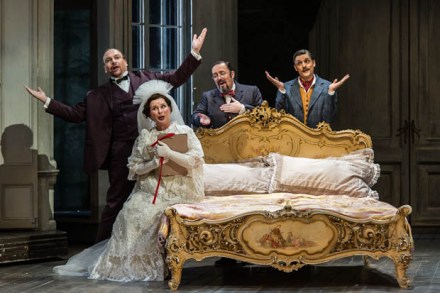
Virtue, hide thyself! The Coronation of Poppea opens with a warning and closes with a love duet for a concubine and a psychopath, their union celebrated in sinuous melismas over a blameless passacaglia. First performed in 1643, Monteverdi’s final opera is all about talking dirty and talking tough. Seductions, threats, boasts and betrayals are snapped, spat, stuttered and smooched over harmonies that pinch and squeeze like a premium-rate sex-line. Does it work in English? Yes and no. There are casualties in Tim Albery’s slick, vicious Opera North production, some historical, some poetic, some musical. In Laurence Cummings’s hybrid edition, drawn from the Venice and Naples scores, transpositions and cuts proliferate.

The drunk conductor who ruined Rachmaninov’s career

Music

Would musical history have turned out differently if Alexander Glazunov hadn’t been smashed out of his wits when he conducted the first performance of Rachmaninov’s Symphony No. 1 in D minor? The best of Glazunov’s own neatly carpentered symphonies hover on the verge of greatness. Perhaps if he hadn’t been such a toper — swigging from bottles of spirits during lectures at the St Petersburg Conservatory, where he was director — they would do more than hover. Unfortunately, his drinking didn’t just screw up his own career. The 23-year-old Sergei Rachmaninov had spent two years working on his first symphony, whose climaxes erupt from melodic cells borrowed from Orthodox chant. Not that Glazunov would have noticed. He barely glanced at the score before the premiere.

The Irony of Wislava Szymborska

More from Books

In London, I remember the indignation.    Surely the Nobel prize should have gone to Zbigniew Herbert, the Polish poet we loved    – dissident, charismatic, much translated – not some woman we had barely heard of? I thought Polish poems should resemble films of Wajda,    charged with the electricity of war. Szymborska’s poetry held no such glamour.    She had not played a part in the Resistance. The poems were almost English in their texture, a bit like Larkin – though serene    where he was glum – never expecting to fill a football stadium.    Her voice was quieter than Cassandra’s – but equally we did not listen to her.

Bored bores boring – critics love the Dull Men’s calendar

The Telegraph has a nice photo gallery featuring the specimens of the 2015 Dull Men of Great Britain calendar, which our own Dot Wordsworth plans to give her husband for Christmas: 'I had thought that dull, in reference to people, was a metaphor from dull in the sense of ‘unshiny’. ‘Dieu de batailles!’ as the Constable of France in Henry V exclaims of the English, ‘where have they this mettle?/ Is not their climate foggy, raw and dull?’ But I was quite wrong, as so often. It started off (in the form dol) meaning ‘foolish’. In English almost as old as you could care to have it, the author of The Seafarer declares: Dol bith se the him his dryhten ne ondrædeth; cymeth him se death unthinged.

Without sci-fi, there would be no cinema

Arts feature

Do you know what’s hateful? The snobbery that film fans have to contend with. There’s the ‘it’s only a movie’ snobbery, by which cinema is suitable only for wastrels and dogs. And there’s the ‘if it ain’t Danish and silent, then it ain’t no good’ snobbery. Proponents of both should spend less time blowing conjecture through their Sobranie smoke, and more time watching the Hollywood films of John Ford, Nicholas Ray and William A. Wellman. Now that’s off my chest, here’s one way in which cinema is relatively free from snobbery. For decades, novelists and literary types have wrangled over whether science fiction books are anything more than — to use Margaret Atwood’s snooty description — ‘talking squids in outer space’.

Why, if Cecilia Bartoli invites you to a party, you drop everything and go

Classical music has a few certainties: Götterdämmerung will always be that little bit longer than you remember, it will reliably rain if you pack a Glyndebourne picnic, and if Cecilia Bartoli invites you to a party, you drop everything and go. Which is why I found myself in Paris earlier this week, along with most of the record industry, prepared for serious music and some even more serious thrills at the launch of Bartoli’s new disc St Petersburg. There are times when only a palace will do. For most of us those times are few and far between, but if you’re mezzo-soprano Cecilia Bartoli – ‘La Gioiosa’, a classical music phenomenon and one of its biggest-selling stars – then life, and art, are far from everyday.

Were the cast of the Old Vic’s Electra clothed by Oxfam?

Theatre

First, a bit of background. Conquering Agamemnon slew his daughter, Iphigenia, in return for a fair wind to Troy. This rather miffed his wife, Clytemnestra, who bashed his head in with an axe when he came swaggering home. Her retribution laid a religious duty on their son, Orestes, to avenge his dad by slaying his mum, which, in its turn, put a bit of a crimp in his social calendar. Sophocles’ play opens during a lull in the butchery. Orestes, now in exile, throws Clytemnestra off her guard by releasing details of his death. The details consist of an urn containing his ashes delivered to the palace.

Effie Gray can effie off

Cinema

Effie Gray, which has been written by Emma Thompson and recounts the doomed marriage of Victorian art critic John Ruskin to his teenage bride (he refused to consummate it), has a blissful cast. It stars Dakota Fanning, Ms Thompson herself, plus Julie Walters, David Suchet, Greg Wise, James Fox, Derek Jacobi and Robbie Coltrane. So it is period drama heaven, in this respect. It’s a cast you could watch all day, whatever, which is handy, as this is probably quite dull otherwise. It is adequate. It does the job. It gets us from A to B. But it feels as if it is missing something crucial, and I don’t just mean a stiffie. It also doesn’t deliver emotionally.

Ukip’s logo is quite successful – in communicating a spirit of gung-ho crapness

More from Arts

Now that the conference season is over, we can compare not just the party policies, but their logos too. Last week’s Tory conference taught us the patriotic adaptation of their tree — now draped in the Union Flag — doesn’t work any better than the original green-tree symbol. The old symbol demonstrated Conservative values as imagined by the Innocent smoothie design team. It said ‘Tradition’. It said ‘the Environment’. It said, ‘Look what I can do with my crayons, Mummy.’ Stephen Bayley, design expert and Spectator colleague, was one of the hapless advisers tasked with picking the old logo. ‘Not so great,’ he told me, ‘but you should have seen the alternatives.

Why Yes are still the funniest rock band in the world (although Radiohead are catching up)

Music

My favourite comment about the Scottish referendum came from the eminent comedian and novelist David Baddiel. ‘What if Yes wins, but due to a typographical error, the prog-rock band gets in and Jon Anderson becomes First Minister?’ You probably had to be there to find this funny, and in this case ‘there’ is the early 1970s. Having been there myself, I too remember Yes as the most intrinsically amusing of progressive bands, along with Emerson, Lake and Palmer. Genesis were quite funny in their early days, when Peter Gabriel dressed up as a flower. Pink Floyd weren’t funny, although Roger Waters is. The Beatles aren’t funny any more, but the Rolling Stones are as hilarious as ever. Many prominent 1980s acts — U2, Duran Duran, Spandau Ballet — were sidesplitting.