Culture

Culture

The good, the bad and the ugly in books, exhibitions, cinema, TV, dance, music, podcasts and theatre.

The characters are barely stereotypes: The Father at the Wyndham’s reviewed

Theatre

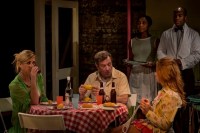
The Father, set in a swish Paris apartment, has a beautifully spare and elegant set. The stage is framed by a slender rectangle of dazzling white dots which impart an air of incalculable and almost intimidating opulence to the show. I felt I was lucky to be there. Here’s the plot. Kenneth Cranham plays a doddery old sausage whose daughter and her husband want to dump him in a nursing home. Will they succeed? That’s the plot. Writer Florian Zeller uses pranks and false starts to create suspense and to illustrate Dad’s scrambled mentality. Different actors play the daughter, the son-in-law and the day-nurse. At first this is gratifyingly weird but repetition makes it seem meagre and banal. Other effects stress the same point.

Giselle has floored many a ballerina — it did so again last week

More from Arts

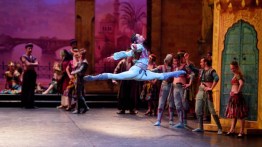
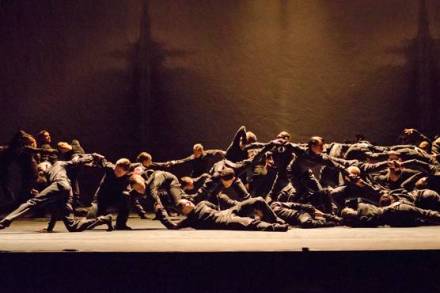
English has all sorts of emotive metaphors for how we feel about the ground. We’re floored. Or well grounded. Or earthbound. Life’s a minefield, so watch where you step. Stay on your toes. One moment we’re walking on air, next brought down to earth. Which is not at all the same as being down-to-earth. We have a fractious, if necessary, relationship, then, with the floor. Dancers even more so. If you were watching the Bolshoi’s live cinema relay of Giselle on Sunday, you will have seen its hyper-exquisite prima ballerina Svetlana Zakharova come clattering down in a most unghostly fashion in Act 2.

Hunted blows a fresh breeze through the stale world of reality TV

Television

Television used to employ entertainers to entertain the public. Back then you could count the channels on the fingers of one hand and still have a thumb left over to stick aloft in praise of the nightly parade of talent. That was decades ago, before every housing estate in the land pointed supplicatory dishes at the cosmos, which beamed back numberless multi-channels devoted to cooking and/or shopping, golfing and/or shagging. It’s all changed. Now television employs the public to entertain the public. It’s cheaper. So we have talent shows, reality shows, aspirational have-a-go shows from which contestants are expelled one at a time. It is always gripping to find out which members of the public can sing/sell/bake exceedingly good cakes.

National Poetry Day broke the key rule of poetry readings: never let normal people do the reading

Radio

Imagine what Brennig Davies must have felt like just before 11 o’clock last Tuesday evening. The 15-year-old was about to hear Ian McKellen reading his prizewinning short story nationwide on Radio 1. The voice of Gandalf broadcasting words that have emerged from your own head must have been a spooky moment for Davies, whose story ‘Skinning’ had just won the BBC’s Young Writers’ Award (organised with the Book Trust).

My Schubert cruise was a transport of delight

Features

'Blessed Cecilia, appear in visions to all musicians, appear and inspire…' Auden wrote his words for the young Benjamin Britten, who was born on St Cecilia’s Day, and who set them to music, but his poem would also be a tribute to the composer that Britten admired above all others except Mozart. Franz Schubert was born in Vienna in 1797, and died there 31 years later. ‘Let us honour the memory of a great man,’ he said, raising a glass after attending Beethoven’s funeral in March 1827, ‘and drink to the man who shall be next.’ Schubert died in November the following year, having heard only one concert in his lifetime dedicated to his own work. It is the greatest loss in the history of music, yet what riches he left behind!

Graham Ovenden’s art is controversial, but its destruction is a scandal

So, it isn't only the hammer-wielding nutters of Isis who destroy 'immoral art'. So do we, in supposedly civilised Britain. A judge's order that the artworks of convicted child abuser Graham Ovenden be destroyed, on the basis that they do not reach our 'standards of propriety', is an act of medievalism to match any of the statue-smashing antics of the Islamic State in recent months. At Hammersmith Magistrates Court, District Judge Elizabeth Roscoe advertised her philistinism for all to see. She said she was not concerned with the 'historical importance or value' of Ovenden's works.

The importance of drawing

Watch a child draw. See how she scrawls with abandon, jabs the felt tip at the paper, colours an eye so deeply the pen drives a hole through the paper. Look as she concentrates on the action of the subject, strips out unnecessary detail, toys with scale. This is pure drawing, instinctive, expressive and truthful. Children’s drawings are interesting, especially to artists, because of their honesty and their energy. Unfortunately, these qualities are frequently abandoned as they grow up and, for most teenagers, a good drawing is one that resembles a photograph, with the emphasis on precision and neatness. The result is usually a tidy drawing stripped of life; neat, dull and dead. The great challenge is to revitalize drawing. Throughout October, The Big Draw seeks to do just that.

John Whittingdale ruffles feathers at BBC campaign event with off-piste speech

Last night BBC staff and musicians alike assembled at Portcullis House to back UK Music's Let it Beeb campaign. As guests including Lord Hall, Sandie Shaw and Anneka Rice raised a glass to the campaign which aims to protect BBC music services from the threat of charter renewal, MPs including Ed Vaizey and Jess Phillips made sure they didn't miss the chance for a celebrity selfie. It then fell on organisers to urge everyone in the room to sign their petition calling on the government to 'protect vital BBC music services from any budgetary cuts during the charter renewal process'. With that in mind, they made sure that John Whittingdale, the Culture Secretary, was in the audience to hear their pleas.

Why did Goya’s sitters put up with his brutal honesty?

Exhibitions

Sometimes, contrary to a widespread suspicion, critics do get it right. On 17 August, 1798 an anonymous contributor to the Diario de Madrid, reviewing an exhibition at the Royal Spanish Academy, noted that Goya’s portrait of Don Andrés del Peral was so good — in its draughtsmanship, its freedom of brushwork, its light and shade — that all on its own it was enough to bring credit to the epoch and nation in which it was created. He (or she) was absolutely correct. [caption id="attachment_9657482" align="alignnone" width="520"] Goya's portrait of Don Andrés del Peral[/caption] The same could be said of many of the exhibits in Goya: The Portraits at the National Gallery.

Why I’m stepping down after 28 years as The Spectator pop critic

Arts feature

This is my 345th and last monthly column about pop music for The Spectator. I believe I might be the third-longest continuously serving columnist here, after Taki and Peter Phillips. Others have been writing for the magazine for longer, but have occasionally been given time off for good behaviour. You may be astounded to learn that I have not been fired. I, certainly, am astounded. I have been waiting for the tap on the shoulder, or maybe the firm but regretful email, since my first column in May 1987. Eventually I came to realise that the less the editor of the time was interested in my subject, the safer I was.

Look beyond ‘Girl with a Pearl Earring’ in The Hague

Notes on...

What a fate it is to be hung next to the most famous painting in a gallery. To be overlooked, a framing device, just out of shot of every selfie taken in front of ‘The Ambassadors’ or ‘Mona Lisa’. The painting immediately to the left of Johannes Vermeer’s ‘Girl with a Pearl Earring’ in the Mauritshuis is Gerard ter Borch’s ‘Combing for Lice’. The weary mother in this close interior has none of the pouty lusciousness of Vermeer’s pin-up, but no Madonna ever cradled her bambino with as much maternal tenderness as this Dutch huisvrouw inspects her son’s blond head.

Cats, whisky and modernity: the J.G. Ballard I knew

Cinema

That cinema is having another Ballardian moment will surprise few fans. J.G. Ballard, who died of cancer in 2009 at the age of 78, was one of the darkest, most unsettling of post-war British novelists. In a career that spanned half a century from his debut as a science-fiction writer in the mid-1950s, his surreal imagination confronted such subjects as nuclear catastrophe and planetary drought. His discomfiting novel Crash (1973) attributed a deviant sexuality to the road accident. Ballard had a taste for ‘automobile pornography’, according to his biographer John Baxter, and fantasised about having sex with Margaret Thatcher in the back of the prime-ministerial Daimler V8. In 1991, I called on Ballard at his home in Shepperton off the M3, where he had lived for 30 years.

It may have a meagre script and no plot but Farinelli and the King is still a major work of art

Theatre

Philippe V was a Bourbon prince who secured the throne of Spain using his family connections. Claire van Kampen is a writer who relied on the same method to secure a West End opening for her play about Philippe. It stars Mark van Kampen (aka Mark Rylance) as the charmingly dotty Frenchman. Philippe was a manic depressive who regarded his Spanish subjects as a puzzling inconvenience. He had no interest in governing them and preferred to laze around the countryside, looking at stars, listening to music and indulging his eccentricities. We first meet him in bed trying to hook a fish supper from a goldfish bowl. Courtiers secretly plot to oust him while the queen scours Europe for a singer capable of cheering him up.

I’ve never thought much of John Lennon’s music – until now

Radio

It’s probably blasphemous to admit that I’ve never thought very much of John Lennon’s music. Common sense tells me it must be good but it’s never made much of an impact on me no matter how hard I’ve tried to appreciate it. If I like a Beatles song, I usually discover it’s by George. But the discovery from a radio trailer (reluctantly, I’ll have to admit they do sometimes work) that Lennon would have been 75 this week was shocking enough (how could he ever be that old?) to make me tune in on Thursday night to John Lennon’s Last Day.

Was BBC1’s Rooney hagiography more scripted reality than documentary?

Television

Close to the Edge (BBC4, Tuesday) feels very much like an idea conceived during a particularly good night in the BBC bar. Why not take the ‘scripted reality’ methods of such youth hits as The Only Way Is Essex and apply them to a group of over-65s living in Bournemouth? So it is that the chosen oldies are given one main characteristic each, and required to act out events from their own lives — events that might or might not have happened if the cameras weren’t there. Or as Tuesday’s opening caption rather optimistically put it, ‘Some of the scenes have been constructed purely for your enjoyment.’ Which scenes these were, the programme didn’t of course specify.

Anna Netrebko’s ascent to greatness: Il Trovatore at the Met reviewed

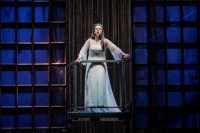
The Met in HD series got off to an exciting start this year with Il Trovatore, an opera I adore but have never seen a satisfactory performance of, until this one. The production by Sir David McVicar is in his now traditional style, with a reasonable number of very solid-looking props designed by Charles Edwards, and more or less time-honoured operatic acting, but done with intensity and conviction, so that this hardened team of Verdi experts were able to give their all, and obliged by doing so. The result, to my surprise, was that I not only enjoyed this uniquely energising work, but for the first time was moved by it. This despite the Met audience's evident desire to turn it into a costume concert by protracted applause after almost every solo.

Women are to blame for the big Glastonbury sell-out

I suppose you can look at it two ways. Glastonbury, and rock festivals generally, were once patronised by music obsessives; largely male and probably some distance along the autistic spectrum, in many cases. People like me, in other words, when I was younger. Oh yes – and that’s another thing. Age. They used to be for the young. But the defining difference with today was that people once went for the music. I note that next year’s Glastonbury has sold out – without anybody knowing who is actually playing. I blame women. In general they have a different approach to music. They like the experience of being somewhere people are making a lot of noise, without worrying about the name of the bass guitarist. It’s probably a healthier way to enjoy music, I suppose.

Assemble’s Turner Prize entry is positive, genuine and ego-free. They’ll never win

Here are some fur coats reclaiming the design canon for the sisterhood. They are draped over the back of tubular steel chairs. In this daring arrangement, they subvert the established patriarchy by partially obscuring the ‘autograph design object’ of the chair, something that represents the historic subsuming of all female creativity under male dominance. While this will be obvious enough, it must be appreciated in the greater context of the work which 'extrudes novelty from recognisability via subtle acts of transformation' and in doing so 'displaces the certainty with which we appoint function and value to objects'. I read this in the catalogue, an essential companion to Nicole Wermers’ ‘Untitled Chairs’.

Will anyone dare to be the new John Ruskin?

Brian Sewell, who died last month, was not popular with his fellow critics. He accused them of kowtowing to power, of puffing up every trendy artist put forward by the galleries and collectors. Of ‘arse-licking’, to be precise (see for example this exchange with Matthew Collings). They could brush off this charge easily enough: Sewell just didn’t get modern art, they said; he hankered for the clear hierarchy of value of the old days. And so he couldn’t really fulfil the function of a critic: to help the public to make sense of the art of our day. Fair point: he was insufficiently sympathetic to contemporary art. And yet he was also right that most art criticism is excessively sympathetic.

Hitler’s émigrés

Arts feature

Next week Frank Auerbach will be honoured by the British art establishment with a one-man show at Tate Britain. It’s a fitting tribute for an artist who’s widely (and quite rightly) regarded as Britain’s greatest living painter. Yet although Auerbach has spent almost all his life in Britain, what’s striking about his paintings is how Germanic they seem. Born in Berlin in 1931, Auerbach was only seven when he came to England (his parents subsequently perished in the Holocaust). By rights, he should stand alongside British artists such as Peter Blake and David Hockney, yet his work feels far closer to German painters like Georg Baselitz or Anselm Kiefer. Auerbach is a one-off, a unique painter with a unique vision.

Now you see it, now you don’t

Exhibitions

The artist, according to Walter Sickert, ‘is he who can take a piece of flint and wring out of it drops of attar of roses’. In other words, whatever else it is — and all attempts at definition tend to founder — art consists in making something rare and memorable out of not very much. Those words of Sickert’s popped into my mind as I looked at an exhibition of works by Avigdor Arikha at Marlborough Fine Art. Among these were pictures of a piece of toast, two pairs of socks, a casually folded orange tie, and part of a bathroom including a roll of toilet paper. Arikha (1929–2010) was a French-Israeli artist based for much of his life in Paris. For 15 years he was an abstract painter, then in 1965 he abruptly began to depict the world around him.

No, Radio 3, not everyone can be an artist

Radio 3 on Saturday had interesting, if over-long programmes about the effect of music on the mind. In one of them, people were discussing musical education. All the panellists agreed with the proposition that ‘everyone is musical’. Later in the day, I attended an exhibition opening at the De La Warr Pavilion, Bexhill, at which Peter Bazalgette, the chairman of the Arts Council, spoke. ‘Everyone is an artist,’ he said. Two things struck me about these propositions. The first is that they are now the orthodoxy in the arts: no teacher in the state system or anyone working in the subsidised arts could publicly deny them and expect to get promotion. The second is that they are not quite true.

How to defend the arts using liberal values

This is a version of a speech I made to the No Boundaries conference at the Bristol Watershed Theatre on how censorship affects the arts, museums and libraries. The organisers asked me to talk about political correctness and the arts; a touchy subject which requires enormous sensitivity to the feelings of others, and long, thoughtful discussions of whether we should use the term 'political correctness' at all. Unfortunately, they continued, you have only 10 minutes and there will be no time for any of that. You will just have to get on with it. So forgive me if I belt out arguments like a machine gun, but I must get on. Politically correct culture presents four problems for writers and artists. 1. Political correctness is not politically correct.

Lady killer

Opera

‘Kiss me, Sergei! Kiss me hard! Kiss me until the icons fall and split!’ sings Katerina Ismailova, adulterous antiheroine of Lady Macbeth of Mtsensk. Stalin was not amused by Shostakovich’s bleak black comedy but our culture would be poorer without bored wives like Katerina. Perhaps all that Emma Bovary, Anna Karenina and Laura Jesson needed was a proper kiss — the sort that mutes the white noise of disappointment. But a kiss is never enough in these cautionary tales of bourgeois bed-hopping. One thing leads to another and before you know it you’re knocking back the arsenic, throwing yourself in front of a train or back home listening to the wireless with poor dear Fred, a man whose kisses were never that hot.

Gutted!

More from Arts

There was blood on the walls and floor at the birth of Kenneth MacMillan’s Romeo and Juliet in 1965. The violence of the subject was matched by the goings-on in the wings, the scrap over the first-night casting, in which the original Juliet, the young Lynn Seymour, found herself relegated down the list having had an abortion to take the role. Due to Machiavellian box-office politics, the première was staged with Fonteyn and Nureyev as the young lovers, and rising star MacMillan, horrified at being steamrollered, quit the Royal Ballet. None of the smell of blood and fury survives in the Royal Ballet’s scrupulously scrubbed-down 50th anniversary staging.

Speech impediment | 1 October 2015

Cinema

Who goes to big-screen Shakespeare? Not theatre-goers much, and with reason. Apart from the odd corker by Kurosawa, arguably Olivier and Orson Welles — and let’s bung in Zeffirelli for those with a sweeter tooth — the Bard is a better scriptwriter when the words are dumped and the plots he nicked from elsewhere are updated. See 10 Things I Hate About You (the Shrew as high-school comedy), Forbidden Planet (Prospero in outer space) and, best of all, West Side Story (in fair Manhattan where we lay our scene). There is, as it happens, a semi-respected English-language version of Macbeth by Roman Polanski, who used the cloak of art to get Lady M’s kit off (in his diaries, Kenneth Tynan perved over Francesca Annis’s ‘fesses tristes’).