Culture

Culture

The good, the bad and the ugly in books, exhibitions, cinema, TV, dance, music, podcasts and theatre.

Incomprehensible genius

Cinema

London’s Goethe-Institut has a two-month season of films of Rainer Werner Fassbinder (whose 70th anniversary it’s celebrating), but only five movies, each one alternating with a film influenced by him from another country. Considering that Fassbinder created about 60 films, it seems rather a slim effort. Still, half of his output is available on DVD, at no vast cost, and, having revisited many of the films in the past few days, I am more struck than ever by how great he was, and how, thanks to innumerable kinds of pressure, he only intermittently did justice to his phenomenal creativity and energy. He exasperates as often as he enthrals and moves.

Independents’ day

Television

I really hadn’t meant to write a postscript to last week’s column on my dark Supertramp past. But then along came a TV programme which reminded me: I WAS cool once. It happened after Oxford when I became, almost simultaneously, both an acid-house freak and an indie kid. And BBC4’s three-part special — Music For Misfits: The Story of Indie (Friday) — captured quite brilliantly what it was like to live in that golden era of floppy fringes, black Levis, obscure music, psychotropic substances and DM boots. Watching it, I knew just how it must have been for combat veterans watching The World at War in 1973. Same distance in time from the actual event; same sense of disbelieving unreality: ‘I was there, man. At least, I think I was.

Foote fault

Theatre

Samuel Foote (1720–77) was a star of the 18th-century stage who avoided the censors by extemporising his performances. Today we’d call him a stand-up comedian specialising in improv. He served tea to play-goers and claimed that the show was a free accompaniment to the beverages. Dogged by homosexual scandals, he was hounded out of England at least once despite the patronage of George III. A riding accident left him with a compound leg fracture (bone piercing flesh), which required amputation to prevent gangrene. The limb was hacked off in 20 minutes. Foote hobbled back to fame and fortune playing Sir Luke Limp in The Lame Lover. At his burial the preserved limb was reunited with its owner.

Fancy that

Features

[audioplayer src="http://rss.acast.com/viewfrom22/boris-nickyandthetoryleadership/media.mp3" startat=1677] Listen [/audioplayer]Stand by your remotes, girls: the second series of Poldark is under way. Filming has started — yes, he’s out there somewhere, wearing those trousers, not wearing that shirt, swinging that scythe. You’ve only got to wait for someone to edit it all together and then Sunday nights can be special again. You’ll be able to gaze and sigh and imagine. Us blokes, meanwhile, will be considering an anomaly: why is that women can express lust without sounding seedy, but men can’t? I didn’t watch the first series. About three weeks in, when the Twitter drums had really started beating, I asked a female friend if it was that good.

Coming up for air

Arts feature

The thing that the photojournalist Don McCullin likes best of all now, he tells me, is to stand on Hadrian’s Wall in Northumberland in a blizzard. He made his name in conflicts in Vietnam, Cambodia, Biafra, Uganda — hot places full of fury, panic and death — but these days he finds his greatest solace in the English landscape. I can see why he is drawn to that wild part of Britain: its isolated beauty, the feeling of being roughed up by the elements but not destroyed by them. Clean air, too: you must get a cool, fresh lungful up there. He’s 80 years old in October: talking to him at home in Somerset, I get the sense he’s been coming up for air all his life.

Stars in their eyes | 24 September 2015

Exhibitions

‘The dominant narrative of space,’ I was told, in that strange language curators employ, ‘is America.’ Quite so. Kennedy stared at the moon and saw a promotional opportunity. Nasa’s logo was designed by the flamboyant Raymond Loewy. A PR man wrote Neil Armstrong’s unforgettable lines. Every event at Cape Canaveral (later the Kennedy Space Center) was televised, while, in the USSR, Star City was built in furtive secrecy just outside Moscow. Tom Wolfe glorified the US space programme in The Right Stuff, his boisterous 1979 masterpiece of reportage where the cowboy mentality of the fly-boys co-mingled with the technical marvels of California aerospace, myth-making the while.

Indiscreet astronaut

Exhibitions

Among my more bohemian friends in 1980s London, Brion Gysin was a name spoken with a certain awe. He was the man who William Burroughs, the author of Junky and Naked Lunch, said was ‘the only man I ever respected’. Gysin was a modernist novelist, inventor and artist. He and his mathematician friend Ian Sommerville invented something called the Dream Machine, which was a spinning cylinder said to induce drug-free hallucinations. He came up with the idea of literary cut-ups, arguing that writing was 50 years behind art in its innovations and this was the writing equivalent of collage. The idea, of introducing random elements by literally cutting up and reassembling either new or found texts, was, for better or worse, taken up with gusto by the likes of Burroughs and David Bowie.

Melting pot

Exhibitions

‘Celtic’ is a word heavily charged with meanings. It refers, among other phenomena, to a football club, a group of languages, a temperament, a style of art and a fringe, once the stronghold of the Liberal Democrats. But who are — and were — the Celts? The curators of the new British Museum exhibition are not at all sure, and that’s one of the reasons why the result is so enthralling. There is a familiar answer to this question: the Celts were an ancient people who moved into Europe from the east in prehistoric times and occupied most areas north and east of the Alps, together with northern Italy and much of the Balkans. They spoke a kindred group of languages and created a style of art that continued to evolve from the 5th century BC into the Middle Ages.

Two country-house treasures in the Borders

Picture Gallery Paxton House, Berwick-upon-Tweed Curved Stream Traquair House, Innerleithen, until 31 October In the Regency picture gallery at Paxton House hangs a full-length portrait of a young man in striking yellow breeches. The horse at his side is rubbing its bridle on its knee, the way horses do, while the man looks out at the viewer with the composed confidence of a fellow who would go on to be professor of moral philosophy at the University of Edinburgh. This is John Wilson, or ‘Christopher North’, writer, critic, advocate and, according to one contemporary, nothing less than ‘a true upright, knocking-down, poetical, prosaic, moral, professional, hard-drinking, fierce eating, good-looking, honorable and straightforward Tory.

Tales of the unexpected | 24 September 2015

Radio

Two significant anniversaries, each very different but both reflecting the BBC’s mission and the reasons for its continued success. From Our Own Correspondent has been on air for 60 years, reporting on events across the world not just as news but to fill in the back story to the headlines. Instead of bombs and bullets, we might find ourselves listening to a Russian-born piano teacher in Gaza who at last finds a grand piano and begins entertaining her neighbours with Chopin.

Talk of the devil | 24 September 2015

Television

For years, Ian Fleming was famously self-deprecating about the James Bond books. (‘I have a rule of not looking back,’ he once said. ‘Otherwise I’d wonder, “How could I write such piffle?”’) Towards the end of his life, though, he finally produced an essay in their defence — proudly pointing out, among other things, that however fantastical the plots may become, they’re always carefully rooted in a world recognisable as our own. Of course, this is not something that can necessarily be said of all the Bond films — but it certainly applies to ITV’s new three-part thriller Midwinter of the Spirit (Wednesday), based on the novel by Phil Rickman. It also explains why the programme already feels so promising.

Home is where the heart is | 24 September 2015

Cinema

99 Homes is an American drama about house repossession. Bummer, you might think, but here is what you don’t yet know: films about house repossessions can be electrifying. Or at least this one is. Set in 2008 or thereabouts, against the backdrop of the real-estate bust and ensuing foreclosure crisis, this has much to say about a system that allows the rich to get richer while the poor get shat on (basically), but, above and beyond that, it is also nail-bitingly tense, as gripping as any thriller, and it will totally tear your heart out. In terms of impact, it may even be the Cathy Come Home of our times.

Fossilised Figaro

Opera

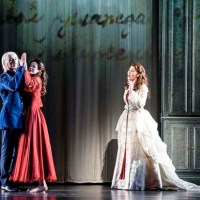
Is there a more extraordinary, more heart-stilling moment in all opera than the finale of Mozart’s The Marriage of Figaro? The Count, suddenly understanding his wife’s fidelity, begs her forgiveness — ‘Contessa perdono!’ Her answer comes like a musical benediction, but not until after the very slightest pause — space to doubt, to hope. It’s a touchstone for any production, and it says everything about the current revival of David McVicar’s long-lived Figaro that, on press night, the audience laughed. Since 2006, McVicar’s elegant period update — poised in the fragile political hinterland between France’s First and Second Republics — has done the business at the Royal Opera.

The big chill

Theatre

Michael Grandage’s latest show is about an old snap. Geneticists regard the X-ray of the hydrated ‘B’ form of DNA as one of the loveliest images ever captured. To laymen it looks like some woodlice drowning in yesterday’s porridge. The pic was taken in 1951 by the British biochemist Dr Rosalind Franklin but she failed to realise its significance. When James Watson passed through her lab he took one glimpse and instantly twigged that it revealed the helical structure of DNA. With his pal Francis Crick he built the famous double-helix model which bagged them the Nobel Prize. Dr Franklin (played by Nicole Kidman) won nothing. We know all this in advance, of course, so the play lacks any suspense.

Friday

More from Books

I have people to see is what I said. I did not say they are all in my head. I am committed; did not say to whom, did not say to my own self in my room. I have places to be where I must go. You want to make arrangements? Sorry, no.

There will be blood | 17 September 2015

Arts feature

If you don’t want to spend hundreds of euros on a good seat, the best place to watch the Palio di Siena is by the start. For my first time — decades ago — I arrived early in the apron-shaped Piazza del Campo and sweated out the long afternoon as a tide of tension rose. By early evening, when the horses and jockeys finally entered from the courtyard of the towering Palazzo Pubblico, 50,000 spectators ached for release. I clambered on to a temporary fence for a better view. A Sienese woman who was maybe 19 hauled herself up and, for balance, grabbed me from behind. As the jockeys embarked on the long, casuistical process of lining up at the start rope, she began to moan, then weep.

Bursting the bubble

Exhibitions

The conventional history of modern art was written on the busy Paris-New York axis, as if nowhere else existed. For a while, nowhere else did. People wondered, for example, whyever the mercurial Whistler volunteered for the unventilated backwaters of Britain. But London was eventually allowed into the international conversation following successful pop eruptions that began in the Fifties. Germany followed. Now, perhaps as a response to a wired and borderless planet, where images can be instantaneously transmitted and sacred cows may be frivolously slaughtered, there is a revisionist and more inclusive policy for entrance to art’s pantheon. The braided cord has been lifted. Everyone can join the club.

Eastern airs

Radio

On Private Passions this week the writer Amitav Ghosh gave us a refreshingly different version of what has become a Radio 3 staple. No Mozart, Mendelssohn or Monteverdi for Ghosh, who speaks five languages including Arabic and Bengali, was born in Calcutta and has lived in Delhi, Oxford, Alexandria, Brooklyn and Goa. Instead, his musical choices were all about fusion and cultural exchange. Perhaps most surprising was an ‘Oriental Miscellany’ from the late 18th century, played on the harpsichord and sounding initially quite baroque until you realised that the fingering was much more complex, more layered, infinitely more interesting. The composer William Hamilton Bird had for the first time given Hindustani folk tunes a Western notation.

Socialist Cluedo

Television

What a load of manipulative, hysterical tosh is An Inspector Calls. It wasn’t a work with which I was familiar till I saw the latest TV adaptation. Now, of course, I see exactly why the luvvies — see, for example, Stephen Daldry’s highly acclaimed early 1990s National Theatre revival — adore it so. It confirms everything they think they know about the world: rich people bad, heartless, oppressive; poor people the long-suffering and saintly salt of the earth. In case you’ve not had the pleasure, J.B. Priestley’s play is like a socialist game of Cluedo: a lovely innocent young working-class woman has died and the toffs all dunnit.

Why emote about migrants during a concert?

Columns

How should we deal with people who sneeze in public places? Stephen Jackson, aged 49, has found himself in court as a consequence of taking direct action against those people who are kind enough to share their nasal mucus with the rest of us. Stephen’s answer is usually to slap the offender across the head and say: ‘Don’t sneeze in front of me.’ He will be sentenced in a couple of weeks on four similar charges of assault, the victims all being people who sneezed when he was nearby. There was one other charge, mind, which involved spitting at a baby in its pram. Now, it may well be that we’ve all spat at a baby at one time or another — but to my mind that doesn’t make it acceptable behaviour.

High and mighty

Cinema

‘Ain’t about what’s waiting on the other side,’ sang Miley Cyrus. ‘It’s the climb.’ She’s not usually a musician to be turned to for profound insight but in this case pop’s wild child has captured the absolute crux of this year’s Gravity wannabe, the visually spectacular 3D Everest, which kicked off the Venice Film Festival two weeks ago to a mixed reception. That’s because, even though in the case of the 1996 Mount Everest disaster (in which eight people died) what was waiting on the other side for most people was a cold and lonely death, it was indeed all about the climb.

Double tragedy | 17 September 2015

Theatre

To examine an ancient text requires an understanding of the ancient imagination. The Oresteia is set in a primitive world where people believed that every animal, tree, stone, river, mountain, star, cloud and clap of thunder was inspired by a spirit controlled by the gods. Heaven signalled its wishes through dreams, oracles or chance events which were interpreted by prophets. What we understand by ‘faith’, i.e. a volitional fealty to a particular religious code, didn’t exist. There was no free will either. Mortals chose between one divine instruction or another. The genius of Aeschylus was to commit his characters to a cycle of moral conflicts where every act of obedience was also an act of betrayal.

All roads lead to Callas

Opera

Bellini belongs to that category of not-quite-great operatic composers whose works are also very difficult to perform adequately, and don’t seem to be all that popular when they are. But Welsh National Opera’s theme for the season of Madness means that as one of the leading exponents of operatic insanity Bellini is bound to turn up, and WNO does him proud vocally, if not in production, by mounting I puritani, his last and for some aficionados his finest opera. Norma seems to me to be clearly superior, certainly as drama. I puritani has a wretched libretto, not only linguistically feeble but also with a hopeless plot. It certainly does contain wonderful music, above all of course Elvira’s mad scene in Act II (she has one in each of the three acts).

Deadlier than the male | 17 September 2015

Music

Last week a 17-year-old girl forced the Edexcel exam board to change its A-level music syllabus to include the work of women composers. Jessy McCabe, a sixth former at Twyford Church of England High School in London, started a petition after studying gender inequality. Good for her, you might think. But is it good for A-level students? A delicate question lies at the heart of the subject of female composers, and it’s not ‘Why are they so criminally underrepresented in the classical canon?’ It’s ‘How good is their music compared with that of male composers?’ Ms McCabe told the press that ‘I’d quite like to learn about the music of Clara Schumann.’ OK, let’s start there.

On the way to Plumpton

More from Books

We pull up at Wivelsfield, under a blue sky, and glance out at the one figure on the platform: a mature, buxom woman in pink. Her arms are open wide, and a burly, moustachioed man climbs out of our carriage and gallops towards her embrace, burying his face in her yellow hair. When will they let go of each other? At last, she grasps his shabby bag, swings it over her shoulder, and off they march, trailing laughter; also disturbance — for some of us are looking a shade wistful as the train pulls out, soberly, to Plumpton.

Hoof-trimming

More from Books

The below is an unpublished poem, written for Moortown, the verse-diary of Ted Hughes’s experiences of farming in Devon in the 1970s, but not included in the sequence as published. A few months after Ted purchased the bull, Sexton, he wrote to his brother Gerald: ‘I really love him. It isn’t just his incredible size and beauty — he has a strange, sweet nature, in every respect like an unusual person.’ Sexton remained at Moortown for many years after his working life, and was buried there in 1991. Some time later his remains were moved to Court Green.   The fee for this poem is donated to Farms for City Children   Sexton’s hooves are too big.

See no evil

Arts feature

When I was at university, Reggie Kray was my penpal. I wrote to him in 1991, asking for an interview for The Word, an Oxford student newspaper. Kray was unavoidably detained at Her Majesty’s pleasure. But he sent me a prompt, polite letter back. ‘Thanks for your letter,’ he wrote. ‘I will see you as soon as possible. We only get three visitors a month. Could you send me a copy of The Word?’ I sent him a copy — but I never did get to be among his three monthly visitors before his death in 2000, at the age of 66. Still, I’m ashamed to say, I was thrilled enough just to get a letter from him; and to drink in his wild, scrawling handwriting — three huge, near-illegible words to a line; nine skew-whiff lines to a page of prison-issue foolscap.