Laura Freeman

Laura Freeman

Best of Notes on…

From our UK edition

29 min listen

The Best of Notes on... gathers the funniest, sharpest and most wonderfully random pieces from The Spectator’s beloved miscellany column. For more than a decade, these short, sharp essays have uncovered the intrigue in the everyday and the delight in digression. To purchase the book, go to spectator.co.uk/shop On this special episode of Spectator Out Loud, you can hear from: William Moore on jeans; Laura Freeman on Brits in Paris; Justin Marozzi on boxer shorts; Mark Mason on coming second; Michael Simmons on doner kebabs; Fergus Butler-Gallie on Friday the 13th; Hannah Tomes on rude place names; and, Margaret Mitchell on lobsters. Produced and presented by Patrick Gibbons, with an introduction from William Moore.

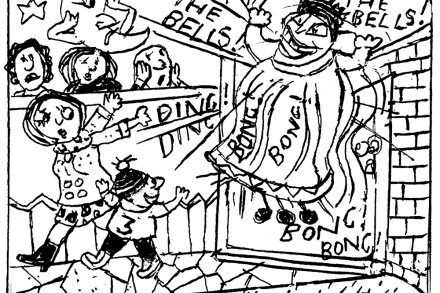
What will love and literature become in the age of the Ring doorbell?

From our UK edition

Knock, knock. Who’s there? Well, according to the app it was the Evri man at 10.27, the Yodel man at 11.17, the post lady at 13.44 and the nursery-run mum with double buggy at 15.22. What romance, what mystery in the age of the Ring doorbell? Every coming and going, every missed parcel and key fumble is filmed, timestamped and sent to my husband’s phone with a notification. We resisted Ring for two years. Two years of a broken doorbell and delivery drivers hammering on the door. Over the summer we caved and now the house is monitored night and day. ‘Must make it difficult,’ I mused to Andy as we reviewed the footage on the first evening, ‘for anyone to have affairs any more.

The pleasures of pebble-spotting

From our UK edition

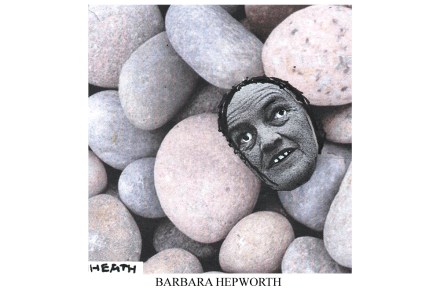
P-p-pick up a pebble. Feel its weight in your palm. Roll it over under your thumb. Any good? Not sure? Shuck it back on the shingle. Plenty of fish in the sea and more pebbles still on the shore. In The Pebbles on the Beach: A Spotter’s Guide, Clarence Ellis, pebble-spotter par excellence, opens with the words: ‘Most people collect something or other: stamps, butterflies, beetles, moths, dried and pressed wildflowers, old snuffboxes, china dogs and so forth. A few eccentrics even collect bus tickets! But collectors of pebbles are rare.’ We are not talking about the common or garden or indeed communal garden collector of pebbles – the sort with a wheelbarrow and a trowel. A true pebble-spotter does not make off with cartloads to resurface the driveway.

Can we know an artist by their house?

From our UK edition

Show me your downstairs loo and I will tell you who you are. Better yet, show me your kitchen, bedroom, billiard room and man cave. Can we know a man – or woman – by their house? The ‘footsteps’ approach to biography argues that to really understand a subject, a biographer must visit his childhood home, his prep-school boarding house, his student digs, his down-and-out bedsit and so on through barracks, shacks, flats, garrets, terraces, townhouses and final Georgian-rectory resting-place. Walk a mile in their shoes – then put on their carpet slippers. So, to know Horace Walpole, we board the 33 bus to Strawberry Hill. For Henry Moore, it’s Hoglands and its cactus house. For Barbara Hepworth, St Ives and sculptor’s dust.

Laura Freeman: Ways of Life

From our UK edition

39 min listen

In this week's Book Club podcast, I'm joined by the writer and critic Laura Freeman to talk about her book Ways of Life: Jim Ede and the Kettle's Yard Artists. Laura's book is the portrait of one of those figures who, without ever quite taking the spotlight themselves, was nevertheless hugely influential in kindling the love and appreciation of art in others – a man who knew everyone from Picasso and Brancusi to David Jones and the Nicholsons, and whose home-cum-gallery in Cambridge has been a sanctuary and inspiration to generations of undergraduate pilgrims.

We’ve reached standing ovation saturation

From our UK edition

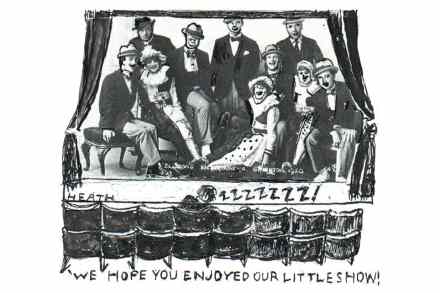
‘And now the end is here / And so I face the final curtain…’ You said it, Frank. The lights dim, the curtain falls, exeunt all to rapturous applause. Too rapturous, if you ask me. The standing ovation, once the exception, is now the rule. Post-Covid, I got it. After months of empty theatres and keeping the ghost lamps burning, I’d have clapped any man and his dog to the skies. But university revues, pub two-handers, primary-school plays? I feel a scab for sitting when every man jack is on his feet. I did it at Cabaret, The Glass Menagerie and Straight Line Crazy. A sit-in protest. ‘Grinch,’ you’ll say, and fair enough. But I want a standing ovation to mean something. An exclamation mark, not just a standard full-stop.

How to mend (almost) anything

From our UK edition

‘Sides to middle’, that’s the cry. When your foot goes through the flat sheet in the night, there’s only one thing for it: scissors down the centre, then sew it edge to edge. Good as new – for as long as your stitches hold up. If you’ve paid for Egyptian cotton, you cannot cut your linen into dusters the minute the thread count wears thin. Besides, call it eco-activism, call it penny--pinching, mending things is fun. From time to time, when my husband is washing up, a plate will crumble like a biscuit in his hands. Seeing his ‘it wasn’t me’ expression, I’ll tell him that the plate, glued and glued again, was beyond salvation. Then I’ll glue it together again.

Jonathan Miller, Cindy Yu and Laura Freeman

From our UK edition

21 min listen

On this week's episode, Jonathan Miller says that whoever wins France's election on Sunday, the country is going to the dogs. (01:00) After, Cindy Yu says that China's online censors are struggling to suppress critics of the Shanghai lockdown. (07:47) And, to finish, Laura Freeman reviews a Walt Disney exhibition at the Wallace Collection. (12:06)Entries for this year's Innovator Awards, sponsored by Investec, are now open. To apply, go to: spectator.

Disney’s rococo roots

From our UK edition

Extensive research went into the writing of this piece. First, I lay on the sofa watching Disney’s Cinderella. Then, Beauty and the Beast. Then, because I’m assiduous about these things, Frozen. The singalong version. I wish I could tell you that the sofa was a rococo number with ormolu mounts and a pink satin seat, but that would upholster the truth. My excuse – who needs one? – was the Wallace Collection’s delightful exhibition Inspiring Walt Disney: The Animation of French Decorative Arts. It’s not often that I leave a show smiling, humming and near enough twirling my way through the West End. Bibbidi-bobbidi-boo.

The politics of war crimes

From our UK edition

42 min listen

In this week’s episode: Is Putin guilty of war crimes?For this week’s cover piece, The Spectator’s Editor Fraser Nelson looks at the risks and rewards of labelling Vladimir Putin and Russian soldiers war criminals. He joins the podcast, followed by Michael Bryant, the author of A World History of War Crimes, who writes in the Spectator this week about what the limits put on acts of war in the past can teach us about atrocities committed today. (00:52)Also this week: Is Europe facing a political stand-off between progressives and populists? This week Hungarian Prime Minister Viktor Orban was elected for a fourth term in office with a large majority. While in France, Emmanuel Macron faces a much harder fight from Marine Le Pen than many expected.

The cult of the extortionate ‘English’ kitchen

From our UK edition

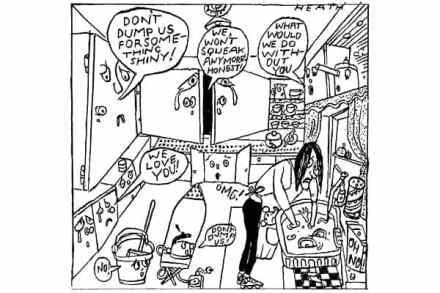
A house around the corner is on its fourth kitchen in a decade. Every two or three years, the house changes hands, the pristine kitchen comes out and a newer, pristiner kitchen goes in. They are always white, they are always shiny, and when I peer through the basement windows there is nothing in the way of signs of life. I reckon I can predict the next kitchen. Think homespun, think rustic, think scullery maid in mobcap and pinny. What the rich want now is a plain old Plain English kitchen. Hand-crafted cabinets, antiqued brass, Delft tiles with authentic craquelure. Starting at £34,000 and going up to… well, how much have you got? Don’t you dare put Dulux on your artisan doors. Plain English has its own bespoke paint chart.

The art of the Christmas card

From our UK edition

It’s the thin end of the wedge, the slippery slope, the beginning of the end of a civilised Christmas. It is the first week of December and I still haven’t started my cards. My friend Charlotte was at it in October. She signed up for a lino-cutting class, cut holly boughs and robin redbreasts and printed her own cards. She sent me photos of the fruits (berries?) of her labours and very merry they were, too. Usually, I am a Charlotte. By November, I have made cards, addressed envelopes, applied thumbs to 80 stamps. But after an illness in the autumn, I’m feeling as uncreative as a turkey. Could I cheat and send emails with a pious little homily about how, for the sake of the planet, I’m forgoing paper cards this year?

Why do we kiss under mistletoe?

From our UK edition

Give us a snog. Pucker up at the Christmas party. Kiss me quick at the Nativity play. Will you be snogging this season? Thérèse Coffey, Secretary of State for Work, Pensions and Office Passion, has spoken. ‘I don’t think there should be much snogging under the mistletoe.’ she told Robert Peston on ITV. Sajid Javid, Secretary of State for Health, weighed in: ‘I’ll certainly be kissing my wife under the mistletoe — it’s a Javid family tradition.’ Not just a Javid tradition. Mistletoe is a pale green shrub which grows on the branches of broad-leaved trees. It is hemiparasitic, which means that it draws water and mineral nutrients, but not synthesised foods, from its host. Shakespeare thought it more dismal than cheerful.

The art of seizing the moment in photographic portraiture

From our UK edition

A Tatler photographer once told me that the secret to taking a good photo was the three Ts: tum, tits, teeth. Suck it in, push ’em out, show your pearly whites. Leaving aside David LaChapelle’s portrait of Pamela Anderson, there’s a shortage of Ts in Phillip Prodger’s Face Time. This looks likea coffee-table book but doesn’t bark like a coffee-table book. On first flick through, I found the pictures desultory, even depressing. I was expecting more of a Condé Nast vibe. Glossy and glossier. On second approach, taking text and pictures together, it became a more interesting beast. Prodger is a former head of photography at the National Portrait Gallery and the founding Curator of Photography at the Peabody Essex Museum in Salem, Massachusetts.

Why should art have ever been considered a male preserve?

I’m a lady, I kept thinking, reading these two books. More: I’m a lady art historian. Oughtn’t I to like books by other lady art historians about lady artists and ladies in art? Why don’t I? Why so out of sync with the sisterhood? Start with the positive. Jennifer Higgie’s The Mirror and the Palette follows an interesting, original line: ‘If she had access to a mirror, a palette, an easel and paint, a woman could endlessly reflect on her face and, by extension, her place in the world.’ Higgie, editor-at-large at frieze magazine and the host of the (excellent) art history podcast Bow Down, considers the lives and ambitions of a series of women artists in the light of the self-portraits they painted.

art women

The joy of a cluttered museum

From our UK edition

On a clear day, from the balcony of Tullie House Museum & Art Gallery in Carlisle, you can see the McVitie’s factory. If the wind were in the right direction, I like to think you’d smell digestives on the breeze. Originally, it was the factory of Carr’s, bakers of table water biscuits since 1831. Carr’s held the Royal Warrant from 1841 until 2012, when it lost the crown due to ‘changing tastes’ in the royal household. I blame Duchy Originals Oaten Biscuits. Inside the museum is a display of Carr’s covetable vintage biscuit tins and, on a satin hanger, the brown velvet waistcoat worn by Jonathan Dodgson Carr himself. The fabric is printed with ears of wheat and the tiny slogan ‘Free’.

Absurd and amusing, solemn and scholarly: Charles Jencks’s Cosmic House reviewed

From our UK edition

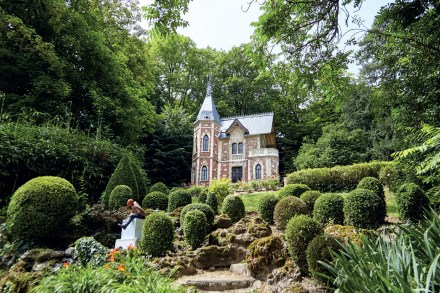
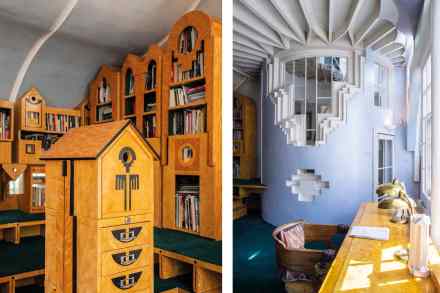
An editor once told me: always look at the loos. It was remarkable, she said, how many grand cultural projets, having spent a fortune on the atrium, the concert hall, the galleries, spent pennies on the bogs. The smallest rooms at Charles Jencks’s Cosmic House are among the loveliest loos in London with windows on to the garden and a ‘Jencksiana’ mirror over the sink. This was the Baltimore-born writer, critic and landscape designer’s take on the ‘Serliana’ window devised by the mannerist architect Sebastiano Serlio and it recurs throughout this mad and marvellous post-modern house. Jencks died in 2019 leaving his house on Lansdowne Walk in Holland Park as a stucco memorial. From the pavement, there isn’t much to distinguish No.

The daring young man who gave his name to the leotard

From our UK edition

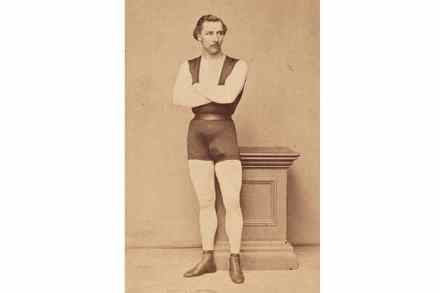
Jules Léotard was blessed in his name. It might have been quite different had he been called, say, Jules Droupé. As it was, his family name was lithe, elongated, taut. It was a name with stretch. Léotard was born in Toulouse in 1838, the son of a gymnastics teacher. The young Jules might have become a lawyer. He passed his legal exams, but twisting words wasn’t enough. He wanted to be twisting, turning, falling, flying. At 18, he began to practise with trapeze bars, ropes and rings over a swimming pool. He joined the Cirque Napoléon, and on 12 November 1859 performed its first flying trapeze routine.

The art of politics: what ministers hang on their walls

If I am ever appointed to one of Britain’s Great Offices of State — stranger things have happened to Spectator hacks — the first thing I’d do is furnish my office. A raid on the Government Art Collection is a perk of being a minister, and better than the car and the driver. A few Hogarth engravings, a set of David Jones’s ‘Ancient Mariner’ etchings, Cedric Morris’s ‘Irises and Tulips’, Edward Bawden’s ‘The Coal Exchange’...I’d have liked to nab Winifred Nicholson’s ‘Flower Piece’, if only Carrie, the new Mrs Boris, hadn’t got there first. A Freedom of Information request from The Spectator has lifted the little red velvet curtains on which works of art ministers have got from the vaults.

art

The National Trust has lost the language of architecture

From our UK edition

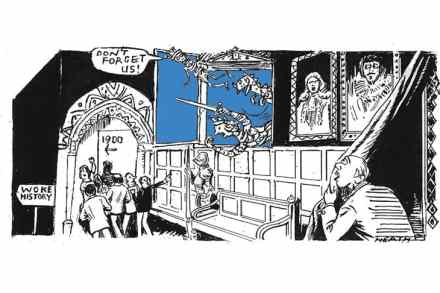
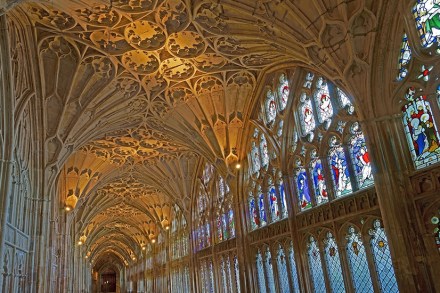
Press officers, breathe easy. This is not another column attacking the National Trust. Actually, I tell a lie. It is. But my complaint isn’t bullying or slavery or LGBTQ+ery or even chocolate Easter eggery. It is more single and specific: the National Trust does not speak architecture. Or if it does, it’s keeping shtum. Since the great May reopening, I’ve dragged my husband around half a dozen National Trust properties, landscapes and gardens (he hardly ever protests, always pays for tea). We’ve done Stourhead, Oxburgh, Ickworth, Lacock, Cobham Woods and Disraeli’s Hughenden Manor. In the gap between lockdowns last year, we did Sissinghurst and Knole. I cannot fault the car parks, the rhododendrons or the second-hand bookshop in the Oxburgh potting shed.