Culture

Culture

The good, the bad and the ugly in books, exhibitions, cinema, TV, dance, music, podcasts and theatre.

Lines of beauty | 10 September 2015

Exhibitions

Marshall McLuhan got it at least half right. The medium may not always be the entire message, but it certainly dictates the kind of message that can be transmitted. This is one lesson of Drawing in Silver and Gold: Leonardo to Jasper Johns, an exhibition at the British Museum that is packed with subtle masterpieces, and as a bonus contains — for those who like such things — two of art’s great studies of dogs. I might as well start with those: one by Albrecht Dürer from around 1520, ‘Dog resting’, and the other by the later Dutch artist Hendrick Goltzius of his own pet, curled up and sleeping in about 1597. Both of these display the virtues of silverpoint.

Hermit

Poems

Let’s celebrate the solitary meal: the serendipitous trawl through the fridge; the hopeful foray into the deep freeze, the obliging egg and — on a good day — the last hurrah of a cheesecake or a cold Jersey potato, pleading for release from its stiffening cocoon of mayonnaise. No waiting for a table here; all you need is your fork, your plate, your glass, and your scallop-shell of quiet.

Get me to an opera house

Opera

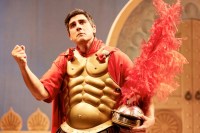
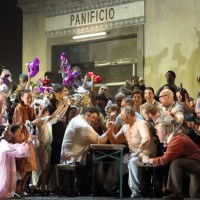
In anyone’s hands, Verdi’s Aida is not the easiest opera to raise up to greatness on the stage. How does a director spotlight hidden subtleties, musical or dramatic, in a libretto and subject so easily swamped by the spectacle of marching breastplates, roaring divas, Egyptian bling and the aroma and sway of live camels? Novice audiences may have their own problems, grappling with characters named Aida, Amneris, Amonasro, Radamès, Ramfis — almost always A and R. If only the librettist, Antonio Ghislanzoni, had called someone Doris. Imagine, then, the difficulties faced when the opera is performed by Opera Australia on a wide-open platform, built over water, at this year’s Handa Opera on Sydney Harbour.

Dual control | 10 September 2015

Cinema

Legend is a biopic of the Kray twins starring Tom Hardy as Reggie and Tom Hardy as Ronnie, so it’s buy one get one free, and this offer will sell the film. It sold it to me, who would otherwise have little interest in the Krays, and was never moved to correspond with either (see Harry Mount's Arts Feature; I did once write to David Cassidy, but did not receive a reply). So it’s Hardy’s performance(s) that’s the draw, and Hardy is dazzling because Hardy is dazzling, not because Legend is especially dazzling.

Going for a song | 10 September 2015

Music

This column does like a bargain. Indeed, it not only esteems and relishes a bargain, it has also worked long and hard to prove Milton Friedman wrong. Sometimes there really is such a thing as a free lunch. And for those of us still wedded to the notion of owning music on some kind of solid, tangible medium (vinyl, CD, dusty box of cassettes at back of cupboard), these are great, cheapskate-friendly years in which to be alive. Almost every song ever recorded can be bought for a song. And still we mothwallets can claim the moral high ground, because we’re not actually stealing it, unlike everyone under 40. As Fagin once sang, ‘In this life, one thing counts. In the bank, large amounts.

Cock and bull

Television

It’s hard to know whether the actor James Norton was being naive or disingenuous when he claimed in publicity interviews for BBC1’s Lady Chatterley’s Lover that ‘We are no longer shocked that people have sex.’ Either way, the tabloids soon proved him wrong. Days before the programme went out, the Sun had duly worked itself up into a state of delighted outrage about a TV drama that was apparently ‘so steamy it borders on porn’. In the event, this proved an exaggeration wild enough to suggest that none of the journalists involved had seen the programme —or, less likely, any porn.

A goddess, a city and a tree

More from Books

Known for her strength, Athena can throw a spear like a dart, and on the day of the contest for Athens it’s a bull’s eye – not just Attica’s but the world’s first olive tree springs where her spear falls. Athena is surprised how at ease the tree is, the Saronic Gulf merely its backyard, the slopes of the Akropolis simply a source of afternoon shade. Athena’s competitor packs his bag, the fruit of the new tree glossy as his lost dream. On Philopappos hill – lizards seeing blindly into the distance, empty olive oil cans already being planted with geraniums in the city below – Athena throws her spear again through air she may as well begin polluting. A chair appears, a table, a bowl of olives, an ashtray.

All white on the night

Arts feature

Shakespeare’s ‘Wars of the Roses’ will have no ethnic minority actors in the cast when the shows (two Henry VI plays and Richard III) open at the Rose Theatre, Kingston upon Thames, later this month. A sprinkling of so-called BME (black and minority ethnic) actors in Shakespeare has been the norm for ages now. So the decision by the director to go with an all-white cast has caused much hurt and concern from the actor’s union Equity, the Guardian, and from various groups promoting racial diversity in the arts. From all the fuss, you’d think the plays are being directed by a hooded white supremacist.

Touchy-feely – not

Exhibitions

‘The eye is fatigued, perverted, shallow, its culture is degenerate, degraded and obsolete.’ Welcome to the Palpable Art Manifesto of Romanian sculptor Paul Neagu. Art must be accessible to all the senses, he argued, for ten fingers will explain more than two eyes and the tongue might tell yet more again. His Palpable Sculpture is the focus of an exhibition at the Henry Moore Institute that itself ‘ascends to the condition of a work of art’, according to the Scottish artist and gallerist Richard Demarco. His opinion carries weight, for it was he who brought Neagu out of Romania in 1969 to exhibit and teach in Edinburgh. A succession of little galleries lead the viewer through Neagu’s playful mind.

Press night

More from Arts

Sam Mendes once said there is no such thing as the history of British theatre, only the history of British press nights. That observation takes us closer to understanding the taboo that constrains journalists from reviewing the opening performance of a West End play. A dozen or so previews take place before the critics are invited in for a star-studded gala, or ‘press night’, which is fixed by the producer to make the show appear in its most seductive light. Newspapers are usually wary of censorship in any form, so their assent to this convention must be considered a great anomaly. The vanity of the lead actor is a significant element. A first night is usually full of hazards and mishaps as the cast acquaint themselves with the props, costumes, door-handles and so on.

Loose women

Radio

Late Night Woman’s Hour has created a Twitter storm with its twice-weekly (Thursdays and Fridays) doses of ‘mischievous and unbridled conversation’. The 11 p.m.–midnight slot is an ideal opportunity for cardigans to be unbuttoned and tongues unloosed, a chance to show that Radio 4’s venerable magazine programme for women can still shake up the station. Lauren Laverne was brought in from 6 Music to host the first few editions, signalling that there would be nothing mumsy about these hour-long chats around the table with a selection of well-chosen guests. Her style is refreshingly different, frank and a little bit cheeky, not at all Radio 4. How could it be when she spends most of her working life talking to musicians or hanging out at Glastonbury?

Shtumming the spiel

London may cry foul over Hamlet’s misplaced to-be-ing and not-to-be-ing but Edinburgh is in raptures over a Magic Flute which ditches its spoken dialogue entirely. Directed by Barrie Kosky and Suzanne Andrade, and first seen a couple of years ago on Kosky’s adopted home turf at the Berlin Comic Opera, the production turns Mozart and Schikaneder’s beloved singspiel into a sing-stumm, in which silent-movie captions and moon-faced gazes replace the original spiel, underscored by fortepiano improvisations with a spot of Chinese opera thrown in for good measure. Not your usual night at the opera, then, but it certainly drove the Festival Theatre audience wild. The visual style mixes up Buster Keaton, F.W.

Lifting the veil

Television

Finally I realise why women are so pissed off. It all goes back to the first codified laws — circa 2,400 bc — when rules like this were invented by men: ‘If a woman speaks out of turn then her teeth will be smashed by a brick.’ Before that, apparently, women lived on a pretty equal footing with their future male oppressors.

Mealybug Nymphs, Gossamer

Poems

after Robert Hooke, Micrographia (1665)   A warm wall, heavy leaves, hard green grapes     and a cluster of berries         spun out of cobweb.   They were packed with brown roe, or, later,     an anarchy of hatchlings,         scattering crawlers   scarce larger than the eggs they once were,     two eye-dots on a body         the shape of an egg.   I counted nine scales at the rear end,     two whiskers, a two-pronged tail         six legs underneath.

Bad conduct

Music

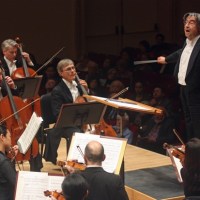
To be honest, my friendship with Michael Tilson Thomas hasn’t gone quite as I had hoped. It started in February 1990, when he chose a Tallis Scholars track for one of his desert island discs. This was a movement from a mass by Josquin des Prez, that he said (apparently impromptu) was music which ‘completely comforts me and brings me into a state of tranquillity’. I thought I might have found a new messiah. For many years now I have had the hope of meeting an orchestral conductor who is prepared to take on the challenges of performing a major work from the unaccompanied choral repertoire. Of course there have always been those who have included choral society-type singing in their symphony programmes.

WATCH: Why Steve Backshall is one of the best presenters on British television

At a time when so much of television is read from autocue, it's a joy to come across complete professionals whose love for their subject is second only to their knowledge of it. Those who don't have young children may not have come across Steve Backshall; those who do will know that he's one of the best-informed and most impressive presenters on television on either side of the Atlantic. This above clip, from BBC3's Big Blue Live filmed in California, gives a measure of his ability: he breaks off an interview after discovering a blue whale swimming behind him. His commentary was ad-libbed, yet dripping in facts and conveyed with wonderful drama.

Chrissie Hynde is right – women should take responsibility for their actions

The popular singer Chrissie Hynde has been reprimanded by feminist campaigners for speaking common sense. Hynde, who is somewhat more astute than most landfill rock slebs, has advanced the proposition that women should take a degree of precaution to ensure that they are not sexually attacked by men. Such as not wandering the streets, pissed out of their skulls, in their underwear. She told the Sunday Times: 'You can't paint yourself into a corner and then say whose brush is this? You have to take responsibility. If you play with fire you get burnt. It's not any secret, is it? 'If I'm walking around in my underwear and I'm drunk? Who else's fault can it be?

Why is the Home Office giving in to illiberal youth by banning rappers like Tyler, The Creator?

In a 2012 interview on Newsnight, foul-mouthed LA rapper Tyler, The Creator told a churlish Stephen Smith that the point of his music was to ‘piss old white people off like you’. Now, the old white people at the Home Office seem to have proved him right, by banning the rapper – real name Tyler Okonma – from entering the UK for the next three to five years. Okonma’s manager, Christian Clancy, wrote in a blog post that he received a letter stating that the rapper would not receive a visa because his work ‘encourages violence and intolerance of homosexuality’ and ‘fosters hatred with views that seek to provoke others to terrorist acts’.

God’s architect

Arts feature

Somewhat magnificently, I made the notes for this article sitting in the back of a Rolls-Royce travelling between London and Goodwood. It’s a journey that provides ample evidence of how the classical language of architecture, at least in Palladio’s version, has infiltrated our imaginations and informed our concept of grandeur. I find Palladio’s spirit in the stately shell of the Rolls-Royce’s radiator, which apes a classical portico, in the famous Sussex country house itself, and in a bottle of Château Margaux: this finest of wines is made in a property of Palladian design. You can see it on the label. Palladio was the finest classical architect of them all, but he was much more than a slavish classicist.

The only art is Essex

Exhibitions

When I went to visit Edward Bawden he vigorously denied that there were any modern painters in Essex. That may not have been true then — this was in the 1980s — or even now. What is indisputable, however, is that there have been plenty of artists in the county. They are the subject of two small but delightfully jam-packed exhibitions at the Fry Art Gallery, Saffron Walden. Bawden (1903–1989) is at the heart of both of them, even if the second point he made to me — equally emphatically — was that he called himself a designer rather than an artist (‘out of self-defence, mainly’). That distinction, and the quirky humour, are both relevant to the question of Essex art, especially the variety that is the focus of attention at the Fry.

The Matador

Poems

The matador scowled at the back of the bar, and sipped his beer. He wanted to stab the people who stared at him. His black tie, his black suit didn’t shield him from their eyes. He ordered testicles, his unique entitlement, and a carafe of deep red wine. He flung his right arm around, as if he was twirling his cape, and declaimed a line of poetry, then giggled, and apologised. Tomorrow he was going out against a bull from Miura. Where was the flashbulb reception? He fixed his eyes on a bearded man who might be discussing him — he sipped his wine, remembering the white-socked bull in Toledo. He could never be defeated.

The BBC’s music man

Radio

To Radio 2 to meet Bob Shennan, controller of the BBC’s most popular radio station (the station attracts one third of all listening hours) and now also head of the newish monolith that is BBC Music. Why corral all of the Corporation’s music output on radio and TV into one enormous sub-division (on a par with BBC News, BBC Drama and BBC Sport)? Isn’t this just another cost-cutting compromise, a way of saving money by smoothing out the BBC’s output (its first production was that weird mish-mash of God Only Knows by a constellation of stars)? How will specialist stations like Radio 3 and BBC4 survive if swallowed up in what is essentially a bureaucratic creative exercise, victims of corporate branding?

All from nothing

Cinema

Andrew Haigh’s 45 Years stars Charlotte Rampling and Tom Courtenay as a long married couple whose relationship is disturbed by a letter relating to his first girlfriend, a German who died in the Swiss alps 50 years earlier. Aside from that, not much happens. A shopping trip to Norwich is about as exciting as it gets, on the action front. But this is one of those ‘inaction films’, as I call them, in which nothing happens, but everything happens; it is simple yet absorbingly profound. And it will resonate. It will resonate afterwards and it will resonate the next day and it will resonate the day after that. In fact I am still resonating, and rather wish I wasn’t, so I could move on with my own life. It’s rare for a film to affect me in this way.

Martian moves

More from Arts

Every August when London dims, Edinburgh calls, promising nothing less than ‘the greats of the arts’ at the International Festival. As if this beautiful, haunting city wasn’t enough enticement, I always pack high expectations for the EdFest, which in the past has delivered some staggeringly good international dance events that commercially biased London could not entertain. Though in recent years things have gone off a bit, this year the ‘great’ box was ticked several times. Israel Galván’s mesmerisingly extraterrestrial flamenco dancing has been seen in London before.

Will he was

Television

In 2011, the Daily Mail carried a long story about how the Queen’s cousin Prince William of Gloucester, who died in a plane crash aged 30, had been Prince Charles’s boyhood idol. (Our own Prince William, it claimed, was named after him.) In passing, it tactfully informed us that William’s ex-girlfriend Zsuzsi Starkloff ‘no longer wishes to be reminded of her lost love’. Well, the good news is that Zsuzsi has certainly changed her mind since. The following year she gave the Mail an interview describing their relationship in some detail. And on Thursday, she appeared in The Other Prince William: Secret History to tell all over again what Channel 4 unblushingly called ‘the untold story’ of their time together.

Strauss-ful

Opera

Richard Strauss’s Daphne is one of the operas he wrote during the excruciatingly long Indian summer of his composing life, where he seems, in one work after another, to be looking for a subject worthy of his skills, and only finding one in Capriccio, his last opera. For that, he and his ideal interpreter Clemens Krauss collaborated on a libretto that, while garrulous, has a real topic to deal with, and handles it with no portentousness or pseudo-depth. None of that can be said about the depressing series of operas he composed in the 1930s, which either have a serious topic to deal with but not the drama or the music to do it justice, or are nothing more than word- and note-spinning.