Culture

Culture

The good, the bad and the ugly in books, exhibitions, cinema, TV, dance, music, podcasts and theatre.

Safe and sound

Music

This week the Southbank Centre began its ‘Belief and Beyond Belief’ festival — a series of concerts and talks claiming to explore the influence of religious inspiration on music. Last summer, after reading its miserably right-on publicity material, I wrote in this column that ‘Beyond Parody’ might be a better title. Jude Kelly, the Southbank’s artistic director, accused me of jumping to conclusions before the programme had been finalised. Well, now it has. In addition to concerts with no discernible connection to their composers’ faith, we’ll be treated to ‘How to be a Shaman’, ‘Mindfulness’, ‘What If God Was A Woman?’ and ‘Right to Die?’.

Dual control | 19 January 2017

Television

Revolting (Tuesdays) is the BBC2 comedy series that spawned the now-infamous sketch ‘Real Housewives of Isis’. It has been watched on the BBC’s Facebook page nearly 30 million times and rightly so because it is fearless, funny and near the knuckle. A pastiche of reality TV shows set in places like Beverly Hills, the sketch depicts three young British jihadi brides brightly discussing their domestic lives in some Raqqa-like hellhole. ‘Ali bought me a new chain,’ boasts one, ‘which is eight feet long. So I can almost get outside, which is great.’ Cue shot of black-hijabed housewife lurching towards the doorway of her bombed-out home, dragging the cooker to which she has been leashed.

Remembrance of things past

Theatre

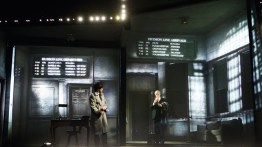
The Kite Runner, a novel by Khaled Hosseini, has sold more than 30 million copies worldwide. Now it arrives on the West End stage, a doggedly efficient piece that somehow lacks true dazzle. The narrative style involves thick wodges of plot being delivered at the audience like news bulletins on the half-hour. The emotional range is limited and the characters never challenge our expectations. The setting is Kabul in the 1970s. We meet nice Amir, a personable everyman, whose family have foreseen the rise of theocratic despotism and are plotting to escape. We hope they do. We’re attracted to Amir’s garrulous, whisky-drinking dad. ‘All crime is a form of theft,’ he philosophises. We find the psychotic street bully Assef utterly appalling.

Death rattle

Opera

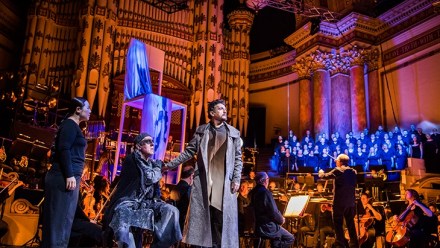
The Barbican website warns us that Ligeti’s opera Le grand macabre ‘contains very strong language and adult themes’. The strong language consists of the four-letter words that are known to everyone and used by most people, and the adult themes are sex/love and death, which this opera has in common with almost any non-comic opera you can think of, and without which the genre would certainly never have been conceived or added to over more than four centuries. But while love and sex have often also provided the stuff of comedy, death is another matter, and presumably it is Ligeti and Michael Meschke’s robust treatment of this (superbly translated into English by Geoffrey Skelton) that we might need to be warned about.

What ‘The Crown’ didn’t get right

Watching the enjoyable Brontë drama To Walk Invisible the other day on television, I was brought up short when Charlotte told Emily that their books would be ‘rubbished’ by male critics in London. Such anachronisms crop up in all period dramas, but would be easy to fix if someone with an ear for language was asked to skim through the script before it was filmed. Which brings us to The Crown. I think we all enjoyed Claire Foy’s shot at the Queen’s voice and Vanessa Kirby’s smoky Princess Margaret. (Not sure why they gave Prince Philip a teddy-boy haircut. Surely all they have to do is copy the photographs?) But The Crown also had some ‘going right down to the wire’, ‘it’s a learning curve’, moments.

Haus of ill repute

Arts feature

Here in Munich, in the gallery that Hitler built, this year’s big hit show is a spectacular display of modern art. Postwar: Art Between the Pacific and the Atlantic, 1945–1965 is a massive survey of international modernism, curated with typical Germanic can-do. Talk about ruthless efficiency — even the catalogue weighs several kilograms. All the stars of German modern art are here, from Joseph Beuys to Gerhard Richter, but the most interesting exhibit isn’t in this huge central hall, where Hitler staged his Great German Art shows, it’s in a quiet corner of the gallery, at the end of a deserted corridor, up an empty flight of stairs.

Shape shifter | 12 January 2017

Exhibitions

Victor Pasmore once told me how he greeted Pablo Picasso at Victoria station. The great man had come to Britain in 1950 to attend a communist-sponsored peace congress in Sheffield. In person Pasmore found him surprisingly different from the solemn art-historical giant suggested by books. ‘He did nothing but joke all the time, non-stop, and he was no more a communist than the local fairy.’ Instead, Pasmore felt, ‘Picasso was 100 per cent anarchist.’ Something similar could be said about Pasmore himself, as can be seen from a fine exhibition devoted to his work from the 1930s to the ’60s at the Djanogly Gallery, Nottingham (moving on to Pallant House, Chichester, on 11 March). Few artists made more abrupt stylistic swerves.

The Bourne identity

More from Arts

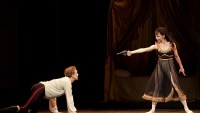
From a film about ballet to a ballet about film. In reworking the 1948 Powell and Pressburger classic The Red Shoes for his latest show, Matthew Bourne pays homage to far more than the unforgettable story of a budding ballerina and the bloody toll of her choice between love and career. With the glee of George Lucas recreating second world war dogfights in space, Bourne, a cinéphile since childhood, stuffs his Red Shoes with images from Hollywood’s Golden Age: a French Riviera coast here, a battered old piano there, fur coats and train whistles and sequin-and-feather tap-dancers. The problem with this love letter to cinema is that it blunts the edge of the story’s cruelty towards Victoria Page, the wearer of the titular shoes.

Word perfect | 12 January 2017

Radio

All that’s needed for Radio 4’s One to One series (Tuesdays) to succeed is a sharp-eyed interviewer, ready with the right question at the right time, and an articulate guest, not afraid to speak freely and openly, but with integrity, all too rare these days. In the opening programme, Julia Bradbury talked to Dr Martin McKechnie, an A&E consultant, about the challenges he faces day in day out. It was a timely reminder that not everything in the NHS is broken beyond repair. Most striking, perhaps, was not so much Dr McKechnie’s calm fortitude in the face of terrible human distress (remarkable thoughthis was) but the way he casually dismissed the idea of talking about his work with his family.

Shall we dance?

Television

‘Blimey! How on earth did they think of that?’ is unlikely to be anyone’s response to Our Dancing Town (BBC2, Tuesday). A few years ago, The Great British Bake Off was adapted into The Great British Sewing Bee by the simple process of fitting another domestic activity to the same formula. Now — after what I imagine was a brain-storming session lasting approximately 30 seconds — the BBC has taken the idea, structure and tone of Gareth Malone’s singing programmes and applied them to a series about dance. Enthusiastic evangelist for the life-changing potential of his chosen art form? Lots of initial sceptics dolefully shaking their heads and insisting that it can’t be done?

Drama queen

Theatre

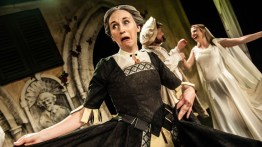
God, what a dusty old chatterbox Schiller is. Like Bernard Shaw, he can’t put a character on stage without churning out endless screeds of cerebral rhetoric. But unlike Shaw, he has no sense of humour, nor any instinct for the quirks and grace notes that create a personality. Mary Stuart is a psychological drama with a single issue. How soon, and with what political consequences, can Elizabeth execute her treacherous cousin Mary? Schiller’s characters sound and feel identical: super-brainy, highly confident know-alls who treat each problem like a gang of Chancery briefs discussing a particularly knotty insolvency case. Director Robert Icke’s regimented production imposes high-street fashions on England in the 1560s.

Affleck carries the film – with the help of that jaw: Manchester By The Sea reviewed

Everyone in Hollywood knows that if you want some good jaw-clenching you go to an Affleck brother. To older brother Ben for the big budget moves, for a chin dimple that looks good in a bow-tie or Batsuit. And to younger brother Casey for something a little more low key. Casey may have the jaw that is less defiantly handsome, a chin that is a little smaller, weaker and more upturned, but that jaw's acting skills in Manchester By The Sea are off the charts. As Lee, a man withdrawn and weighed down by grief amid the beautiful but bitter frost of a coastal Massachusetts town, Affleck’s Oscar glory seems assured, particularly following his Golden Globe win.

Callas would have found it a very big bore: Met Opera Live’s Nabucco reviewed

Nabucco Met Opera Live Callas, writing to her husband Meneghini from Naples in 1949, where she was performing a run of Verdi's Nabucco for the only time in her life, said 'the opera itself has beautiful music, but it's also a big bore!' That seems just, but it goes on being done fairly often, mainly on the strength of the chorus 'Va, pensiero', Italy's unofficial national anthem, and of Abigaille's Act III aria and the meaty part for the title character, who is provided with one of the relatively few baritone mad scenes, and ends up as a convert to the Hebrew god. The plot is rather complicated, considering there are only five main characters, who are locked in relationships of concealed fatherhood, elaborate deceptions and religious hostilities.

Munchkins and mischiefs

Arts feature

Arthur Rackham shouldn’t have lived in anything as conventional as a house. It should have been a gingerbread cottage, like the one he drew for Grimms’ Fairy Tales, with cakes for a roof and boiled sugar for windows. Or a Rapunzel turret, for letting down ropes of long, blonde hair, except he was so very goblin-bald. Or a Sleeping Beauty palace with a spinning-wheel in the topmost tower. As it was, he lived in Chalcot Gardens, north of Primrose Hill and south of Hampstead Heath, with his wife Edyth Starkie, a portrait painter, and their daughter Barbara, at the end of an 1880s row set back from the road.

Hedda Garbler

Theatre

Hedda Gabler is one of the most influential plays ever written. It not merely illuminated an injustice, the enslavement of women within marriage, it fomented the revolutionary achievements of feminism. It deserves to be done as Ibsen intended. This updated version from Ivo van Hove locates Hedda in one of those posh urban dream homes that resemble an art gallery. Stage left, buckets filled with flowers. Centre, an abandoned plinky-plonk piano. At the rear, a lamp the size of a traffic bollard. Scruffy off-white masterpieces deck the walls. Everything looks chic and scaled-up. Tesman is a penniless American academic married to tetchy Hedda who pads about barefoot, in her nightie, grousing. Effortful gestures abound.

Joining the dots

Radio

A new website, radio.garden, lets us browse radio stations across the globe. Nothing new about that. That’s been a key feature of wireless since the days of valves and crystals. Turning a knob and stopping off at Hilversum, Motala, Ankara or Reykjavik, if and when short-wave reception was possible, is part of radio’s magic, listening in to life elsewhere without having to leave the house. Now, though, with radio.garden (developed in Amsterdam by Jonathan Puckey for the Netherlands Institute for Sound and Vision, and part-funded by the EU), it’s possible to turn the globe that appears on your computer screen as soon as you log on to the site and to sweep across India, Africa or Australia, stopping off wherever you find a green dot.

Holmes spun

Television

One of the few intelligent responses from the liberal-left to our radically altered political landscape was an essay published last year in the impeccably right-on Vox. It began: ‘There is a smug style in American liberalism ...It is a way of conducting politics, predicated on the belief that American life is not divided by moral difference or policy divergence — not really — but by the failure of half the country to know what’s good for them.’ You could apply very much the same argument to Britain and, as evidence, you could cite the first episode in the new series of Sherlock. (Shitlock as I prefer to call it, in the interests of accuracy.

Giving it both barrels

Opera

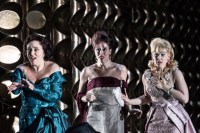
In Joseph Roth’s The Radetzky March, the ageing Emperor Franz Joseph regrets the drab field-grey that has replaced his army’s once-colourful uniforms, seeing in it a premonition of an empire — a world — soon to be defeated and broken up. Franz Joseph is present in Act One of Robert Carsen’s new production of Der Rosenkavalier, right there in the Marschallin’s boudoir: I counted at least four portraits of the old man, gazing phlegmatically down on the sexually charged capers below. And the men in grey are there too. In Carsen’s conception, Baron Ochs and his yobbish retinue are cavalry officers, plotting on one side of the room, while on the other gorgeously dressed fashion models resembling drawings by Erté parade and pose.

Lin Cook, who died before Christmas, personified that odd breed: the celebrity widow

Amid the flurry of famous deaths during 2016, one particular passing has been more or less forgotten. Peter Cook’s third and final wife, Lin Cook, died on the eve of Advent, at the age of 71, shortly after the BBC broadcast Victor Lewis-Smith’s new documentary about Peter, for which Lin gave a rare interview. I got to know Lin in the Noughties, while compiling two biographical collections of her late husband’s work. It was an intriguing insight into the world of that strange showbiz phenomenon, the celebrity widow. Celebrity widows are a paradox – ostensibly public people, they’re actually intensely private. Lin personified this odd breed. Although I was in touch with her for over 15 years, when she died I realised I barely knew her at all.

Kenneth Clark was much better at opening people’s eyes to great art than Marxist John Berger

It is one of those interesting quirks of postwar cultural history that John Berger, who has died at the age of 90, could have presented Civilisation. Millions of viewers who saw that unsurpassed – unsurpassable – series when its 13 programmes were screened in 1969, or who have seen it in the years since, associate Civilisation with Kenneth Clark – Lord Clark of Civilisation, as he came to be known. But Berger might easily have got the nod. It was Clark himself who suggested to Michael Gill, Civilisation's producer, that he might find a more congenial ally in Berger, who, of course, three years later presented Ways of Seeing as a counter-argument to Clark's magisterial televisual essays. Who knows?

Sherlock Holmes and the Mystery of the Murdered Script

In the first days of January ‘17, the Arctic air frosted over London forcing even the most careless citizen of that metropolis to accept the mastery of those great elemental forces which shriek at mankind through the bars of his civilisation. Holmes would not move from his fire, and was as moody as only he could be when he had no case to interest him. ‘Why,’ said I, glancing up at my companion, ‘that was surely the bell. Who could come tonight? Some friend of yours, perhaps?’ ‘Except yourself I have none,’ he answered. 'A client, then?' 'If so, it is a serious case. Nothing less would bring a man out on such a day and at such an hour. But I take it that it is more likely to be some crony of the landlady’s.

Why do people hate poetry?

Why do so many people think poetry is important, and so few of them read it? And why does what might pass unnoticed as a minority activity, like — say — tiddliwinks or sniffing bicycle seats, arouse such strong views in the public at large? The award-winning American writer Ben Lerner has a theory. In this week's Spectator books podcast I talk to him about his new collected poems, his monograph The Hatred of Poetry, and how he drew inspiration from the gigantic Wal-Mart in his hometown of Topeka, Kansas. You can listen to our conversation here: And if you enjoyed that, please subscribe to the podcast on iTunes for a new episode every Monday!

In defence of 2016

This is going to be a positive, optimistic column. I promise. Because, look, let’s be honest, I’ve been a bit moany this year, haven’t I? Which may, I suspect, have been a bit misleading. Read me here, or indeed anywhere, and I suspect you could come away thinking I’ve spent the last 12 months, or at least the last six, lying awake, staring at my expensive north London Farrow & Ball ceiling, weeping sad, shuddering, self-indulgent tears at a world moving beyond my ken. I know, I know. I do go on. Whereas actually, it hasn’t really been like that.

Back in the USSR

Arts feature

For much of 1517 Michelangelo Buonarroti was busy quarrying marble in the mountains near Carrara. From time to time, however, he received letters relating how his affairs were going in Rome. These contained updates on — among other matters — how his friend and collaborator Sebastiano del Piombo was getting on with a big altarpiece which he hoped, with Michelangelo’s help, would vanquish their joint rival, Raphael. This picture, ‘The Raising of Lazarus’, has been in the National Gallery for almost 200 years now (it is No. 1 in the inventory of the collection). Next March it will be one of the centrepieces in an ambitious exhibition that inaugurates the new North Galleries, Michelangelo & Sebastiano: A Meeting of Minds (15 March–25 June).

Why I was ashamed to love Status Quo

Columns

I bought a record in a second-hand shop in the summer of 1981. A double album. I made sure nobody was looking when I handed over my money, and kept the purchase hidden in its brown paper bag all the way home. Back in my room, I locked the door to make sure my house-mates couldn’t surprise me — and plugged in my headphones. What followed was more than an hour of dirty bliss, a guilty pleasure before the term had been invented. What I was listening to was a compilation album of Status Quo’s singles and most popular album tracks. I can’t remember what it was called — ‘Again and Again and Again and Again and Again’ would have been fitting, but too arch for the Quo.

Deplorable entertainment

Theatre

Buried Child is a typical Sam Shepard play. The main character, Dodge, is a brain-damaged alcoholic cripple stuck in a Midwest shack with a half-witted xenophobic wife shrieking at him from the coal cellar. The wife makes an early speech about her son who ‘married a Catholic whore’ and got stabbed to death by her on his honeymoon. This sets the tone for the play. Every character is a shrill, chippy barbarian and every speech is an exercise in tragicomic one-upmanship. The audience for Shepard’s work consists of social voyeurs who want to gawp at the underclass from a safe distance. The play purports to be a mystery but the family secret is revealed in the title. Even so, Shepard proceeds as if there were a puzzle to solve. He keeps offering us ‘clues’.