Book review

A box of delights | 11 February 2016

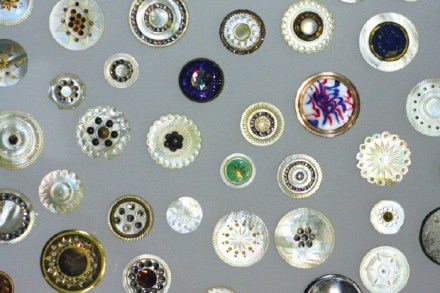
How could you possibly justify a whole book about buttons? How could the mention of a humble wooden toggle, a diamond clasp, a ‘blue side buckle’ inspire such an unusual and irresistibly delightful account of more than a century’s worth of women’s lives? You might wonder. But as Lynn Knight sorts her way through her Victorian grandmother Annie’s old treasures, a rich hoard of buttons of infinite shapes, sizes and textures, all packed into an old sweet tin, the smell of the lemon-scented geranium in Annie’s house comes hurtling through the door of her mind and returns her with a technicolour clatter to childhood. This is a book to make you smile, a story luminous with nostalgia.
Riddles in the sand

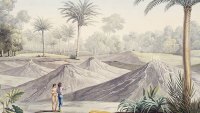
When the Saqqara pyramids were opened in 1880, the chamber walls were found to be covered in hieroglyphic writings, and these texts have been a subject of discussion among Egyptologists ever since. What do they mean? What do they represent? What do they tell us about the religion or the cosmology or the worldview of a culture that can sometimes seem incomprehensibly far from our own? Taking issue with the scholars that have come before her, Susan Brind Morrow uses this fascinating, challenging book to demonstrate her view that the message on the walls is poetic, timelessly meaningful and sophisticated.

Muskets v. the Highland charge

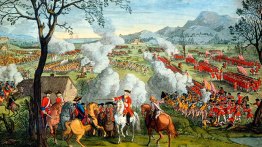
What a wretched lot the Stuarts were, the later ones especially, the males at least. James II fled England without a fight in 1688, and the battlefield of the Boyne in 1690 earning him the unaffectionate nickname Séamus an Chaca, ‘James the Shit’. During the Jacobite rising of 1715 on the death of Anne and the accession of George I, his son Prince James Edward, coming late to the fight from France, fled Scone palace, telling his hapless supporters to ‘shift for themselves’ after the defeat at Sheriffmuir. In turn his son, Charles Edward, the Bonnie Prince, brought up in Rome, hurried from the field at Culloden in 1746, the culminating battle of the second major rising, the ‘Forty-five’, having mismanaged the whole affair.

From surgeon’s scrubs to patient’s gown

Who would you trust to take a blade to your brain? Medical schools and hospitals, arbiters of this outrageous intimacy, select the steadiest hands and the steadiest temperaments. Neurosurgery has an almost religious aura, an intellectual status approaching quantum physics and a work ethic of unforgiving precision. Most elusive of all, this elite should be able to express the pleasures and pains of being human. Ian McEwan’s fictional neurosurgeon, Henry Perowne, is suspicious in his indifference to literature, whereas Henry Marsh, neurosurgical consultant and author of Do No Harm, has earned respect through his elegant prose. To take care with words is invaluable in the heroic efforts of preserving personhood. Paul Kalanithi was to become one of these rare surgeon-storytellers.

We are not all in this together

Not so long ago I stumbled into a little pop-up in Hoxton: a delightful tearoom hardly bigger than a walk-in wardrobe, all 1940s home-craft ‘boutique’ style. Nice table linen, a ‘make-do-and-mend’ tea service with artfully mix-matched china, victoria sponge slices, and the strains of some popular bygone tune in the background. I’m not sure I got much change out of a crisp new tenner, but retro heaven, right? Before I’d even got my hands on Owen Hatherley’s The Ministry of Nostalgia (nice austerity-era block-red dust jacket) I had the feeling — call it gut instinct — that this sort of austerity chic might not be quite the author’s thing.

Humboldt’s gift

The Prussian naturalist Alexander von Humboldt was once the most famous man in Europe bar Napoleon. And if you judge a man by his friends (as you should), how about Goethe, Schiller, Simon Bolivar, Cuvier, Lamarck, Laplace, Guy-Lussac and Jefferson? And that is only the start of the supper list. So what happened? Why is he forgotten? For the best of reasons: because he contributed so much to so many fields of intellectual interest that are now separate scientific disciplines. And also because most of his ideas that were once startlingly original are now commonplace. We take it for granted that there are vast rivers running through the seas (but at least the Humboldt Current is named after him). He was the first oceanographer. He was the first ecologist.

Down and out in Park Lane and Plaistow

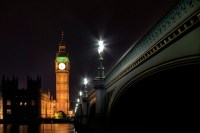
‘I was born in London,’ Ben Judah tells us early in this vivid portrait of Britain’s capital, ‘but I no longer recognise the city.’ London has become a building site where dirty money is converted into gleaming blocks of bullion. The smartest parts of town are lined with empty houses owned by foreign plutocrats, and London’s spirit is embodied not so much by the bearded hipster brewing your £3 cup of coffee as by the Shard, a soaring monument to wealth and inequality. Judah isn’t all that interested in the well-shod hirelings who lubricate this shiny capitalism. We’re halfway into the book before we encounter anyone who could be described as privileged (other than the widely-travelled, Oxford-educated Judah).

Escaping the Slough of despond

Most spy novels have a comfortable air of familiarity. We readers can take moles in our stride. We have grown up with cut-outs and dead letter boxes. There’s little we don’t know about angst-ridden, morally fallible spooks in raincoats and sharp-suited, gun-toting agents in casinos. Mick Herron, however, takes a different approach from most other espionage writers. Real Tigers is the third novel in his ‘Slow Horses’ series. Its predecessor, Dead Lions, won the CWA Goldsboro Gold Dagger as the best crime novel of the year. The Slow Horses are a department made up of MI5 rejects — officers who have committed gross errors of judgment or made enemies of powerful figures in the organisation. (‘Persona non grata,’ muses one character.

Odi et amo

Reading Daisy Dunn’s ambitious first book, a biography of the salty (in more ways than one) Roman poet Catullus, it struck me how lucky we are: only one copy of his collection of poems survived the ages, hidden under a bushel in Verona. Catullus might have gone the way of his contemporaries, such as Cinna, whose lynching is immortalised in Julius Caesar, and whose poems are now dust. Happily, we have Catullus’s small, polished oeuvre, varied and ravishing: there are squibs, lambasting his fellow Romans (‘The father has the filthier right hand/ But the son’s anus is the more voracious’); fascinating mini-epics traversing all of Greek myth; beautiful marriage hymns; and the ‘Lesbia’ poems, recounting his affair with the aristocratic Clodia Metelli.

Roaming in the gloaming

One of the epigraphs to Peter Davidson’s nocturne on Europe’s arts of twilight is from Hegel: ‘The owl of Minerva begins to fly only at dusk’, an image of philosophy as posthumous, able to explain things only after we have experienced them. Or an image of dusk as threshold, the blue hour when light transforms itself, and other worlds become possible. The Last of the Light is a cultural companion to such notions. A cabinet of curiosities — paintings, poems, music — framed by the idea of Europe as an archipelago of regret, many of whose most vital artefacts have dealt in echo and obscure longing, translated into a feeling for light. This is a trail going back to Virgil, poet of shadows, or else starting from Christian ideas of a crepuscular fallen world.

No end to the Final Solution

David Cesarani, Research Professor of History at Royal Holloway University of London, died at the age of 58 on 25 October 2015. The book now appears without its author, a kind of huge mausoleum for an astonishing enterprise. Cesarani wants to change our view of the Holocaust and to close the yawning gap between popular understanding of this history and current scholarship on the subject… to challenge the traditional concepts and periodisations … the term itself. He substitutes the ‘Final Solution’ for the Holocaust, but that Nazi term has become an alternative name for the Holocaust, which remains after 900 pages entirely unchallenged.

‘Crazy mixed-up Yid’

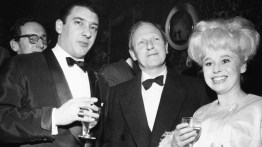
Even David Litvinoff’s surname was a concoction. It was really Levy. Wanting something ‘more romantic’, he appropriated that of his mother’s first husband. So his elder half-brother, the respected writer Emanuel Litvinoff, informed Keiron Pim, adding that David was ‘an unfortunate character altogether’, prone to ‘inventing roles for himself that didn’t have any reality’. Yet this fantasist is the elusive figure whom Pim has endeavoured to capture in an ambitious book which seeks to resurrect an era as much as an individual.

Tawdry tales of Tinseltown

This is a very odd book that Jean Stein has compiled — about the evanescent splendour of Los Angeles, which only occasionally touches on the film industry. Its setting’s most memorable landmark appears to be the name of one of its districts, written in enormous white letters on a hillside. That, and various opulent houses, preserved in one movie after another and generally concealed from public view. Stein’s subject is the failure to leave any kind of a mark — despite huge spectacle and expenditure; and witnesses are reduced to repeating over and over again,‘Well, you should have been there at the time.’ She tells five stories. The first concerns the Doheny family, whose wealth derived from Los Angeles’ main commodity before films: oil.

A legend in her own time

I usually dread the final 15 minutes of a celebrity interview: the awkward section during which the writer must steer the conversation away from the polite, mutually enjoyable discussion of whatever the star is currently promoting toward the juicy personal details that your readers really want to know and your subject really (and justifiably) wants to keep private. You sit in the consciously impersonal atmosphere of an upmarket hotel room with a total stranger, and broach topics you might spend decades dancing around with friends and family. I still have nightmares in which I blurt out lines worthy of Alan Partridge: Yes, the bass line on that track is terrifically deep isn’t it!

Tricks of the trade | 28 January 2016

This book, the blurb warns us, was written by ‘an established voice in popular psychology, with a regular column on the New Yorker online’. Maria Konnikova is also the ‘bestselling author of Mastermind’, a book which explains how we can train our minds to see the world as Sherlock Holmes saw it. The Confidence Game identifies a template pattern of stages peculiar to every successful confidence trick, and devotes a chapter to each: the Put Up, the Play, the Rope, the Tale, the Convincer, the Breakdown, the Send, the Touch and the Fix. (The first chapter offers a psychological profile of ‘the Grifter’ or confidence trickster and ‘the Mark’ — his prey.

Alive and kicking | 28 January 2016

Four years after his death, it is still faintly surprising to recall that Christopher Hitchens is no longer resident on this Earth — or on any other sphere, if his friend Richard Dawkins is correct. A quote from Dawkins graces the cover of And Yet..., a final gathering together of Hitchens’s essays and the sequel to the bestselling anthology Arguably; he was, notes his ‘fellow horseman’, the ‘finest orator of our time’. And here is that voice again, alive, fiercely engaged with many of the same issues he left us to deal with: politics, patriotism, God or His absence, death and, inevitably, books. There was much about Hitchens that was contradictory and he knew it and embraced it in his work.

A country in crisis

Jack Shenker is a throwback to an older, more romantic age when foreign correspondents were angry, partisan and half-crazed with frustration at the stupidity of the powerful. He made his name in Egypt, arriving with nothing more than a desire to be a reporter. As the revolution began, he moved to Tahrir Square and started to publish stories in the Guardian. He soon began to win awards, notably for a piece on the deaths of African migrants in the Mediterranean. He has continued to report around the world, but his first love remains Cairo. The Egyptians, his first book, is fuelled by anger and frustration.

Poverty + anarchy + drug dollars = Mexico

You may not have heard of the Maras. Or Barrio 18. Or the Jalisco New Generation Cartel, or the Zatas, or the Knights Templar, or the Shower Posse. But you should have heard about them, says Ioan Grillo in his new book about transnational drug and crime gangs, because any one of them may have played a profitable and blood-drenched role in bringing you not only your weekend baggie of recreational powder, but also the gold in your earring, the lime in your gin and tonic, the avocado in your salad and even the steel in your Volvo. These ‘gangster warlords’ are the new century’s international mafias. They originate in Central America, Mexico and the Caribbean, although now they have trading subsidiaries everywhere from Bombay to Brixton.