Art

A flammable individual

On the night of 18 October 1969, thieves broke into the Oratory of San Lorenzo, Palermo, and removed Caravaggio’s Nativity. On the night of 18 October 1969, thieves broke into the Oratory of San Lorenzo, Palermo, and removed Caravaggio’s Nativity. The altarpiece has not been seen since. Three decades later, in 1996, Italians were aghast when the Mafia claimed responsibility. Somewhere in the Sicilian capital of Palermo, it seemed, a gangland capo sat in awed admiration of the stolen Christmas canvas. Far from submerging rivals in wet concrete, now the Cosa Nostra were enthusiasts of 17th century religious art. Born in 1571 near Milan, Caravaggio was a flammable individual.

Small but perfectly formed

Some years ago, Edmund de Waal inherited a remarkable collection of 264 netsuke from his great-uncle Iggie, whom he had got to know 20 years previously while studying pottery and Japanese in Tokyo. Each week the young de Waal visited his urbane, elderly relative and his friend, Jiro. He heard ancient family stories and was introduced to the hare and all the other miniature carvings in ivory or wood, each one ‘a small, tough explosion of exactitude’. When eventually he inherited the netsuke, he felt he had also been ‘handed a responsibility — to them and to the people who have owned them.

Painting the town together

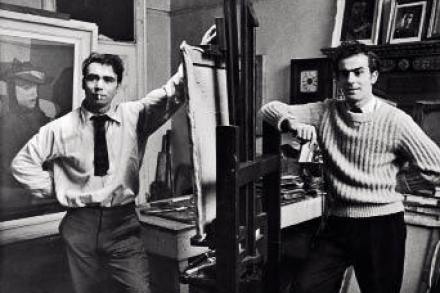
This book recounts a terrible story of self-destruction by two painters who, in their heyday, achieved considerable renown in Britain and abroad. Robert Colquhoun (1914-62) and Robert MacBryde (1913-66), both from Scottish working-class families, met in 1932 when they were students at the Glasgow School of Art. From then onwards they were personally and professionally inseparable in their headlong rise to fame and descent downhill. Although both have been the subject of anecdotes and snapshots in many a memoir of the period — all those accounts of Soho and ‘Fitzrovia’ — this is the first full-length study devoted to them, the result of over 20 years’ research.

Red faces in the galleries

Art fraudsters, especially forgers, have a popular appeal akin to Robin Hood. Their cock-a-snook cunning provides a twist on those money shots on the Antiques Roadshow when some dotty great aunt from Sidmouth discovers her umbrella stand is Ming Dynasty. ‘How much?’ cries Dotty. The forger levels the field from the other side of the pitch. When some shipping magnate finds his Monet ‘Nympheas’ is more pond scum than Giverny gold the public collapses into bouts of schadenfreude. Many books and films have covered this subject, and yet The Conman has a particularly interesting tale to tell. This is a true story not only of dubious oils but also the obfuscation of the paper trail which allows a work of art to be declared genuine.

Thoroughly hooked

On the southern edge of Kensal Green cemetery, beneath the wall that separates the graves from the Grand Union Canal, is a memorial inscription that would stop a Duns Scotus in his tracks. At the top of the heart-shaped marble there is a fading photograph of a man in his middle years, and then beneath some touching messages of love and regret, a single, enigmatic line of inscrutable theological subtlety ‘FROM ODDS ON TO ODDS AGAINST.’ It is hard to know what to make of that — ‘From certainty to doubt?’ ‘From scant rewards to a last, triumphant pay-out?’ — but for any self-respecting angler still on the other side of that wall this is the very definition of Heaven.

Our squandered national treasure

Torn with grief, Melvyn Bragg has produced a condolence book for the South Bank Show (born 1978, died of neglect, 2010). These 25 vignettes, based on the best of his interviews, are more than just the cosy clippety-cloppety sounds of an old cowboy trotting into the sunset. They offer intriguing comments on the film-making process and present valuable new insights into their subjects. Most have the shape and phrasing of short stories and his meetings with the gravest maestros read like mini-epics. We watch plucky little Melvyn as he approaches the armoured titan in his lair, tempts him forth and charms him into dropping his guard. He meets Francis Bacon at 9 am and finds six bottles of champagne waiting on the table, one open.

Fine artist, but a dirty old man

I have always been sceptical of those passages in the ‘Ancestry’ chapters of biographies that run something like this: Through his veins coursed the rebellious blood of the Vavasours, blended with a more temperate strain from the Mudge family of Basingstoke. I have always been sceptical of those passages in the ‘Ancestry’ chapters of biographies that run something like this: Through his veins coursed the rebellious blood of the Vavasours, blended with a more temperate strain from the Mudge family of Basingstoke. Those passages seem to claim too much for heredity, and to bear out A. J. P. Taylor’s dictum that snobbery is the occupational disease of historians.

Proscribing legalised drugs

‘My wife says these drugs turned me into a zombie, but the truth is I wouldn’t know, as I have hardly any memory of the past 40 odd years.’ The Mail printed Keith Andrew’s testimony, a 74-year-old retired electrician who has guzzled prescribed benzodiazepines for nearly half a century. Andrew is one an estimated 1.5 million British people who have been addicted to valium and other tranquilisers. Whether addiction is voluntary or not is irrelevant. Anti-anxiety treatment remains a laxly regulated area of medicine: more than 8 million prescriptions are made each year and there are an estimated 100,000 illicit addicts currently using. In a fascinating piece in the Telegraph, Andrew M Brown outlines the side-effects of long-term ‘Benzos’.

Life beyond the canvas

Angela Thirlwell’s previous book was a double biography of William Rossetti (brother to the more famous Dante Gabriel) and his wife Lucy (daughter of the more famous Ford Madox Brown). Angela Thirlwell’s previous book was a double biography of William Rossetti (brother to the more famous Dante Gabriel) and his wife Lucy (daughter of the more famous Ford Madox Brown). Now she has once again turned her attention to the margins of the Pre-Raphaelite group, with a joint portrait of the four women who influenced Ford Madox Brown: his two wives, Elisabeth and Emma, and two women for whom he had spiritual affinities, and (probably platonic) romantic yearnings. Elisabeth was, in reality, the least influential, for her life was pathetically brief.

A dramatic streak

Late in the 19th century, archaeologists digging in the Roman Forum discovered a lime kiln. It had been built to incinerate marble into an aggregate for the mortar for the new structures of the Middle Ages. Inside were statues of six Vestal Virgins, stashed together like firewood. Their arms had been snapped off. The image came to mind as I read this excellent new book on the artist John Armstrong (1893-1975). In the 1930s he painted a series of ruined streets, with broken statues and broken monuments. They are bare and stark, and there is nothing like them in 20th-century British art. The first Armstrong I saw stopped me short: ‘Phoenix, 1938’, in Leeds City Art Gallery. When the guard turned I took a photograph, and still have the bright blue slide.

A dream made concrete

You are celebrated as the architect of one of the most famous buildings in the world, now in your late eighties and living quietly in your home outside Copenhagen. One day a beautiful blonde German girl knocks on your door. She is clutching a folder of her photographs of the extraordinary structure on the other side of the world which, following a dispute in 1965 with a new Australian Government, you have never seen completed. For her, that architectural work was love at first sight. For you, her images are a love letter that confirms the enduring greatness of your conception. It is happiness on both sides, and its fruit the publication of this hauntingly beautiful book. Few modern buildings can have been more photographed than the Opera House on Geelong Point in Sydney Harbour.

Master of accretion

Frank Auerbach (born 1931) is one of the most interesting artists working in Europe today, a philosophical painter of reality who works and re-works his pictures before he discovers something new, something worth saving. William Feaver, in this grand new monograph, calls Auerbach’s paintings ‘feats of concentration’, and stresses the hard work which goes into their construction, despite their appearance of spontaneity. Feaver has a gift for the evocative phrase: ‘Studied yet impulsive, ranging from darkness to radiance and from the declamatory to the subdued, they are keyed to an air of resolve as unguarded as joy, as involuntary as grief.’ This is a book strong on context.

The king of chiaroscuro

These days, it is easy to take it for granted that Caravaggio (1571-1610) is the most popular of the old masters, yet it was not ever thus. In my Baedeker’s Central Italy (published exactly 100 years ago), he is acknowledged as having been ‘the chief of the Naturalist School’, but it is pointed out that from the outset ‘it was objected that his drawing was bad, that he failed in the essential of grouping the figures in his larger compositions.’ The first major exhibition of his works — in what has only very recently been established as the city of his birth, Milan — did not take place until 1951.

The optimism of a suicide

A postal strike would have been a disaster for Van Gogh. Letters were his lifeline and consolation. Not only did he receive through the mail his regular allowance from his brother Theo but, in letter after letter in return, he poured out his thoughts and feelings, recorded his work in progress and conveyed his impressions of books, people and places. In his often solitary existence, he was an avid recipient and kept in touch with a variety of correspondents, especially when he was in the South of France during the last two years of his life. The glory must be shared, however, with Theo, in that he kept Vincent’s letters, many of which contained drawings, either appended or on the sheet itself, surrounded by his tumble of words.

Repeat that, repeat

When the Louvre invited me to organise for the whole of November 2009 a series of conferences, exhibitions, public readings, concerts, film projections and the like on the subject of my choice, I did not hesitate for a second and proposed the list. Thus Umberto Eco on the genesis of this book, published simultaneously in Italian, French and English. Considering those parallel manifestations of the project, it was perhaps to be expected that this, its sole printed version, would be situated at the more ingratiatingly ludic end of the Eco spectrum. The Infinity of Lists is a work less of theory than of taxonomy.

Romantic approaches

Spectator readers will know that Andrew Lambirth is a romantic, a force for the literary and poetic approach to art criticism, so he is an admirably empathetic guide to Hoyland: In England the subversive underground Romantic spirit has never run dry, it consistently nourishes art in this country and erupts forth in strange and unexpected ways. The late work of John Hoyland is one such unpredictable manifestation. Mel Gooding’s standard monograph covers Hoyland’s career to 2006, but such is the artist’s productivity that, despite serious heart surgery last year, many of the excellent colour plates — the majority in the case of the 46 full-page illustrations — are of new paintings.

Surprising literary ventures | 9 September 2009

Patricia Highsmith, as readers will know, was the author of the upmarket thrillers Strangers on a Train and The Talented Mr Ripley, among others. She was also a keen artist, and illustrated (rather than wrote) the rare book Miranda the Panda is on the Veranda, to text supplied by her friend Doris Sanders. Its pages, somewhat Seussian in tone, include statements such as: ‘Mabel Grable, a sable, reads a fable at the table in the stable near the gable with a cable’; ‘A monk and a skunk and some junk on an elephant’s trunk’; and ‘A veil on a snail.’ The book was published by Coward-McCann, who also handled her adult fiction.

Dilly-dallying romance

Translated to Borsetshire, John Constable’s courtship of Maria Bicknell would provide more material than any script editor could handle without straining audience impatience beyond endurance. Nine years it took, from initial yearnings and tacit engagement to get them to the altar at St Martin-in-the-Fields and even then, in October 1816, it was the quietest of weddings. Over those years Constable’s ardour was divided. ‘Deplorable as our case is, I would not be without it for the world’, he wrote to his beloved early on when she was at her most inaccessible. That left him plenty of time in which to obsess over his art. Martin Gayford has an eye for emotionally-charged episodes or ‘detailed microbiography’, as he puts it, set in and around art history.

From worthless to priceless

A combination of art history ‘lite’ and the personal touch — a common yoking together these days, even in books supposedly of art history ‘full strength’ — makes for, in Philip Hook’s hands, an engaging read. As a dealer and auctioneer, and the author of several thrillers, he has advantages not given to the general run of such investigative writers. His subject is the rise of French Impressionist painting, after its initial years of critical contempt and commercial failure, to international mass appeal and soaring value. It’s a familiar story, frequently told, and a reader looking for new light on the fortunes of Monet, Pissarro, Renoir, Sisley et al. will search in vain. Where Hook scores is in his practical experience.

Shrine of a connoisseur

Sir John Soane’s Museum, London, by Tim Knox, photographs by Derry Moore Sir John Soane’s Museum is very nearly a folly — a mad grotto in the midst of Georgian London. It is clearly the monument of someone both eccentric and egocentric. What saves it from being Hearst Castle, Liberace’s palace or Michael Jackson’s Neverland, is that its creator was a great architect — the Bank of England was his masterpiece. In the early 1790s Soane and his rich wife bought No. 12 Lincoln’s Inn Fields. The house was rebuilt to Soane’s designs, and they moved there in 1794.