Gary Dexter

Meet the humans training robots at the ‘arm farm’

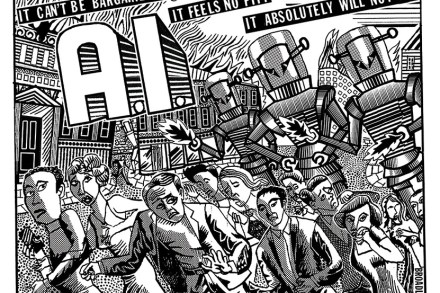
AI is set to take over all cognitive tasks in the next few years. Your hard-won career as a paralegal, data analyst, radiologist, coder or novelist is about to be hacked out from under you. So far, so apocalyptic. But what about the jobs that are primarily embodied? Sous-chef, rehabilitation nurse, plumber, dog-trainer? These are expected to lag behind, awaiting the next generation of robots. But there is an important further question. Who will train these robots? Answer: you will.  This is the concept of the arm farm. On an arm farm, practitioners of the aforementioned jobs - chefs, nurses, plumbers etc. - wear Go-pro helmets, pressure-sensitive gloves, even full motion-capture rigs, and do the jobs that the robots will ultimately usurp.

Your AI Granny will speak to you now

There’s a trend on YouTube at the moment for videos in which older people give advice. They speak directly to camera, frankly and without pretension. One can almost sense the care home staff hovering in the background, coaxing their barely extant charges into making one last testament of their time on Earth. The videos have titles such as ‘Things I’d tell my 30-year-old self’, ‘Harsh realities of being an 85-year-old woman’, ‘A girl and a woman talk about life’, ‘Lessons learned’ and ‘How to deal with loneliness.’   The commenters below the videos respond, largely, with gratitude and a surprising lack of trollery. ‘I’m terrified of dying,’ one commenter writes. ‘I fear many things, but nothing scares me as much as death does.

The strange economics of Japan’s all-you-can-drink pubs

From our UK edition

Imagine going into an English pub and slapping a tenner down on the bar. ‘All I can drink, please,’ you say. ‘Certainly sir,’ says the barman. ‘You’ve got two hours.’ ‘Right then,’ you say. ‘I’ll start with a pint.’ Ten minutes later: ‘Whisky, please, no ice.’ Shortly afterwards: ‘I think I’ll have a Bloody Mary.’ Then: ‘Pint of that there. The green one. Please.’ Shortly afterwards. ‘Large white wine.’ And so the night wears on. You can have absolutely anything you like: cocktails, double G&Ts, rum and coke, Jack Daniels and Jack Daniels. Two hours is enough to render you senseless. You have drunk the equivalent of £100 of booze for £10, and you need a taxi, a chicken fajita and an urgent visit to the toilet.

What happens when there’s nothing left for AI to scrape?

From our UK edition

There are several class actions going on against developers of Large Language Models. Jodi Picoult, George R.R. Martin, John Grisham and several other well-known authors are among those engaging in long-drawn-out lawsuits with tech companies such as Meta (who developed the chatbot LLaMA), OpenAI (who developed ChatGPT) and Google DeepMind (who developed Gemini). These companies, without seeking permission (imagine!), used books, newspapers, websites and other text sources to generate datasets to train their machines. The lawyers for these tech companies claim it was ‘fair use’. No one actually copied and resold anything, they say; it was used to train, and only to train.  One of my novels was ‘scraped’ by Meta, and features, in a tiny way, in the lawsuit.

I’m writing a novel without using AI – and I can prove it

From our UK edition

Everyone’s seen stories about the creep of AI into art of all kinds. Recently the people behind the music-fabrication website Suno have been making outrageous statements to the effect that people don't enjoy learning musical instruments and writing their own songs, so why not let AI do it for them? This is very new, very disturbing and very consequential. I could talk about graphic art and video and film-making, but you’ll know what’s been going on there. I’ll just cut to the chase and get to how AI tools are impacting and will continue to impact the writing of fiction.  I anticipate a future in which human authorship will need to be proven. A few years ago I simply wouldn’t have believed that this landscape could be possible.

Why the Japanese love wearing facemasks

From our UK edition

On any given street in Tokyo today, almost everyone will be wearing a mask. The Covid-19 death toll in Japan is around 1,500 in a country of 126 million people. This is dramatically less than the UK’s, yet everyone still covers up, and there are hardly any anti-mask movements of the sort that have become popular in Europe and America. Why are the Japanese so happy to wear masks, when it makes some people from other nationalities so cross? The first reason is the most obvious: to avoid spreading germs. Not catching germs, mind — spreading germs. It is considered bad manners in Japan to have a cold or a cough without trying to contain the bacteria or viruses being discharged. Of course, Japanese people, like anyone else, also wish to avoid catching germs.

Abe’s challenge

From our UK edition

As the only nation to have suffered mass casualties from a nuclear bomb, Japan has been understandably nervous about Kim Jong-un’s missile tests. Sales of domestic nuclear bunkers and gas masks have soared and nationally aired TV ads with a chilling ‘Protect and Survive’ flavour urge residents to hunker behind washing machines in basements and stay away from windows. This is one reason why Shinzo Abe, Japan’s long-standing Prime Minister, felt confident enough to surprise the world this week and call a snap election. In the light of Theresa May’s recent disaster, it seemed to many like a rash move.

Mixed blessings | 13 July 2017

From our UK edition

Japan is the only developed country where people openly espouse two distinct and incompatible religions at the same time — Buddhism and Shinto. The Japanese go to Shinto shrines for weddings and children’s celebrations. They go to Buddhist temples for funerals. Shinto shrines are sometimes found within the precincts of Buddhist temples, and vice versa, so it’s possible to beseech Buddha and the fox god in the same ten minutes. To confuse the picture still further, Japan is one of the most secular places on Earth: atheism is practised simultaneously with the other mutually incompatible religions. My Japanese wife, for example, visits and prays at temples and shrines, but in all other respects takes a scientific attitude to the world (and is trained in medicine).

Found in translation

From our UK edition

Buririggu deshita. Suraibi tōbu Wēbu de gairu to gimburu shite, Nante mimuji na borogōbu, Mōmu rassu autoguraibimashita ne. If this looks familiar, it’s not surprising. This is the first verse of ‘Jabberwocky’ by Lewis Carroll, translated into Japanese by Noriko Watanabe. Ms Watanabe is a translator of children’s books living in Sendai, in the north of Japan, and she is working on a new translation of the two Alice books. I met her in a bar called Come Here. Is translating Lewis Carroll, which is already nonsense, into another language, a near-impossible task? I asked her. ‘No, not at all,’ she said. ‘Actually it’s easy because Japanese is about 15 per cent English.

The poetic state of the nation

From our UK edition

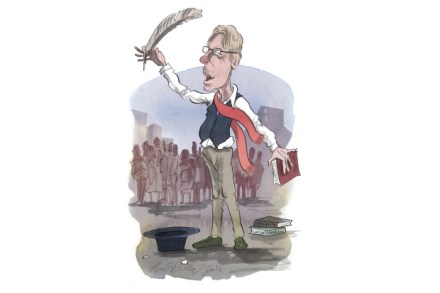
[audioplayer src="http://rss.acast.com/viewfrom22/thespectatorpodcast-eugenics-torywars-poetry/media.mp3" title="Gary Dexter and Dean Atta discuss the poetic state of the nation" startat=1169] Listen [/audioplayer] It was past midnight in Norwich. There was a keen wind rifling up London Street. It was dark and it was January. I was hoarse, my feet hurt and, more to the point, I was cold. I had been punishing myself for four-and-a-half hours reciting poems by Eliot, Larkin, Wordsworth and Whitman. I stopped a pretty Hungarian girl and her boyfriend to ask for their favourite poem. ‘Anything by Pablo Neruda,’ she said. I told her I would recite some Neruda and offer my hat for a donation if they enjoyed it.

Bookends: Not filthy enough

From our UK edition

The Pursued (Penguin, £12.99) is a lost crime thriller by C. S. Forester, the author of the Hornblower novels. It was written in 1935, rediscovered in 2003 and is now published for the first time. Marjorie, a suburban wife and mother, comes home after a ‘jaunt’ in ‘town’ to find her sister dead in the kitchen on page four It is said to be suicide, but we have doubts. Towards the end of the book, Forester summarises the action: ‘It was a filthy business, a tale of lust and murder and revenge, unredeemed by any of the nobler qualities of mankind.’ Not a bad précis, though anyone who reads The Pursued hoping to have their jaded 21st-century palate tickled is likely to be disappointed.

The body in the library

From our UK edition

Jacques Bonnet is a distinguished French art historian and novelist who has amassed a private library of 40,000 volumes (around double the number contained in the average Waterstones). Phantoms on the Bookshelves is Bonnet’s meditation on a life lived with so many books. Particularly pressing is the matter of classification. ‘Should I put Norbert Elias’s What is Sociology? next to his more historical works?’ he worries. ‘Should Paul Veyne’s Comment on écrit l’histoire be next to his studies of sexuality and euertegism (gift-giving) in ancient Rome? Does Picasso count as French or Spanish? Modigliani as Italian or French? And what am I to do with Michelangelo?

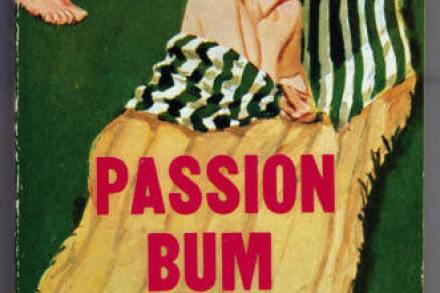
Alternative Reading: Passion Bum

From our UK edition

Robert Silverberg is the great 20th-century pioneer of science fiction, the multiple Hugo- and Nebula-award-winning author of books such as Nightwings and Lord Valentine’s Castle. Robert Silverberg is the great 20th-century pioneer of science fiction, the multiple Hugo- and Nebula-award-winning author of books such as Nightwings and Lord Valentine’s Castle. What few know, however, is that he is also the super-prolific author of scores of soft-porn pulp titles under pseudonyms such as John Dexter, Don Elliott and Loren Beauchamp.

Alternative reading | 25 September 2010

From our UK edition

The cover of On Snooker shows the Queen Mother sizing up a shot, making a passable bridge but rather failing to get behind the cue. The book is by Mordecai Richler, the great Canadian novelist and essayist, author of The Apprenticeship of Duddy Kravitz and Barney’s Version, who died in 2001. On Snooker takes in all the major figures of the late-20th-century game, and is unafraid to bring out its juicier side, particularly the depredations of its bad boys: Alex Higgins trashing hotel rooms, urinating in plant-pots, whaling his cue at the spectators, ending up broke, drinking from left-over beer glasses; Ronnie O’Sullivan and his dad, Ronnie O’Sullivan Sr.

Surprising literary ventures | 14 December 2009

From our UK edition

Here are two Alternative Reading Christmas gift ideas: books respectively by Gordon Brown and David Cameron. The Gordonian offering is by an ordained minister who wants to help you with your finances. ‘Gordon Brown’s message is very clear,’ the back cover says. The Cameronian offering is by a poet from Brooklyn, whose poems are ‘false translations’ of Baudelaire’s Les Fleurs du Mal. This he achieves by taking the original French verse and then transmuting it into English via a sort of wilful mishearing: ‘Tout Entière’, for example, becomes ‘Two Ton Chair’, and its first line, ‘Le Démon, dans ma chambre haute…’ becomes ‘Lime demons are out dancing.

Alternative reading | 2 December 2009

From our UK edition

Thomas Keneally is the Booker-Prize-winning author of Schindler’s Ark and The Chant of Jimmie Blacksmith. Tom Keneally is the author of The Utility Player, a biography of the rugby league player Des Hasler. Naturally Thomas and Tom are the same person. The unashamed idolatry of The Utility Player is difficult to convey here, but can be glimpsed in the following description: ‘Des is an Australian version of an Arthurian knight. His heart was strong because his soul was rigorously aligned . . . he is the Zen practitioner of rugby league, the code’s monk.’ Keneally is one of those people who see a single sport as a template for the clockwork of the universe, and he is not alone among practitioners of fiction in this.

Surprising literary ventures | 18 November 2009

From our UK edition

The Benefit of Farting was published in pamphlet form in 1722, ostensibly by one Don Fartinando Puff-Indorst, Professor of Bumbast at the University of Crackow (a ‘crack’ being 18th-century slang for a fart). The Benefit of Farting was published in pamphlet form in 1722, ostensibly by one Don Fartinando Puff-Indorst, Professor of Bumbast at the University of Crackow (a ‘crack’ being 18th-century slang for a fart). Its real author, however, was Jonathan Swift, though you will search in vain through biographies to find any reference to the fact. That The Benefit of Farting was a real emanation of the Dean of St Patrick’s is hardly to be doubted, since it appeared in the fifth edition of his Miscellanies of 1736, when the author himself was still alive.

Surprising literary ventures | 4 November 2009

From our UK edition

William Tell Told Again was published by A & C Black in 1904 (‘Black’s Beautiful Books for Boys and Girls’), and is now extremely rare. William Tell Told Again was published by A & C Black in 1904 (‘Black’s Beautiful Books for Boys and Girls’), and is now extremely rare. In substance it is a reworking of the Swiss tale from a humorous angle. This was long before Jeeves and Bertie, Lord Emsworth, Mr Mulliner and Ukridge, and before even most of the school stories (Mike only appeared in 1909, five years after William Tell). Evelyn Waugh wrote in 1941: ‘Collectors prize as bibliographical rarities such early works as William Tell Told Again and Swoop, but it is impossible to discern in them any promise of what was to come.

Surprising literary ventures | 21 October 2009

From our UK edition

Love Letters of a Japanese begins: ‘These letters are real. Love Letters of a Japanese begins: ‘These letters are real. And like all real things they have a quality which no artificial counterpart can attain.’ They were pseudonymously published by Marie Stopes, the birth control reformer, under the editorship of ‘G. N. Mortlake’, and document a love affair between ‘Mertyl Meredith’ and ‘Kenrio Watanabe’. ‘G. N. Mortlake’ was an invention; Marie herself was ‘Mertyl’; and a married Japanese botanist, Kenjiro Fujii, was the model for ‘Kenrio’. Marie had had a disastrous love affair with him, and Love Letters of a Japanese, in edited form, are their billets-doux.

Surprising literary ventures | 7 October 2009

From our UK edition

‘Recipe for a chic murder,’ runs the blurb on the back of Death Likes it Hot. ‘Recipe for a chic murder,’ runs the blurb on the back of Death Likes it Hot. ‘Take a social-climbing dowager; a house-party full of bright, brittle, amoral idlers; let simmer for a long hot summer weekend, and you get the fanciest killing of the season.’ ‘Recommended to all but maiden aunts,’ said the Manchester Evening News. ‘Welcome to another 100 percent thriller by Edgar Box,’ said the Glasgow Evening News. The Spectator joined in the general praise: ‘The relaxed urbanity of Mr Box ensures a smooth surface finish.’ Indeed. Only it wasn’t by Edgar Box. Edgar Box was a pseudonym for Gore Vidal.