William Feaver

The English El Greco

From our UK edition

Talk about ‘enemies of promise’. Talk about ‘enemies of promise’. In the March 1942 number of Horizon magazine there appeared what could be a heartfelt illustration of the whinger’s conceit propagated by Horizon’s editor, Cyril Connolly, to the effect that life stifles artistic ambitions. Plate 2, ‘Dreamer in Landscape’ by John Craxton, is a pen-and-wash drawing of horny plants breathing down the neck of a dozing boy. How very Craxton. Not yet 20 and already well-versed in overgrown styling and poetic self-pity. For decades Craxton lived with the fact that early promise guarantees nothing.
Another form of segregation

From our UK edition

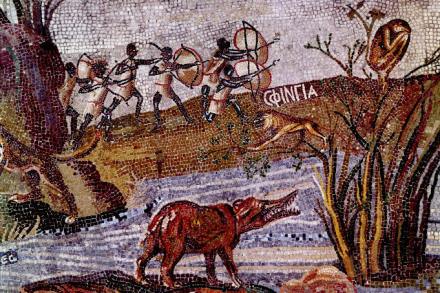
N.B. This review was published without its final two paragraphs in the 18th December 2010 issue of The Spectator. These paragraphs have been reinstated for the online version below. These volumes — four for now, and a further six to come — are saddled with a title redolent of lantern lectures delivered in Godalming, say, round about the time that Rorke’s Drift became legendary overnight. The Image of the Black suggests people, or things, of a certain stamp. Penny blacks, so to speak: picked out with tweezers, profiles raised, their blackness being their distinction, their black face value assessed within the swelling majesty of Western Art.

Dilly-dallying romance

From our UK edition

Translated to Borsetshire, John Constable’s courtship of Maria Bicknell would provide more material than any script editor could handle without straining audience impatience beyond endurance. Nine years it took, from initial yearnings and tacit engagement to get them to the altar at St Martin-in-the-Fields and even then, in October 1816, it was the quietest of weddings. Over those years Constable’s ardour was divided. ‘Deplorable as our case is, I would not be without it for the world’, he wrote to his beloved early on when she was at her most inaccessible. That left him plenty of time in which to obsess over his art. Martin Gayford has an eye for emotionally-charged episodes or ‘detailed microbiography’, as he puts it, set in and around art history.

Trademarking the ordinary

From our UK edition

Lecterns have been installed in some bookshops enabling customers to flip through the 625 tabloid-format pages of what must be the largest volume ever devoted to a single modern artist. Andy Warhol ‘Giant’ Size is Warhol the Lot, a bulk buy, a gross amplitude of Warhol the Simple, Warhol the Smart and Warhol the Resourceful Blank capitalising on paradox and incorrigibility. Weightlifters could try, I suppose, for a Buy One Get One Free deal: two vols screwed to a plank, ideal for workout purposes. Alternatively, imagine Buster Keaton doggedly lugging his copy down Charing Cross Road and dumping it — perfect timing — in front of a runaway bendy bus. Ordinary purchasers, however, will need wheels. Enough of sizeist whimsy.

A backdrop of beasts and losers

From our UK edition

There’s this cow nuzzling a bunch of roses though floating belly up over a matchwood village where smoke springs from every blessed chimney and a po-faced couple issues forth, poised either to sink back among the onion domes or zoom to the far corner where the Eiffel Tower teeters on two legs in moonlit snow. This isn’t an actual Chagall but it could well be. A late concoction of heart-warming bits melded together and overlaid with memories of a chortling Topol, or the scene in Notting Hill when the Julia Roberts character goes and gives the Hugh Grant character a Chagall original, a love token that he all too understandably mistakes for a framed reproduction. The trouble with generic Chagalls is that their sticky profusion supplanted Chagall’s one-time originality.

Ego trip with excess baggage

From our UK edition

Readers may sympathise with Tracey Emin. Her big mouth and huge appetite for self- advertisement make her a ready target; she’s so shameless and yet, by her own account, so abused. (‘And then they started: “SLAG, SLAG, SLAG.” A gang of blokes, most of whom I’d had sex with at some time or other…’) Life has dealt her a raw yet currently rewarding deal. And now that she’s a proper celebrity, as real as Cindy Sherman — the photographer of a thousand guises — and much more in-your-face, she owes it to her public to keep delivering, living her dreams, spicing resolutions with relapses. Margate’s most famous daughter grew up in what were, by her account, intermittently abject circumstances.

‘Seeing by doing’

From our UK edition

William Feaver explains how his book ‘Pitmen Painters’ inspired a new play at the National ‘It means knaaing what to de.’ This is Jimmy Floyd speaking, his Ashington accent spelt out, his words — more dialect than dialectic — written by Lee ‘Billy Elliot’ Hall. In Hall’s The Pitmen Painters, newly transferred from Live Theatre, Newcastle, to the National Theatre, the ‘Jimmy Floyd’ character is more canny, more droll, than the man I remember from 37 years ago when I first came across the Ashington Group. The actual Jimmy, retired after 60 years down the pit, had a perky air and a slight speech impediment. ‘One time I used to paint drab sort of pictures,’ he told me. ‘But now I like a bit colour in them.

Lashings of homely detail

From our UK edition

Norman Rockwell’s the name. You’ll know it of course. Rockwell the byword. It wasn’t simply the perpetual air of impending Thanks- giving that gave his Saturday Evening Post covers such appeal. Rockwell covers were cover stories really; that was their distinction. Others, John Falter for example or Steve Dohano, delivered similar eyefuls of graphic cheer to the mass readership but never came near him in popularity. They could ape the manner but not the air. Legend has it that, in his heyday, every time the Post ran a Rockwell, they upped the print order by a quarter of a million. Whether this is true hardly matters: print the legend.

A tasteless ham from Parma

From our UK edition

Girolamo Francesco Mazzola was born in Parma (hence the tag ‘Il Parmigianino’), and died in 1540 aged 37. At some point he dropped the ‘Girolamo’, maybe round about when he painted ‘Self-Portrait in a Convex Mirror’, a startling little picture in which the smoothy-chops young artist demonstrates a mastery of optical distortion, his face polished, his non-painting hand thrust towards the viewer like a fish foregrounded on a slab. Parmigianino attracts attention for two or three reasons. There’s the oddity: such furtive or chill characters, each portrait a study in black-eyed wariness or Parmesan complacency.

Shaggy dog story

From our UK edition

Until 1970 when he got his first Weimaraner from a litter in Long Beach, California, William Wegman was just another West Coast conceptual tyro, doing regular doubletake stuff like spelling out the word WOUND in sticking plaster stuck to the face. He loved the way the puppy asleep looked like a dropped sock. That gave him an idea, a juicy bone of an idea, an idea worth fooling around with for years to come. Pausing only to name him Man Ray after the only all-American Surrealist, he began thinking up inappropriate poses. Being a Weimaraner Man Ray could be relied on to look long-suffering no matter what and this was great when it came to role-plays involving mind-blowing costume changes.

A free spirit in Philadelphia

From our UK edition

‘Eakins errs just a little — a little — in the direction of the flesh,’ Walt Whitman observed in the late 1880s. Ideally he would have had the Frenchman Millet do his portrait, but the painter of humble peasants was already dead. Eakins made him a flushed old soul in jovial mood. Sidney Kirkpatrick’s account of Thomas Eakins (1844-1916) errs a little in the direction of voiceover-speak. His Eakins is ‘a neglected and tortured genius’ for whom Philadelphia, city of love, was no fleshpot and who, though somewhat prim himself, was rated outrageous by the leading figures of that God-fearing hell-hole. This Eakins is one of those posthumously vindicated figures common in popular accounts of 19th-century painting.

From dumb to singing pictures

From our UK edition

Patrick Caulfield’s paintings look specific while giving us tantalisingly little to go on. Where are we? Seemingly, a spotlight moves, the disc of dislocated brightness slithering over tablecloth, tankard, swirly-plastered wall and simulated half-timber. Could this be a Vermeer-themed hostelry for the discriminating guest? Details punctuate the ambience. Take a pew, why don’t we, and let each picture absorb us. Things like chained pen sets and buttoned-effect wallpaper are stimulants for Caulfield, his eye-catchers, his wherewithal.

Not a matching pair

From our UK edition

Horny black hills on red grounds and exposed roots clawing the air like scary glove puppets are typical of Graham Sutherland in his prime. Teeth and thorns, the odd crucifixion and Somerset Maugham perched on a rattan stool with a jaundiced tortoise look on his face are typical of him soon after, in the Forties, when he and Bacon became friends and their work came close to colliding. Similarities between the two painters are mustered in a colour-plate section at the beginning of an unbelievably circumspect book. ‘This account proceeds,’ the author explains, ‘from the specifics of an interchange between two individuals to considering more general frames of reference within which their affinities and differences may be usefully considered.

A true poet of war

From our UK edition

‘On a hazy day Jerry comes droning over, three miles up.’ May sound Biggles-ish now, but it was OK for then, November 1940, in the commentary for Humphrey Jennings’s brief film Heart of Britain. Nine minutes is all it takes to cover the Lakes, Lancashire, the Pennines and Sheffield, homing in on aircraft spotters, air-raid wardens, mill hands and Sir Malcolm Sargent and then panning around the blitzed centre of Coventry to the sound of Beethoven’s Fifth. The action ends at full throttle with a Hallelujah Chorus from the Huddersfield Choral Society as a newly built Whitley takes off in freezing mist to give Jerry hell.

Never short of an answer

From our UK edition

People, that’s to say some critics, just don’t get it about R. B. Kitaj. They dislike the way he paints, running things past us in dead heats, so to speak, drawing things together with a Huck Finn-like disregard for propriety. He’s bookish, it seems, and full of himself, which annoys them, and he can be bitterly cantakerous. They particularly hate the way he answers back. These days Kitaj lives in Los Angeles, where the critical climate is comparatively mellow.

The usual Soho suspects

From our UK edition

When John Moynihan was three and living with his painter parents in a flat off Primrose Hill he used to be terrified by nocturnal howls and squeals from the Regent's Park zoo. Wetting himself, desperate to be 'rescued from the labyrinths of an unspeakable jungle', he was soothed by whoever happened to be around, sometimes the young Bill Coldstream, who would stand beside his 'blabbering urine-moistened form, urging restraint'. Initiated into parental artistic circles which extended, prewar, from St John's Wood to the New Forest, Bloomsbury and the Euston Road, Moynihan was reared in a ferment of rows and realignments. His father, Rodrigo Moynihan, had an 'Objective Abstraction' phase - thick, pitted and unsaleable - and was apt to slope off to Soho in search of amusement.

Very trying indeed

From our UK edition

Ralph Steadman has always employed graphic spatter. The pen jabs, the ink spurts and - yoiks! - how the victims suffer. Eyes popping, they retch, they convulse, they become pinstriped roadkill. The projectile handling has extended from cartoons to illustrations (Fear and Loathing in Las Vegas) to caricature-biographies of Sigmund Freud and Leonardo da Vinci. In Doodaaa the spatter hits the fan. A 'Triography' he calls it, meaning, I guess, a 'Try-anything-once'. My, how he tries. He begins with drinks-all-round acknowledgments and several preambles before introducing the reader to his alter ego 'Gavin Twinge', a name with a Goon Show ring to it, a narrative conceit that one might have expected to find in the late Spike Milligan's wastepaper basket.

A set of linked doodles

From our UK edition

The niceties of Saul Steinberg's cartoon drawings are doodle-related. Figures begin at the nose, become elaborately hatted and shod and strut like clockwork toys; words are transformed into free-standing objects; horizontal lines denote runways or table edges. Often, it seems, the draughtsman's pen went on automatic, pen-pushing the same old absurdities, perplexities and double-takes on increasingly expensive paper. Steinberg liked to think that his drawings possessed 'poetic strangeness'. Indeed they do, often enough, partly because he never quite erased from his work the sense of his being a stranger in foreign parts. Born in 1914, in Ramnicul-Sarat, Romania, he grew up against the background of his father's fancy cardboard-box factory.