More from Books

Stage Blood, by Michael Blakemore – review

Stage Blood, as its title suggests, is as full of vitriol, back-stabbing and conspiracy as any Jacobean tragedy. In this sequel to Arguments with England, his superb first volume of memoirs, Michael Blakemore presents us with an enthralling account of his five embattled years as an associate director of the National Theatre. When in 1970 Blakemore was offered the position by Laurence Olivier, he had a distinguished career as an actor behind him and was already well-established as a successful director.

Poker

To Dad You wonder if it’s worth the gamble getting up out of your armchair onto your bad leg, to stoke a little life back into the fire.

Bizarre Cars, by Keith Ray – review

My various Oxford dictionaries define bizarre as eccentric, whimsical, odd, grotesque, fantastic, mixed in style and half-barbaric. By so many tokens, and with the casuistry of both Calvinist and Jesuit, it has been possible for the author of this pretty little Christmas-stocking book to include as bizarre any vehicle he chooses, including motorcycles and the micro-cars that made motoring possible after the defeat of Germany in 1945. Without these categories, a bus-cum-truck-cum-tractor,variations on the Hummer and the stretched limousine, and too many excursions into the bizarrerie of car names that in other languages have meanings genital and scatalogical, this book would be very thin.

An Appetite for Wonder, by Richard Dawkins – review

It is peculiarly apt that the author of this autobiography should be the man who coined that now fashionable term ‘meme’ — so long as it is written ‘me me’. His name is shown so large on the cover that one might miss the title printed below it. On the opening page he tells us that his full name is Clinton Richard Dawkins, which ‘serendipitously’ gives him the same initials as those of his greatest hero, Charles Robert Darwin. The time has come, he has decided, to tell the story of his life up to that seminal moment in 1976 when he published the book which made him famous, The Selfish Gene. He begins by describing where he has come from genetically, going back to the General Clinton who presided over the loss of the American colonies in 1783.

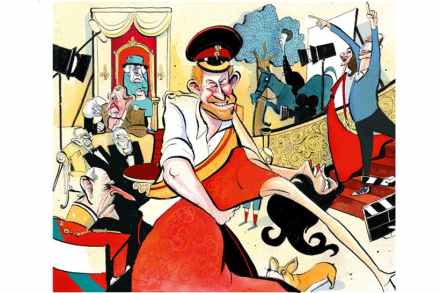
Royal Marriage Secrets, by John Ashdown-Hill – review

My brother Pericles Wyatt, as my father liked to say, is by blood the rightful king of England, the nephew of Richard III in the 18th generation, and as such the senior surviving Plantagenet. Richard was crowned king of England on 6 July 1483. It was described at the time as a joyous occasion. Little did anyone present imagine that it would become an event of rancorous controversy, for never has it been so true, sadly for my own family, that history is written by the winners. Just two years later, an exiled adventurer called Henry Tudor took Richard’s life and crown at Bosworth Field and unleashed an assault of unprecedented viciousness on the reputation of the last Plantagenet king of England.

What’s in a Surname, by David McKie – review

In South Korea, some 20 million people share just five surnames. Every one of Denmark’s top 20 surnames ends in ‘-sen’, meaning ‘son of’, a pattern that is replicated across Scandinavia. British surnames have never favoured such neatness, and we can be grateful for that. While we may have lost such delightfully chewy names as Crackpot, Crookbones and Sweteinbede, the average city will still provide its Slys, Haythornthwaites, and McGillikuddys. David McKie’s winding and sensitive study of British surnames is based on his findings in cemeteries, registers and oral accounts across six villages called Broughton, from Hampshire to Furness.

Isaac & Isaiah, by David Caute – review

The scene is the common room of All Souls College, Oxford, in the first week of March 1963. It is the idle half-hour after lunch when fellows slump into armchairs and gaze out of the window at the sparrows in the Fellows’ Garden. David Caute, a young first-class mind in his mid-twenties, is buttonholed by the revered figure of Sir Isaiah Berlin. What did Caute think of Isaac Deustcher? Did he admire him, as so many young scholars on the left did? Well, Caute replied cautiously, he knew Deutscher’s book on Stalin and his trilogy on Trotsky.  ‘Quite sufficient.’ And Berlin bounded off into one of his rapid-fire bombardments: there were Marxist historians such as Eric Hobsbawm and E.H.

The Story of the Jews, by Simon Schama – review

The recorder of early Jewish history has two sources of evidence. One is the Bible. Its centrality was brought home to me by David Ben-Gurion when I went to see him in Jerusalem in 1957. He had a big Bible on his desk, and banged it repeatedly with his fist: There, it’s all there, the past, present and future of the Jewish people. God? Who knows God? Can you believe in someone you don’t know? But I believe in the Bible. [Bang, bang.] The Bible is a fact. [Bang.] A record and a prophecy. [Bang.] It’s all there, Mr Johnson. Read your Bible, understand your Bible, and you won’t go wrong about the Jews. [Final bang.] Simon Schama, being a learned scholar as well as a proud and sensitive Jew, is not so sure.

Wilkie Collins by Andrew Lycett – review

In the outrageous 2010 press hounding of the innocent schoolteacher Christopher Jefferies over the murder of his young female tenant (of which a neighbour, Vincent Tabak, was later convicted and over which the guilty newspapers later shelled out punitive sums), the Sun produced, as suspicious facts, that Jefferies was ‘obsessed by death’, and ‘scared the kids’ in his classroom. He had, for example, exposed his pupils to the ‘Victorian murder novel’ The Moonstone. As an English teacher at a high-ranked school, Jefferies would surely have prescribed my edition of Wilkie Collins’s novel— the only one, if I may toot my trumpet, to make comprehensive use of the manuscript. Pulp the edition, I thought with a shudder, before it kills again.

Marriage Material, by Sathnam Sanghera – review

Sathnam Sanghera, in his family memoir The Boy with the Topknot, heaped much largely affectionate contempt and ridicule on his home town (now a city) Wolverhampton, with its shabby factories and shimmering new gurdwaras — ‘Wolverhampton, the arse of the Black Country, in itself the bumcrack of the West Midlands, in itself the backside of Britain’. In Marriage Material he returns to the same rich and little explored multicultural terrain, in a novel that ingeniously ‘shoplifts’ (his word) characters and elements of plot from Arnold Bennett’s The Old Wives’ Tale.

The Mitford Girls’ Guide to Life, by Lyndsy Spence – review

For some reason you don’t expect people to be fans of the Mitford sisters, as others are fans of Doctor Who or Justin Bieber. But just in case this subset of humanity does exist, we have The Mitford Girls’ Guide to Life (The History Press, £12.99). Lyndsy Spence’s elegant little hardback is a compendium of all things Mitford, from family nicknames (‘Sir Ogre’ for Sir Oswald Mosley) and fashion tips (tweed skirts only on weekdays) to Pamela’s household hints (‘choose an aga to match one’s eyes’) and Diana’s guide to prison life (take a fur coat to use as a blanket, use congealed hot chocolate as face cream).

Mr Loverman, by Bernardine Evaristo – review

In 1998, the Jamaican singer Bounty Killer released a single, ‘Can’t Believe Mi Eyes’, which expressed incredulity that men should wear tight trousers, because tight trousers are an effeminate display of gayness. Fear and loathing of homosexuals has a long history in the West Indies. Jamaica’s anti-sodomy laws, deriving from the English Act of 1861, carry a ten-year jail sentence for ‘the abominable crime’. Similar laws exist elsewhere in the Anglophone Caribbean, yet Jamaica is outwardly the most homophobic of the West Indian islands. A white man seen on his own in Jamaica is often assumed to be in search of gay sex. Batty bwoys (‘bum boys’) are in danger of being stoned, cutlassed or shot.

Signifying Rappers, by David Foster Wallace – review

Since his suicide, David Foster Wallace has made the transition from major writer to major industry. Hence this UK issue of a slender work of music history got up for a small US press in 1990 by a young Wallace and his college friend Mark Costello. The premise: it’s the early days of rap, and two overeducated white kids who like it produce a sampler considering What It’s All About. That it’s dated doesn’t matter much. That it’s juvenilia does. Its cleverness is that of a writer in possession of an immense talent but not yet remotely in control of it: a learner driver doing doughnuts in a powerful car. Almost every sentence is arch or overwrought.

Uncle Bill, by Russell Miller – review

Given the outcome of recent military campaigns in Iraq and Afghanistan, it is pertinent to look for one particular quality in our senior commander: honesty. In other words, after blaming vainglorious politicians for precipitating us into war without adequate preparation or resources, it is reasonable to ask, how capable are our generals of admitting their own mistakes? Their persistence in two failed strategies — the application of Northern Ireland peace-keeping tactics to Basra and the dispersal of troops among forward posts in Helmand — does not suggest any culture of mea culpa, and ruthless self-examination has not been a distinguishing feature of the annual lectures delivered by the Chiefs of the Defence Staff to the Royal United Services Institute in the past decade.

Multiples, edited by Adam Thirlwell – review

There is a hoary Cold War joke about a newly invented translating machine. On a test run, the CIA scientists feed in ‘The spirit is willing, but the flesh is weak’, press the button to translate it into Russian, and then re-translate it into English. It emerges as ‘The vodka is passable, but the meat is putrid.’ Our modern translating machine is Google Translate. It takes more than one transmutation to scramble the Biblical quotation: however, if you shift it through Russian, Azerbaijani, Chinese, Hungarian, Tamil and Haitian Creole into French, you can get ‘J’aime la chair, elle était faible.’ Since the original is usually quoted by dieters reaching for a fourth cream bun, this, paradoxically, might in practice be accurate enough.

The Tragedy of Liberation, by Frank Dikötter – review

The historian of China Frank Dikötter has taken a sledgehammer to demolish perhaps the last remaining shibboleth of modern Chinese history. This is the notion, propagated in countless books and documentaries, that Mao’s regime started off well, deservedly coming to power on a wave of popular support and successfully tackling the evils left behind by the corrupt and incompetent Nationalists. Then, at the end of the 1950s, it all started to go wrong. There were terrible natural disasters, followed by famine; and, seemingly unaccountably, the brotherhood of brave revolutionaries fell out, creating the bloodbath of the Cultural Revolution. This is the version still served up to A-level students in Britain.

Narcoland, by Anabel Hernandez – review

It is by now surely beyond doubt that those governments committed to fighting the war on drugs — and on paper that’s all of them — face a total rout. To understand the scale of the defeat, all you need to know is that Barack Obama and David Cameron have both been unable to deny that they were once users. The US spends more than a billion dollars a year on international narcotics control and as a result, as a US official in Colombia once told me, has forced up the price of a gram of cocaine in New York by just a few dollars. That must have put drugs beyond the reach of a few potential consumers. But it seems a very modest achievement for a government programme that has enjoyed such sustained, cross-party support for decades.

Noble Endeavours, by Miranda Seymour – review

Like Miranda Seymour, the author of this considerable work on Anglo-German relations, I was raised in a Germanophile home. I spent summer holidays on the Bodensee and, after graduating from university, lived for a year in Munich and then another in Berlin. It seems to me a pity that my children and most of my friends, familiar with the Dordogne, Tuscany, California, New York and Rajasthan, have never been to the Black Forest or the Bavarian Alps; have never visited Potsdam, Dresden, Würzburg, Freiberg, Heidelberg, Regensburg or Passau; in fact know next to nothing of either the culture or civilisation of the largest nation in western Europe. Yet there have been throughout our history many Britons who loved Germany and Germans who loved Britain.