More from Books

A seamless whole

This short memoir deserves a longer review than this, encompassing, as it does, migration, intellectual excellence, a successful professional life, two marriages, children and an honesty and contentment not usually found in close proximity. Miriam Gross (née May), with a Jewish legal background (both her parents, who left Nazi Germany in 1933, were lawyers), was brought up in Palestine, then under the British Mandate, where she stayed until 1947. In Jerusalem she felt little affinity with other exiles, only with the landscape. From the start, she seems to have been clear-sighted to an unusual degree. Unfazed by her unmaternal mother, she drew close to her father, from whom she derived an understanding of men which was to be useful in both her public and emotional future lives.

Money and the Flying Horses

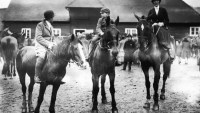
Intriguing, the oaten seethe of thoroughbred horses in single stalls across a twilit cabin. Intimate, under the engines’ gale, a stamped hoof, a loose-lip sigh, like dawn sounds at track work. Pilots wearing the bat wings of intercontinental night cargo come out singly, to chat with or warn the company vet at his manifests: four to Dubai, ten from Shannon, Singapore, sixteen, sweating their nap. They breed in person, by our laws: halter-snibbed horses, radiating over the world. Under half-human names, they run in person. We dress for them, in turn. Our officer class fought both of its world wars in riding tog: Luftwaffe and Wehrmacht in their jodhpur pants.

Another Restoration romp

Robert Merivel made his first appearance in 1989, in Restoration, Rose Tremain’s popular and acclaimed Carolingian novel. The passage of time has left the Everyman doctor sadder and theoretically wiser, but still in thrall to his master, Charles II, still priapic, still governed by ‘uncontainable appetites’. He sits in his chilly library at Bidnold, his Norfolk estate, contemplating life — will his own end through Loneliness, Poverty, Poisoning, Suicide or Meaninglessness? His decrepit manservant, Will, brings him a manuscript found hidden beneath his mattress; it is Merivel’s own account of his earlier years. It looked, to the chambermaid, ‘a mere Wedge, to hold fast the corner of the bedstead’.

The making of a president

When presented with a title of this kind, many readers think they know what to expect: drugged-up child soldiers, wince-inducing brutality, ranting demagogues, rebels in women’s wigs. This, thankfully, is not that book. It is something more nuanced, elliptical and elegant. Ghana is in a different league from Liberia, Guinea or Sierra Leone, its traumatised West African neighbours. Even before the recent discovery that it was sitting on large oil reserves, it was routinely hailed as one of Africa’s success stories. As the ‘first’ in the title makes clear, it has certainly been through its share of political upheaval since independence from Britain in 1957.

Was it misfortune or carelessness?

James Wyatt was considered by George III to be ‘the first architect of the kingdom’, but he was also the unluckiest, or perhaps most careless, architect of his day. Fonthill Abbey, the Gothic extravaganza he designed for William Beckford, collapsed after just 25 years. He started building a new palace for the king at Kew, which was later blown up by George IV. His Tudor-Gothic remodelling of the Palace of Westminster went massively over budget, was deeply unpopular and employed a combination of timber and plaster that proved spectacularly flammable in 1834. And the commission that made Wyatt’s name, the assembly rooms of the Oxford Street Pantheon, was only 20 years old when it was devastated by fire.

The poetry of the streets

For good or ill, black West Indian culture is synonymous with youth culture in Britain today. Even among white teenagers, a Jamaican inflection (‘buff’, ‘bruv’) is reckoned hip. The ‘Jamaicanisation’ of British cities quickened after Jamaica’s independence in 1962, when more West Indians migrated to Britain, and London was poised to become the most Jamaican city in Europe. Zadie Smith is well placed to chart the vagaries of life in mixed-up, mixed-race Britain. Born in 1975 to a Jamaican mother and a British father, she grew up in the ethnically multi-shaded London borough of Brent. Her marvellous new novel, NW, crackles with reflections on race, music and migration in Brent’s north-west suburb of Willesden.

Brotherly love

Twenty years ago Pat Barker won acclaim with Regeneration, her novel about shell-shocked army officers undergoing treatment at the Craiglockhart psychiatric hospital for soldiers during the first world war. Her new novel is a close scrutiny of parallel atrocities of 1914–18. As in Regeneration, some characters are based on real-life figures. Several scenes are set in Queen Mary’s Hospital, Sidcup, where the pioneer plastic surgeon Harold Gillies worked to rebuild the smashed or scorched faces of soldiers who had been fighting on the Western Front — ‘1,000 young men with gouged-out eyes, blown-off jaws, gaping holes where their noses had been’, as a visitor finds.

Death of a hero

Sitting down to inspect the final volume of Pierre Coustillas’s monumental trilogy, I decided to start by counting the number of titles by or about George Gissing (1857–1903) that gleamed from the bookshelf hard by. There were 45 of them. Next, I decided to count the number of these items with which Professor Coustillas was in some way associated, either as editor, compiler or presiding genius. This realised a tally of 19, including such titanic endeavours as the Collected Letters of George Gissing (nine vols, 1990–1997) or the 600-page and now, alas, superannuated George Gissing: The Definitive Bibliography from 2005.

Tangier, by Josh Shoemake – review

This may sound a little orientalist, but Tangier has some claim to being the most foreign city in the world. Back in the day, its position at the northernmost tip of Africa was regarded as the edge of civilisation — more than that, as the edge of what was known, the edge of everything. Here were the Pillars of Hercules, which in addition to performing the important function of holding up the sky, were said to be engraved with the words ‘nec plus ultra’: beyond this, nothing. Since its foundation in the 5th century BC, the city has been variously controlled by the Carthaginians, the Phoenicians, the Romans, the Arabs, the English (for a couple of decades in the 17th century) and the Spanish.

A Classless Society, by Alwyn W. Turner – review

The title of Alwyn W. Turner’s book could deter readers. Even the Hollywood film The Secret Lives of Dentists promised more excitement. John Major sought the creation of a classless society in the 1990s. He confused this with equality of opportunity and social mobility. Efforts to engineer classlessness always end in tears. George Orwell was right: some animals are more equal than others — even in death. Orwell shares an Oxfordshire churchyard with Herbert Asquith. It was an insipid decade when managerialism triumphed over leadership. Ideas and intellectual rigour were kept in check, and institutions were repeatedly assaulted.

Red or Dead by David Peace – review

The last time David Peace wrote a novel about football he got his publishers sued for libel, which may help explain why his new one avoids invention wherever it can squeeze interest out of such stony matters of record as team sheets and attendance figures. Red or Dead follows the legendary manager Bill Shankly from his arrival at Liverpool — second-division stragglers in 1959 — to his death in 1981, seven years after retirement, having built a league-winning team that went on to rule Europe. Seldom does a novel, dedicated at such length to a single life, venture so scarcely into the mind of its subject; the gamble is that Peace’s biblically iterative method is strong enough to sustain but not overwhelm you. All the novel’s effects depend on repetition.

The Good Nurse, by Charles Graeber – review

Charles Cullen, an American nurse, murdered several hundred patients by the administration in overdose of restricted drugs. Hospitals should be safe places but they are actually rather dangerous: mistakes are made, accidents happen, medics may be careless or just exhausted. But although many patients die when they should have recovered, very few die at the hands of a psychopathic serial killer — so far as we know. The trouble is, we often don’t know. There could be a Cullen working and murdering in a hospital near you. Look up ‘Healthcare professionals convicted of murdering patients’ on the internet and you find 39, and note the ‘convicted’. Many have merely been suspected but escaped conviction because of lack of evidence. Alarmist?

The Email About Writing the Poem

I’ve been occupying myself trying to write a long-ish poem. It’s an odd sensation writing a poem. You’re trying to make something come out of nothing, and you have an idea of what it could be, of stray lines and thoughts, and it takes shape as you do it, and you have to somehow notice what you’ve done and see how it tells you what you are engaged in and what clue it gives on proceeding. Even then of course you have no guarantee of the finished thing being a ‘success’ or that anyone else will like it or get it; or, in fact, that it qualifies as finished.

The Rainborowes, by Adrian Tinniswood – review

Adrian Tinniswood, so gifted and spirited a communicator of serious history to a wide readership, here brings a number of themes from his previous books together. The Verneys recounted the individual experiences of 17th-century members of a leading Buckinghamshire family. The Rainborowes, set in the same period, applies the same technique to a less substantial family of Londoners. As in his study of the great fire of London in 1666, By Permission of Heaven, Tinniswood takes us into the daily life of the capital, though here his emphasis is on the suburban world of commercial enterprise and religious dissent from which the Rainborowes emerged. Tinniswood’s previous book, Pirates of Barbary, showed Europeans doing battle with the corsairs of the Mediterranean.

A Rogues’ Gallery, by Peter Lewis – review

Like Mel Brooks’s character the Two Thousand-Year-Old Man, Peter Lewis has met everyone of consequence. Though he doesn’t mention being an eyewitness at the Crucifixion, he was told by T.S. Eliot that working in a bank was quite nice (‘I never thought about poetry in the day’). Frankie Howerd wanted Lewis to give him a massage (‘I have this trouble, a hernia, you see. Gives me a lot of discomfort’); Diana Dors confessed to him that she’d rather watch television than go to orgies (‘but I had to become a sex symbol on tiger rugs and in mink bikinis’); and Samuel Beckett made his excuses and fled (‘Sorry, I just have to go to the lav’).

Philip Hensher reviews the Man Booker prize longlist

The Man Booker prize has strong years and weak years. There have been ones when the judges have succeeded in identifying what is most interesting in English-language fiction and others when the task has been comprehensively flunked. With Robert Macfarlane as chairman, 2013 promises to be very good; 2011, which was in fact a strong year for fiction, was widely agreed to be a catastrophe; 2012, while an improvement, was disappointing in that it reflected the conventional tastes of academics. This year’s longlist shows a confident take on the direction of the English-language novel. There are certainly some sad omissions, including splendid novels by Evie Wyld and Michael Arditti.

The Coronation Chair and the Stone of Scone, by Warwick Rodwell – review

The Coronation Chair currently stands all spruced up, following last year’s conservation, under a crimson canopy, by the west entrance to Westminster Abbey. The sovereign has used this throne during the actual ceremony almost continuously since the coronation of Henry IV (1399). The oldest dated piece of English furniture (1297-1300) made by a known artist (Walter of Durham) to survive has been given the comprehensive study it deserves by Warwick Rodwell, with supplementary chapters on its most recent conservation by Marie Louise Sauerberg and its current display by Ptolemy Dean.

Migration Hotspots, by Tim Harris – review

Consider for a moment the plight of the willow warbler. Russian birds of this species fly between eastern Siberia and southern Africa and back every year of their short lives, a distance of nearly 7,500 miles in each direction. Each weighs roughly as little as two teaspoons-full of sugar. But at least these tiny birds can refuel on their journey. Southern bar-tailed godwits are unluckier. These fly the 7,000 or so miles between New Zealand and Alaska over the immense Pacific Ocean — hence non-stop — twice each year. Moreover, Arctic terns migrate from the Antarctic to the Arctic and back again: a fledgling of this species, born on the Farne islands off the Northumberland coast, was recorded only three months later near Melbourne, Australia.