More from Books

Licensed to feel: The new James Bond fusses over furnishings and sprinkles talc

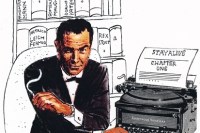
First, an appalling admission: I have never read any of Ian Fleming’s Bond books. Nor have I read any of anybody else’s, the number of which seems to grow with each passing year. For a civilised man of a certain age this is a shameful oversight, given that I have seen all but three of the 23 films in the cinema, many of them at the Odeon, Leicester Square within days of their opening; that I can’t put on a dinner jacket without wondering whether Sean Connery would look better in it; and that I still own a copy, on 7” vinyl, of ‘Nobody Does It Better’ by Carly Simon, the theme tune to The Spy Who Loved Me. (And the soundtrack it came from, just in case the single went missing.

Stephen King isn’t as scary as he used to be, but ‘Doctor Sleep’ is still a cracker

Though alcohol withdrawal is potentially fatal, booze has none of the media-confected glitz of heroin (imagine Will Self boasting of a Baileys Bristol Cream addiction). The 17th-century word for the sickness that follows excessive drinking — ‘crapula’ — effectively hints at the alcoholic’s sleazy kind of stupor. In his earlier years, Stephen King would drink himself daily into a wall-eyed hangover. His scariest novels — Carrie, The Stand, The Shining — were written in the 1970s when sobriety was a no-no for him. Jack Torrance, the author who goes off his rocker in The Shining, suffers the most horripilating of alcohol-tainted visions while holed up in the Overlook Hotel in the Colorado Rockies.

Anorexia, addiction, child-swapping — the Lake Poets would have alarmed social services

The last time the general reader was inveigled into the domestic intensities of the Wordsworth circle was by Frances Wilson in The Ballad of Dorothy Wordsworth. She engaged delicately with Dorothy’s inordinate love for her younger brother William, and seemed to think her passionate attachment was romantic and sentimental rather than sexual — though there are 50 shades of grey between the one and the other, and honestly, it doesn’t matter. Katie Waldegrave, in her riveting family saga The Poets’ Daughters, is not much concerned with that anyway. Her focus is on what happened to Wordsworth’s daughter Dora, the second of his five children, and Coleridge’s youngest, Sara. There were 20 months between them and they were much together as children.

Guido Fawkes to Damian McBride: Who’s spinning now?

When Gordon Brown eventually became aware that his Downing Street was about to be engulfed in the Smeargate scandal, he called Damian McBride to try to get to the bottom of the story. The latter recounts the conversation verbatim in Power Trip, his tell-all book dedicated ‘to Gordon, the greatest man I ever met’. Brown says: ‘OK, Damian, I need your word that you will tell me the truth. If the years we’ve worked together mean anything, I need your absolute word.’ ‘Yep, of course,’ McBride replies solemnly, ‘I give you my word, I promise I’ll tell the truth.’ ‘Right,’ says Brown, ‘firstly, is there anyone else in No. 10 or in the government or in the Labour party who is involved in these emails or this website?

Meeting the Enemy, by Richard Van Emden; 1914, by Allan Mallinson – review

The Great War was an obscene and futile conflict laying waste a generation and toppling emperors. Yet here are two books that situate the horrors of trench warfare within a much larger perspective. One argues that the war had a forgotten ‘human face’. The other that it might all have had a very different outcome. Henry James described  the 1914 plunge of civilisation into blood and darkness as ‘too tragic for any words’ — and about tragedy there is always some air of inevitability, of sailing Titanic-like towards a foredoomed catastrophe. This air of unstoppable fatality has solidified over the intervening century.

An Officer and a Gentleman, by Robert Harris – review

The Dreyfus Affair, the furore caused by a miscarriage of justice in France in 1894, is a source of perennial interest. It raises questions of national identity, political morality and personal integrity that are still relevant today with immigration, Euroscepticism and dodgy dossiers. It is also, as Emile Zola recognised, a gripping story: ‘What a poignant drama, and what superb characters.’ Like Zola, Robert Harris has recognised the Affair’s dramatic potential and re-tells it here as the taut, first-person, present-tense narrative of the heroic Colonel Georges Picquart.

Walking in Ruins, by Geoff Nicholson – review

Geoff Nicholson is the Maharajah of Melancholy. The quality was there in his novels, it was there in his non-fiction book The Lost Art of Walking, and it’s there in the latter’s successor, Walking in Ruins (Harbour Books, £12.50). He savours the comfort to be gained from accepting decay as an inevitable part of life. Ruins are his muse. So he spends the book doing exactly what its title suggests. Locations include an abandoned Los Angeles zoo, now inhabited by two homeless men, a Sheffield housing estate whose road layout survives even though its houses don’t, and a desert town that’s been, er, deserted. Nicholson keeps finding shoes there, though never a matching pair. If you share his mindset, you’ll love the philosophical ruminations that result.

The Sunflowers Are Mine, by Martin Bailey – review

‘How could a man who has loved light and flowers so much and has rendered them so well, how could he have managed to be so unhappy?’ This was Claude Monet’s comment on seeing Van Gogh’s ‘Three Sunflowers’ (1888). There he put his finger on one of the enigmas of the Dutch painter’s tragic life. The journalist and scholar Martin Bailey has written an admirable new book which tells the story of Van Gogh’s life and posthumous rise to fame through the pictures of sunflowers, Helianthus annuus, which the painter produced at intervals through his brief career.

Do women want what they say they want?

What do women want? You might have thought the Wife of Bath had got this one sorted, but Daniel Bergner has brought science to bear on the perennial question. And the answer from this book is that what women want is not just sex but sex outside the confines of monogamy. You know the received wisdom about women needing relationship security and emotional commitment before they feel right about having intercourse? It’s all hokum, apparently. What women want when it comes to sex is, it seems, at odds not just with societal expectations but with what they — we — say they want. Actually, do you mind if I talk about women as ‘they’ in what follows? You’ll see why.

As Luck Would Have It, by Derek Jacobi – review

Alan Bennett once overheard an old lady say, ‘I think a knighthood was wasted on Derek Jacobi,’ and I know what she means. It’s strange how he has always been singled out for prizes and high honours — why not Ronald Pickup, Charles Kay, Edward Petherbridge, Frank Finlay or the late Jeremy Brett? Ian Richardson absolutely hated him — just couldn’t contain his envy and incredulity, at least in my presence. Though I’ve never been able to believe in Jacobi on stage or screen as a villain or as a passionate lover, by being fundamentally unthreatening (and shrewd), he is esteemed — just like the Emperor Claudius, his signature role.

When Britain Burned the White House, by Peter Snow – review

Peter Snow explains that he decided to look into this extraordinary story when he realised how few people knew about it, and was inspired to write a book by the wealth and quality of eyewitness accounts from both sides. The result is superb. When Britain Burned the White House is an exemplary work of history — lucid, witty and humane, with terrific pace, and so even-handed that it will surely be received as well in America as here. Annoyed by what he regarded as the excesses of the British empire — its fight with Napoleon interfered with America’s trade, it was in the habit of pressing American citizens into the Royal Navy, and it supported the Indian tribes who stood in the way of American settlers — President James Madison had declared war in June 1812.

One Night in Winter, by Simon Sebag Montefiore – review

Simon Sebag Montefiore’s One Night in Winter begins in the hours immediately following the solemn victory parade that marked the Soviet Union’s victory over Nazi Germany — probably the high point of Stalinism. Two teenagers, dressed in 19th- century costume and members of a secret literary club called, aptly as it turns out, the Fatal Romantics, have chosen this moment, of all moments, to re-enact a duel from Pushkin’s Onegin on a bridge beneath the very walls of the Kremlin. Needless to say, when the duel goes fatally wrong and the dead boy and girl are revealed to be the offspring of members of the Soviet leader’s inner circle, we know there will be consequences for the families and friends they’ve left behind.

Six Bad Poets, by Christopher Reid – review

Is poetry in good enough health to be made fun of in this way? The irony is that this long, funny poem describing the incestuous peccadilloes of contemporary poetry’s social purlieus deserves to be read, and almost certainly will be read — and purchased — by far more readers than all but a few collections of poetry, even those by rather good poets. Christopher Reid was known originally as a poet of the ‘Martian’ school, which sought to find new ways of looking at the familiar: ‘Splitting an apple, / I find a cache of commas.’ More recently he gained wider attention as the author of the award-winning A Scattering, a moving collection of poems about his wife in her last illness and his own life as an ‘inhabitant/ of an empty house’.

Monsieur le Commandant, by Romain Slocombe – review

There can be few characters in modern fiction more unpleasant than Paul-Jean Husson, the narrator in Romain Slocombe’s Monsieur le Commandant. Indeed, he is at times too nasty. If this otherwise compulsively readable novel about betrayal in Nazi-occupied France has a flaw, it lies in Husson’s irredeemable villainy, as if to make such a man more rounded, more subtle, were to allow a flicker of understanding for his actions, or to suspect the author of a degree of sympathy for the man. Husson is an anti-Semite, a Pétainist, a much-decorated hero of the first world war and a member of the Académie Française.

Music at Midnight, by John Drury – review

When John Drury, himself an Anglican divine, told James Fenton (the son of a canon of Christ Church) that he was writing about George Herbert, Fenton replied with gnomic brio ‘The poet!’ adding ‘Both in intention and execution.’ Herbert’s authentic lightness and strength, pathos and wit, alertness and sympathy have long been as precious to poets as to fellow believers. In Music at Midnight Drury has produced a pleasantly old-fashioned account of Herbert’s life and poetry which will serve as an introduction to new readers and remind devotees of many favourite passages, sometimes interestingly contextualised.

Pine by Laura Mason; Lily, by Marcia Reiss – review

After the success of their animal series of monographs, Reaktion Books have had the clever idea of doing something similar for plants. Writers are commissioned to investigate the botanical, historical, social and cultural aspects of individual plants, with volumes on oak and geranium already published, and yew, bamboo, willow, palm and orchid forthcoming. The structure and content of the books appears to be left up to the writers, but all the volumes combine scholarship with lively anecdote and are beautifully and generously illustrated. While lilies seem an obviously attractive choice for such a series, who would have thought conifers could be so interesting?

Hanns and Rudolf, by Thomas Harding – review

Confronted by this lavishly endorsed book — ‘compelling’ (David Lodge), ‘gripping’(John le Carré),‘thrilling’ (Jonathan Freedland) — I felt depressed. Two weeks ago, the New York Times’s savvy London correspondent accused the British of being obsessed with the Nazis. This might appear a case of pots and kettles: not for nothing did America’s widely watched History Channel become known as the Hitler Channel. Nevertheless, Sarah Lyall had made a valid point. A stupefying 830 books on the Third Reich were published in the UK in 2010 and — although no figures are yet available for 2013 — a reduction any time soon seems unlikely. Germany’s history of genocide is unforgivable.