Arts feature

The unnerving world of Erik Satie’s 20-hour composition 

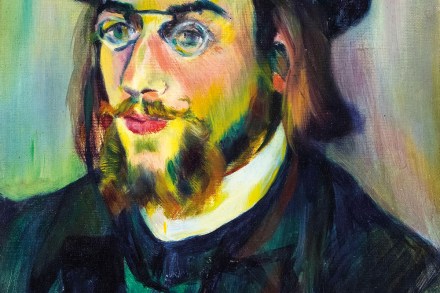
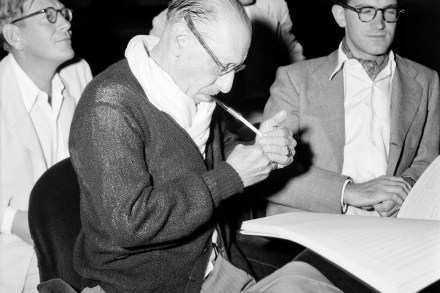
Once Igor Levit starts playing Erik Satie at 10 a.m. on 24 April at the Queen Elizabeth Hall, he can expect to be there for a long time. Satie’s Vexations is a piece that looks innocent enough, like butter wouldn’t melt in its composer’s ears. A doleful 18-note theme in the bass is filled in with stately, chorale-like notes in the right hand; the theme repeats, followed by the same chorale except turned upside-down. Nothing too strenuous so far. But Satie’s enigmatic inscription ‘To play this motif 840 times in succession, it would be advisable to prepare oneself beforehand, in the deepest silence, by serious immobilities’ mixes up the variables. Taking him to the letter of his word adds up to a performance duration of anywhere between 14 to 20 hours.

The National Trust’s plans for Clandon Park are a travesty

In April 2015, a fire raged through Clandon Park, destroying much of the 18th-century Palladian mansion’s prized interiors. Contrary to all expectations, the National Trust, its custodian, announced plans to keep the Grade I-listed building ‘as a ruin’. Architects Allies and Morrison would ‘creatively curate’ the celebrated property as ‘a country house laid bare’, adding a modern roof and walkways, but otherwise leaving the interior in its half-charred form. Last month, Guildford Council waved through the plans unanimously. It was a landmark decision. Without any fanfare, a sweeping precedent was set for how we restore damaged buildings – one that throws out the lauded example set by Windsor and Notre-Dame – with incendiary implications for our architectural heritage.

Why we’re flocking to matinees

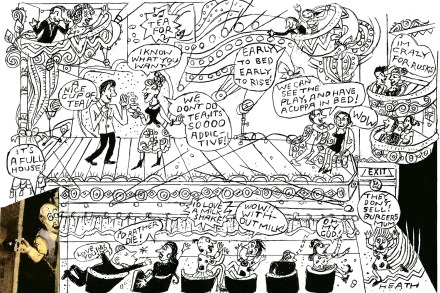
The Starland Vocal Band were on to something. In their 1976 hit ‘Afternoon Delight’ they sang, in gruesomely twee harmony: ‘Gonna grab some afternoon delight/ My motto’s always been when it’s right it’s right/ Why wait until the middle of a cold, dark night?’ Granted, they were singing about rumpy-pumpy, not theatre-going, but for many of us the same principle applies.  ‘I’ve turned into the kind of person who loves toddling off to matinees,’ admitted my actor friend Timmy recently. He’s not the only one. I’m at that age when lunch is preferable to dinner and matinees appeal far more than evening shows. There’s something hedonistic about a matinee. When everyone else is working (or should be), you’re luxuriating in the theatre.

Why was this fêted Mexican painter left out of the canon?

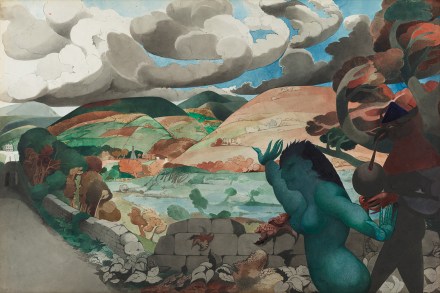
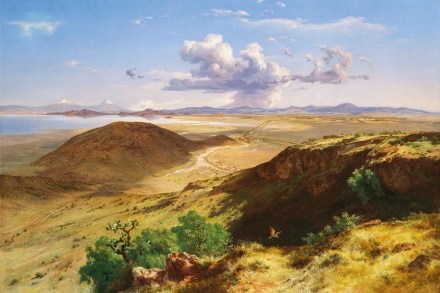
Think of a Mexican painting, and chances are you’ll conjure up an image of an eyebrow-knitted Frida Kahlo, or a riot of exotic figures by her husband Diego Rivera, or a brightly coloured guitarist by Rufino Tamayo. What you’re unlikely to have in mind is an earthy landscape with a dusty road leading to a nascent city, dotted with hyper-real plant life, and an eagle soaring under a vast, cloudy sky. This is ‘The Valley of Mexico from the Hill of Santa Isabel’ (1877), the finest work by a painter who was a household name in Mexico long before Kahlo, Rivera or Tamayo. And from next week, it and many others of his works will hang in London’s National Gallery, the first historical Latin American artist ever to have been exhibited there.

‘The possibilities of paint are never-ending’: Sir Frank Bowling interviewed

‘I’m full of excitement waiting for this to dry out,’ Sir Frank Bowling exclaims. We are sitting in his studio, a room in a quiet Victorian yard that survives amid the tower blocks of Elephant and Castle. In front of us a semi-finished canvas – a glorious welter of yellow and orange in diverse modulations – is pinned to the wall. It’s executed in acrylics, a water-based material. Bowling, like Turner – one of his heroes – believes in using buckets of water, sometimes more or less literally. ‘I don’t always use conventional tools to mark the surface,’ he confides. ‘Sometimes marks are made by a brush, sometimes by simply flinging the paint at the canvas.’ Such matters have long fascinated Bowling.

The true birthplace of the Renaissance

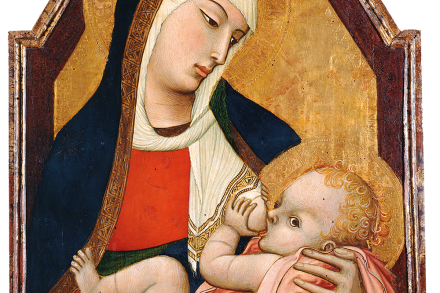
The baby reaches out to touch his mother’s scarf: he studies her face intently, and she focuses entirely on him. There is connection; there is familiarity; there is love. It could be one of the pictures on my phone from last weekend of my daughter with her six-month-old. In fact, it dates from Tuscany c.1290, and the mother and child are the Virgin Mary and Christ. It’s a small painting, tempera on wood; it’s the opener of the National Gallery’s new blockbuster, Siena: The Rise of Painting 1300-1350; and it’s there to make the show’s fundamental point, which is that its creator, the Sienese Duccio, introduced many of the painterly innovations that paved the way for the Renaissance. With this ‘Virgin and Child’, emotion takes centre stage.

Real artists have nothing to fear from AI

Christie’s is making digital-art history again – or at least trying to. Between 20 February and 5 March, it is hosting Augmented Intelligence, the first major auction dedicated solely to AI-generated art. This follows a series of headline-grabbing stunts, including the first major sale of an AI-generated artwork in 2018 – ‘Portrait of Edmond de Belamy’ ($432,500) by the Paris-based collective Obvious – and the first NFT sale by a major auction house,  Beeple’s ‘Everydays: The First 5,000 Days’, which shattered expectations (and good taste) by selling for $69 million in 2021.

In defence of deaccessioning

There’s more than a grain of truth in the popular caricature of a curator as a mother hen clucking frantically if anyone gets too near her nest – not that her eggs are about to hatch, let alone run. The recent threat of the British Council to ‘deaccession’ – to put it more bluntly, sell – its 9,000-strong collection of British art has caused a predictable flurry in the curatorial world. Doesn’t the British Council know that public art collections are sacrosanct and must be preserved for all time? When I was director of Glasgow’s museums and art galleries, I remember talking to my committee about my long-term plans for the city’s great permanent collection when the leader of the council, Pat Lally, commented drily that there was no such thing as ‘permanent’.

Tarot isn’t very old or esoteric – but it does work

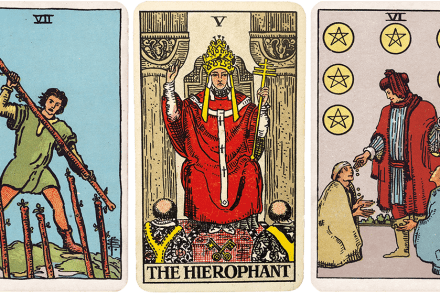
Among my many fake and useless skills, I’m a reasonably decent tarot reader. I can do one for you now if you like. A very simple three-card spread: your cards are the Seven of Wands, the Hierophant and the Six of Pentacles. There are lots of vaguely drippy ways of interpreting a three-card spread: past-present-future, or mind-body-spirit; I usually prefer to think of the cards as representing first, the mess you’re in; second, how you got there; and third, how you might plausibly manage to get your way out. And you, reader, are in a bit of a mess.

The thankless art of the librettist

Next week, after the première of Mark-Anthony Turnage’s new opera Festen, the cast and conductor will take their bow. All being well, there’ll be applause; and then a brief lull as the creative team takes the stage. There’s often a ripple of curiosity in the audience at this point, because it’s rare that we get to see just how many people it really takes to make an opera. Standing near the composer will be Lee Hall, the writer of Billy Elliot and The Pitmen Painters, and now part of the most maligned – and indispensable – profession in all of music. He’s the librettist. In short, Hall wrote the words, and in the world of opera there’s no more thankless task. ‘There’s this snobbery about it, an English snobbery, I suppose,’ he says.

‘Innovation is not enough’: meet visionary English painter Roger Wagner

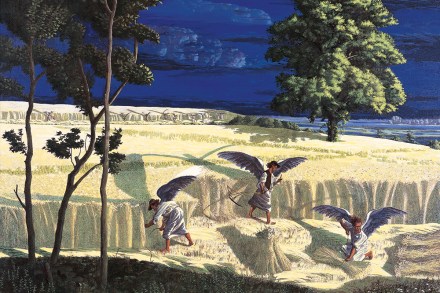
In the side chapel of the church of St Giles’, at the northern apex of the historic Oxford thoroughfare, hangs a remarkable painting. ‘Menorah’ (1993) depicts the (now demolished) Didcot power station with its six massive cooling towers and central chimney stack as the setting for the crucifixion; Christ and the two thieves are set against the minatory bulk of the huge industrial buildings while other figures, lamenting and covering their faces, occupy the foreground. It is haunting and profound, an appalling vision but also a beautifully realised one – the work of a master of his craft. For Wagner, art should never be ‘one person thick’.

Was Brazil the real birthplace of modernism?

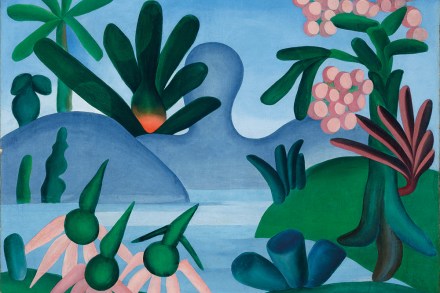
A paradox of art history: to understand the artists of the past, it helps to study how, and where, they conceived of the future. If today we foresee the future in the East, previous generations looked westward. In the last century, Europeans, having inherited a seemingly aged and decrepit civilisation, determined that the future of art was to be found in the New World. That much is well known. But this did not always mean America. Indeed, the true cognoscenti had a different country in mind: Brazil.

Is the tide turning on restitution? 

When passions are aroused, all of us are liable to overstate our case. Dan Hicks, a curator at Oxford’s extraordinary Aladdin’s Cave of anthropology, the Pitt-Rivers Museum, is perhaps a case in point. A Swedish academic, Staffan Lunden, has convincingly argued that Hicks is guilty of ‘distortion’ when writing about the British raid on Benin in 1897, which brought several thousand objects, including finely wrought brass statuettes, to museums across the world. Hicks published his uncompromising views in 2020 in a prize-winning book, The Brutish Museums: The Benin Bronzes, Colonial Violence and Cultural Restitution.

The architectural provocations of I.M. Pei

When first considering architects for the new Louvre in 1981, Emile Biasini, the project’s head, liked that I.M. Pei was both ‘Chinese as well as American: Chinese in his respect of the past, and American in the way of radical solutions’. His controversial glass pyramid ignited much debate about which side won out. These entanglements, between traditionalism and modernity, East and West, would come to characterise both Pei’s Louvre and his six-decade career. After a seven-year gestation, the first comprehensive retrospective of the architect, at Hong Kong’s M+ museum, finally offered a longer view. Despite calling America home, Pei felt a duty to help China find its own architectural language Pei’s prolific career had a head start.

How French absolutism powered a techno-progressive revolution

The Enlightenment is back. Despite the best efforts of the past decade of handwringing about cultural imperialism and wailing over machismo, money and majesty, the future keeps crashing in. The Science Museum has now laid its cards on the table with Versailles: Science and Splendour. Think gilt, not guilt. Is there anything in our lives that could compare to witnessing the first successfully grown pineapple? It’s marvellous, and unusual these days, to visit an exhibition and feel the colossal force of history without anyone bashing you over the head with infantile morality tales. Expanding on a 2010 display at the Palace itself, lead curator Anna Ferrari ought to be saluted for this unabashed celebration of genius – perhaps with a three-hour firework display.

The Church of the Holy Sepulchre contains terrible art – but is filled with magic

For a press tour of the Church of the Holy Sepulchre in Jerusalem – the Church of the Resurrection, the Mother of churches, site of the last four stations of the Cross – you must apply to the Patriarch. This being Jerusalem, there are three: the Latin, the Armenian and the Greek Orthodox. The process of accreditation is like a scene from an Olivia Manning novel. If you receive an acknowledgment of your email from the Greek Patriarchate – the Latin and the Armenian were otherwise engaged – you turn into Greek Patriarchate Street and present yourself at the Patriarchate palace. It is pale limestone, silent, a home to spoilt cats.

‘La Scala was maddening’: an interview with John Macfarlane, the finest set designer of his generation

Pantomime season is upon us, and unless your taste in colour runs no further than Smarties, there is no more magnificent spectacle on offer than Birmingham Royal Ballet’s production of The Nutcracker – performed so many hundred times since its première in 1990 that two years ago it disintegrated and required reconstruction. Its scenery and costumes are the work of John Macfarlane, a softly spoken Glaswegian who is ranked worldwide as one of the great stage designers of his generation. They demonstrate in abundance a quality that characterises all his work: a brooding chiaroscuro, in which nightmarishly surreal flickers of ruin and decay are shot through with gorgeous sensuality. There is no tinsel-pink prettiness. His Nutcracker has been inspired by the haunted imagination of E.T.

‘When a work lands the excitement is physical’: William Kentridge interviewed

Watching William Kentridge’s film Self-Portrait as a Coffee-Pot is like being submerged inside his mind, inside the coffee pot maybe. There’s so much going on both visually and intellectually that there’s no room at all for a viewer’s own feeble thoughts. ‘When a work lands the excitement is physical, like biting into chocolate. You feel it in your salivary glands’ Superficially, the film is a look inside the South African artist’s studio and an invitation to watch him work. Over four-and-a-half hours and nine themed episodes you see him making his familiar expressive drawings in charcoal and ink, but this studio is also a stage; there’s dance, puppetry, dips into history, astronomy, philosophy.

Why is Fauré not more celebrated?

It is 100 years since the death of Gabriel Fauré, a composer whose spellbinding romantic tunes emerge from harmonies and rhythms that nudge us towards the future. No other composer deploys such subversive mastery of the conventions of French music: again and again, if we look underneath the arches of his melodies, we find ambiguous chromatic shifts or disorientating spiralling arpeggios. For some critics, the musical argument of Fauré’s late chamber work is so understated it evaporates And – see above – no other French composer is so hard to describe without falling into a purple puddle.

William Morris’s debt to Islam

When William Morris was born in Walthamstow, in 1834, it was little more than a clump of marshland at the edge of the Epping Forest. This was the terrain of his free, frolicsome childhood, and it would forever form his image of humble, Edenic England, uncorrupted by the industrialist’s yoke. About the only thing that remains of this prelapsarian Walthamstow, amid its railway lines and brownfield sites, is the family home where Morris grew up, in some splendour – now a gallery dedicated to his artistic legacy. ‘To us pattern designers, Persia has become a holy land, for there our art was perfected’ The landscape has been supplanted, and much of the population transplanted.