Robin Aitken

Robin Aitken is a former BBC journalist and author of 'The Noble Liar: How and Why the BBC Distorts the News to Promote a Liberal Agenda'. He is also co-founder of the Oxford Foodbank.

Why the BBC wants to go German

From our UK edition

The BBC’s Director General Tim Davie made a speech this week which suggests he’s leaning toward a radical fix for the Corporation’s financial woes. The question is whether even this government will buy an idea that, to put it politely, seems unlikely to be popular. Davie’s problem is that the writing is on the wall for the licence fee. Last year the Corporation’s annual report noted that half a million households had stopped paying in the previous 12 months. All of which makes for grim reading for an organisation which has seen its real-term income fall by over 30 per cent in the last decade. Finding a replacement to the licence fee is now a matter of urgency which must be settled by 2027 when the current BBC charter runs out.
‘Innovation is not enough’: meet visionary English painter Roger Wagner

From our UK edition

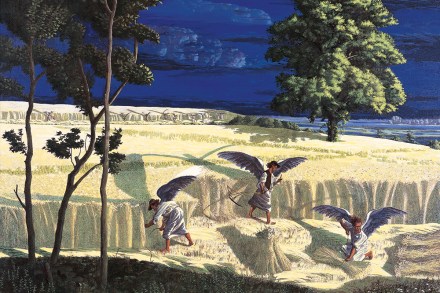
In the side chapel of the church of St Giles’, at the northern apex of the historic Oxford thoroughfare, hangs a remarkable painting. ‘Menorah’ (1993) depicts the (now demolished) Didcot power station with its six massive cooling towers and central chimney stack as the setting for the crucifixion; Christ and the two thieves are set against the minatory bulk of the huge industrial buildings while other figures, lamenting and covering their faces, occupy the foreground. It is haunting and profound, an appalling vision but also a beautifully realised one – the work of a master of his craft. For Wagner, art should never be ‘one person thick’.

More northern accents won’t save the BBC

From our UK edition

It seems that the BBC has finally acknowledged the truth of George Bernard Shaw’s aphorism. Demonstrating his inherent anti-Englishness, the old Fabian snob declared:  ‘It is impossible for an Englishman to open his mouth without making some other Englishman hate or despise him.’  And the barb hurts because to an extent we must accept that it is partly true.  Sticking a few more regional accents in front of a microphone doesn’t begin to address the real problems the BBC faces In our defence, it is also true of people other than the English. Every European country, and probably every country in the world (including Shaw’s Ireland) has its own bumpkin regional twang which the boss class looks down on.

Inside the BBC’s culture of cover-ups

From our UK edition

As fans of the BBC hit show Line of Duty know very well the ‘one rotten apple’ explanation for police corruption won’t wash. It’s never just the one — corruption flourishes only when it is facilitated by others. The corrupt officer needs others around them; people who will lie for them, cover-up for them, brazenly praise and reward them. This is logical because if the ‘bent copper’ is surrounded only by honest people they will be quickly rumbled; they need others who are dishonest, or morally weak, or who actively collude in their schemes. We know this. We’ve watched the series. And, as it turns out, it’s much the same story when it comes to corrupt journalists.

Was this the BBC’s ‘Emily Thornberry’ moment?

From our UK edition

Charlie Stayt and Naga Munchetty's mocking of Robert Jenrick's flag was unintentionally revealing of the BBC's problems. It also made it clear that Tim Davie's decision to shift hundreds of jobs outside London won't solve the corporation's quest for diversity. https://twitter.com/wallaceme/status/1372521185792167937?ref_src=twsrc%5Etfw What instantly came to mind watching this interchange was another telling incident nearly seven years ago now, during the Rochester and Strood by-election. Ed Miliband had sent the Islington battlecruiser Emily Thornberry out on manoeuvres on the touchingly misplaced assumption that she would ‘bring out the vote’. She did, but not in the way intended.

Jeremy Paxman is right about BBC newsreaders

From our UK edition

Once upon a time there was a very powerful news organisation that was watched, respected and loved by almost the whole of the people. And that big organisation put a very special importance on its main news bulletin of the day which it broadcast at nine o'clock in the evening. And all this happened in the faraway land called ‘back then’; and The Word was the BBC’s and the man – for it was always a man – who read out The Word became one of the most recognisable and famous faces in the country. And then things changed and the big organisation became less-loved and its important bulletin became less-watched; which brings us back to today and Jeremy Paxman who has said some very disobliging things about other, lesser, members of his tribe.

Is the news making us unwell?

From our UK edition

Since the start of the pandemic I’ve been observing friends and family and their reactions to the virus. Broadly speaking they fall into two groups; at one end of the spectrum there are the insouciant, apparently unconcerned about a viral threat they think has been exaggerated; at the other are the corona-obsessives who have avidly consumed every scrap of information they can find – of which there has been no shortage. They’ve become minutely informed on everything from T-cells to lateral-flow tests; their lives have been subsumed under a tsunami of technical information. Of the two groups it is the wilfully ignorant who seem happier.

The BBC licence fee hike adds insult to injury

From our UK edition

In these chill winter days it’s good to know that at least one old lady is warmly wrapped up. The announcement that the BBC licence fee will rise in line with inflation is another modest, but comforting, layer of financial insulation wrapped around Auntie’s well-padded frame.  The new cost will be £159, up by about £1.50; so nothing to get excited about perhaps. But each time the licence fee is raised it focuses attention on the funding privileges that the Corporation enjoys and fuels the debate about whether those privileges should continue. The BBC, in its defence, makes what at first glance seems a very sound ‘value for money’ argument.

The truth about rugby is hard to admit for fans like me

From our UK edition

The Six Nations begins today, bringing joy into the hearts of millions of rugby fans. It will, as ever, be a predictably unpredictable tournament – there are always upsets – which will showcase great athletic skill, close teamwork and raw physical courage; and like the first snowdrops, it is one of those reliable harbingers of spring guaranteed to lighten the gloom of cheerless February days. But this year, hovering in the background, is a spectre at the feast; the fast-accumulating evidence that rugby is a danger to the players’ health and well-being. The truth is that many rugby spectators, who love the game, end up feeling guilty.

The truth about the new BBC chairman? He won’t make much difference

From our UK edition

The ‘pre-appointment hearings’ system overseen by parliament’s select committees doesn’t exactly set the heart racing; a pale imitation of the American system, where presidential nominees (to the Supreme Court for instance) are savaged by senators sitting as a kind of hanging jury, our version is generally bloodless. Certainly Richard Sharp, the government’s candidate for chairman of the BBC, who dutifully presented himself for cross-questioning last week, emerged with never a scratch on him.

Richard Sharp will not lead a BBC revolution

From our UK edition

If you wanted to start a revolution would you choose an Oxford educated multi-millionaire banker to lead it? Not the obvious choice is it? Which is why the news that the next chairman of the BBC Board is to be ex-Goldman Sachs banker Richard Sharp looks very like a retreat from any serious attempt to reform the Corporation. Tim Davie, the Director-General (DG) and the rest of the BBC executive board will be breathing sighs of relief; it looks very much like ‘business as usual’ at New Broadcasting House. The Revolution is postponed. In choosing Mr Sharp, a walking caricature of the Establishment, the Johnson government is signalling that it’s opting for a quiet life rather than conflict with the BBC. It is also demonstrating a continuing fondness for moneymen.

The BBC’s Christmas schedule is a tawdry disappointment

From our UK edition

Along with holly wreaths, unfeasibly large poultry and popular carols played on an endless loop, there is another ritual at this time of year; the BBC unveils its Christmas schedules — followed immediately by a chorus of sour complaint about the fare on offer. The Corporation published details of its programming at the start of December and, true to form, the Daily Mail and its readers were far from pleased: ‘Deja View’ ran the headline ‘BBC Christmas schedule in slammed by viewers’. In uncertain times it’s good to see time-hallowed traditions kept alive.

The BBC’s real diversity problem

From our UK edition

Another day, another breast-beating confession from a BBC news-wallah about how the Corporation has sinned against diversity. This time it was ‘head of newsgathering’ Jonathan Munro lamenting the fact that most of the editors who labour under him are highly-educated, middle-class white men: 'I don’t think anyone can think that is right or justifiable,' he declaimed piously in a Media Masters podcast. He added: 'We don’t want all our editorial meetings to be dominated by what white people think. We don’t want any single group in society to dominate our editorial thinking, because we are not being diverse in our thought process.

The BBC’s allies are starting to panic

From our UK edition

For the first time, there are signs that a Tory government is freeing itself of its Stockholm Syndrome attitude towards the BBC. There have been suggestions it will de-criminalise non-payment of the BBC license fee this autumn, and there are signals that Number 10 is finally seeing the Corporation as what it has become: an enemy of conservatism and a champion of a vapid potpourri of fashionable nonsense. It’s beginning to look like out there in viewer-land, support for the licence fee is ebbing fast In response, it is clear the Corporation is mounting its own defence and once again calling on its friends in high places to take up arms and man the defences on its behalf.

Is the BBC finally coming to terms with its diversity problem?

From our UK edition

‘Diversity’ — who today would dare to stand up and declare themselves against it? What, after all, is the alternative? Homogeneity? Uniformity? Indistinguishability? But there is clearly a problem with what that term has come to represent. It will come as no surprise then that June Sarpong, the BBC’s ‘director of creative diversity’, has been forced to admit that the corporation has a problem connecting with a white working-class audience.

Ten ways to save the BBC

From our UK edition

It is encouraging to hear that the new Director-General of the BBC, Tim Davie, is demanding changes in the BBC’s comedy output to correct its bias to the left. As a starting point for reforming the whole Corporation, comedy might seem an oddly trivial place to begin. This, however, signals intent. Not that reforming comedy shows will be easy; the BBC’s in-house joke-mongers accurately reflect the woke agenda to which the whole organisation subscribes. By choosing comedy as his target, Mr Davie has picked out a loose strand in a great ball of wool; if he tugs hard enough for long enough the whole ball might unravel. But as ‘reform’ seems now to be on Mr Davie’s agenda perhaps he might put some other things on his to-do list.

The BBC’s real problem is nothing to do with the licence fee

From our UK edition

Lord Hall, the outgoing director general of the BBC, used his valedictory interview on Radio 4’s Media Show this week to ruminate on the question of what funding mechanism should replace the licence fee. But to my mind, this was like listening to a man whose house is perched precariously on the lip of a crumbling cliff talking about whether he should plant an orchard. Somehow one feels it’d be a better use of Hall's time to address the immediate problems rather than worrying about long-term issues. In the BBC’s case, the next Great Leap Forward might well be over the edge of the cliff.

My Unionist faith is wearing thin

From our UK edition

How does a believer lose the faith? It might begin with some quibble about a point of doctrine: the Virgin Birth, for instance. The believer struggles intellectually but cannot accept the dogma. What starts as a quibble then turns into an obstacle; as the doubt grows, the whole belief system starts to unravel. One day it dawns on them that they no longer believe. Reader, I am myself undergoing such a struggle to maintain my political faith in Unionism. I have been an instinctive, largely unquestioning Unionist ever since I became politically aware. The roots of my faith are simple enough: Scotland and England can do more together than individually. That and the fact of our shared history and land mass.

The BBC only has itself to blame for the licence fee mess

From our UK edition

For an organisation that likes to be popular these are troubling times for the BBC. This month the Corporation started sending out letters explaining that it had ended the universal exemption from paying the licence fee for the over-75s. From now on, unless you are in receipt of pension credits (taken as evidence of poverty) you’ll have to stump up £157.50 if you want to watch EastEnders – no matter how old you are. Needless to say, the BBC’s decision has not been popular; charities for the elderly have been highly critical – the Corporation has been accused of ‘lacking compassion’ and charities predict some pensioners will have to forego essentials like food and heating to keep the telly on.

Wearing a mask is good manners

From our UK edition

Early on in lockdown, I was picking up my daily paper and was confronted by someone who had contrived his own face mask with polythene bags and masking tape. He seemed blissfully unselfconscious, despite looking as if he was off to a Hannibal Lecter-themed fancy-dress party; I shared a superior snigger with the newsagent and decided I would have no truck with masks. But as time went on I had a change of heart; I do all the shopping in our household (a quirk of our domestic arrangements) and it began to dawn on me that many of my fellow citizens had been scared half to death by the pandemic and viewed every close encounter with a fellow shopper as potentially fatal.