Julian Spalding

A plea for painting: David Hockney 25, at the Fondation Louis Vuitton, reviewed

From our UK edition

The exploding sails of Frank Gehry’s Louis Vuitton building in Paris are currently packed with the exhilarating visual explorations of the octogenarian artist David Hockney. The exhibition begins with a roomful of the paintings that made Hockney famous in the 1960s: his graffiti-style canvases, packed with secret codes and illicit kisses. The next gallery is full of the very different paintings that made him even more famous: swimming pools in sunshine and boys sprawled on beds. Gays straight on, square to the picture frame – images, pure and simple; no hidden hints, no text. This gallery also contains a couple of the portraits that further spread his fame. Sadly, none of the drawings for these are included.

'Play within a Play within a Play and Me with a Cigarette', 2024-2025, by David Hockney. Photograph: Jonathan Wilkinson/David Hockney, © Jonathan Wilkinson

Why were the Scots so much better at painting than the English?

From our UK edition

This exhibition is awash with luscious brushstrokes, but then that’s to be expected: it’s full of Scottish painting. Before the barren era of conceptual art, which most hope is over, people often observed that the Scots could paint while the English could draw. Why is a bit of mystery, but it was true right through the 18th and 19th centuries and well into the 20th. The Dovecot Studios exhibition opens with John Duncan Fergusson’s portrait of his lover and first muse, Jean Maconochie, painted about 1902. It’s a fabulous eyeful of brush marks.

In defence of deaccessioning

From our UK edition

There’s more than a grain of truth in the popular caricature of a curator as a mother hen clucking frantically if anyone gets too near her nest – not that her eggs are about to hatch, let alone run. The recent threat of the British Council to ‘deaccession’ – to put it more bluntly, sell – its 9,000-strong collection of British art has caused a predictable flurry in the curatorial world. Doesn’t the British Council know that public art collections are sacrosanct and must be preserved for all time? When I was director of Glasgow’s museums and art galleries, I remember talking to my committee about my long-term plans for the city’s great permanent collection when the leader of the council, Pat Lally, commented drily that there was no such thing as ‘permanent’.

Drama students: how universities raised a generation of activists

From our UK edition

39 min listen

This week: On Monday, tents sprung up at Oxford and Cambridge as part of a global, pro-Palestinian student protest which began at Columbia University. In his cover piece, Yascha Mounk, a professor at Johns Hopkins University, explains how universities in both the US and the UK have misguidedly harboured and actively encouraged absurdist activism on campuses. Yascha joined the podcast to discuss further. (01:57) Next: Bugs, biscuits, trench foot: a dispatch from the front line of the protests. The Spectator’s Angus Colwell joined students at tent encampments this week at UCL, Oxford and Cambridge. He found academics joining in with the carnival atmosphere. At Cambridge one don even attended with their baby in tow. ‘Peaceful protest?

The brilliance of Beryl Cook

From our UK edition

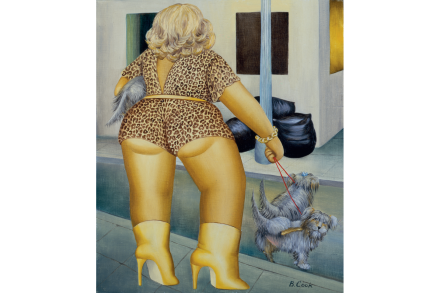
Nobody claims Beryl Cook was an artistic genius, least of all the artist herself. ‘I think my work lies somewhere between Donald McGill [the saucy postcard artist that George Orwell wrote so lyrically about] and Stanley Spencer,’ she once told me. ‘But I’m sorry to say I’m probably nearer McGill.’ She was, as ever, being modest. I actually think she’s nearer Spencer – and Hogarth, come to that. Cook’s paintings make us laugh but that doesn’t stop them from being art. (Few would say Shakespeare’s comedies are as profound as his tragedies, but they’re brilliant creations, nevertheless.) Though Victoria Wood dubbed her work ‘Rubens with jokes’, there aren’t actually any jokes in her pictures; they’re all direct observations, not double entendres.

When Francis Davison made me judge — and burn — his art

From our UK edition

In 1983, Damien Hirst saw an exhibition at the Hayward Gallery of the collages of Francis Davison which ‘blew him away’. He spent the next two years trying to emulate them, in vain. As he discovered, although Davison’s works might look casually thrown together, they are in fact immaculately crafted orchestrations of colour, shape and tone.  In the light of this experience, Hirst’s subsequent output can be regarded as his dispiriting revenge on all genuine artistic creation.