Arts feature

Ralph Vaughan Williams: modernist master

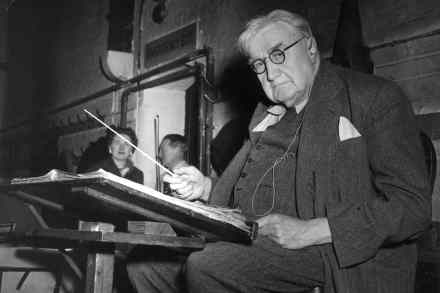
To look at a picture of Ralph Vaughan Williams is like contemplating an image of a mountain. Not the elegant, keen-eyed Edwardian intellectual whom we sometimes glimpse on CD sleeves or in concert programmes; I’m thinking of the portraits from the last decade of his long life. By the 1950s ‘RVW’ had been the father of British music for so long that he already seemed like part of the landscape, and he looked it too. The craggy jowls, the weathered thatch of grey hair; that questioning gaze — and beneath it all, those great, tumbling scree slopes of rumpled tweed. In his 150th anniversary year he’s still there, towering in the middle distance of national memory.

Feral showstoppers and some of the greatest paintings of the 20th century: Francis Bacon at the RA reviewed

The superb new exhibition at the Royal Academy, Francis Bacon: Man and Beast, is not a retrospective. Nonetheless it is one of the most revealing presentations of this great painter’s work I have ever seen. It follows one of the most important of the chains of thought and feeling that ran through his art — animality: the beastliness in humanity, and the humanity of beasts. He was a great master of the feral. ‘Man with Dog’ (1953) depicts a creature with which it would be hazardous to tangle: a blurred, slathering smear with just a hint of Cerberus, the ancient guardian of Hades. Just below its paws is the gutter, with a drain opening downwards into the earth.

Robert Harris on Boris Johnson, cancel culture and rehabilitating Chamberlain

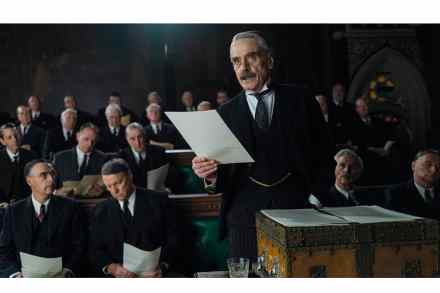
Robert Harris has long been on a one-man crusade to reverse history’s negative verdict on the architect of appeasement. He argues that it was Neville Chamberlain’s duty to go the extra mile for peace and give Britain the moral authority to fight Hitler in the second world war. ‘There seems to be a general feeling that he couldn’t have done much else. He bought us precious time.’ Now the appearance of an acclaimed Anglo-German Netflix film Munich — The Edge of War, starring Jeremy Irons as Chamberlain, and based on Harris’s 2017 novel Munich, gives him the chance to bring his quixotic campaign to a mass audience.

‘Oculus Quest is really the way’: film-maker Apichatpong Weerasethakul interviewed

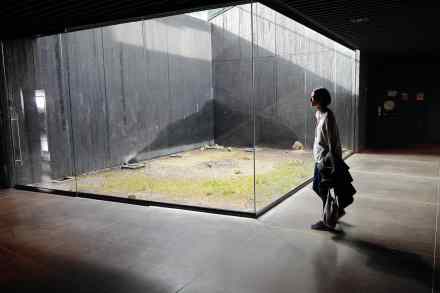
There always comes a moment in the films of Apichatpong Weerasethakul where you’re forced to scoop your brain up from the floor. In his last, Cemetery of Splendour, this occurs at the point where the sky is invaded by a colossal blimpish amoeba. You stare. Blink. Adjust eyes. It slowly dawns that you’re peering into a crystal-clear lake, cloudy heavens and whirring mitochondria in blissful, cosmic coexistence. Man, however, is weak. And the first time I was introduced to his films, one of the most significant, sensual, startling, transcendent bodies of work by any director this century, I fell asleep. ‘Amazing,’ beams Weerasethakul over Zoom. ‘Even I slept in my films sometimes.

In praise of understudies

The actor Ronald Fraser was famous for two things: his comic timing and his liking for a drink. On one occasion in the 1960s, he was happily sitting three sheets to the wind in a local hostelry, when he remembered that he was supposed to be on stage at a matinee. After walking unsteadily to the theatre, he stood in the wings and heard someone else in his role: the understudy, holding the audience in the palm of his hand. His name was Donald Sutherland, and he was revealing the quality that took him from bit parts on the London stage to worldwide stardom. The importance of understudies and covers has been elevated to new heights by the Covid pandemic. Leading men and ladies are dropping out the world over.

This radical Nativity is also one of the great whodunnits of art history

On 25 October 1510 Isabella d’Este, the Marchioness of Mantua, wrote a letter to her agent in Venice inquiring after a certain highly collectable item. ‘We believe that in the effects and the estate of Zorzo da Castelfranco, the painter, there exists a painting of a night scene, very beautiful and unusual.’ She thus set off one of the great whodunnits of art history: a mystery hidden inside an enigma that caused a furious 20th-century quarrel between one of the greatest connoisseurs of Renaissance art and the most powerful dealer of the age — and which has never been definitively solved.

‘I am not able to answer your question’: an irascible Paolo Sorrentino interviewed

Loving the films of the Italian auteur Paolo Sorrentino, I thought he’d be easy to chat to. But a maestro is a maestro, as I was reminded when I interviewed him in London last week. Masked and communicating through a translator, I semaphored my admiration for his new film The Hand of God, starting with its spectacular opening shot. Like a bird, the camera flies over the sea, then focuses on a vintage car tooling along the promenade, before panning over the city again. But he rejected my praise: ‘It’s not complicated. It’s a normal shot by helicopter.’ He’s right, of course, that his new classic coming-of-age story represents a departure towards simplicity.

Meet climber, photographer and filmmaker extraordinaire Jimmy Chin

‘Why did you want to climb Everest?’ reporters quizzed mountaineer George Mallory in 1922. That the question even needed asking shows mountaineering is fundamentally different from other pursuits. No journalist would ever ask a footballer why they kick a ball around. But mountaineering is gruelling and you’re way more likely to perish from it than to make a fortune. So why would anyone climb any mountain, let alone Everest? Mallory’s rationale was short and sweet: ‘Because it’s there.’ And what about Jimmy Chin? Why does he climb? Chin, 48, is part Bear Grylls, part David Attenborough.

The forgotten story of the pioneering surgeon who healed disfigured airmen

‘You’re inside an incinerator. The cockpit is on fire. You are burning. You can see bits of your body melting off. And you are struggling to get out.’ This is Andrew Doyle, the creator of Titania McGrath, describing to me the experience of an RAF pilot trying to escape from a stricken plane during the second world war. He explains that the injured airmen were treated by a New Zealand surgeon, Archibald McIndoe, who developed new methods for repairing skin damage at a specialist burns unit in the 1940s. And this is the subject that Doyle has chosen for a new musical. It may seem an odd departure for the anti-woke satirist but his passion for musical theatre is long-standing. He has written more than half a dozen song-and-dance shows with various collaborators.

The art and science of Fabergé

After all the magnificent presents she’d received from his workshop, Queen Alexandra was eager to meet the most famous jeweller in Russia. ‘If Mr Fabergé ever comes to London,’ she said to Henry Bainbridge, a manager of the design house, ‘you must bring him to see me.’ Peter Carl Fabergé paid a rare visit to the capital to inspect his new shop — the only one located outside the Russian empire — at 48 Dover Street in 1908. ‘The Queen wants to see me! What for?’ he asked an exasperated Bainbridge. ‘Well, you know what an admirer she is of all your things.’ Insisting that she would not wish to be troubled, Fabergé demurred, polished off his lunch and requested the time of the next train.

Albrecht Dürer was a 16th-century Andy Warhol

On 6 January 1506, Albrecht Dürer wrote from Venice to his friend Willibald Pirckheimer, who was at home in Nuremberg. The artist had already been in the city for a little while, and like many people who visit Venice he had spent a good deal of time shopping. Pirckheimer had asked him to buy some jewellery for him, ‘a few pearls and precious stones’, and the artist had been looking out for something suitable. There were, however, difficulties. For one thing, he says: ‘I can find nothing good enough or worth the money; everything is snapped up by the Germans.’ For another, Dürer complained, there were a lot of swindlers around. These ‘always expect four times the value for anything, for they are the falsest knaves’.

The tyranny of the visual

In 1450, the Duke of Urbino, Federico da Montefeltro, became monocular after losing vision in his right eye following a jousting accident. In order to improve the peripheral vision of his left eye, he had surgeons cut off the bridge of his nose. In Piero della Francesca’s 1472 portrait, the Duke is depicted in profile, so we can see that an equilateral triangle of flesh and bone has been chopped from what must have been an elegant aquiline beak. I have been more fortunate. In the past year I’ve had four operations at Moorfields Eye Hospital in London to repair a detached retina that made me blind in one eye. I didn’t have to cut off my nose to spite my face and improve my vision. What was impossible in the 15th century has become routine in the 21st.

‘What do you think the English will say?’ Pablo Larrain on his pop horror Diana film

It all looks ever so Sandringham. Formal evening garb, dining table the length of a cricket pitch, royalty nibbling in silence. As a tableau vivant it might be lit by Lichfield and styled by Hartnell. And yet something is awry. The beautiful princess feels stifled. She grabs at the tourniquet of pearls roped round her neck, whereupon it snaps. Huge gems plop into her gloopy green soup. Dauntlessly she dips a spoon in, feeds a pearl into her mouth and takes a pulverising bite. This royal Christmas is not normal for Norfolk. Spencer is the latest entertainment seeking to decrypt the myth of Diana, Princess of Wales.

How the Beano shaped art

Superman and the Beano are both 83 years old. The American superhero first pulled on his tights for Action Comics No. 1 in June 1938. The following month, roughly 443,000 copies were sold of the Beano’s first issue, featuring Pansy Potter (the Strongman’s Daughter), Big Fat Joe, Wee Peem (He’s a Proper Scream) and, my personal role model, Lord Snooty. Not until Grand Theft Auto launched in 1997 has anything so culturally significant come out of Dundee. But there is a key difference between Superman and the Beano. While American heroes in general and Superman in particular uphold rules, the Beano’s success — its 4,000th edition in 2019 made it the world’s longest-running weekly comic — is predicated on characters who break them.

Granada’s Brideshead Revisited remains the sine qua non of mini-series

It is 40 years ago today since Granada’s masterly adaptation of Evelyn Waugh’s Brideshead Revisited first beamed into British homes. This 11-part serialisation of a book originally entitled A Household of the Faith soon gathered millions of faithful householders. The autumn of 1981 was an especially cold and wet one and it was still too soon in the Thatcher premiership for her patron saint, Francis of Assisi, to have worked his magic. So while ITV was not able to deliver harmony, truth, faith or hope, it certainly provided 659 minutes of romantic escapism.

How the culture wars are killing Western classical music

Musicology may appear an esoteric profession. But several events in the past few years have pushed musicological debates into the columns of national newspapers, from the American academic who claimed that music theory was a ‘racial ideology’ and should be dismantled, to the Oxford professor who allegedly suggested that studying ‘white European music’ caused ‘students of colour great distress’, to the high-profile resignation of a professor at Royal Holloway, University of London, reportedly in response to academic ‘cancel culture’. These disputes have not emerged from nowhere.

In defence of Marvel

The teaser for Spider-Man: No Way Home, out this Christmas, which had a record number of 355 million views in the first 24 hours of online availability, delivers three minutes of thrills. Tom Holland is back, in the titular role, with his girlfriend from the previous Spidey movie, his best friend Ned, references to Mysterion, jokes from Benedict Cumberbatch as master wizard Dr Strange, plus engagement with that most playful of Marvel concepts, the multiverse. Bring in the multiverse, and anything, everything, is possible. Are you old enough to recall that moment in Dallas when the shooting of JR was revealed to be a dream? Well, the multiverse does all that, and some. Time is not a constant.

How the British musical conquered the world

What do Henry VIII’s wives, a Rastafarian musical icon and a drag queen have in common? They are all the subjects of new stage shows that are heralding a golden age of the British musical. Let’s start with the court of Henry VIII. A pair of friends at Cambridge University, Toby Marlow and Lucy Moss, decided to write their own musical four years ago because the student theatre society couldn’t afford to pay the royalties for an existing one. They based it on the life stories of the six women who were unfortunate enough to marry Henry VIII. Six, as this debut effort came to be known, opens on Broadway this week, with huge advance ticket sales already achieved. ‘Historically, Britain was a place of Shakespeare, and new plays.

Why The Sopranos remains the greatest gangster drama of all time

The Sopranos is called the greatest television show in history. It is the tale of Anthony ‘Tony’ Soprano, a middle-aged man in psychotherapy who also happens to run a New Jersey crime family. Anthony means ‘priceless’; the choice of name is surely deliberate. The Sopranos is complex — all masterpieces are — but it is fundamentally about greed: for money; for sex (the crew inhabit the Bada Bing! lap-dancing club, where breasts are landscape); for alcohol; for power; for the base drug of food. In the first episode Tony, who is played by James Gandolfini as a human devil, all need and charm (he is defiantly sexy with his fat hands and dachshund’s eyes), is almost human-looking. By the end, he is immense.

Is the life of Jimmy Savile a suitable subject for drama?

One day in 1975 the Israeli cabinet found themselves being lectured on the most intractable political problem of our age — how to bring peace to the Middle East — by a peculiar white-haired British entertainer wearing a pink suit with short sleeves. His name? Jimmy Savile. That’s how he told it anyway. Remarkably, witnesses back up the generality if not the specifics of the anecdote. Savile indeed visited the Holy Land in 1975. And he did talk to the Israeli president Ephraim Katzir, saying (so he claimed): ‘I’m very disappointed because you’ve all forgotten how to be Jewish and that’s why everyone is taking you to the cleaners.