Spectator Life

Spectator Life

An intelligent mix of culture, style, travel, food and property, as well as where to go and what to see.

What England’s wild swimmers can learn from Scotland

Why can't you swim in reservoirs? They look so cool and inviting and are often the only open bodies of water available in certain parts of the country. And yet swimming is prohibited in the majority of them. The answer usually offered is that they are dangerous, cold, deep, that there are underwater structures and machines that could injure you or suck you under the water. The strange thing is that this answer only applies in England and Wales, not Scotland, where reservoir swimming is common. Access to inland waters in Scotland is enshrined by law: my local group in West Lothian is full of dippers chatting about their adventures in the nearby reservoirs in the Pentland Hills and beyond.


Sing for your supper: London’s best Karaoke booths

After Cabinet members recently took to the microphone for a karaoke evening, is Westminster's new favourite hobby on course for a winter comeback? With summer days of al fresco cocktails and late-night picnics in the park almost behind us, a let-your-hair-down evening belting out karaoke could be just the answer. Here’s our guide to London’s best booths. Bloomsbury Bowling Lanes Bloomsbury bowling lanes Cosy rooms with vinyl records covering every inch of wall, studded leather sofas and low-lit kitschy lamps create a perfectly funky vibe for an evening of crooning along to Otis Reading and Stevie Wonder.

The moral panic over Instagram and girls

This week’s biggest social media panic that isn’t about Nicki Minaj’s cousin’s balls comes to us from the Wall Street Journal, in a bombshell report titled ‘The Facebook Files.’ According to WSJ reporters, a trove of internal documents from the secretive social media company reveals that, despite much protest (and congressional testimony) to the contrary, Facebook’s executives know better than anyone that their platform is a place of chaos and social destruction. The multi-part series digs into everything from content moderation to curb ‘anger’ to Facebook’s efforts to promote the COVID-19 vaccine.

How to make an authentic paella

The UK has something of a reputation for butchering those classic European dishes on which entire cultures seem to be founded. Think spaghetti carbonara creamy enough to make an Italian weep or the kind of rubbery, watery beef bourguignon that is the culinary equivalent of our grizzly, grey weather to any self-respecting Frenchman or woman. But perhaps no dish is more maligned or widely miscooked than Paella. Certainly, we’re not helped in this respect by our celebrity chefs. And the usual suspects are at it again – Jamie Oliver reportedly received death threats for adding chorizo to his version and Gordon Ramsay followed suit, eliciting a similar reaction.

The return of the milk round

How do you help the environment and improve your quality of life? Why, buy milk in bottles. Some of us can remember them – foil topped, left outside the door, washed, then returned…a virtuous cycle which worked because it made practical sense. Life went downhill when the milk industry was deregulated in the 1990s and milk turned up in plastic cartons, homogenised and in supermarkets, and so it has remained, until quite recently. But the rattle of the milk van is returning to the streets in parts of London and elsewhere…things, folks, are looking up. It was one of the great advances in human civilisation when we developed lactose to enable us to digest milk.

The wine bars every Londoner should know about

A funny thing happened in lockdown. Bars shut but they seeded a growing crop of bottle shops that, since freedom has been declared have either turned back into, or become, bars in their own right. And now that we can, there is pure pleasure in twisting bottles around in the light, mulling labels and wine lists first hand instead of squinting at them online. There is also a comforting intimacy to wine bars that sits at odds with the clatter of a pub: an air of sophistication, even if you have no idea what the sommelier is talking about.

French toast: an easy-peasy bougie brunch

A rose by any other name may smell as sweet, but somehow, eggy bread just doesn’t hold the same appeal as French toast, does it? The latter has become a bougie brunch dish, while the former languishes in second-hand student cookbooks. At heart, they’re the same thing: slightly stale bread soaked in an egg-based custard, then fried. Whatever pretensions French toast may have (and however delicious it might be), its origins are a cheap dish that improves and extends the life of stale bread with just a couple of eggs and a knob of butter.

The North Water: ten films set in the wilderness

BBC2’s mid-19th century Arctic whaling drama The North Water is earning critical praise for its gruelling depiction of seafaring life above the 66th Parallel. Murder, deceit, starvation, shipboard homosexuality (willing/unwilling), cannibalism (or at least hints of it in The North Water), an irate polar bear and deliberately scuttled ships feature in the drama. If you’re thinking that the scenario of The North Water sounds familiar, you’d be right, as these elements were all present in season one of The Terror (2018, AMC), which was finally shown earlier this year, also on BBC2.

Has Boris Johnson given up on free schools?

For the founders of the West London Free School, of which I was one, last Thursday should have been a moment of great pride. We gathered in the assembly hall, surrounded by the politicians and officials who’d helped us, to celebrate the school’s tenth anniversary and reflect on what we’d achieved. Not only has the school thrived — it is now part of a growing academy chain — but where we led, others followed. As the first school of its type to be approved by Michael Gove, WLFS showed what a determined group of volunteers could achieve, and there are now more than 600 free schools. Contrary to the predictions of the critics — too many to mention — this is one education policy that seems to have worked.

Now’s the time to house hunt in Chelsea

Every now and then the London property cycle creates an anomaly missed by the majority of property buyers until it’s too late. It started about 25 years ago when overseas buyers lobbed a rock into the prime central London property pond – created ironically by a Labour government. In the run up to the Euro, the demand for prime central London property went into overdrive. The reasons were many, but ultimately it came down to London’s unique blend of safety - both geographical and political, ability to look and trade East to West and its status as a world City. London always had that air amongst international buyers of a place where, if the balloon went up in your own country, you could safely go and live in your not insubstantial investment.

Beyond 1984: why I’m listening to George Orwell

One of the great things about touring in the age of audio books, is that you can use your time driving between gigs, with nothing more to concentrate on than other half-tons of steel and rubber hurtling down 'Smart' motorways at suddenly varying speeds, to really binge on reading. I’d long been meaning to expand my knowledge of George Orwell. I’m pretty familiar with his better, or at least better known, essays and I have of course regularly scaled his Two Last Peaks, Animal Farm, and 1984. I've read Animal Farm so often that it has become a sort of catechism, and if it had a tune I could probably sing it right through.

London’s best pubs with rooms

‘Pub with rooms’ used to mean ‘backpackers’ hostel’, the sort of place with three bunk beds to a dorm and a pound deposit on your towel. But recently the capital’s pubs have realised that by raising their game, they could steal a decent chunk of the London hotel market. In a city where £400 a night often buys you nothing more than a fake mahogany desk, pubs are now offering boutique rooms at Travelodge prices. And apart from the value they offer, what could be more exciting than staying above a pub? It’s a return to the days of the coaching inn, somewhere you could eat and drink with an interesting collection of strangers, then spend the night before continuing your journey.

What I learnt about fear from Richard Branson

More than any other season, autumn brings to mind change. Perhaps it's the sense of letting something go. The movement of the seasons is present in New Zealand artist Angela Heisch’s first solo UK show at the Pippy Houldsworth gallery, entitled Burgeon and Remain. Her semi floral abstracts represent the peak of summer and her use of bright colours are a warm welcome before we head into a darker time of year. The limitless feel to these paintings suggests growth and change, provoking a playful engagement. Stepping closer to these conceptual forms, I want to leap inside them. They are interactive and dramatic with a curious sense of mischief to them. The repeated spinning symbols grow outwards and seem to communicate to each other like trees.

Has the true crime genre reached its peak?

Veteran comic Steve Martin has returned to our screens, this time taking aim at that most prolific of podcast genres: the true crime documentary. In his new Hulu show, Only Murders in the Building, the former star of The Jerk plays a washed-up TV actor and true crime obsessive who, along with two other misfits, sets out to turn a neighbourhood homicide into the new great American podcast a la Serial. The first episodes of Martin’s sitcom are funny enough, managing to skew the pretentiousness and ego of the wannabe sleuths.

Curry can be guilt-free (if you know how to make it)

Two of the misconceptions surrounding curry that it consistently struggles to shrug off are one, that it is unhealthy, and two, that it is difficult to make at home. I’ve always found both perplexing. Turks and Persians must be similarly bemused given the reputation of their archetypal food, the kebab. Yes the late night version, carved from a rotating trunk of greasy lamb with a mini chainsaw and then covered in garlic mayo, is a calorific car crash. But kebab as it was meant to be – meat simply grilled over charcoal and served with rice and salad – is perfectly healthy every day food. And yes a curry house korma is fattening, even before you add in the three poppadoms and pints.

The secret to restoring old records

It’s a kind of alchemy, transforming worthless clutter into pleasing and valuable collectors’ items, a slow but gratifying process all but forgotten in the modern age. I first learned it from the woman who ran a second-hand record store in my hometown, Tunbridge Wells, from the late seventies to the early nineties, where I misspent much of my youth and most of my pocket money. Fiona, a hangover from the hippie era, with her whispered husky voice and the endless extraordinarily-thin hand-rolled cigarettes that perhaps explained it, first imparted this lesson in around 1982. I speak of the lost art of fixing warped records.

Why Venice and little-known Trieste are the perfect holiday pairing

Italy's relaxation of its travel restrictions for double-vaccinated Brits has many of us eyeing up the options for an autumn getaway. And why not? Come September, cities like Venice are no longer tourist traps (Dolce & Gabbana fashion shows aside) and yet the balmy weather remains. Many visitors head to Italy for Venice alone but they miss a trick by foregoing the beautiful nearby port town of Trieste – beloved by Italian holiday makers and yet untouched by Brits. With the Venetian authorities rumoured to be considering turnstiles on the periphery of Venice, Italy's most iconic city increasingly feels like a museum. And so, for those left hankering for a slice of living, breathing Italian culture, Trieste is the perfect tonic.

Jam Roly Poly: why it’s time to revive this retro pudding

More than new pencil cases, name tapes, and the smell of school halls, back to school season always makes me think of proper puddings. There’s a category of pudding that seems reserved for properly old cookbooks, a handful of old-fashioned pubs, and dinner ladies. Spotted dick, cornflake tart, and jam roly poly. Perhaps its ubiquity at school lunches accounts for its ghoulish alias: dead man’s leg or dead man’s arm. School children have a taste for the macabre, but to be fair to them when the pudding is unwrapped and before it is sliced, it does look fairly uninspiring, and not a hundred miles away from a pallid limb. This probably wasn’t helped by the fact that, before baking parchment and foil were widespread, the pudding would be steamed in a shirtsleeve.

The rise of British gin

Any avid gin drinker will know that botanicals are all the rage at the moment. From juniper to orange peel to lavender, the ingredients list on the backs of bottles are getting more elaborate by the day, and seemingly more exotic. But what may come as a surprise is the growing number of distillers who are sourcing all of their ingredients in Britain. Tom Warner was one of the first distillers to incorporate homegrown botanicals into gin - a craze that has now taken off across the market.

Revenge and retribution: why we’re still watching Westerns

What is it about Westerns? They are the Chinese takeaway of film – they’re no one’s first choice, they haven’t been fashionable in living memory, and yet you never have to look too hard to find one. One might also compare Westerns to cockroaches or sharks; pre-Jurassic survivors who have seen off much mightier beasts time and again scuttling from the dark shadows after the latest apocalypse. So here’s a prediction: Hollywood’s finest will be dusting off their chaps and six-shooters in years to come, long after the present glut of comic-book led mega franchises have hung up their CGI leotards for good.

How to make the perfect Spritz

Ten years ago, the United Kingdom was largely unaware of the Spritz and its bittersweet charms. The Negroni was gaining popularity in our bars, a European import that dovetailed nicely with a general levelling-up of our national cocktail programme. But most of the Aperol in these parts was gathering dust in last generation’s Italian restaurants. This all changed when some canny marketing spend by Aperol’s owner, the drinks titan Gruppo Campari, put bright orange deckchairs and branded glassware in cities up-and-down the country. In just a few years, we became a nation of Spritz drinkers – captivated by the light, appetite stimulating, low-ABV afternooner to such an extent that it’s come to overshadow homegrown favourites like Pimm’s.

French connection: how to make cherry clafoutis

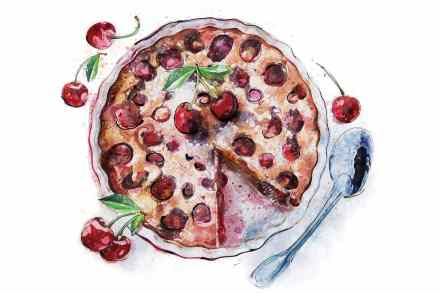
My daydreams at the moment follow a predictable theme. I am on holiday somewhere balmy, with a carafe of cold white wine in front of me. Someone handsome has just brought me a large bowl of salted crisps, unbidden but very welcome, and the greatest responsibility I have is finishing the book that I’m reading. The reality has been a little more prosaic. I am at my Manchester dining table, nursing a cold cup of tea, as the rain falls so heavily it’s like sitting in a drum. I’m sure I’m not alone: changing rules, quarantines, vaccination certificates, or simply the sheer weight of anxiety mean that the majority of us have spent this summer in the UK. I would give my eye teeth for a proper holiday. If I could choose, I’d be in France.

Life on campus is so much worse than The Chair

For those disappointed by the humorless and deeply earnest treatment of the contemporary campus experience in the 2020 TV adaptation of Sally Rooney’s Normal People, the new Netflix series The Chair will be a welcome tonic. Over its punchy six half-hour episodes, the show, co-created by the actress Amanda Peet and produced by her husband David Benioff, deals with the iniquities of contemporary university life. Its setting is Pembroke, a fictitious minor Ivy League campus somewhere in New England. The action is mainly seen from the perspective of the English department chair Ji-Yoon Kim, a Korean-American academic who fears that her promotion has been brought about through ‘diversity issues’, rather than merit.

The rebellion of wearing a suit

During my first job at an advertising firm, there was a palpable disdain for suits amongst my colleagues. For a newly appointed copywriter, fresh out of university and hooked on Mad Men, wearing a suit seemed like the sensible thing to do in the office. But to the Generation-X creative director I was now working for – perhaps having been forced to wear a suit for most of his earlier career – it was an unwelcome relic of the past. He set me straight in my first client meeting. I bought a cheap two-piece from the high street, hoping to make a good impression. Ten minutes before we sat down, he pulled me to the side, wanting to know if I could find anything more ‘relaxed’ for next time: 'the suit is a bit… pompous,' he added.

10 films about September 11th

It will soon be 20 years since the horrific events of September 11th, 2001. Most who are old enough will recall the attacks, witnessing them in real time as they unfolded live on TV. The notion that American Airlines Flight 11’s collision into the World Trade Center’s North Tower was some sort of tragic accident was rapidly disabused when the South tower was hit by United Airlines Flight 175 shortly afterwards. A third plane was crashed into the Pentagon; the fourth strike, which probably targeted the U.S. Capitol Building, only averted by the heroic action of the passengers. The attacks have naturally prompted movies and TV series dealing with events leading to 9/11, the day itself and its continuing aftermath.

The rise of Emma Raducanu

British teenager Emma Raducanu’s straight set victory (6-1, 6-2) at the US Open last night was exciting. Exciting for all the reasons we love to watch tennis; the thrill of the underdog triumph, the inevitable comparisons with other, prodigal, teenage stars like Becker, and of course, the very fact of her Britishness. In this, our Brexit era, Raducanu took her best to the world stage and outperformed all expectations. Virginia Wade, the last British woman to win the title at Flushing Meadows in 1968 and grand dowager of the British women’s game, rose to her feet in the stands applauding the guts of the 18-year old as she won 12 of the final 13 games to send American Shelby Rogers packing in just over an hour.

From Berlin to Bilbao: Europe’s museums are blissfully quiet

Now travel restrictions are finally easing off, there’s never been a better time to visit Europe’s greatest galleries. Sightseers won’t be back en masse for a good while yet, I reckon. in the meantime, you’ll be able to wander round these places in comparative peace and quiet. I was back in Berlin last month, and it felt wonderful to stroll through tranquil museums that are usually so crowded. It made me impatient to return to other Continental capitals, and revisit some of the precious masterpieces I’ve grown to love. You’re bound to have your own favourites, but here’s my magnificent seven. AmsterdamImage: iStock The Rijksmuseum is a must, but, as in all big galleries, it pays to be selective.

Why the camper van craze is here to stay

Britain’s staycation charge has seen thousands of people buying campervans for the first time, not least the classic VWs beloved of hippies, surfers and generations of families whose definition of a good day out is a Thermos flask of tea. These clattery, engine-in-the-back vehicles already had cult status, but it seems the pandemic has supercharged their appeal, with demand for VW campers soaring both before and after lockdown. But what’s it like living with a box on wheels originally conceived seventy plus years ago? Fun, according Midlands-based Graham ‘Dougie’ Douglas, who owns two 1966 and ’67 vans, the latter, a retired Austrian police minibus, bought on a whim in 2006 when his wife and family were out and he had nothing but eBay for company.

Britain’s best Art Deco restaurants

What do you picture when you hear the term Art Deco? Fantastical ideas of Baz Lehrman’s Great Gatsby, gilded brasseries and de facto extravagance  fail to capture the pastiche of styles making up this early 20thcentury movement. Somehow, what was once a collective word for the artistic expressions that followed Art Nouveau has morphed into a dizzying, dancing circus troupe of hairbands, flapper dresses and sidecars. In Britain, the lasting legacy of the movement has been in our architecture.